
TL;DR summary:
- Replacement cost coverage pays to repair or replace property at today’s prices. Actual cash value (ACV) pays that cost minus depreciation for age and wear.
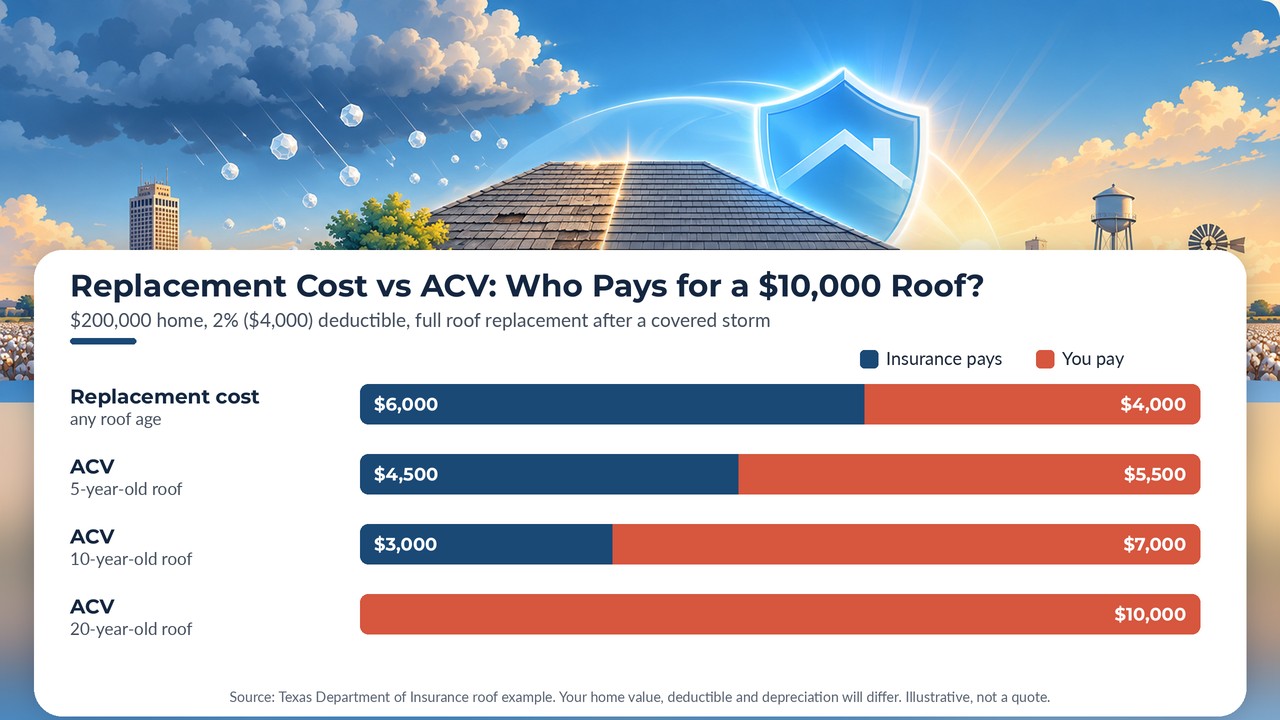
- On a $10,000 roof with a $4,000 deductible, the Texas Department of Insurance example shows replacement cost paying $6,000 at any roof age, while ACV pays $4,500 on a 5-year-old roof, $3,000 at 10 years and $0 at 20 years.
- Many policies split the two: replacement cost on the house, ACV on roofs, belongings or certain other property unless you add an endorsement.
- Replacement cost claims usually come in two checks, and you collect the depreciation holdback only after you finish repairs.
- Most companies require you to insure your home for at least 80% of its replacement cost. Ask your agent five specific questions before your next renewal.
Replacement cost vs ACV decides how big your check is after a loss. Replacement cost value (RCV) pays what it costs to repair or replace your property at today’s prices, with no deduction for age or wear. Actual cash value (ACV) pays that same cost minus depreciation, which usually means a smaller check. In West Texas, where hail can total a roof in minutes, that gap can be thousands of dollars. Most policies also mix the two, so the real question isn’t which one you bought. It’s which parts of your home each one covers.
Table of Contents
- Key Takeaways
- Replacement Cost vs ACV: The Quick Comparison
- How Do Insurers Calculate ACV and Replacement Cost Payouts?
- Where Does ACV Apply Even on a Replacement Cost Policy?
- Why the 80% Rule Can Cut a Replacement Cost Claim
- Is Replacement Cost Coverage Worth the Extra Premium?
- 5 Questions to Ask Your Agent Before Renewal
- What If You Disagree With the Depreciation?
- Are ACV or Replacement Cost Payouts Taxable?
- Our Take: Know Which One You Have Before the Storm
- How Hettler Insurance Agency Helps You Compare Replacement Cost and ACV
- Sources
- Frequently Asked Questions
Key Takeaways
Replacement cost and ACV can look like fine print until a claim check arrives. These are the points that matter most.
| Point | Details |
|---|---|
| Two ways to value a loss | Replacement cost pays today’s price to repair or replace. ACV subtracts depreciation for age and wear. |
| Roof age changes ACV | On a $10,000 roof with a $4,000 deductible, ACV pays $4,500 at 5 years, $3,000 at 10 years and $0 at 20 years in the TDI example. |
| Policies mix both | A policy can pay replacement cost on the house but ACV on the roof, belongings, fences or appliances. |
| Two checks, not one | Replacement cost claims usually pay the depreciated amount first and the holdback after repairs are done. |
| Insure to value | Most companies require coverage of at least 80% of your home’s replacement cost. |
Replacement Cost vs ACV: The Quick Comparison
The National Association of Insurance Commissioners (NAIC) defines ACV as payment “based on its value, considering its age and wear and tear (depreciation),” and replacement cost as payment to repair or replace “using materials of a like kind and quality.” Here’s how the two compare side by side.
| Feature | Replacement cost (RCV) | Actual cash value (ACV) |
|---|---|---|
| What it pays | Cost to repair or replace with like kind and quality at current prices | Replacement cost minus depreciation |
| Older roof or items | Same payout regardless of age, minus your deductible | Pays less as the property ages |
| How you’re paid | Usually two checks: ACV first, then the holdback after repairs | Usually one check |
| Premium | Higher | Lower |
| Best fit | Most homeowners who would struggle to cover a large gap after a storm | Tight budgets, older belongings, or a home you wouldn’t rebuild the same way |
One note on the last row: replacement cost is not the same as your home’s market value. The NAIC points out that market value includes the price of land and moves with the real estate market. Replacement cost is what it takes to rebuild. For a deeper look at the replacement cost side alone, see our guide to replacement cost coverage.
How Do Insurers Calculate ACV and Replacement Cost Payouts?
The math isn’t complicated once you see it worked out. The gap between the two numbers is what surprises people.
ACV starts with replacement cost and subtracts depreciation. Depreciation is the decrease in value from use, age, and wear and tear, as the Texas Department of Insurance (TDI) glossary defines it. Insurers estimate an item’s useful life and how much of it has been used up. Here’s a simple illustration, not a carrier formula:
- A laptop costs $1,500 to replace today.
- The adjuster assumes a five-year useful life, so it loses about 20% of its value each year.
- Your laptop is three years old, so 60% of its value ($900) is depreciated.
- The ACV is $600, before your deductible.
Replacement cost usually pays in two checks. According to the TDI home insurance guide, the first check is the estimated cost of repairs, minus depreciation and your deductible. The company pays the amount it kept for depreciation after it gets the bill for the finished job. The North Carolina Department of Insurance calls that second payment “recoverable depreciation.” In the laptop example, a replacement cost policy would pay $600 first, then the $900 holdback after you buy the new laptop, minus any deductible.
TDI also warns that you usually must complete repairs within a certain period of time. The deadline is set by your policy, so ask your agent or adjuster how long you have before you start shopping contractors.
Roofs show the gap best. TDI’s replacement cost vs actual cash value example uses a $200,000 home with a 2% ($4,000) deductible and a $10,000 roof replacement after a covered storm.
| Roof age | Replacement cost pays | ACV of roof | ACV policy pays | You pay with ACV |
|---|---|---|---|---|
| 5 years | $6,000 | $8,500 | $4,500 | $5,500 |
| 10 years | $6,000 | $7,000 | $3,000 | $7,000 |
| 20 years | $6,000 | $4,000 | $0 | $10,000 |
With replacement cost, your share stays at the $4,000 deductible no matter how old the roof is. With ACV, a 20-year-old roof’s depreciated value can fall below the deductible, so the policy pays nothing toward a new roof. Percentage deductibles make this worse on higher-value homes, which we explain in how percentage deductibles work on Texas homes and our Texas hail deductible guide.
Where Does ACV Apply Even on a Replacement Cost Policy?
A replacement cost policy doesn’t always mean replacement cost on everything. Texas’s Office of Public Insurance Counsel (OPIC) says that even if you purchased coverages that pay replacement cost, some property may only be paid at ACV, including:
- Roofs. TDI’s roof insurance tips say that as roofs age, some companies switch to ACV, and a roof in poor condition might not be covered at all. Your company should tell you when it changes your coverage.
- Other building property. OPIC lists appliances, wood fences, awnings, carpeting, outdoor antennas and equipment, and structures that aren’t buildings.
- Certain personal property. OPIC lists antiques, collectibles, memorabilia, items that can’t be replaced, and obsolete property that’s stored or not being used.
Two more places ACV hides:
Belongings by default. Many policies pay ACV on personal property unless you add a replacement cost contents endorsement. TDI’s statistical plan for residential policies tracks exactly that case: a policy “that normally provides ACV coverage to personal property but has a replacement cost contents endorsement attached.” It also has a separate code for an ACV roof endorsement. If you’re unsure what yours includes, our list of must-have home insurance endorsements is a good place to start.
Age and condition rules. Each carrier sets its own roof rules. As one published example, the Texas Windstorm Insurance Association’s underwriting manual attaches an ACV roof endorsement when a roof covering exceeds 15 years of age or shows curling, cracking, missing shingles or significant deterioration. TWIA covers the coast, not Lubbock, but it shows the kind of rule to look for in your own policy.
Jewelry, art and collectibles with no simple replacement price usually need scheduled coverage. See how to insure valuables for how that works.
Pro Tip: Pull your declarations page and every endorsement, then look for the words “actual cash value” and “loss settlement.” If they appear next to your roof or personal property, that part of your claim will be depreciated, no matter what the rest of the policy says.
Why the 80% Rule Can Cut a Replacement Cost Claim
Buying replacement cost coverage isn’t enough by itself. You also have to carry enough of it. The TDI home insurance guide says most companies require you to insure your house for at least 80% of its replacement cost, and some require 100%.
That matters because replacement cost policies often tie full payment to that threshold. In TDI’s summary of the ISO homeowners forms approved in Texas, if coverage is less than 80%, the loss settlement is based on the ratio of the insured amount to replacement value, but not less than ACV. In plain terms, an underinsured home can turn a replacement cost claim into something closer to an ACV claim.
Your dwelling limit is a separate number from your home’s market value or loan amount. Rebuilding costs change, so check that limit every year. Our guides on how much home insurance is enough and underinsurance walk through how to estimate it.
Is Replacement Cost Coverage Worth the Extra Premium?
Replacement cost coverage costs more than ACV, and the difference depends on the carrier, the home, the roof and the coverage amounts. The only reliable way to see your price gap is to quote both options on the same home. TDI’s position is direct: “To be fully protected, make sure your policy has replacement cost coverage.”
Replacement cost tends to be worth it when:
- You couldn’t comfortably pay several thousand dollars beyond your deductible after a storm.
- Your roof is newer, so it’s still eligible for replacement cost with many carriers.
- You own a lot of furniture, electronics or appliances you would replace at full price.
- You live where hail and wind claims are common, which includes Lubbock and much of West Texas.
ACV can be a reasonable trade-off when your budget is tight and your belongings are older, or when the only policy available for an older roof is ACV on the roof. If that’s your situation, consider setting aside savings for the gap, and ask whether replacing the roof would make you eligible for replacement cost again. Our guide to home insurance costs in Texas covers the other factors that drive your premium.
5 Questions to Ask Your Agent Before Renewal
A policy review doesn’t need to be complicated, but it does need to cover specific ground. Bring these five questions to your next conversation with your agent.
- Is my dwelling paid at replacement cost or ACV, and is my dwelling limit at least the percentage of replacement cost my carrier requires?
- Is my roof paid at replacement cost or ACV, and will that change at a certain roof age or condition?
- Are my belongings paid at replacement cost or ACV, and what would a replacement cost contents endorsement cost?
- How long do I have to finish repairs and collect the depreciation holdback?
- Which items, such as jewelry, collectibles or fences, need scheduled coverage or have their own limits?
Bring your declarations page, any renewal notice that mentions roof or loss-settlement changes, an inventory of your belongings and photos of your home’s current condition. That paperwork turns a vague conversation into specific answers.
What If You Disagree With the Depreciation?
Depreciation is an estimate, so two adjusters can look at the same roof and reach different numbers. The TDI home insurance guide lays out the steps if you disagree with the adjuster’s estimate or the amount the company is offering:
- Tell the company why. Ask for the estimate in writing, including how depreciation was calculated, and send your own contractor estimate, receipts and photos.
- Ask for an appraisal. Appraisal is for disputes about the amount of a claim, not whether a loss is covered. You and the company each hire an appraiser, and the two choose an umpire whose decision is binding. You pay for your appraiser and half of the umpire’s costs.
- Complain to TDI. Complaints must be in writing, through the TDI complaint portal or by calling 800-252-3439.
Texas law also sets deadlines. TDI says your company must acknowledge your claim within 15 days, accept or deny it within 15 business days of getting everything it needs, and pay within five business days after agreeing to pay, with longer deadlines in some cases. Knowing the role of the adjuster also helps you keep the conversation productive.
Documentation is your best leverage, especially in ACV disputes. A home inventory and dated photos taken before a loss make it far easier to show an item’s age and condition.
Are ACV or Replacement Cost Payouts Taxable?
Usually not. In IRS Publication 547, insurance reimbursement reduces your casualty loss: “You don’t have a casualty or theft loss to the extent you are reimbursed.” That applies to the first check and the depreciation holdback alike.
There are a few exceptions worth knowing:
- Payments above your basis. If your reimbursement is more than your adjusted basis in the property, you have a gain. You may be able to postpone reporting it if you repair or replace the property within the replacement period, which generally ends two years after the close of the first tax year in which any part of the gain is realized.
- Living-expense payments. Insurance payments for living expenses that exceed your temporary increase in costs must be included in income, unless the casualty occurred in a federally declared disaster area.
For a typical roof or contents claim, none of this comes up. For a total loss or a large settlement, talk to a tax professional before you assume the whole payment is tax-free.
Our Take: Know Which One You Have Before the Storm
Most complaints about ACV aren’t really about depreciation. Depreciation is a reasonable way to value used property. The problem is finding out you have ACV on your roof or belongings after the storm, when the first check is thousands of dollars short.
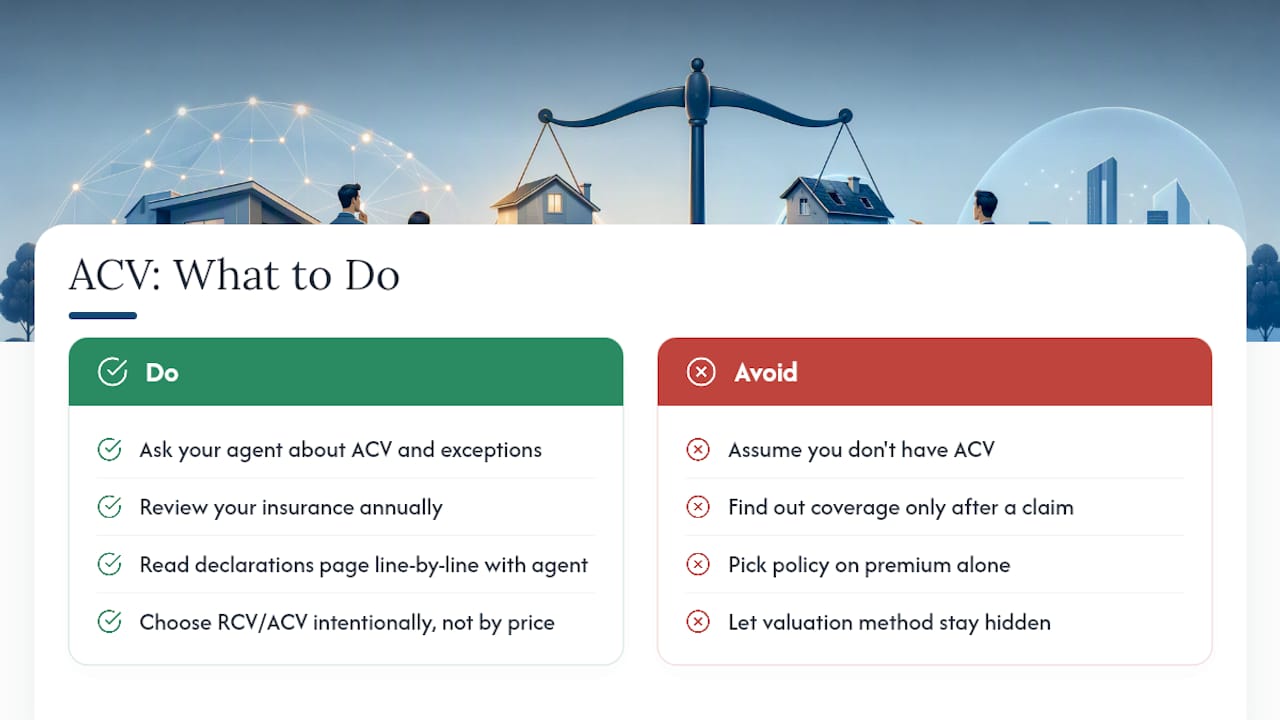
Replacement cost isn’t automatically the right answer for every household. A starter home with older appliances and a tight budget may reasonably choose ACV on some items. But that should be a decision you make on purpose, with the numbers in front of you, not a surprise in a claim letter. Ask the five questions above, read your renewal notice for roof changes, and check your dwelling limit every year.
“The best independent insurance agents don’t just find you a policy. They find you the right insurance policy and then make sure it stays right as your life changes.” — Ron Hettler, CIC (Certified Insurance Counselor), Hettler Insurance Agency
How Hettler Insurance Agency Helps You Compare Replacement Cost and ACV
Hettler Insurance Agency has served Lubbock and clients across Texas since 1992 and is licensed statewide. Ron Hettler, CIC (Certified Insurance Counselor), agency founder and president with 45+ years of insurance industry experience, and Meghan Harris, CIC, who co-leads the agency with Ron, help Texas homeowners read their loss-settlement terms and compare replacement cost and ACV options side by side. The agency carries a 4.5-star Google rating, an A+ BBB rating, and recognition from Three Best Rated® and Expertise.com.
Hettler Insurance Agency is one of the few family-owned agencies in Texas where both principals carry the high level certification of CIC (Certified Insurance Counselor). Fewer than 2% of licensed insurance professionals in the U.S. have earned the CIC designation.

As an independent agency working with 30+ top-rated carriers, Hettler Insurance Agency can compare how different insurers handle roof age, contents coverage and recoverable depreciation, instead of fitting you into one company’s rules. Learn more about why an independent agent matters. We do not charge extra fees for ID cards or certificates of insurance. Ron calls it a fundamental customer service.
For a review, have your declarations page, your latest renewal notice, your roof’s age and any recent photos ready. Then call (806) 798-7800, visit 4720 S Loop 289, Lubbock, TX 79414, or start your quote at Hettler Insurance Agency. Get Better. Get Hettler.
This article provides general information and is not a substitute for advice from a licensed insurance professional. Loss-settlement terms, roof rules, endorsements, deadlines and premiums vary by insurer, policy and property. Review your own policy and consult a licensed insurance professional, and a tax professional for tax questions, before buying or changing coverage.
Sources
- NAIC: What’s the Difference Between Actual Cash Value Coverage and Replacement Cost Coverage?
- Texas Department of Insurance: Home Policies, Replacement Cost or Actual Cash Value?
- Texas Department of Insurance: Home Insurance Guide
- Texas Department of Insurance: Insurance and Your Roof
- Texas Department of Insurance: Home Insurance Glossary
- Texas Department of Insurance: Texas Statistical Plan for Residential Risks (2026)
- Texas Department of Insurance: New ISO Residential Property Policy Forms Approved
- Texas Windstorm Insurance Association: Instructions and Guidelines Manual (2026)
- Texas Department of Insurance: File a Complaint
- Texas Office of Public Insurance Counsel: ACV vs RCV
- North Carolina Department of Insurance: Actual Cash Value vs. Replacement Cost Value
- IRS Publication 547: Casualties, Disasters, and Thefts
Frequently Asked Questions ?
Q1 ?: What is the difference between replacement cost vs ACV?
Q2 ?: Why did my insurer pay less than the full cost of my new roof?
Q3 ?: Can my roof be paid at ACV even if I have a replacement cost policy?
Q4 ?: How much do I need to insure my home for to get replacement cost?
Q5 ?: Are home insurance claim payouts taxable?
Recommended
- Top Home Insurance Mistakes To Avoid That Cost Homeowners the Most
- Home Insurance Myths Debunked: What Your Policy Really Covers
- Open Peril vs Named Peril: What Homeowners Need to Know
- Why Insure Against Hail Damage: A Texas Guide
- Home Insurance Renewal Process Guide for Texas Homeowners
- What Is Personal Property Coverage? Protect Your Texas Home
- How to Find the Best Coverage for Texas Homeowners
About the Author
Ronald J. Hettler, CIC is a Certified Insurance Counselor (CIC) [a gold-standard credential in the independent insurance industry that less than 2% earn]. Ron has over 46 years of real-world experience in the insurance industry. He is the owner/president of Hettler Insurance Agency in Lubbock, Texas and is licensed by the Texas Department of Insurance (License #666862). (Why Trust Hettler Insurance Agency? It’s a Local independent insurance agency representing multiple carriers. Hettler Insurance Agency has established business roots 100+ years going back to it’s predecessor in the late 1800’s. Local expertise in Lubbock Texas and West Texas risks. Focused on clarity before a claim occurs.) Ron and his daughter Meghan, also a CIC, lead a team that represents 30+ carriers and serves clients across Texas.
Ron specializes in helping individuals, families, and small business owners understand complex insurance concepts in clear, practical terms so they can make informed decisions about their coverage. He specializes in helping individuals and families understand coverage gaps, deductible structures, and real-world claim outcomes before a loss occurs. Ron helps you to understand how insurance policies respond in real-world claim situations.
License verification available through the Texas Department of Insurance.
— Life Insurance Instant Quote and Apply Tool @ GetLifePolicy.com > * Quick self-service term life insurance quote. With or without medical exam.
— Call us about Auto, Home, Business, Life, or Health insurance. * Click to Call (806) 798-7800, Mon-Fri 8:30am-5pm (lunch closed Noon-1pm)
— Come see us @ our new address 4720 S Loop 289 Lubbock, TX 79414 (maps link), or get your online quote started at https://GetHettler.com