
TL;DR summary:
- Understanding hail deductibles in Texas starts with one fact: most Texas homeowners policies use a separate wind/hail deductible set as a percentage of Coverage A (your dwelling limit), not the flat dollar amount you may remember. A 2% deductible on a $300,000 dwelling limit means you pay the first $6,000 of a hail claim. Do the math on your declarations page now, confirm whether your roof settles at replacement cost or actual cash value, never accept a contractor’s offer to “waive” your deductible (it’s illegal in Texas), and review your options with an independent agent before the next storm.
Your wind/hail deductible in Texas is almost certainly a percentage of Coverage A (your dwelling limit), not a flat dollar amount. Understanding hail deductibles in Texas means knowing that a 2% deductible on a $300,000 home costs you $6,000 out of pocket before your carrier pays a cent. That number surprises most homeowners. Do these three things right now:
- Pull your declarations page and find the “Coverage A” or “Dwelling” limit.
- Multiply that number by your wind/hail deductible percentage (often 1% or 2%).
- Call your agent if you see a percentage rather than a flat dollar figure and you have not done this math before.
The Texas Department of Insurance (TDI) urges homeowners with a percentage deductible to “make sure you know how that translates to a dollar amount.” According to consumer reporting from United Policyholders, 2% deductibles have become common across hail-prone Texas markets, including Lubbock and the South Plains.
Table of Contents
- Key Takeaways
- How hail deductibles in Texas are calculated
- Why many Texas carriers shifted to higher deductibles
- How RCV and ACV interact with your percentage deductible
- What happens to your deductible at renewal
- What to do after hail or wind damage
- How to choose the right deductible for your finances
- A Texas agent’s practical checklist for right now
- Deductibles for secondary and rental properties in Texas
- Common misconceptions about hail deductibles in Texas
- How to handle disputes or denials related to hail deductibles
- How your deductible affects the total claim payout
- Why reviewing your deductible before storm season is the right call
- Hettler Insurance Agency can help you review your deductible options
- Sources
- Frequently Asked Questions
Key Takeaways
| Point | Details |
|---|---|
| Compute your dollar deductible | Multiply Coverage A by your deductible percentage to find your true out-of-pocket exposure. |
| 2% is now common in Texas | Many carriers shifted to 2% wind/hail deductibles in hail-prone markets; verify yours at renewal. |
| RCV vs. ACV changes your net payout | ACV settlements subtract depreciation, reducing your check significantly on older roofs. |
| Deductible waivers are illegal | Never accept a contractor’s offer to cover your deductible; TDI confirms it is illegal in Texas. |
| Hettler Insurance Agency shops 30+ carriers | An independent policy review can show you 1% vs. 2% options and their real premium trade-offs. |
How hail deductibles in Texas are calculated
The formula is straightforward: deductible dollar amount = Coverage A × deductible percentage. Coverage A is the dwelling rebuild limit on your policy, not your home’s market value.
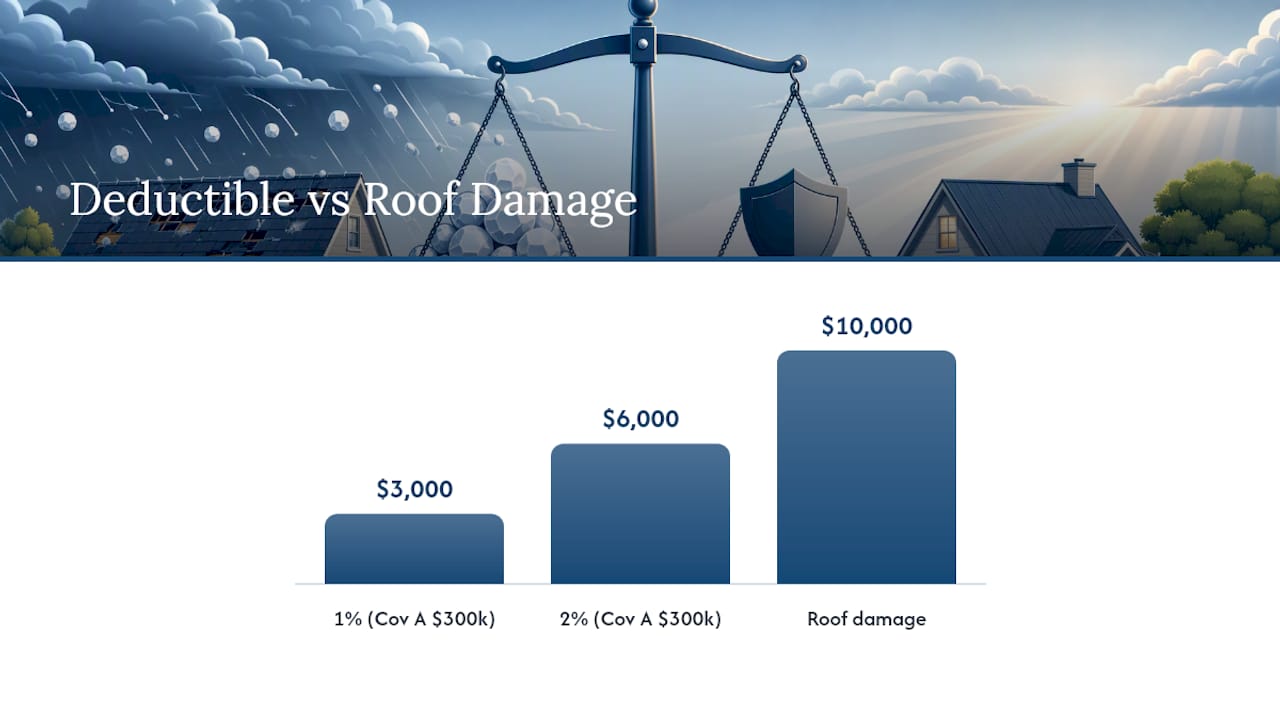
These numbers matter most when a hailstorm causes $10,000 in roof damage and your deductible consumes most of the claim. TDI’s own example shows a home insured for $150,000 with a 5% deductible ($7,500): a $6,500 roof repair would receive no payment at all, because the repair cost is less than the deductible.
Pro Tip: Your declarations page lists Coverage A near the top, usually labeled “Dwelling” or “Coverage A.” The wind/hail deductible line appears separately from the all-other-perils deductible. Confirm this with your agent annually, because a Coverage A increase at renewal automatically raises your dollar deductible.
A side-by-side guide from RoofVista shows these dollar differences and notes that the wind/hail deductible should be disclosed on the declarations page separately from the all-other-perils deductible.
| Coverage A | 1% Deductible | 2% Deductible |
|---|---|---|
| $200,000 | $2,000 | $4,000 |
| $300,000 | $3,000 | $6,000 |
| $400,000 | $4,000 | $8,000 |
For a deeper look at the mechanics, see our earlier guide on how percentage deductibles work on Texas homes.
Why many Texas carriers shifted to higher deductibles
- Storm frequency. The Insurance Information Institute documents hail as one of the most frequent and costly property perils in the U.S., with Texas consistently among the hardest-hit states.
- Material and labor costs. Higher roofing material and labor costs push claim payouts up, even for moderate hail events.
- Insurer losses. Repeated severe-storm years have left many carriers writing Texas homeowners policies paying out large amounts in claims relative to the premiums they collect.
- Reinsurance cost pressure. Carriers buy their own insurance (reinsurance) to cover catastrophe years, and those costs rise after large storm seasons and get passed through in rates and deductible structures.
Homeowners most exposed to this shift: those in Lubbock, the South Plains, and other hail-prone areas of West and North Texas, those with higher Coverage A limits, and homes with aging roofs. If your policy renewed in 2025 or 2026, verify which deductible percentage is now in effect. Our post on why home insurance rates rise in Texas explains the broader pricing picture.
How RCV and ACV interact with your percentage deductible
Replacement cost value (RCV) pays to rebuild or replace damaged property at today’s prices, minus your deductible. Actual cash value (ACV) pays replacement cost minus depreciation, and then your deductible is subtracted from that lower figure.
Here is an example. A hailstorm causes $18,000 in roof damage on a home with $400,000 in Coverage A and a 2% wind/hail deductible ($8,000).
Under RCV, the carrier pays $10,000 ($18,000 minus the $8,000 deductible). Under ACV, if the adjuster depreciates the 15-year-old roof by $6,000, the carrier pays only $4,000 ($18,000 minus $6,000 depreciation, minus the $8,000 deductible). That $6,000 gap is real money.
Check your policy for a replacement-cost endorsement, depreciation schedules, and whether roof-only settlements follow a separate ACV schedule. Many carriers now use ACV for older roofs even on otherwise RCV policies, so ask your agent how your policy treats roof age.
What happens to your deductible at renewal
Carriers must notify you of deductible changes at renewal, so read every renewal notice carefully. You have options:
- Accept the change and adjust your emergency savings accordingly.
- Decline the change where the carrier allows it, understanding that some carriers require the higher deductible to continue coverage.
- Shop other carriers. An independent agent can compare multiple carriers to find one still offering a 1% option in your market.
- Ask about endorsements that modify the deductible structure, such as a deductible buy-down where available.
Questions to ask your agent at renewal: What is my current Coverage A? What is the dollar equivalent of my deductible percentage? Has my carrier changed its wind/hail deductible terms?
Dwelling limits also increase automatically on many policies through inflation-guard endorsements, which raises the dollar value of a percentage deductible even when the percentage stays the same.
What to do after hail or wind damage
File the claim promptly and keep careful records. Here is the timeline:
Days 0–3:
- Document all visible damage with dated photographs before any repairs.
- Make temporary repairs to prevent further damage (keep all receipts).
- Contact your carrier to open a claim.
Days 4–30:
- Meet the adjuster and walk the property together.
- Get at least two independent contractor estimates.
- Review the adjuster’s scope of loss against your estimates.
Days 31–90:
- Track all payments and confirm RCV vs. ACV settlement terms.
- Submit receipts for completed repairs if your policy holds back depreciation until work is done.
Legal caution: Contractors who offer to “waive,” “cover,” or rebate your deductible are violating Texas law. According to TDI, it is illegal for contractors to waive your deductible or help you avoid paying it. Texas Insurance Code Chapter 707 requires policyholders to pay their deductible, and your insurer can ask for proof that you paid it before paying the full claim. Walk away from any contractor making this offer. Read more in our post No More “Free Roof” or Rebates for Insurance Deductibles.
How to choose the right deductible for your finances
Decide by comparing the premium savings from a higher deductible against the increased out-of-pocket exposure.
Decision checklist:
- Liquid emergency savings. Can you cover your full deductible dollar amount without borrowing? If an $8,000 deductible would require a loan, a 1% option may be worth the higher premium.
- Roof age. A roof within 5 years of replacement has lower claim risk. An aging roof increases the probability you will need to use the deductible.
- Claim frequency in your area. Lubbock, the South Plains, and North Texas see frequent hail, so the chance of using your wind/hail deductible is higher than in many other parts of the state.
- Mortgage/lender requirements. Some lenders limit the deductible allowed on the policy.
- Coverage A accuracy. Outdated dwelling limits mean your deductible dollar amount, and your claim protection, may be miscalculated.
Our Texas insurance deductible guide walks through this decision in more detail.
A Texas agent’s practical checklist for right now
Seven steps you can take before the next storm:
- Pull your declarations page and locate Coverage A and the wind/hail deductible line.
- Compute your dollar deductible (Coverage A × percentage).
- Check your roof age and pull any photos from past inspections or repairs.
- Confirm whether your policy settles on RCV or ACV for roof damage.
- If you also own coastal property, confirm whether it needs a separate windstorm policy through the Texas Windstorm Insurance Association (TWIA).
- Ask your agent for the deductible dollar equivalent in writing.
- Schedule a policy review before storm season.
Pro Tip: Photograph your roof every fall and after any hail event, even minor ones. Date-stamped photos establish pre-existing condition and protect you if a carrier disputes whether damage occurred during a specific storm.
Deductibles for secondary and rental properties in Texas
Secondary homes and rental properties often carry higher wind/hail deductibles than primary residences. Carriers may view non-owner-occupied properties as higher risk because damage can go undetected longer and maintenance standards vary.
Landlords should also note that a standard homeowners policy is written for owner-occupied homes. A landlord policy (dwelling fire policy) with its own deductible structure is generally the correct form, and loss of rental income coverage is something to confirm separately. Coverage A on a rental property reflects the rebuild cost of the structure only, not furnishings or tenant belongings. Verify the deductible percentage on each property separately.
Common misconceptions about hail deductibles in Texas
“My deductible is $1,000.” Many Texas homeowners policies carry a separate, percentage-based wind/hail deductible. The $1,000 figure may be your all-other-perils deductible, which does not apply to hail claims.
“The contractor will handle the deductible.” No. A contractor absorbing your deductible is illegal under Texas law. You owe it.
“A small hail event won’t trigger the wind/hail deductible.” Any hail claim is subject to the wind/hail deductible, regardless of storm size. If the damage is less than the deductible, the carrier pays nothing.
“My Coverage A equals my home’s market value.” Coverage A reflects rebuild cost, which often differs significantly from market value. An underinsured Coverage A also means you may not have enough coverage to rebuild after a major loss.
How to handle disputes or denials related to hail deductibles
If a carrier denies a hail claim or disputes the damage scope, you have clear options. First, request the denial in writing with the specific policy language cited. Second, consider hiring a licensed public adjuster to conduct an independent damage assessment. Third, file a complaint with TDI if you believe the denial is improper. TDI can investigate carrier conduct; call TDI’s consumer help line at 800-252-3439.
If the dispute centers on the deductible calculation itself (wrong Coverage A applied, wrong percentage used), pull your declarations page and compare it against the carrier’s claim calculation. Errors in Coverage A or percentage application are correctable. A written request to the carrier’s claims department with a copy of the correct declarations page is a good first step.
How your deductible affects the total claim payout
Your net claim payment equals the covered loss amount minus your wind/hail deductible (and minus depreciation under ACV). Three examples:
- $12,000 roof claim, 1% deductible on $300,000 Coverage A ($3,000): Net payment = $9,000 under RCV.
- $12,000 roof claim, 2% deductible on $300,000 Coverage A ($6,000): Net payment = $6,000 under RCV. Same storm, same damage, $3,000 less in your pocket.
- $12,000 roof claim, 2% deductible on $300,000 Coverage A, ACV settlement with $4,000 depreciation: Net payment = $2,000. The deductible and depreciation together consume most of the claim.
These scenarios show why both the deductible percentage and the RCV/ACV settlement method matter. A high deductible combined with ACV settlement on an older roof can result in a near-zero net payment on a moderate hail event.
Why reviewing your deductible before storm season is the right call
Many Texas homeowners discover their deductible is higher than expected only after filing a claim. That is the worst time to find out. Reviewing your policy now, before a storm, gives you time to adjust Coverage A, compare deductible options, and build the emergency savings buffer your deductible requires.
The homeowners who feel the sharpest pain after a hail event are not always those with the most damage. They are often the ones who assumed their deductible was still a flat $1,000 and discovered it was $8,000 when the adjuster’s check arrived. If you are weighing whether hail protection is worth it at all, read Why Insure Against Hail Damage: A Texas Guide.
Hettler Insurance Agency can help you review your deductible options

Hettler Insurance Agency is a family-owned independent agency in Lubbock, Texas, serving Texans since 1992. Because the agency represents more than 30 top-rated carriers, the team can compare wind/hail deductible structures across multiple companies to find the right fit for your home and budget. Ron Hettler, CIC (Certified Insurance Counselor), agency founder and president with 45+ years of insurance industry experience, and Meghan Harris, CIC, who co-leads the agency with Ron, can walk you through your declarations page, your dollar deductible, and what to gather if you ever need to file a claim.
No pressure, no fee for the review. Schedule a policy review with Hettler Insurance Agency or call (806) 798-7800 and know exactly where you stand before storm season arrives. Hettler Insurance Agency is one of the few family-owned agencies in Texas where both principals carry the high level certification of CIC (Certified Insurance Counselor). Fewer than 2% of licensed insurance professionals in the U.S. have earned the CIC designation.
Sources
- What to know about deductibles — Texas Department of Insurance
- Is it OK for a contractor to waive my deductible? — Texas Department of Insurance
- Texas Windstorm Insurance Association (TWIA)
- Texas Is Entering Peak Hail Season — And Most Homeowners Don’t Understand the Deductible That Could Cost Them Thousands — United Policyholders
- Texas Wind & Hail Deductible Guide 2026 — RoofVista
- Facts + Statistics: Hail — Insurance Information Institute
This article provides general information and is not a substitute for advice from a licensed insurance professional. Deductibles, settlement terms, and eligibility vary by carrier and policy.
Frequently Asked Questions ?
Q1 ?: How is a hail deductible calculated in Texas?
Q2 ?: Does my $1,000 deductible apply to hail damage?
Q3 ?: How do RCV and ACV affect my hail claim payout?
Q4 ?: Can a roofing contractor pay or waive my deductible in Texas?
Q5 ?: What should I do to prepare my deductible before storm season?
Recommended
About the Author
Ronald J. Hettler, CIC is a Certified Insurance Counselor (CIC) [the gold-standard credential in the independent insurance industry]. Ron has over 46 years of real-world experience in the insurance industry. He is the owner/president of Hettler Insurance Agency in Lubbock, Texas and is licensed by the Texas Department of Insurance (License #666862). (Why Trust Hettler Insurance Agency? It’s a Local independent insurance agency representing multiple carriers. Hettler Insurance Agency has established business roots going back to it’s predecessor in the late 1800’s. Local expertise in Lubbock Texas and West Texas risks. Focused on clarity before a claim occurs.) Ron and his daughter Meghan, also a CIC, lead a team that represents 30+ carriers and serves clients across Texas.
Ron specializes in helping individuals, families, and small business owners understand complex insurance concepts in clear, practical terms so they can make informed decisions about their coverage. He specializes in helping individuals and families understand coverage gaps, deductible structures, and real-world claim outcomes before a loss occurs. Ron helps you to understand how insurance policies respond in real-world claim situations.
License verification available through the Texas Department of Insurance.
— Life Insurance Instant Quote and Apply Tool @ GetLifePolicy.com > * Quick self-service term life insurance quote. With or without medical exam.
— Call us about Auto, Home, Business, Life, or Health insurance. * Click to Call (806) 798-7800, Mon-Fri 8:30am-5pm (lunch closed Noon-1pm)
— Come see us @ our new address 4720 S Loop 289 Lubbock, TX 79414 (maps link), or get your online quote started at https://GetHettler.com