

TL;DR summary:
- An insurance adjuster investigates your claim, confirms what your policy covers, values the loss, and negotiates the settlement.
- Staff and independent adjusters work for the insurance company paying the claim. Public adjusters work for you and charge a fee.
- Texas law sets claim deadlines: your insurer must acknowledge your claim within 15 days, accept or deny it within 15 business days of getting everything it needs, and pay within 5 business days of agreeing to pay.
- If you disagree with the offer, Texas policyholders can send supporting estimates, ask for a different adjuster, use the policy’s appraisal process, file a complaint with TDI, or hire a licensed public adjuster, whose fee is capped at 10% of the settlement.
- Photos, receipts, and a written log of every claim conversation are the best protection you have when a claim gets disputed.
An insurance adjuster investigates your Texas claim, calculates what the insurer owes, and negotiates the settlement, usually on behalf of the company that issued the policy. That’s the role of adjusters in insurance in one sentence. As the Texas Department of Insurance (TDI) puts it, “the adjuster works for the insurance company paying the claim.” Some adjusters work for you instead, but most policyholders will deal with someone representing the insurer’s side of the table.
Every claim moves through the same basic sequence, whether it’s a fender bender or a hail-damaged roof:
- Review the policy and confirm coverage
- Investigate the loss (statements, reports, evidence)
- Inspect the damage in person or virtually
- Calculate the value of the claim
- Negotiate and settle
Table of Contents
- Key Takeaways
- Insurance Claims Adjuster Duties and the Step-by-Step Process
- Types of Insurance Adjusters and Who They Represent
- How Adjusters Investigate and Calculate Claim Value
- Working With an Adjuster: What to Expect and How to Prepare
- Texas Claim Deadlines Your Insurer Must Meet
- What to Do When You Disagree With the Claim Decision
- Public Adjusters and Appraisal in Texas
- Licensing, Authority, and How Adjusters Get Paid
- How an Independent Agency’s Experience Shapes This Advice
- Why Independent Guidance Matters Once a Claim Gets Complicated
- What Decades of Claims Experience Taught Us
- Sources
- Frequently Asked Questions
Key Takeaways
An insurance adjuster’s core job is to investigate, value, and negotiate your claim, and knowing which type you’re dealing with, and which Texas rules apply, determines how much leverage you have.
| Point | Details |
|---|---|
| Know who they represent | Staff and independent adjusters work for the insurer; public adjusters work for you and charge a fee, capped in Texas at 10% of the settlement. |
| Understand the five-step process | Review, investigate, inspect, value, and negotiate are the standard stages every claim moves through. |
| Texas sets claim deadlines | Your own insurer must acknowledge, decide, and pay your claim within deadlines set by state law. |
| Estimate gaps are normal | An adjuster’s estimate and a contractor’s bid often differ. Supporting estimates and receipts are how you close the gap. |
| Document everything early | Photos taken before cleanup and a written log of every call protect your position if the claim gets disputed. |
| Escalation options exist | A different adjuster, appraisal, a TDI complaint, mediation, a public adjuster, or an attorney are all legitimate paths when you disagree. |
Insurance Claims Adjuster Duties and the Step-by-Step Process
The Bureau of Labor Statistics describes the core job plainly: adjusters “investigate, evaluate, and settle insurance claims,” “determine whether the insurance policy covers the loss claimed,” and “decide the appropriate amount the insurance company should pay.” The BLS also lists making sure claims are not fraudulent, negotiating settlements, and authorizing payments. That work follows a fairly predictable path.
- Policy review. The adjuster pulls your declarations page and checks coverage types, limits, deductibles, and any exclusions that might apply to the loss.
- Investigation. This includes recorded statements, police or medical reports, and interviews with witnesses when the facts are disputed.
- Inspection. Property claims often get an in-person walkthrough; smaller claims, and claims filed during high-volume storm events, are often handled through photos and video calls.
- Valuation. The adjuster estimates repair or replacement costs under the terms of your policy, including your deductible and whether you have replacement cost or actual cash value coverage.
- Negotiation and settlement. An offer goes out, you can respond with supporting documentation, and once both sides agree, payment follows.
Not every adjuster can approve every payment on their own. The BLS explains that adjusters often put together a report for claims examiners to review, and “when the examiner approves the claim, the adjuster negotiates with the policyholder and settles the claim.” That internal review is one reason larger or more complex claims can take longer than a simple one.
Pro Tip: At the start of your claim, get the adjuster’s name, phone number, email, and the best time to reach them, and ask when you can expect the insurance company’s offer. TDI recommends both steps.
Types of Insurance Adjusters and Who They Represent
Not every adjuster answers to the same boss, and knowing which type you’re dealing with changes how you should approach the conversation.
- Staff (company) adjusters are employees of the insurer. They handle the bulk of routine claims for the company that issued your policy.
- Independent adjusters are contractors hired by insurance companies, often during catastrophe events like hail outbreaks or hurricanes when claim volume outpaces staff capacity. Even though they aren’t on the insurer’s payroll, they report to the insurer.
- Desk and field adjusters describe how the work is split. SageSure explains that desk adjusters handle most communication by phone, email, or text, while field adjusters travel to the loss to inspect the damage and report back.
- Public adjusters work for you, the policyholder, and charge a fee for helping you present and negotiate your claim. In Texas, they must be licensed by TDI, and their fees are capped by law.
If you’re not sure who the person on the other end of the phone works for, ask. It’s a reasonable question, and the answer tells you whose interests they’re there to represent.
How Adjusters Investigate and Calculate Claim Value

Adjusters build their valuation from evidence, not guesswork: photos of the damage, repair invoices, receipts for damaged property, and police or medical reports where relevant. According to the BLS, adjusters may contact claimants’ doctors or employers for more information on questionable claims and talk with legal counsel when needed. On complex or high-dollar claims, the insurer may also bring in:
- Structural engineers for foundation or roof damage
- Contractors for repair scope and pricing
- Physicians for injury claims
- Attorneys when liability is contested
Why your contractor’s bid and the adjuster’s number don’t match: Adjusters commonly price repairs with estimating software, while your contractor prices the specific job in front of them. Different line items, labor assumptions, or missed damage can all create a gap. TDI advises policyholders to be prepared to negotiate: if your repair or replacement estimates are higher than the company’s offer, talk to your adjuster and give them original receipts, advertisements, or other documents that show a higher cost.
Your policy terms shape the final number, too. Your deductible comes off the top, and many Texas homeowners carry a separate wind and hail deductible. Whether you have replacement cost coverage or actual cash value also changes how depreciation affects your payment.
Working With an Adjuster: What to Expect and How to Prepare
Claims move faster and settle closer to fair value when you show up organized. TDI’s home insurance guide and claim tips line up with what we see work in practice:
- Tell your insurance company as soon as possible. Most policies have deadlines for filing a claim.
- Pull your policy declarations page and confirm your coverage limits and deductibles before the first call.
- Photograph or video everything before any repairs, including pre-loss pictures of the property or vehicle if you have them.
- Make only temporary repairs, like a tarp on the roof or boards over a broken window. TDI warns that the company might deny your claim if you make permanent repairs before it sees the damage.
- Keep the damaged property for the adjuster to inspect, and keep receipts for repair materials and anything you replace.
- Try to be there when the adjuster inspects the damage, and consider having your contractor with you. Point out anything the adjuster might miss, like water damage behind drywall.
- Keep copies of all documents and write down every call, with the date, who you talked to, and what was said.
If you bring in your own contractor estimate, ask the adjuster to walk through scope differences line by line rather than accepting a flat “that’s too high.” If the damage turns out to be worse than the adjuster first thought, TDI notes that you or your contractor can talk to the adjuster about raising the estimate. Filing a car claim? Our guide on how to file an auto insurance claim covers the auto-specific steps.
Pro Tip: If you have trouble reaching your adjuster or can’t work out an issue with them, call the insurance company. TDI says you can ask the company to assign a different adjuster. It’s a normal request, not a confrontation.
Texas Claim Deadlines Your Insurer Must Meet
Texas law gives policyholders something many states don’t spell out as clearly: firm deadlines for how quickly your own insurance company must act once you file a claim. These deadlines come from TDI’s home insurance guide and the Consumer Bill of Rights.
| Claim Stage | Deadline | What the Insurer Must Do |
|---|---|---|
| After you file | Within 15 days | Tell you it received your claim, start its investigation, and ask for any information it needs. |
| After it gets all requested information | Within 15 business days | Approve or deny your claim in writing. A denial must explain why. |
| If it needs more time | Up to 45 days | Notify you that it needs more time and tell you the reason. |
| After it agrees to pay | Within 5 business days | Send payment for the approved amount. |
| Weather-related catastrophe | Up to 15 more days | TDI can extend claim handling deadlines after a declared catastrophe. |
Sources: TDI home insurance guide and TDI Consumer Bill of Rights.
There are a few exceptions. TDI notes that if a company suspects arson, it has 30 days to accept or deny the claim, and a surplus lines company has 20 business days to pay after it agrees to pay. If the insurance company doesn’t meet the payment deadline, TDI says you can sue the company for the amount of the claim, plus interest and attorney fees.
These deadlines apply to claims on your own policy. If you’re filing against another driver’s insurance after a wreck, TDI explains that their company doesn’t have the same time limits, but it should still try to make a prompt and fair settlement. That’s one reason your own collision or comprehensive coverage can be the faster route, even when the other driver was at fault.
Pro Tip: Write down the date you filed your claim and the date you sent each requested document. If the deadlines above pass without a response, that written timeline is what you’ll need when you call the company or TDI.
What to Do When You Disagree With the Claim Decision
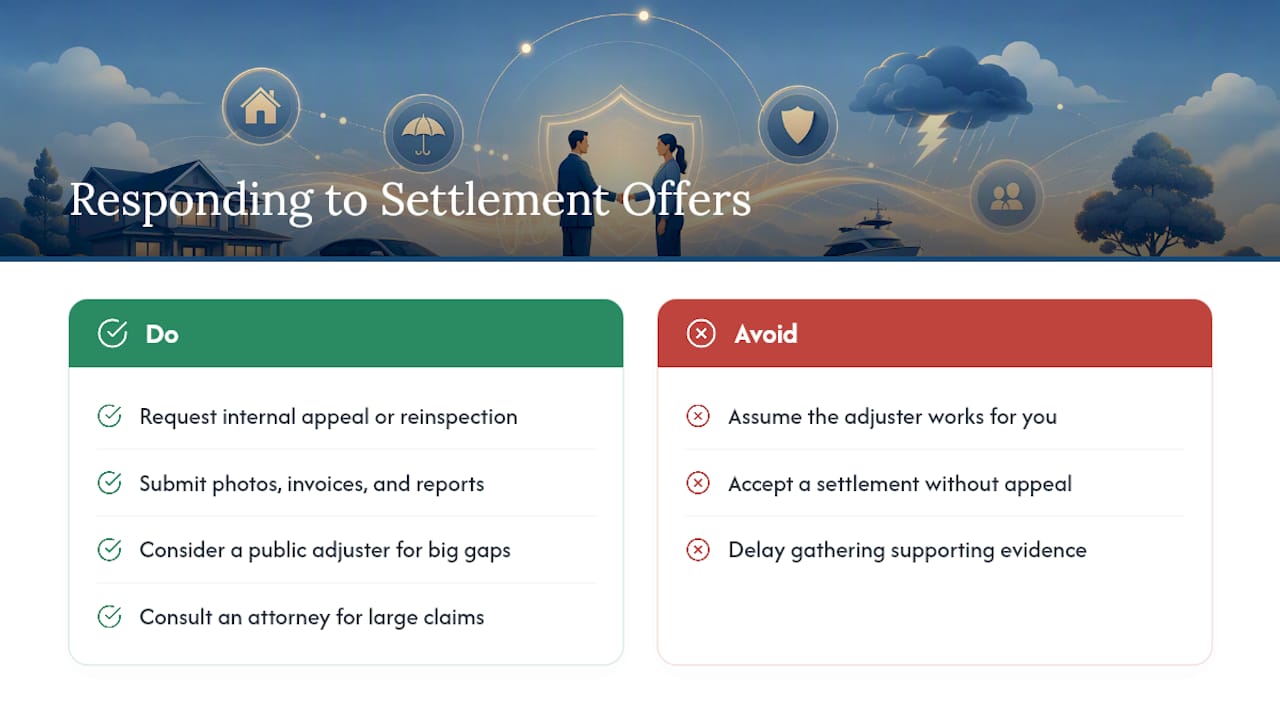
Disagreement doesn’t mean you’re stuck with the first number offered. TDI’s page on what to do if your insurance isn’t paying enough lays out the options Texas homeowners have:
- Tell the company why you disagree. TDI says the company may have overlooked something and may adjust the offer. Send supporting documents, like a contractor’s repair estimate. Many disputes resolve at this stage once new documentation surfaces.
- Ask for a re-inspection or a different adjuster if you believe damage was missed or communication has broken down.
- Request appraisal if your policy includes it. This is a formal process for disputes over the amount of a covered loss, explained in the next section.
- File a complaint with TDI if you think the company has treated you unfairly. TDI’s complaint page walks through the steps, or you can call the Help Line at 800-252-3439.
- Ask for alternative dispute resolution. TDI notes that mediation with a neutral third party can settle disputes outside court.
- Hire a licensed public adjuster if the gap is large enough to justify their fee.
- Consult an attorney for larger losses or bad-faith concerns. TDI notes you have the right to sue the insurance company if you’re not satisfied with the outcome of your dispute.
Expect a renegotiation or reinspection to move in days or weeks. Appraisal, mediation, and litigation can stretch into months.
Public Adjusters and Appraisal in Texas
Two dispute tools come up often after a big Texas hailstorm, and both have rules worth knowing before you sign anything.
Public adjusters: what Texas law allows
A public adjuster represents you, not the insurer. According to TDI’s guide to hiring a public adjuster:
- Public adjusters must be licensed by TDI. You can call the Help Line at 800-252-3439 to confirm a license and ask about complaints or disciplinary actions.
- They can charge up to 10% of the total amount the company will pay for your claim. The fee can be based on the total settlement, not just the amount you’re disputing.
- TDI’s example: if the company wants to pay $100,000 and you’re disputing $20,000, the public adjuster could charge $10,000.
- You can ask for the fee to be stated as a dollar amount instead of a percentage, and you can try to negotiate a lower fee.
- If your insurance company doesn’t increase its offer, you might still have to pay the public adjuster, and you still owe your deductible.
- You have 72 hours after signing a contract to cancel it.
TDI’s homeowner FAQ adds one more limit: if the insurer commits to paying the policy limits on certain claims within 72 hours of the loss being reported, the public adjuster is entitled only to reasonable compensation for time and expenses, not a percentage commission. And Texas doesn’t allow a roofer or contractor to act as a public adjuster on a claim if they’re also doing the work, per TDI’s roofing guidance.
Appraisal: settling a dispute over the amount
Many policies include an appraisal clause for disagreements about how much a covered loss is worth. TDI explains how it works for homeowners: you and the company each hire an appraiser, and those appraisers choose a third appraiser to serve as umpire. If the two appraisers’ estimates differ, the umpire makes the final decision, which is binding on both you and the company. You pay for your own appraiser and half of the umpire’s expenses.
Appraisal settles the dollar amount, not whether something is covered. For auto policies, TDI notes the appraisal decision is binding on the amount of damage, and a coverage dispute can be pursued separately afterward. Check your policy for deadlines to demand appraisal, since waiting too long can cost you the option.
Pro Tip: Before choosing between a public adjuster and appraisal, look at the size of the gap. A 10% fee on the whole settlement can eat up much of a small disagreement, while appraisal costs are split and may make more sense for a narrow dispute over price.
Licensing, Authority, and How Adjusters Get Paid
In Texas, TDI licenses adjusters, and a 2026 TDI bulletin reminds the industry that all public insurance adjusters must be licensed, with civil and criminal penalties for violating that requirement. The same bulletin confirms that consumers have the right to contract with a licensed public adjuster. If someone shows up after a storm offering to “handle your claim,” verify their license through the TDI Help Line before signing anything.
- Larger settlements may need approval from a claims examiner or supervisor, not just the adjuster handling your file.
- Staff and independent adjusters are paid by the insurer, through salary or contract fees, and work within the company’s claim guidelines.
- Public adjusters are paid by you, usually as a percentage of the settlement, which ties their pay to the size of your recovery.
How an Independent Agency’s Experience Shapes This Advice
Decades of watching claims unfold from the policyholder’s side of the desk teaches you where things go wrong. It’s rarely the adjuster acting in bad faith. It’s usually a documentation gap or a coverage assumption nobody double-checked before the loss happened.
- Reviewing your policy limits, deductibles, and endorsements before a loss, not after, prevents most of the surprises that turn a routine claim into a dispute. A regular policy review catches gaps early.
- Knowing whether your home is insured for replacement cost or actual cash value, and what your wind and hail deductible is, tells you roughly what to expect before an adjuster ever arrives.
- One habit we recommend to every client: take photos before cleanup starts and keep a written log of every claim conversation, starting the day the loss happens.
Why Independent Guidance Matters Once a Claim Gets Complicated

Most homeowners and small business owners don’t file enough claims in a lifetime to know when a valuation looks off. An independent agent doesn’t replace the adjuster, but can help you understand your own policy before you ever need it and walk you through your options when a claim gets complicated.
Ron Hettler, CIC (Certified Insurance Counselor), agency founder and president with 45+ years of insurance industry experience, and Meghan Harris, CIC, who co-leads the agency with Ron, help Texas families and businesses choose coverage that holds up when a claim happens. As an independent agency representing 30+ top-rated carriers, we can compare how different companies handle the coverage that matters most at claim time, like deductibles and replacement cost, instead of offering whatever a single insurer sells. We do not charge extra fees for ID cards or certificates of insurance. Ron calls it a fundamental customer service.
Hettler Insurance Agency is one of the few family-owned agencies in Texas where both principals carry the high level certification of CIC (Certified Insurance Counselor). Fewer than 2% of licensed insurance professionals in the U.S. have earned the CIC designation.
“The best independent insurance agents don’t just find you a policy. They find you the right insurance policy and then make sure it stays right as your life changes.” — Ron Hettler, CIC (Certified Insurance Counselor), Hettler Insurance Agency
If you’re not sure your current coverage would hold up under a real claim, a policy review with an independent agent is worth doing now rather than mid-dispute. For business owners, understanding minimum coverage requirements before a claim happens saves a lot of friction later. Contact Hettler Insurance Agency, call (806) 798-7800, or visit 4720 S Loop 289, Lubbock, TX 79414. Call us before you need us, not just after. Get Better. Get Hettler.
What Decades of Claims Experience Taught Us
The biggest misconception we see is thinking that adjusters are adversaries by default. Most aren’t. They’re working within company guidelines and approval limits that shape what they can offer without a supervisor or examiner signing off. The habits that actually change outcomes are simple: photos taken the day of the loss, before cleanup starts; receipts and estimates that back up your numbers; and a dated log of every conversation. Add a working knowledge of your Texas claim deadlines and dispute options, and you’ll be negotiating from a position of strength instead of guesswork.
This article provides general information and is not a substitute for advice from a licensed insurance professional. Claim procedures, deadlines, appraisal provisions, and policy forms vary by carrier and policy, so review your own policy or talk with a licensed agent before making decisions.
Sources
- Claims Adjusters, Appraisers, Examiners, and Investigators | U.S. Bureau of Labor Statistics
- Working with an insurance adjuster | Texas Department of Insurance
- Home insurance guide | Texas Department of Insurance
- Consumer Bill of Rights (PDF) | Texas Department of Insurance
- Tips for filing a claim with your insurance company | Texas Department of Insurance
- What if my insurance isn’t paying enough? | Texas Department of Insurance
- Public adjusters: What to know before you hire one | Texas Department of Insurance
- Homeowner FAQ | Texas Department of Insurance
- Roofing and insurance: Know the law | Texas Department of Insurance
- Commissioner’s Bulletin B-0006-26 | Texas Department of Insurance
- Texas Insurance Tips: Five steps to getting your insurance claim paid | Texas Department of Insurance
- What does an insurance adjuster do? | SageSure
Frequently Asked Questions ?
Q1 ?: What is the role of adjusters in insurance claims?
Q2 ?: Do insurance adjusters work for me or the insurance company?
Q3 ?: How long does an insurance company have to respond to a claim in Texas?
Q4 ?: What should I do if I disagree with the adjuster’s settlement offer?
Q5 ?: How much can a public adjuster charge in Texas?
Recommended
About the Author
Ronald J. Hettler, CIC is a Certified Insurance Counselor (CIC) [a gold-standard credential in the independent insurance industry that less than 2% earn]. Ron has over 46 years of real-world experience in the insurance industry. He is the owner/president of Hettler Insurance Agency in Lubbock, Texas and is licensed by the Texas Department of Insurance (License #666862). (Why Trust Hettler Insurance Agency? It’s a Local independent insurance agency representing multiple carriers. Hettler Insurance Agency has established business roots 100+ years going back to it’s predecessor in the late 1800’s. Local expertise in Lubbock Texas and West Texas risks. Focused on clarity before a claim occurs.) Ron and his daughter Meghan, also a CIC, lead a team that represents 30+ carriers and serves clients across Texas.
Ron specializes in helping individuals, families, and small business owners understand complex insurance concepts in clear, practical terms so they can make informed decisions about their coverage. He specializes in helping individuals and families understand coverage gaps, deductible structures, and real-world claim outcomes before a loss occurs. Ron helps you to understand how insurance policies respond in real-world claim situations.
License verification available through the Texas Department of Insurance.
— Life Insurance Instant Quote and Apply Tool @ GetLifePolicy.com > * Quick self-service term life insurance quote. With or without medical exam.
— Call us about Auto, Home, Business, Life, or Health insurance. * Click to Call (806) 798-7800, Mon-Fri 8:30am-5pm (lunch closed Noon-1pm)
— Come see us @ our new address 4720 S Loop 289 Lubbock, TX 79414 (maps link), or get your online quote started at https://GetHettler.com