

TL;DR summary:
- Term life covers a set period, usually 10 to 30 years. Whole life lasts for life and builds cash value.
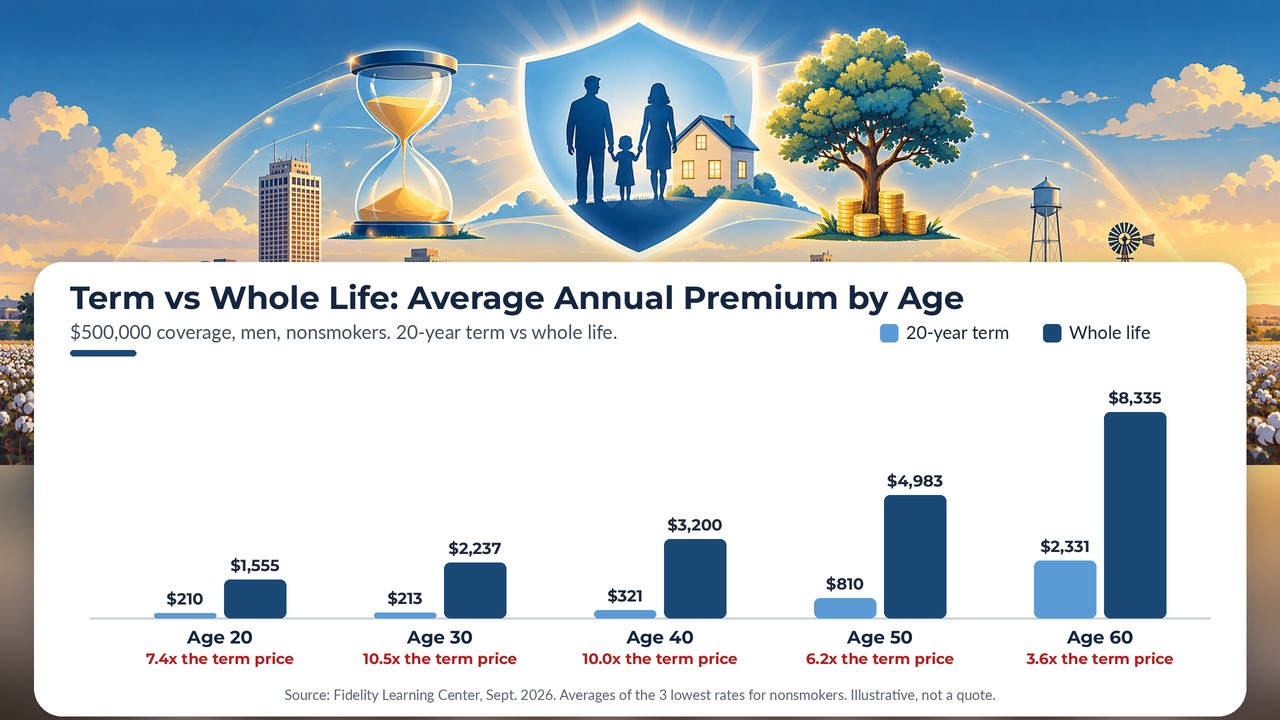
- For a 40-year-old nonsmoking man, a 20-year, $500,000 term policy costs about $28 to $47 a month, while whole life averages about $706 a month.
- Term vs whole life, in Fidelity’s 2026 averages, whole life costs about 7 to 10 times as much as term through age 40, and about 3.6 times as much at 60.
- Term fits temporary needs like a mortgage or raising kids. Whole life fits needs that never end, like estate liquidity or a lifelong dependent.
- Compare coverage amount, term length, conversion rules, insurer ratings and rider costs. An independent agent can quote several carriers side by side.
Term vs whole life is really a question about time. Term life covers the years your family depends on your income, and it costs far less. Whole life guarantees lifelong coverage and builds cash value, but for the same death benefit it can cost roughly 10 times as much. For most budget-focused buyers, term is the better first purchase. If you’re unsure, buy enough term life insurance now and ask a licensed agent about adding permanent coverage later, when you know whether your need will ever end.
Table of Contents
- Key Takeaways
- Term vs Whole Life: The Quick Comparison
- How Does Term Life Insurance Work?
- How Does Whole Life Insurance Build Cash Value?
- Why Does Whole Life Cost So Much More Than Term?
- Which Type of Life Insurance Fits Your Situation?
- How Are Term and Whole Life Taxed in an Estate Plan?
- How Should You Compare Policies Before You Buy?
- Our Take: Buy for the Need You Actually Have
- How Hettler Insurance Agency Helps You Compare Term and Whole Life
- Sources
- Frequently Asked Questions
Key Takeaways
Term and whole life can carry the same death benefit and still be built for very different jobs. These are the points that matter most.
| Point | Details |
|---|---|
| Term is built for a window | Term covers a set period, usually 10 to 30 years, and builds no cash value. |
| Whole life is built for life | Whole life stays in force as long as premiums are paid, and part of each premium builds tax-deferred cash value. |
| The price gap is large | A 40-year-old nonsmoking man pays about $321 a year for $500,000 of 20-year term versus about $3,200 a year for whole life. |
| Early exits are costly | Whole life surrender charges are highest in the early years and generally fade after 10 to 15 years. |
| Size first, then choose | Financial planners often start at 10 times your pretax income, then match the term length to your longest obligation. |
Term vs Whole Life: The Quick Comparison
Before you meet with an agent or compare quotes, here’s how the two policies stack up side by side.
| Feature | Term life | Whole life |
|---|---|---|
| Coverage length | A set term, usually 10 to 30 years | Your entire life, as long as premiums are paid |
| Cost for $500,000 (age 40, male, nonsmoker) | About $321 a year for 20-year term | About $3,200 a year |
| Cash value | None | Grows tax-deferred and can be borrowed against or withdrawn |
| Common riders | Conversion option, waiver of premium, return of premium | Paid-up additions, waiver of premium |
| Best for | Income replacement, a mortgage, the years kids are at home | Estate liquidity, a lifelong dependent, a guaranteed legacy |
The cost row comes from Fidelity’s 2026 average premium table, which averages the three lowest rates found for nonsmokers with few health conditions. The gap is widest for younger buyers and narrows as you age, because term premiums rise steeply later in life. Women pay less at every age: a 40-year-old woman averages about $278 a year for term and $2,849 for whole life.
The NAIC puts it simply: term insurance “generally offers the largest insurance protection for your premium dollar.” Either way, the death benefit is generally income-tax-free to your beneficiary, which you’ll see more about in the tax section below.
How Does Term Life Insurance Work?
Term life insurance is exactly what the name says: coverage for a defined term, typically 10 to 30 years, with a death benefit paid only if you die during that window. There’s no cash value, no savings component and nothing to borrow against. You pay a level premium for the term, and if you outlive it, the coverage ends unless you renew or convert it.
Renewing usually costs more. According to the NAIC Life Insurance Buyer’s Guide, you can renew most term policies for one or more terms even if your health has changed, but premiums may be higher each time you renew. If you’re still healthy, a new policy may be cheaper than renewing the old one.
Two features matter most when you compare term contracts:
- Convertibility: The NAIC notes that you may be able to trade many term policies for a cash value policy during a conversion period, even if you are not in good health. Premiums on the new policy will be higher, and AARP adds that some policies charge a fee for the conversion option.
- Riders: A return-of-premium rider refunds your premiums if you outlive the term, at a higher cost. A waiver-of-premium rider keeps the policy in force if you become disabled.
For a sense of price, a 30-year-old nonsmoking man averages about $213 a year for a 20-year, $500,000 term policy, and a 30-year-old woman about $183, according to Fidelity. Your actual rate depends on your health class, tobacco use and the carrier’s underwriting. For more on term options in Texas, see our term life insurance guide for Texas families.
How Does Whole Life Insurance Build Cash Value?
Whole life works differently from the ground up. Part of every premium pays for the death benefit, and the rest goes into a cash value account that, as AARP explains, grows tax-deferred over time. Growth comes from a guaranteed minimum rate, and with participating policies, from dividends the insurer may pay but doesn’t guarantee.
You can use that cash value in three ways:
- Borrow against it. An unpaid loan plus interest is subtracted from the death benefit, and if the loan outgrows the cash value, the policy can lapse. Our guide to a loan from life insurance walks through how that works.
- Withdraw part of it. A withdrawal also reduces what your beneficiaries eventually receive.
- Leave it alone and let it grow as a possible source of supplemental retirement income.
Cash value grows slowly at first. The NAIC notes that some policies have low cash values in the early years that build quickly later, while others build more evenly. A simplified view of a whole life policy over time looks like this:
| Policy years | Typical cash value pattern | What to know |
|---|---|---|
| Years 1–5 | Modest, often less than total premiums paid | Surrender charges still apply |
| Year 15 | Growth starts to accelerate | Dividends, if any, begin to compound |
| Year 25 | Substantial relative to premiums paid | Loans and withdrawals become more practical |
| Year 40 | Can approach the death benefit in some designs | Well past the surrender-charge period |
This pattern is illustrative only. Actual values vary widely by insurer, premium design and dividend performance. The NAIC Buyer’s Guide says a policy illustration will show both what the company guarantees and what could happen in the future, and you’ll be asked to sign a statement that some numbers aren’t guaranteed. Ask for the guaranteed column. That’s the number you can count on.
What if you cancel early? Canceling term is simple: stop paying and coverage ends. Canceling whole life is costly in the early years. AARP notes that the earlier you cancel, the higher the surrender charges, and that they generally disappear after 10 to 15 years. The NAIC is blunt: “Do not buy life insurance unless you intend to stick with your plan.” Before you surrender, ask whether you can switch to reduced paid-up coverage or take a partial withdrawal instead.
Why Does Whole Life Cost So Much More Than Term?
Term vs whole life, the price gap isn’t arbitrary. A whole life insurer knows it will pay a claim eventually, since the policy pays whenever you die, not just within a window. That certainty, plus the cash value and lifelong guarantees, drives the premium up.
Four cost drivers show up in nearly every quote:
- A near-certain payout: Permanent coverage pays out eventually, so the insurer must fund for it.
- Cash value funding: Part of every whole life premium builds savings, not just insurance protection.
- Lifetime guarantees: A level premium for life and a guaranteed minimum growth rate cost more than a 20-year promise.
- Commissions and setup costs: These are recovered early in the policy, which is why early cash values are low.
For a sense of scale, AARP reports that a 40-year-old nonsmoking man could buy a 20-year, $500,000 term policy for $28 to $47 a month, versus an average of $706 a month for a $500,000 whole life policy. Treat these as illustrative ranges, not quotes.
A few variables move your premium more than people expect:
- Age: Locking in whole life younger lowers your lifetime premium. In Fidelity’s figures, a man’s whole life premium more than doubles between ages 30 and 50, from $2,237 to $4,983 a year.
- Health class and tobacco use: Both are major pricing factors for term and whole life alike.
- Term length: A 30-year term costs more than a 10-year term for the same death benefit, since the insurer is on the hook longer.
- Underwriting type: Fully underwritten policies with a medical exam usually price lower than simplified-issue policies. Guaranteed-issue coverage, usually small whole life “final expense” policies, is among the most expensive per dollar of coverage.
Both policy types use the same core underwriting factors: age, health history, family medical history, tobacco use, occupation and sometimes risky hobbies. Your health class is set when the policy is issued and doesn’t change while the policy stays in force.
One more point: employer group life usually isn’t enough on its own. As our guide to life insurance paid by an employer explains, most employers provide one to two times your salary, and coverage generally ends when you leave the job. It’s a helpful supplement, but rarely a replacement for a policy you own.
Which Type of Life Insurance Fits Your Situation: term vs whole life?
Matching the policy to your life stage matters more than any general rule about which product is “better.”
- Young family on a tight budget: Term is almost always the right call. A 20- or 30-year level term policy covers the years your kids depend on you, at a fraction of whole life’s cost.
- Homeowner with a mortgage: Match the term to your remaining mortgage. If you have 22 years left on the loan, a 25-year term lines your coverage up with your debt.
- High-net-worth household planning an estate: Whole life can make sense here, often held in a trust to provide estate liquidity or equalize inheritances.
- Caregiver for a lifelong dependent: Whole life’s permanence fits a need that never expires, such as providing for a child with lifelong special needs.
How much coverage? AARP notes that financial planners often recommend coverage of 10 times your pretax annual salary as a starting point, and Fidelity suggests 10 to 12 times your salary plus bonuses if you have dependents. Then choose a term that covers your longest obligation, whether that’s the mortgage or the year your youngest finishes college. Our guide on how much life insurance to buy walks through the math.
Mixing the two is common, too. Some households buy a large term policy for income replacement and a smaller whole life policy for final expenses or estate liquidity. That keeps most of term’s affordability without giving up permanence entirely.
Does inflation change the math? A fixed death benefit buys less over time with either policy. A $500,000 payout in year 20 won’t stretch as far as it does today. With term, the fix is to buy a little more coverage up front or add a policy as your income grows. With whole life, dividends used to buy paid-up additions can grow the death benefit over time, but dividends aren’t guaranteed. On the premium side, a level premium gets cheaper in real terms each year. Term gives you that benefit only until the term ends, while whole life gives it to you for life.
How Are Term and Whole Life Taxed in an Estate Plan?
Both policy types share one major tax advantage. According to the IRS, life insurance proceeds you receive as a beneficiary because of the insured person’s death generally aren’t included in gross income, though any interest paid on the proceeds is taxable.
The differences show up while the policy is in force:
- Cash value growth: Term has none. Whole life cash value grows tax-deferred, so you don’t owe tax on gains each year.
- Surrender: The IRS says that if you surrender a policy for cash, any proceeds above the policy’s cost, generally the premiums you paid, are taxable income.
- Policy loans: Loans generally aren’t taxed while the policy stays in force. If the policy lapses with a loan outstanding, the balance can become taxable income.
- Overfunding: A policy that fails the IRS 7-pay test under Section 7702A becomes a modified endowment contract, and its loans and withdrawals lose their favorable tax treatment. Talk with a tax professional before overfunding any permanent policy.
In an estate plan, life insurance creates cash exactly when your family needs it. A death benefit can cover funeral costs, debts and estate expenses without waiting on probate or selling property in a hurry.
Whole life plays a specific role here because it’s built to pay out eventually. It’s often used to fund estate-tax costs or to equalize inheritances, for example leaving a family business to one child and an equal death benefit to another. These policies are often owned by an irrevocable life insurance trust (ILIT) so the payout stays out of the taxable estate. One caution: under Section 2035, if you transfer an existing policy into the trust and die within three years, the proceeds can still be counted in your estate. Keep in mind that few households owe federal estate tax at all, since the 2026 basic exclusion amount is $15 million.
Term still has an estate-planning role for most families. It covers the years when your estate is least liquid, such as while you’re paying off a mortgage and raising kids. Once the debt is paid and other assets have grown, that need often shrinks, which is exactly why term is priced to expire.
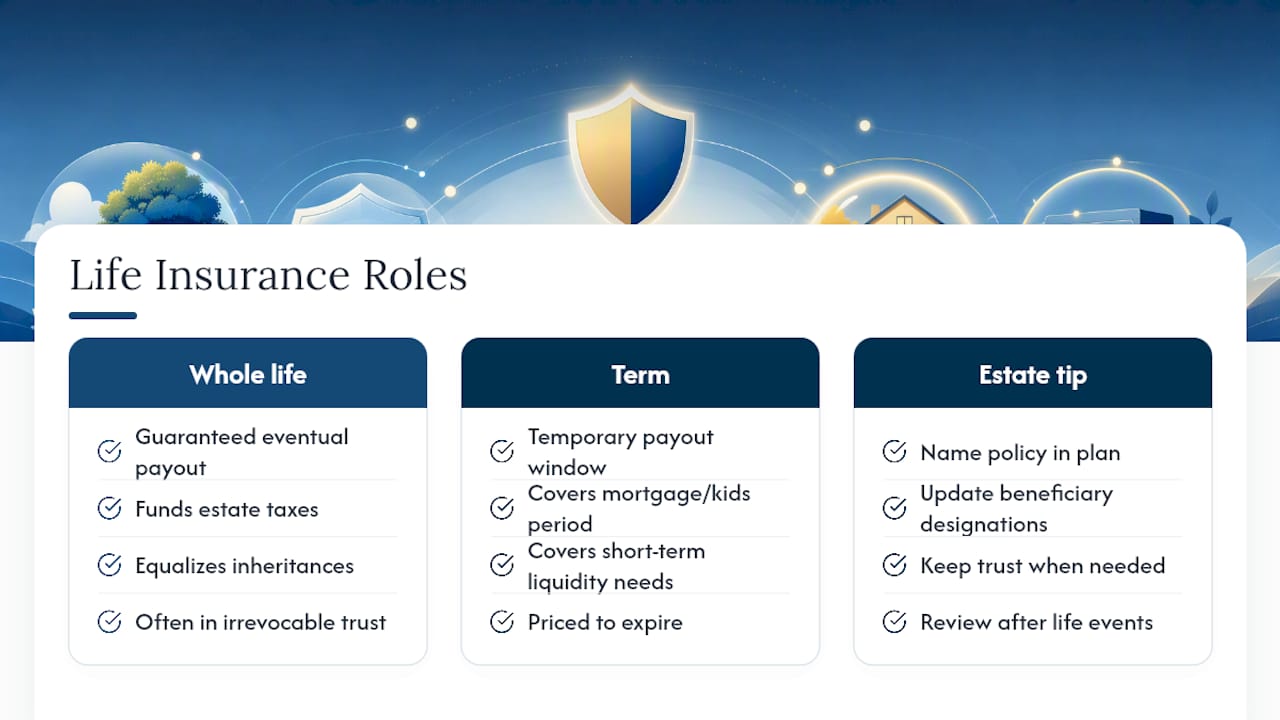
The bigger mistake usually isn’t picking the wrong policy type when considering term vs whole life. It’s leaving life insurance out of your estate plan or letting old beneficiary designations sit unchanged while your family changes. Our checklist of life insurance steps for Texas families covers what to review.
How Should You Compare Policies Before You Buy?
Comparing quotes without a checklist leads to comparing apples to oranges. Before you sit down with any agent, confirm these details for every policy:
- The coverage amount, and whether it meets your income-replacement or debt-payoff target.
- The term length, if it’s term, and whether it covers your longest obligation.
- Whether you can afford the premium for the full term, not just the first year.
- The insurer’s financial-strength rating and complaint history.
- For whole life, the guaranteed and non-guaranteed cash value columns in the illustration.
- Conversion rules and deadlines, if you might switch from term to permanent later.
- Riders and their cost: waiver of premium, return of premium, accelerated death benefit.
When you talk to an agent, ask direct questions. How is your commission different on this policy versus others? Did you compare this quote against other carriers, or only one company’s products? What exactly happens if I convert this term policy in year 12? A good agent will answer all three without hesitation.
Watch for red flags: vague cash value illustrations, pressure to buy whole life without ever seeing a term quote, or an agent who can’t show a Texas license. You can verify a license with the Texas Department of Insurance agent lookup.
Pro Tip: Working with an independent agent who compares multiple carriers removes the pressure to fit you into one insurer’s product when another carrier’s policy fits better.
Our Take: Buy for the Need You Actually Have
Most people who struggle with this decision are buying for the wrong time horizon. They buy permanent coverage for a temporary problem, or they buy too little term because a whole life quote scared them away from shopping altogether.
The usual advice stops at “term is cheap, whole life is expensive.” That’s true, but the more useful question is this: in what year does your need for coverage go away? If you can answer that, such as when the mortgage is paid off or when your youngest graduates, you’ve mostly answered the term vs whole life question yourself.
Whole life isn’t a bad product. For estate liquidity or a dependent who will always need support, it’s built for a need with no end date. For a 20-year income-replacement gap, term almost always makes more financial sense. Size your coverage correctly first. The dollar amount usually matters more than the policy type.
“The best independent insurance agents don’t just find you a policy. They find you the right insurance policy and then make sure it stays right as your life changes.” — Ron Hettler, CIC (Certified Insurance Counselor), Hettler Insurance Agency
How Hettler Insurance Agency Helps You Compare Term and Whole Life
Hettler Insurance Agency has served Lubbock and clients across Texas since 1992 and is licensed statewide. Ron Hettler, CIC (Certified Insurance Counselor), agency founder and president with 45+ years of insurance industry experience, and Meghan Harris, CIC, who co-leads the agency with Ron, help Texas families size their coverage and compare term and whole life quotes side by side. The agency carries a 4.5-star Google rating, an A+ BBB rating, and recognition from Three Best Rated® and Expertise.com.
Hettler Insurance Agency is one of the few family-owned agencies in Texas where both principals carry the high level certification of CIC (Certified Insurance Counselor). Fewer than 2% of licensed insurance professionals in the U.S. have earned the CIC designation.

As an independent agency working with 30+ top-rated carriers, Hettler Insurance Agency can show you real term and whole life pricing from several insurers, not just one company’s product. The review starts with your coverage target, your longest financial obligation, any employer coverage you already have, and whether a conversion option makes sense for you. We do not charge extra fees for ID cards or certificates of insurance. Ron calls it a fundamental customer service.
To get a life insurance quote, have your age, health history, tobacco status and a rough coverage target ready. Ten times your income is a common starting point. You can also read what life insurance covers for Texas families. Then call (806) 798-7800, visit 4720 S Loop 289, Lubbock, TX 79414, or start your quote at Hettler Insurance Agency. Get Better. Get Hettler.
This article provides general information and is not a substitute for advice from a licensed insurance professional. Life insurance premiums, cash values, conversion rules, riders and tax treatment vary by insurer, policy and personal circumstances. Review your options and consult a licensed insurance professional, and a tax professional for tax questions, before buying, changing or canceling coverage.
Sources
- AARP: Term vs. Whole Life Insurance and How to Choose
- Fidelity: How Much Does Life Insurance Cost in 2026?
- Fidelity: Term vs. Whole Life Insurance: What’s the Difference?
- NAIC: Life Insurance Consumer Guide
- NAIC Life Insurance Buyer’s Guide (Illinois Administrative Code copy)
- Cornell Law School LII: Term Life Insurance
- IRS: Life Insurance & Disability Insurance Proceeds
- IRS Publication 525: Taxable and Nontaxable Income
- Cornell LII: 26 U.S. Code § 7702A, Modified Endowment Contract Defined
- Cornell LII: 26 U.S. Code § 2035, Adjustments for Certain Gifts Made Within 3 Years of Death
- IRS: What’s New, Estate and Gift Tax
- Texas Department of Insurance: How to Find a Licensed Insurance Agent or Adjuster
Frequently Asked Questions ?
Q1 ?: What is the main difference between term vs whole life insurance?
Q2 ?: How much more does whole life cost than term?
Q3 ?: Can I convert a term life policy to whole life later?
Q4 ?: Is the life insurance death benefit taxable?
Q5 ?: What happens if I cancel a whole life policy early?
Recommended
- Term Life Insurance Guide for Texas Families 2026
- Term Life Insurance in Lubbock, TX | Affordable Texas Coverage
- Loan from Life Insurance: What Policy Owners Need to Know
- Life Insurance Paid by Employer: What Employees Need to Know
- Life Insurance Steps for Families in Texas
- How Much Life Insurance Should We Buy?
- Podcast Intro: Hettler Life Insurance Instant Quote Tool at GetLifePolicy.com
About the Author
Ronald J. Hettler, CIC is a Certified Insurance Counselor (CIC) [a gold-standard credential in the independent insurance industry that less than 2% earn]. Ron has over 46 years of real-world experience in the insurance industry. He is the owner/president of Hettler Insurance Agency in Lubbock, Texas and is licensed by the Texas Department of Insurance (License #666862). (Why Trust Hettler Insurance Agency? It’s a Local independent insurance agency representing multiple carriers. Hettler Insurance Agency has established business roots 100+ years going back to it’s predecessor in the late 1800’s. Local expertise in Lubbock Texas and West Texas risks. Focused on clarity before a claim occurs.) Ron and his daughter Meghan, also a CIC, lead a team that represents 30+ carriers and serves clients across Texas.
Ron specializes in helping individuals, families, and small business owners understand complex insurance concepts in clear, practical terms so they can make informed decisions about their coverage. He specializes in helping individuals and families understand coverage gaps, deductible structures, and real-world claim outcomes before a loss occurs. Ron helps you to understand how insurance policies respond in real-world claim situations.
License verification available through the Texas Department of Insurance.
— Life Insurance Instant Quote and Apply Tool @ GetLifePolicy.com > * Quick self-service term life insurance quote. With or without medical exam.
— Call us about Auto, Home, Business, Life, or Health insurance. * Click to Call (806) 798-7800, Mon-Fri 8:30am-5pm (lunch closed Noon-1pm)
— Come see us @ our new address 4720 S Loop 289 Lubbock, TX 79414 (maps link), or get your online quote started at https://GetHettler.com