
TL;DR summary:
- With home insurance myths debunked, the biggest surprises are clear: most standard Texas home policies do not cover flood, earthquake, continuous leaks, mold (unless caused by a covered loss), or sewer backup without an endorsement, and a landlord’s policy never covers a renter’s belongings. The gap that quietly costs homeowners the most is a dwelling limit that no longer matches today’s rebuild cost. Read your exclusions, get a contractor-based rebuild estimate, schedule your valuables, and review your policy with an independent agent who can compare multiple carriers.
What does your home insurance policy really cover in Lubbock or across Texas? With these home insurance myths debunked, you will know where the most common surprises hide. According to the Texas Department of Insurance (TDI), most home policies don’t cover floods, earthquakes, or a continuous water leak, and a renter is not protected by a landlord’s policy. According to Triple-I, about 1 in 18 insured homes has a claim each year, and wind and hail is the leading cause, followed by water damage and freezing. That means most homeowners go years without filing a claim, then face a loss with gaps they never knew existed.
Three actions to take today:
- Check your declarations page: confirm your dwelling coverage limit reflects what it would cost to rebuild, not what the home would sell for.
- Look for flood and earthquake exclusions in your policy’s exclusions section, then ask an independent agent to price a separate flood policy through FEMA’s National Flood Insurance Program or a private carrier, and an earthquake endorsement if you want one.
- Open your phone and record a room-by-room video of your belongings. Date it. Store it in the cloud.
Table of Contents
- Key Takeaways
- Home insurance myths debunked: the top 10 misconceptions
- How standard homeowners and renters policies actually work
- How to audit your policy right now
- What agents wish every homeowner knew
- The myth that actually costs homeowners the most
- Sources
- Frequently Asked Questions
Key Takeaways
Standard homeowners policies exclude floods, earthquakes, and gradual damage, and renters are never covered by a landlord’s policy, making a proactive policy review the single most important step any homeowner or renter can take.
| Point | Details |
|---|---|
| Floods and earthquakes are excluded | Most home policies require separate flood coverage or an earthquake endorsement; most flood policies have a 30-day waiting period. |
| Renters need their own policy | A landlord’s policy covers the building only, not tenant belongings or liability. |
| Dwelling limit vs. rebuild cost | Set your dwelling limit to the contractor rebuild cost, not the home’s sale price. |
| Claims affect rates and renewability | Pay small repairs out of pocket; reserve claims for significant losses. |
| Schedule valuables and add endorsements | Jewelry, sewer backup, foundation, and home business coverage typically require separate endorsements. |
Home insurance myths debunked: the top 10 misconceptions
These are the beliefs that cost homeowners and renters real money. Each one comes with the correction and the exact next step to close the gap.
1. “My policy covers floods.”
Flood is an excluded peril on most home policies. TDI states that most home policies don’t cover damage caused by floods, and that floods can happen anywhere: more than half of the homes flooded by Hurricane Harvey were outside designated flood zones. Flood coverage is handled through the NFIP or private flood carriers.
What to do: Contact an independent agent to price flood coverage. Most flood policies have a 30-day waiting period before taking effect, so do not wait until storm season. Learn more in Texas Flood Insurance Explained for Homeowners.
2. “My landlord’s insurance covers my belongings.”
A landlord’s policy covers the building structure, not a tenant’s personal property or liability. If a fire, theft, or burst pipe damages a renter’s furniture, clothing, or electronics, the landlord’s policy does not pay for those items.
What to do: Purchase a renters policy, which covers your personal property and personal liability. See What Is Renters Insurance? A Clear Guide for Renters.
3. “My policy covers earthquake damage.”
TDI lists earthquakes and earth movement among the damages most policies don’t cover, with earthquake coverage available as an endorsement. This is not just a California issue. A magnitude 5.4 earthquake struck West Texas in November 2022, the largest recorded in the state since 1995, and seismic activity in the Permian Basin has increased in recent years.
What to do: If you live in or near the Permian Basin, including Midland-Odessa, ask your agent whether an earthquake endorsement makes sense for your home.
4. “My policy covers everything inside my home.”
On many policies, including standard HO-3 forms, the structure is covered on an open-perils (all-risk) basis, while your belongings are covered on a named-perils basis, meaning only the events listed in the policy trigger a payout. Policy forms in Texas vary by company, so that broader protection on the house does not automatically extend to your belongings.
What to do: Read your personal property section carefully. Ask whether your contents are on a named-perils or open-perils form.
5. “My coverage is based on my home’s market value.”
Market value includes land and reflects buyer demand. Replacement cost reflects what it actually costs to rebuild your home today with current labor and materials. Relying on market value to set your dwelling limit is one of the most reliable paths to underinsurance. See Replacement Cost Coverage: What Every Homeowner Should Know.
What to do: Get a contractor-based rebuild estimate, not a real estate appraisal, and match your dwelling limit to that figure.
6. “Mold, pests, and gradual damage are covered.”
Insurance covers sudden, accidental losses from covered perils. TDI lists a continuous water leak among the damages most policies don’t cover and notes that policies won’t cover mold removal except to repair damage caused by a covered risk. Termite damage and general wear and tear are maintenance issues, not insured events.
What to do: Inspect your home regularly and address slow leaks and moisture problems early. Ask your agent about mold and foundation or slab endorsements, which TDI lists as optional coverages, especially important for slab-on-grade homes common across West Texas.
7. “Sewer backup is covered under my standard policy.”
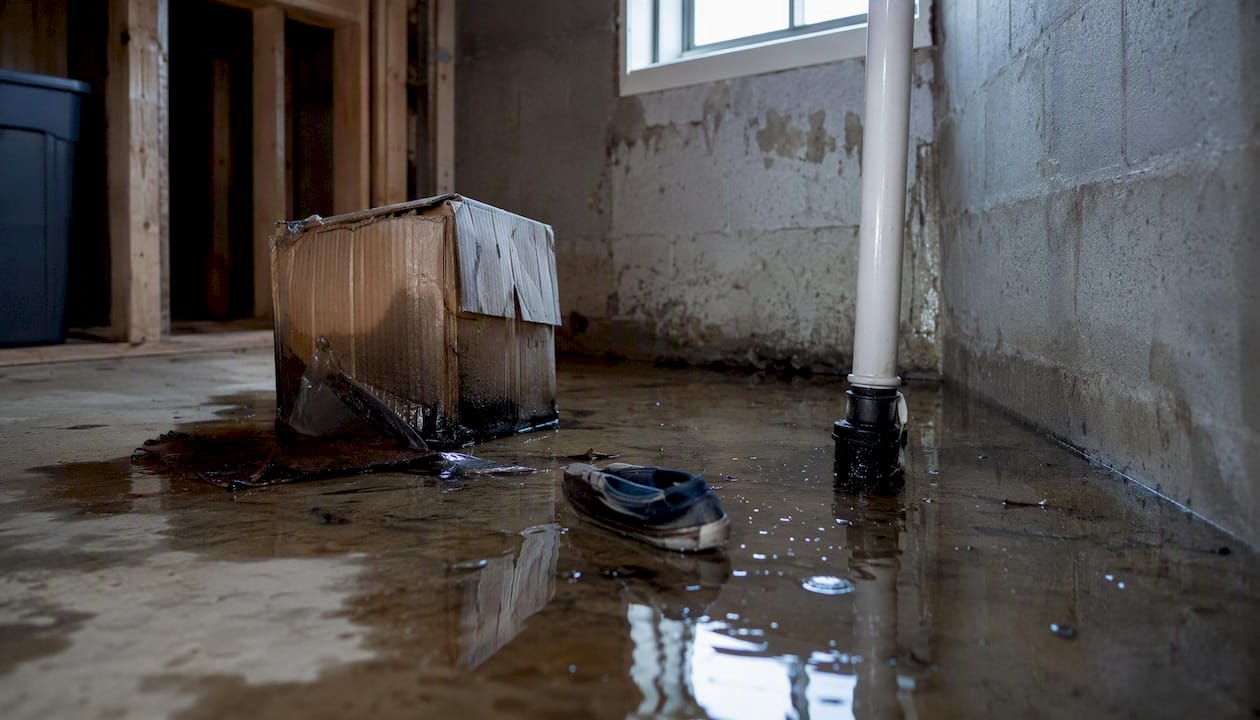
Standard policies typically exclude water that backs up through sewers or drains. This is separate from flood coverage, and TDI lists backup of sewers or drains as an available endorsement.
What to do: Ask your agent to add a sewer and drain backup endorsement. It is usually an affordable addition that covers a surprisingly common and expensive loss.
8. “Filing a small claim won’t affect my rates.”
Claims history directly influences premiums and renewability. A single claim can raise your rate at renewal, and multiple claims within a few years can make you harder to insure in the standard market. See also: why home insurance rates rise in Texas.
What to do: For repairs under or near your deductible, consider paying out of pocket. Reserve claims for significant losses.
9. “My home business and renovations are automatically covered.”
Running a business from home, adding a rental unit, or completing a major renovation changes your risk profile. Standard policies may not cover business equipment, business liability, or the increased rebuild cost of a renovation without an endorsement or policy update.
What to do: Notify your agent before starting a renovation or home-based business. A quick call can prevent a denied claim later.
10. “My collector car or boat is covered under my homeowners policy.”
State insurance regulators list the collector car in the garage as a common home insurance myth. Motor vehicles are generally excluded from homeowners policies, and coverage for boats or recreational vehicles stored on your property is limited, if any.
What to do: Ask your agent about a collector car policy, a watercraft policy, or a separate recreational vehicle policy.
Ready to check your own policy? A policy review with an independent agent can surface gaps you would never find on your own.
How standard homeowners and renters policies actually work
Understanding the structure of your policy is what makes the myths above make sense. Here are the core components found on a typical homeowners policy. Coverage labels and forms vary by company in Texas, so always check your own declarations page.
The standard coverage parts:
- Dwelling (Coverage A): Pays to repair or rebuild the structure of your home after a covered loss. On an HO-3 form, usually written on an open-perils basis, meaning it covers any peril not specifically excluded.
- Other structures (Coverage B): Covers detached structures such as fences, sheds, and detached garages.
- Personal property (Coverage C): Covers your belongings. Often written on a named-perils basis, meaning only the events listed in the policy are covered. TDI notes that home policies usually set this limit as a percentage of your dwelling coverage limit.
- Loss of use (Coverage D): Covers additional living expenses if your home is uninhabitable after a covered loss.
- Personal liability (Coverage E): Pays if someone is injured on your property or you are found legally responsible for damage to others. Does not cover intentional acts.
- Medical payments to others (Coverage F): Pays limited medical bills for guests injured on your property, regardless of fault.
Renters policies (HO-4) cover personal property and liability but not the building structure.
Replacement cost value (RCV) vs. actual cash value (ACV):
| Coverage type | How it pays | Practical impact |
|---|---|---|
| Replacement cost (RCV) | Pays to repair or replace at current prices | Higher premium, fuller recovery |
| Actual cash value (ACV) | Pays replacement cost minus depreciation | Lower premium, significant out-of-pocket gap on older items |
TDI’s own roof example shows the difference: on a 10-year-old roof, an ACV policy subtracts depreciation before paying, so the homeowner covers both the deductible and the depreciation. A replacement cost policy leaves the homeowner paying only the deductible. TDI advises, “To be fully protected, make sure your policy has replacement cost coverage.”
Common claim scenarios and which coverage responds:
- Burst pipe (sudden): Dwelling and personal property coverage typically respond. A continuous leak that causes mold does not.
- Wind or hail damage to roof: Dwelling coverage responds under most policies. Texas homeowners should confirm their wind/hail deductible, which is often a percentage of dwelling coverage rather than a flat dollar amount. See how percentage deductibles work on Texas homes.
- Flood from heavy rain: Excluded from standard policies. Requires NFIP or private flood coverage.
- Sewer backup: Excluded unless you have added the endorsement.
- Theft of jewelry: Covered only up to the policy’s special limit for jewelry. Anything above that requires a scheduled personal property endorsement.
How to audit your policy right now
You can do a meaningful policy review in under an hour. Work through these steps in order.
- Find your declarations page. This summary lists your coverage limits, deductibles, and endorsements. It is the fastest way to see what you have.
- Compare your dwelling limit to your rebuild cost. Your dwelling limit should reflect what it costs to rebuild your home today, not what it would sell for. If you have renovated, added square footage, or if local construction costs have risen, your limit may be outdated. Get a contractor-based estimate rather than relying on a real estate appraisal. See how much home insurance is enough.
- Check your deductibles. You may have a standard deductible and a separate wind/hail deductible. In Texas, the wind/hail deductible is often 1–2% of your dwelling coverage. On a home insured for $300,000, that means $3,000–$6,000 out of pocket before coverage kicks in.
- Read the exclusions section. This is where most coverage gaps live. Look specifically for flood, earthquake, sewer backup, mold, foundation, and business activity exclusions.
- Review your personal property limit and special limits. Confirm whether your contents are covered at RCV or ACV. Note any special limits on jewelry, electronics, firearms, or collectibles.
- Check your endorsements. Look for scheduled personal property, sewer backup, foundation, home business, and replacement cost endorsements. If they are not listed, you do not have them.
- Price flood and earthquake coverage. Even if you are not in a high-risk zone, flood damage can occur anywhere. NFIP policies are available through licensed agents, and private flood options may offer broader terms.
- Start or update your home inventory. A room-by-room video with a timestamp, stored in cloud backup, is one of the most useful documents you can have when filing a claim. A detailed digital inventory helps prove what you owned and can speed up the claims process.
Pro Tip: Before scheduling a renovation, ask your agent whether your dwelling limit needs to increase and whether you need builder’s risk coverage or a policy update during construction. Photos of your home’s condition before the work begins can also protect you in a dispute.
What agents wish every homeowner knew
Most coverage gaps are not the result of bad policies. They are the result of homeowners who never read the exclusions section. Insurance professionals consistently point to the same preventable mistakes.
Read the exclusions first. The insuring agreement tells you what is covered in broad terms. The exclusions tell you what is actually taken off the table. Most of the myths above live in the exclusions section.
Schedule high-value items. TDI notes that home policies limit what they’ll pay for things like jewelry and art. An engagement ring, a firearm collection, or fine art can easily exceed those limits. A scheduled personal property endorsement covers the appraised value and often covers mysterious disappearance, which a standard policy does not.
Keep records of renovations. A kitchen remodel or addition increases your rebuild cost. If your dwelling limit does not reflect that, you are self-insuring the difference. Document every major project with photos, receipts, and contractor invoices.
Understand how claims affect your long-term insurability. Weighing a small repair against filing a claim is not just about this year’s premium. Multiple claims in a short window can lead to nonrenewal, which may leave you with fewer carrier options at higher rates. Protecting your claims history is a long-term asset.
Consider an umbrella policy. A personal umbrella policy adds liability protection above your home and auto limits, often in increments of $1 million or more. If you have a pool, a trampoline, a dog, or significant assets to protect, it is worth a conversation. See Umbrella Liability Insurance in Lubbock, TX.
Work with a credentialed, independent agent. At Hettler Insurance Agency, Ron Hettler, CIC (Certified Insurance Counselor), agency founder and president with 45+ years of insurance industry experience, and Meghan Harris, CIC, who co-leads the agency with Ron, review policies line by line. The CIC designation is a nationally recognized and highly respected credential that requires five 16-hour courses, each with a proctored essay exam, plus 16 hours of update education every year. An independent agent who represents multiple carriers can also compare options across the market rather than steering you toward a single product.
The myth that actually costs homeowners the most
Most myth-busting articles focus on the dramatic exclusions: floods, earthquakes, sinkholes. Those matter. But the coverage gap that quietly costs homeowners the most money is far less dramatic: the gap between dwelling limit and actual rebuild cost.
Homeowners set their coverage limit once, at purchase, and rarely revisit it. Construction costs rise. Renovations add value. Local labor markets shift. If the cost to rebuild your home has climbed since you bought it and your policy limit has not moved, that gap is not covered by any endorsement. It is simply a loss the homeowner absorbs.
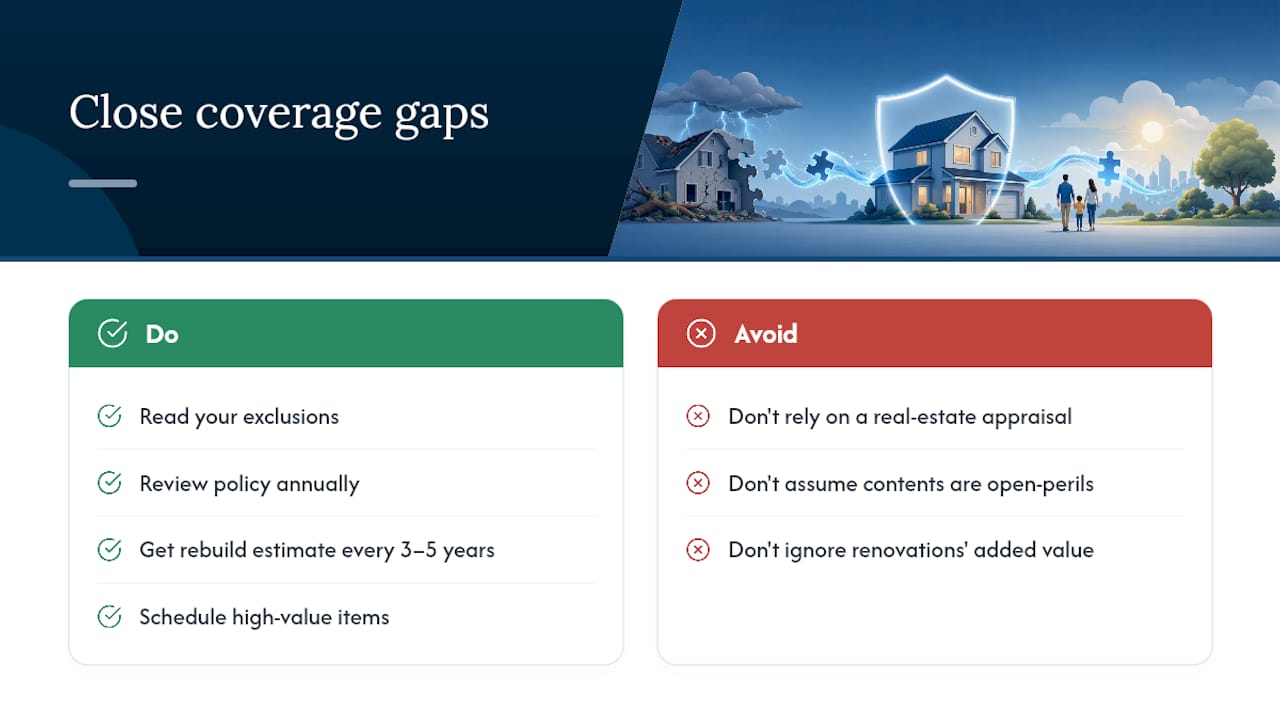
The conventional advice is to “review your policy annually.” That is correct but incomplete. The more specific instruction is to get a contractor-based rebuild estimate every three to five years, or immediately after any significant renovation, and adjust your dwelling limit to match. A real estate appraisal will not give you this number. A home sale comp will not give you this number. Only a rebuild estimate, factoring in current local labor and material costs, gives you the right figure.
The second thing most articles understate is the named-perils problem on personal property. Homeowners assume that because their structure is on an open-perils form, their belongings are too. On many policies, they are not. If your contents are covered on a named-perils basis and the cause of loss is not on the list, the claim is denied. That is not a technicality. It is a structural feature of the policy that requires you to read the personal property section specifically, not just the declarations page.
Read your exclusions. Get a rebuild estimate. Schedule your valuables. Those three steps close more coverage gaps than any other action you can take.

Protect your home with the right coverage, not just any coverage. Hettler Insurance Agency shops 30-plus carriers to find the policy that actually fits your home, your risk, and your budget, and serves Texans from Lubbock to Dallas to Midland-Odessa and all of Texas. Whether you need a policy review, a flood quote, or help scheduling high-value items, the team is ready to walk you through it. Hettler Insurance Agency is one of the few family-owned agencies in Texas where both principals carry the high level certification of CIC (Certified Insurance Counselor). Fewer than 2% of licensed insurance professionals in the U.S. have earned the CIC designation.
Contact Hettler Insurance Agency or call (806) 798-7800 for a no-pressure policy review.
This article provides general information and is not a substitute for advice from a licensed insurance professional. Coverage, exclusions, and endorsements vary by carrier and policy.
Sources
Use these sources to confirm coverage rules, program details, and Texas consumer information.
- Home Insurance Guide — Texas Department of Insurance
- Facts + Statistics: Homeowners and Renters Insurance — Triple-I
- National Flood Insurance Program — FEMA
- Top 10 Home Insurance Myths — Oregon Division of Financial Regulation
- Homeowners Insurance Facts and Statistics — MoneyGeek
- Texas Agency Investigating 5.4 Magnitude Earthquake in West Texas — The Texas Tribune
When to use each: Go to FEMA for flood program specifics. Use TDI for Texas coverage rules, complaints, and consumer rights. Use Triple-I for claim statistics. Consult a licensed independent agent for case-specific coverage questions.
Frequently Asked Questions ?
Q1 ?: Does a standard Texas home insurance policy cover flood damage?
Q2 ?: Does my landlord’s insurance cover my belongings as a renter?
Q3 ?: Should my dwelling coverage match my home’s market value?
Q4 ?: Are mold and sewer backup covered by homeowners insurance?
Q5 ?: Are my belongings covered the same way as my house?
Recommended
About the Author
Ronald J. Hettler, CIC is a Certified Insurance Counselor (CIC) [a gold-standard credential in the independent insurance industry that less than 2% earn]. Ron has over 46 years of real-world experience in the insurance industry. He is the owner/president of Hettler Insurance Agency in Lubbock, Texas and is licensed by the Texas Department of Insurance (License #666862). (Why Trust Hettler Insurance Agency? It’s a Local independent insurance agency representing multiple carriers. Hettler Insurance Agency has established business roots 100+ years going back to it’s predecessor in the late 1800’s. Local expertise in Lubbock Texas and West Texas risks. Focused on clarity before a claim occurs.) Ron and his daughter Meghan, also a CIC, lead a team that represents 30+ carriers and serves clients across Texas.
Ron specializes in helping individuals, families, and small business owners understand complex insurance concepts in clear, practical terms so they can make informed decisions about their coverage. He specializes in helping individuals and families understand coverage gaps, deductible structures, and real-world claim outcomes before a loss occurs. Ron helps you to understand how insurance policies respond in real-world claim situations.
License verification available through the Texas Department of Insurance.
— Life Insurance Instant Quote and Apply Tool @ GetLifePolicy.com > * Quick self-service term life insurance quote. With or without medical exam.
— Call us about Auto, Home, Business, Life, or Health insurance. * Click to Call (806) 798-7800, Mon-Fri 8:30am-5pm (lunch closed Noon-1pm)
— Come see us @ our new address 4720 S Loop 289 Lubbock, TX 79414 (maps link), or get your online quote started at https://GetHettler.com