

TL;DR summary:
- Replacement cost coverage pays to rebuild or replace damaged property at today’s prices with no depreciation deduction — the stronger financial protection compared to actual cash value (ACV) policies. Most homeowners policies default the DWELLING to replacement cost but leave PERSONAL PROPERTY on ACV unless you add an endorsement. Coverage limits must meet at least 80% of the home’s full replacement cost to avoid coinsurance penalties, and claims pay in two stages: ACV upfront, recoverable depreciation after documented repairs.
If your roof gets destroyed by hail tomorrow, will your insurance pay to REPLACE it — or just what it was worth after 20 years of West Texas sun? That single question is the difference between REPLACEMENT COST coverage and ACTUAL CASH VALUE (ACV). Most Texas homeowners assume they have the stronger of the two everywhere in their policy. Almost none of them actually do. Ron Hettler, CIC (Certified Insurance Counselor) walks through what replacement cost coverage actually is, how it pays out at claim time, and the two silent traps — the 80% coinsurance rule and the personal-property ACV default — that decide whether your policy is real protection or just paperwork.
Table of Contents
- Key Takeaways
- What is replacement cost coverage in home insurance?
- How replacement cost coverage differs from actual cash value
- How replacement cost coverage works in a real claim
- Advantages and disadvantages of replacement cost coverage
- Expert guidance from a certified insurance counselor
- Frequently Asked Questions
Key Takeaways
Replacement cost coverage pays to rebuild or replace damaged property at today’s prices with no depreciation deduction, making it the stronger financial protection compared to actual cash value policies.
| Point | Details |
|---|---|
| Replacement cost vs. ACV | Replacement cost pays full current-price value; ACV subtracts depreciation, often leaving a large funding gap. |
| Personal property default | Most policies cover belongings at ACV unless you add a replacement cost endorsement. |
| Two-payment claim process | Insurers pay ACV first, then release recoverable depreciation after you complete and document repairs. |
| 80% coinsurance rule | Your coverage limit must meet at least 80% of the home’s replacement cost to avoid claim penalties. |
| Annual review matters | Rising construction costs can erode your coverage adequacy over time; review limits every year. |
.
What is replacement cost coverage in home insurance?
Replacement cost coverage pays the full amount needed to repair or replace damaged property with new materials of like kind and quality at today’s prices, with no deduction for depreciation. That single distinction separates it from cheaper policy types that factor in age and wear before cutting you a check.
The insurance industry standard, as defined across property insurance contracts, holds that replacement cost means restoring what was lost with new property of comparable kind and quality. The National Association of Insurance Commissioners (NAIC) reinforces this definition, describing it as reimbursement at current market prices without depreciation deduction.
Here is what replacement cost coverage typically applies to:
- Dwelling structure: Most standard homeowners policies include replacement cost coverage for the home itself by default.
- Other structures: Detached garages, fences, and outbuildings usually fall under the same dwelling provision.
- Personal property: Furniture, electronics, and clothing often default to actual cash value unless you add a replacement cost endorsement.
- Built-in appliances: Typically covered under dwelling replacement cost when permanently installed.
One point worth keeping straight: replacement cost is not the same as your home’s market value. Replacement cost covers only rebuilding expenses, including materials and labor, while market value includes land and fluctuates with real estate conditions. Insuring to market value could leave you over or underinsured for what actually matters after a loss.

How replacement cost coverage differs from actual cash value
Actual cash value (ACV) is replacement cost minus depreciation. The older or more worn your property, the less an ACV policy pays. That gap can be significant, and in some cases, it leaves you with nothing at all.
The Texas Department of Insurance illustrates this clearly with a roof example. If it costs $10,000 to replace a roof:
- A replacement cost policy pays $10,000 minus your deductible, regardless of the roof’s age.
- An ACV policy pays based on the roof’s depreciated value, which drops sharply over time.
Source: Texas Department of Insurance
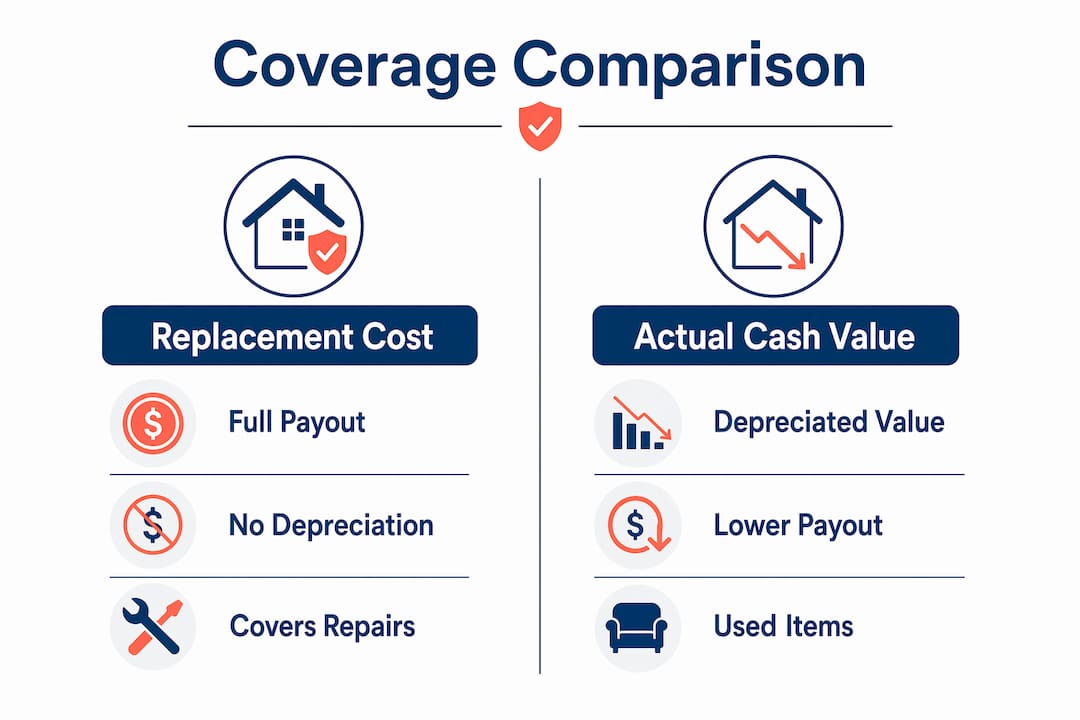
The 20-year-old roof scenario is the one that catches homeowners off guard. ACV may pay zero for items at the end of their useful life, leaving you to cover the full replacement out of pocket. That is not a hypothetical risk. It is a documented outcome for policyholders who chose the lower-premium option without understanding the tradeoff.
Key differences at a glance:
- Depreciation: ACV subtracts it; replacement cost does not.
- Payout size: Replacement cost pays more, especially on older property.
- Premium cost: ACV policies carry lower premiums.
- Personal property default: Most policies default personal belongings to ACV unless you upgrade.
- Financial risk after a major loss: ACV policies can leave a large funding gap; replacement cost policies do not.
Pro Tip: Check your declarations page right now. If your personal property section lists “ACV,” you are likely underinsured for electronics, appliances, and furniture. Adding a replacement cost endorsement for personal property typically costs only a few dollars more annually.
How replacement cost coverage works in a real claim
The claim process under a replacement cost policy usually unfolds in two stages, and understanding both prevents frustration after a loss.
- Initial payment: After your claim is approved, the insurer pays you the actual cash value of the damaged property minus your deductible. This gets money in your hands quickly.
- Recoverable depreciation payment: Once you complete repairs or replacement and submit receipts, the insurer releases the withheld depreciation amount. This second payment is called recoverable depreciation.
- Documentation: Keep all contractor invoices, purchase receipts, and photos. Insurers require proof of actual replacement before releasing the second payment.
- Deductible: Your deductible applies once, to the initial payment. It does not reduce the recoverable depreciation amount separately.
- Decision point: If you choose not to replace the damaged item, you keep only the initial ACV payment and forfeit the recoverable depreciation. The policy rewards actual replacement, not cash-outs.
The 80% coinsurance requirement is one of the most misunderstood elements of replacement cost policies. Many homeowners assume it means they only need to insure 80% of their home’s value. That is not how it works. Most policies require that your coverage limit equals at least 80% of the home’s full replacement cost. Fall below that threshold and your insurer may reduce your claim payout proportionally, even on a partial loss. Knowing how much home insurance is enough is a question worth answering before a storm hits, not after. You can explore that question in detail at Hettler Insurance Agency’s guide on adequate coverage limits.
Inflation and rising material costs also affect replacement cost calculations over time. A home insured adequately three years ago may be underinsured today if lumber, labor, or supply costs have risen. Reviewing your coverage limit annually is a straightforward way to stay protected.

Advantages and disadvantages of replacement cost coverage
Replacement cost coverage reduces the risk of major out-of-pocket expenses after a loss, but it is not the right fit for every situation. Here is an honest look at both sides.
Benefits:
- Full rebuilding coverage: You receive enough to restore your home with comparable materials at current prices, not a depreciated fraction of that cost.
- Protection against inflation: As construction costs rise, replacement cost coverage accounts for current labor and material prices rather than locking you into outdated valuations.
- Reduced out-of-pocket exposure: After a major loss, the gap between what you receive and what you spend is far smaller than with an ACV policy.
- Peace of mind on personal property: With a replacement cost endorsement added for belongings, a stolen laptop or fire-damaged furniture gets replaced at today’s retail price, not a fraction of it. Learn more about personal property coverage and when upgrading makes sense.
Drawbacks:
- Higher premiums: Replacement cost policies cost more than ACV policies. The tradeoff is real, though the premium difference is often modest relative to the coverage gap it closes.
- Two-payment claim process: Receiving the recoverable depreciation requires completing repairs and submitting documentation. That takes time and organization.
- Coinsurance risk: If your coverage limit falls below the required percentage of your home’s replacement cost, you may face a penalty on claims even with replacement cost coverage in place.
- Personal property upgrade is not automatic: The dwelling typically gets replacement cost by default, but your belongings do not. You must add an endorsement, or your furniture and electronics remain on ACV terms.
For most homeowners, especially those with newer homes or significant personal property, the benefits outweigh the higher premium. For a rental property with older fixtures or a vacation cabin with minimal contents, ACV may be a reasonable choice. The decision depends on the property’s age, your financial cushion, and how much risk you are willing to carry after a loss.
Expert guidance from a certified insurance counselor
Ron Hettler, a Certified Insurance Counselor (CIC) with over 40 years of experience, founded Hettler Insurance Agency in Lubbock, Texas, in 1992. His daughter Meghan, also CIC credentialed, leads the agency alongside him today. The CIC designation is the gold standard credential in the insurance industry, requiring ongoing education and demonstrated expertise across all lines of coverage.
That insight reflects a pattern that the Hettler Insurance Agency team sees regularly. Policyholders who assumed they had full replacement cost protection discover at claim time that only the dwelling qualified, while their furniture, appliances, and electronics were depreciated down to a fraction of their value.
“The best independent insurance agents don’t just find you a policy. They find you the right insurance policy and then make sure it stays right as your life changes.” — Ron Hettler, CIC (certified insurance counselor), Hettler Insurance Agency
Pro Tip: Ask your agent specifically whether your personal property is covered at replacement cost or actual cash value. If the answer is ACV, request a quote for the replacement cost endorsement. The annual cost difference is usually small, and the claim-time difference can be thousands of dollars.

Hettler Insurance represents over 30 top-rated carriers, which means the team can compare replacement cost policy structures across multiple insurers to find the right fit at the best price. That kind of independent comparison is something a single-carrier agent cannot offer. If you want to understand your current coverage or explore whether your limits meet the 80% coinsurance threshold, a conversation with a CIC-credentialed advisor is the most direct path to a clear answer.
Understanding how replacement cost differs from market value also matters when setting coverage limits. A free home valuation can help you establish a baseline, but your insurance coverage limit should reflect rebuilding costs, not sale price. Those two numbers often differ by a wide margin, particularly in markets where land value drives the listing price.
Recommended
About the Author
Ronald J. Hettler, CIC is a Certified Insurance Counselor (CIC) [the gold-standard credential in the independent insurance industry]. Ron has over 46 years of real-world experience in the insurance industry. He is the owner/president of Hettler Insurance Agency in Lubbock, Texas and is licensed by the Texas Department of Insurance (License #666862). (Why Trust Hettler Insurance Agency? It’s a Local independent insurance agency representing multiple carriers. Hettler Insurance Agency has established business roots going back to it’s predecessor in the late 1800’s. Local expertise in Lubbock Texas and West Texas risks. Focused on clarity before a claim occurs.) Ron and his daughter Meghan, also a CIC, lead a team that represents 30+ carriers and serves clients across Texas.
Ron specializes in helping individuals, families, and small business owners understand complex insurance concepts in clear, practical terms so they can make informed decisions about their coverage. He specializes in helping individuals and families understand coverage gaps, deductible structures, and real-world claim outcomes before a loss occurs. Ron helps you to understand how insurance policies respond in real-world claim situations.
License verification available through the Texas Department of Insurance.
Frequently Asked Questions ?
Q1 ?: What is replacement cost coverage in home insurance?
Q2 ?: How does replacement cost coverage differ from actual cash value?
Q3 ?: Is my personal property automatically on replacement cost?
Q4 ?: What is the 80% coinsurance rule?
Q5 ?: How does a replacement cost claim get paid?
— Life Insurance Instant Quote and Apply Tool @ GetLifePolicy.com > * Quick self-service term life insurance quote. With or without medical exam.
— Call us about Auto, Home, Business, Life, or Health insurance. * Click to Call (806) 798-7800, Mon-Fri 8:30am-5pm (lunch closed Noon-1pm)
— Come see us @ our new address 4720 S Loop 289 Lubbock, TX 79414 (maps link), or get your online quote started at https://GetHettler.com