
TL;DR summary:
- A homeowners policy is built for a house you live in. The Texas Department of Insurance (TDI) says most homeowners insurance won’t cover damage to a rental property, or it might limit what it pays.
- For a long-term lease, such as six months or a year, the Insurance Information Institute (Triple-I) says you’ll likely need a landlord or rental dwelling policy.
- A landlord policy covers the structure, items you leave on-site for tenant use, liability if a tenant or guest is hurt, and, on most policies, lost rental income after a covered loss.
- Neither a homeowners policy nor a landlord policy covers your tenant’s belongings. That’s what renters insurance is for, and your lease can require it.
- Call your agent before the first rent check. Ask whether you need a separate landlord policy or an endorsement, and get the answer in writing.
Landlord vs homeowners insurance comes down to one question: who lives in the house? Once a tenant moves in and you move out, the policy built for an owner-occupied home may no longer match the risk. This guide compares the two policies side by side, explains when Texas property owners should switch or add coverage, covers short-term rentals and vacancy between tenants, and lays out what to ask your agent before you hand over the keys. It draws on TDI and Triple-I consumer guidance.
Table of Contents
- Key Takeaways
- Landlord vs Homeowners Insurance: What Each Policy Covers
- When to Switch to a Landlord Policy
- Short-Term Rentals and Home Sharing
- Vacancy Between Tenants
- What Your Tenant Should Carry
- What Landlord Insurance Costs
- How to Switch Before You Collect Rent
- Our Take: The Phone Call Comes Before the Lease
- How Hettler Insurance Agency Helps Texas Landlords
- Sources
- Frequently Asked Questions
Key Takeaways
The switch from homeowners to landlord coverage is about timing as much as coverage. These are the points that matter most.
| Point | Details |
|---|---|
| Homeowners insurance is for the home you live in | TDI says most homeowners insurance won’t cover damage to a rental property, or it might limit what it pays. |
| Long-term leases need landlord coverage | Triple-I says a lease of six months or a year will likely need a landlord or rental dwelling policy. |
| Lost rent is a landlord coverage | Most landlord policies pay lost rental income for a set period while the property is repaired after a covered loss. |
| Tenant belongings need renters insurance | Your policy doesn’t cover your tenant’s things. Renters insurance isn’t required by Texas law, but your lease can require it. |
| Short-term rentals are a separate question | TDI says most policies won’t pay for damage or injuries during short-term rentals. Ask about an endorsement or a business policy. |
Landlord vs Homeowners Insurance: What Each Policy Covers
Both policies insure the house itself. The difference is who the rest of the policy is built around. A homeowners policy protects you, your belongings and your household in the home you live in. A landlord policy, sometimes called a rental dwelling policy, protects the building and your financial interest in it while someone else lives there.
TDI’s home insurance guide lists six coverages most Texas home policies include: dwelling, personal property, other structures, additional living expenses, personal liability and medical payments. The Triple-I guide to renting out your home explains how a landlord policy reshapes those pieces once the house is rented.
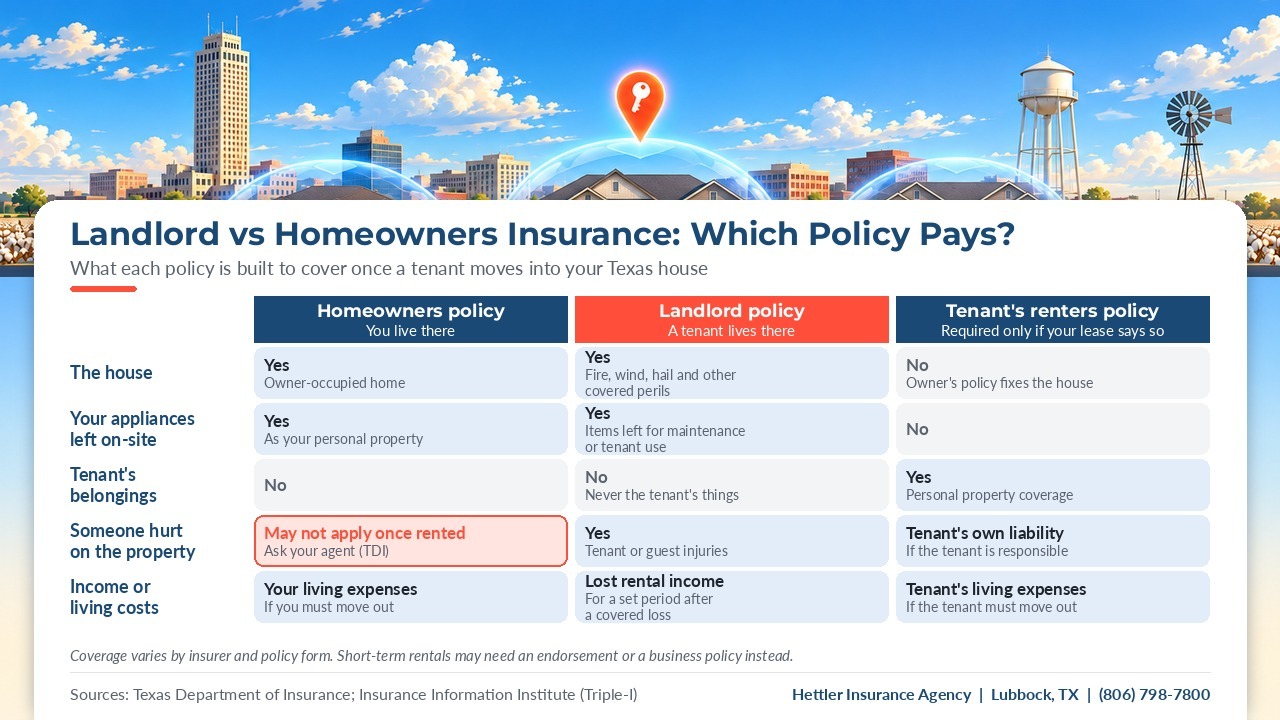
| Coverage | Homeowners policy (you live there) | Landlord policy (a tenant lives there) |
|---|---|---|
| The house | Dwelling coverage for damage from a covered peril | Damage to the structure from fire, lightning, wind, hail and other covered perils |
| Your belongings | Your furniture, clothing and other things you own | Only items you leave on-site for maintenance or tenant use, such as appliances or a lawnmower |
| Tenant’s belongings | Not covered | Not covered. The tenant needs renters insurance. |
| Liability | People you’re legally responsible for injuring, and damage to others’ property | Legal fees and medical expenses if a tenant or one of their guests gets hurt on the property |
| If the house can’t be lived in | Additional living expenses, such as rent and food, while you’re out of your home | Lost rental income for a specific period while the property is repaired or rebuilt after a covered loss (most policies) |
The homeowners column comes from TDI’s home insurance guide. The landlord column comes from Triple-I. Coverage details vary by insurer and policy form, so check your own declarations page and ask your agent. For more on the personal property side, see what personal property coverage includes on a Texas home.
Exclusions still apply. TDI lists wear and tear and earthquakes among the losses most Texas home policies don’t cover, and renters policies don’t cover floods. Flood coverage is a separate policy, so ask about it for any rental you own. Our Texas deductible guide explains how hail and flood deductibles work.
When to Switch to a Landlord Policy
The time to talk to your agent is before a tenant moves in, not after. TDI’s renting-out-your-home tips say homeowners insurance “probably won’t cover the costs if someone else gets hurt or causes damage on your property” when you rent it out, and that most homeowners insurance won’t cover damage to a rental property, or might limit what it pays.
How you rent the house shapes the answer:
- You move out and lease the whole house. Triple-I says a lease to one person, a couple or a family for six months or a year will likely need a landlord or rental dwelling policy. The same goes for a vacation home or investment property you rent out regularly.
- You rent out a room while you still live there. TDI suggests asking your agent or insurance company whether it makes sense to add landlord coverage to your homeowners policy or get a separate policy.
- You rent the house for a few weeks or weekends. That’s a short-term rental, which raises different questions. See the next section.
TDI also notes that a company may cancel a home policy in the first 60 days if it learns about a risk you didn’t tell it about. Telling your insurer the house will be rented isn’t just paperwork. It’s how you make sure the policy in force matches how the house is used. If you’re still shopping for coverage on a property, our guide to securing property insurance in Texas covers the steps.
Pro Tip: A phone call to “update” your policy isn’t the same as an endorsement or a new policy. Ask your agent to confirm in writing what changed, what the new policy covers, and the date it starts.
Short-Term Rentals and Home Sharing
Short-term rentals don’t fit neatly into either policy. TDI’s home insurance guide says most policies “won’t pay for damages or injuries that occur during short-term rentals,” and suggests asking your insurance agent whether you’re covered. TDI’s renting tips add that landlord insurance “is mainly for traditional, long-term leases, and may not be appropriate for short-term rentals.”
Triple-I describes two scenarios for renting your primary residence for a short time:
- Some insurers allow an occasional short-term rental if you notify them. Others require an endorsement, or rider, on your existing policy.
- If you rent your home for short periods on a regular basis to different guests, Triple-I says that’s a business. Standard homeowners policies don’t cover business activities in the home, so you’d need a business policy, such as a hotel or bed-and-breakfast policy.
TDI also notes that some home-share websites and apps offer coverage you can buy, and that renting out only a pool or storage area probably needs specific coverage. Before you list a property, ask your agent how your policy treats paying guests, and whether the platform’s coverage fills any gap.
If you furnish a rental with art, collectibles or other high-value items, ask your agent about scheduling them separately. Standard limits on certain kinds of property can fall short fast, as this collector’s guide to wine insurance shows for one specialty collection. Our guide to insuring valuables covers jewelry and collectibles.
Vacancy Between Tenants
A rental often sits empty between leases or during a make-ready. That matters. TDI lists losses that occur while a house is vacant for the number of days in your policy among the things most home policies don’t cover. TDI also says most companies stop coverage if a house is vacant for 60 days or more, though they usually don’t stop liability coverage.
If a turnover or repair will leave the property empty for long, tell your agent before it happens. Ask how many days your policy allows and what changes after that. For longer gaps, see our guide to vacant building insurance for Texas property owners.
What Your Tenant Should Carry
Your policy covers the building and your financial interest in it. Triple-I says your tenant’s personal possessions aren’t covered under your policy, and that many landlords require tenants to buy renters insurance before signing a lease.
TDI’s renters insurance tips say a renters policy typically includes three coverages:
- Personal property: the tenant’s belongings
- Additional living expenses: extra costs if the tenant has to move out for a short time after a covered loss
- Personal liability: protection if someone is injured in the tenant’s home, including legal costs if the tenant is liable
TDI says renters insurance isn’t required by law, but some landlords require it, and the average renters policy in Texas costs about $20 a month. If you require it, put it in the lease and ask for proof before move-in and at each renewal. Send tenants to our guide on what renters insurance is.
TDI also notes that renters insurance won’t pay to fix the house or apartment building. The building owner’s policy does that.
What Landlord Insurance Costs
Triple-I says landlord policies generally cost about 25 percent more than a standard homeowners policy, to pay for the added protections. Your own premium depends on the property, its location, the coverages and deductibles you choose, and the insurer.
TDI’s home insurance guide notes that each company uses its own rating guidelines and that prices for the same coverage can vary from company to company. When you compare landlord quotes, match the dwelling limit, liability limit, lost-rent coverage and wind and hail deductible line by line. For a closer look at the cost side, see landlord insurance rates in 2026.
How to Switch Before You Collect Rent
Work through these steps before the lease starts.
- Tell your agent how the house will be used. Say whether it’s a long-term lease, a room rental, or short-term stays, and when the tenant moves in.
- Ask which policy fits. Find out whether you need a separate landlord policy or an endorsement on your current policy.
- Confirm lost-rent coverage. Ask whether the policy pays lost rental income after a covered loss, and for how long.
- Check your liability limit. Make sure it covers injuries to tenants and their guests. Ask whether higher limits or an umbrella policy make sense.
- Ask about vacancy and flood. Find out how many vacant days the policy allows and whether you need separate flood coverage.
- Set your lease requirements. Decide whether to require renters insurance and proof of coverage before move-in.
- Get it in writing. Have the new policy or endorsement in hand, with its start date, before the first rent check.
Bring your current declarations page, the expected lease start date, and the monthly rent to the conversation. If you’re new to homeownership too, our Texas homeowners insurance guide for first-time buyers covers the basics.
Our Take: The Phone Call Comes Before the Lease
Most of the difference between landlord and homeowners insurance is easy to see on paper. The hard part is timing. A house that becomes a rental doesn’t change its policy on its own, and TDI’s own advice for anyone renting out a home is to talk to an agent or the insurance company first.
Make that call before you sign the lease. Then fine-tune limits, lost-rent coverage and deductibles with someone who can compare more than one company.
“The best independent insurance agents don’t just find you a policy. They find you the right insurance policy and then make sure it stays right as your life changes.” — Ron Hettler, CIC (Certified Insurance Counselor), Hettler Insurance Agency
How Hettler Insurance Agency Helps Texas Landlords
Hettler Insurance Agency has served Lubbock and clients across Texas since 1992 and is licensed statewide. Ron Hettler, CIC (Certified Insurance Counselor), agency founder and president with 45+ years of insurance industry experience, and Meghan Harris, CIC, who co-leads the agency with Ron, help Texas property owners decide when to switch from homeowners to landlord coverage and what the new policy should include. The agency carries a 4.5-star Google rating, an A+ BBB rating, and recognition from Three Best Rated® and Expertise.com.
Hettler Insurance Agency is one of the few family-owned agencies in Texas where both principals carry the high level certification of CIC (Certified Insurance Counselor). Fewer than 2% of licensed insurance professionals in the U.S. have earned the CIC designation.

As an independent agency working with 30+ top-rated carriers, Hettler Insurance Agency can compare how different insurers write landlord coverage, lost-rent limits and endorsements, instead of fitting you into one company’s terms. Learn more about our landlord protection coverage and why an independent agent matters. We do not charge extra fees for ID cards or certificates of insurance. Ron calls it a fundamental customer service.
For a review, have your current declarations page, your lease start date and your monthly rent ready. Then call (806) 798-7800, visit 4720 S Loop 289, Lubbock, TX 79414, or start your quote at Hettler Insurance Agency. Get Better. Get Hettler.
This article provides general information and is not a substitute for advice from a licensed insurance professional. Landlord, homeowners and renters coverage, exclusions, endorsements, vacancy provisions and limits vary by insurer and policy form. Review your own policy and consult a licensed insurance professional before you rent out a property or change coverage.
Sources
- Texas Department of Insurance: Renting Out Your Home? Check Your Insurance
- Texas Department of Insurance: Home Insurance Guide
- Texas Department of Insurance: Renters Insurance, What Does It Cover and How Much Does It Cost?
- Insurance Information Institute: Coverage for Renting Out Your Home
Frequently Asked Questions ?
Q1 ?: What is the difference between landlord and homeowners insurance?
Q2 ?: Does homeowners insurance cover a house I rent out in Texas?
Q3 ?: When do I need a landlord policy instead of an endorsement?
Q4 ?: Does landlord insurance cover my tenant’s belongings?
Q5 ?: Are short-term rentals covered by homeowners or landlord insurance?
Recommended
- Landlord Insurance Rates in 2026: What You’ll Pay
- Vacant Building Insurance for Texas Property Owners: What to Do Next
- What Is Renters Insurance? A Clear Guide for Renters
- How to Secure Property Insurance in Texas
- Texas Homeowners Insurance Guide: 5 Essential Facts
- 3 Common Homeowners Insurance Mistakes
About the Author
Ronald J. Hettler, CIC is a Certified Insurance Counselor (CIC) [a gold-standard credential in the independent insurance industry that less than 2% earn]. Ron has over 46 years of real-world experience in the insurance industry. He is the owner/president of Hettler Insurance Agency in Lubbock, Texas and is licensed by the Texas Department of Insurance (License #666862). (Why Trust Hettler Insurance Agency? It’s a Local independent insurance agency representing multiple carriers. Hettler Insurance Agency has established business roots 100+ years going back to it’s predecessor in the late 1800’s. Local expertise in Lubbock Texas and West Texas risks. Focused on clarity before a claim occurs.) Ron and his daughter Meghan, also a CIC, lead a team that represents 30+ carriers and serves clients across Texas.
Ron specializes in helping individuals, families, and small business owners understand complex insurance concepts in clear, practical terms so they can make informed decisions about their coverage. He specializes in helping individuals and families understand coverage gaps, deductible structures, and real-world claim outcomes before a loss occurs. Ron helps you to understand how insurance policies respond in real-world claim situations.
License verification available through the Texas Department of Insurance.
— Life Insurance Instant Quote and Apply Tool @ GetLifePolicy.com > * Quick self-service term life insurance quote. With or without medical exam.
— Call us about Auto, Home, Business, Life, or Health insurance. * Click to Call (806) 798-7800, Mon-Fri 8:30am-5pm (lunch closed Noon-1pm)
— Come see us @ our new address 4720 S Loop 289 Lubbock, TX 79414 (maps link), or get your online quote started at https://GetHettler.com