

TL;DR summary:
- A named storm deductible is a separate, usually higher deductible that applies when damage comes from a storm named by the National Weather Service, such as a tropical storm or hurricane.
- It’s usually a percentage of your home’s insured value, not of the claim. At 2%, a $350,000 home carries a $7,000 deductible. At 5%, a $500,000 home carries $25,000.
- The NAIC says percentage hurricane and named storm deductibles can run from 1% to as high as 15%, and Texas is one of the states that uses them.
- On the Texas coast, wind and hail coverage often comes from the Texas Windstorm Insurance Association (TWIA), with its own deductible. Flood and storm surge need a separate flood policy.
- You can’t buy TWIA coverage once a storm is in the Gulf, and most flood policies have a 30-day wait. Check your declarations page before hurricane season.
Named storm deductibles are easy to miss until a hurricane has a name and a path toward Texas. Your regular deductible might be $1,000 or $2,500, but a separate named storm deductible can be a percentage of your home’s insured value. On a $500,000 home, 5% is $25,000 before your insurer pays anything. This guide explains what a named storm deductible is, when it applies, how to turn the percentage into dollars, and how TWIA and flood coverage fit in, using guidance from the NAIC, the Texas Department of Insurance (TDI), the Office of Public Insurance Counsel (OPIC) and TWIA.
Table of Contents
- Key Takeaways
- What Is a Named Storm Deductible?
- When Does a Named Storm Deductible Apply?
- What a 2% or 5% Named Storm Deductible Could Cost You
- Named Storm vs Wind and Hail vs Flood Deductibles
- Coastal vs Inland Texas: Where TWIA Fits
- Check Your Policy Before Hurricane Season
- 5 Questions to Ask Your Agent About Your Named Storm Deductible
- Our Take: Know the Dollar Amount Before the Storm Has a Name
- How Hettler Insurance Agency Helps You Review Your Named Storm Deductible
- Sources
- Frequently Asked Questions
Key Takeaways
A named storm deductible can be the biggest out-of-pocket number in your policy. These are the points that matter most.
| Point | Details |
|---|---|
| A separate deductible | Named storm deductibles apply separately from your standard deductible and are typically higher, according to the NAIC. |
| Based on insured value | A percentage deductible is figured from your home’s insured value, not the amount of the claim. At 2%, a $350,000 home has a $7,000 deductible. |
| Triggered by a name | It typically applies when the National Weather Service officially names a storm. The exact trigger is set by your policy. |
| Flood is separate | Flood and storm surge damage are covered only by a separate flood policy, which has its own deductible. |
| Timing matters | TWIA can’t sell a policy once a hurricane is in the Gulf, and most flood policies have a 30-day wait. |
What Is a Named Storm Deductible?
A named storm deductible is the amount you pay before your insurer pays on damage caused by a named storm. The National Association of Insurance Commissioners (NAIC) says hurricane and named storm deductibles are applied separately from standard deductibles and are typically higher. As of June 2025, the NAIC counts 19 states and the District of Columbia with hurricane or named storm deductibles, and Texas is one of them.
These deductibles can be a fixed dollar amount, but the NAIC says they’re more commonly a percentage of the home’s insured value, from 1% to as high as 15%. The NAIC says they were first introduced in 1992 after Hurricane Andrew, as a way to share risk: the policyholder bears more of the risk without premiums rising to unaffordable levels.
What counts as a “named” storm? A named storm deductible applies to storms named by the National Weather Service or the National Hurricane Center, such as tropical storms and hurricanes, according to the NAIC. The National Hurricane Center says Atlantic storm names come from lists maintained by the World Meteorological Organization, and the lists rotate every six years.
How it differs from a hurricane deductible. Some policies use a hurricane deductible that applies only to hurricanes. A named storm deductible is broader because it can also apply to a named tropical storm. The NAIC notes that the triggers for these deductibles vary by state and by insurer, so the wording in your own policy is what counts.
When Does a Named Storm Deductible Apply?
Texas’s Office of Public Insurance Counsel (OPIC) says a named storm deductible is typically triggered when the National Weather Service officially names a storm. Beyond that, a few rules decide how much you actually pay.
- Your policy sets the trigger. The NAIC says triggers vary by state and insurer. Your deductible applies only if the conditions spelled out in your insurance contract are met, so read the definition in your policy or endorsement.
- It may apply once a season. OPIC says most deductibles apply per claim, but a named storm deductible may apply once a season. If two named storms damage your home in the same year, ask whether you’d pay the deductible once or twice.
- Usually only the largest deductible applies. When more than one deductible could apply to the same loss, OPIC says typically only the largest one applies. You don’t usually add your standard deductible on top of a named storm deductible.
- No contractor “deductible waivers.” OPIC warns that it’s illegal for a contractor to waive or absorb your deductible. If a roofer offers to “cover” it, walk away.
For more on how separate deductibles work on one policy, see our Texas insurance deductible guide.
What a 2% or 5% Named Storm Deductible Could Cost You
The percentage is the easy part to read and the hard part to picture. OPIC says a percentage deductible is based on your home’s insured value, not on the amount of the claim. The Texas Department of Insurance (TDI) puts it plainly: “If a policy has a deductible that’s a percentage, make sure you know how that translates to a dollar amount.”
The math is one step: multiply your dwelling limit by the deductible percentage.
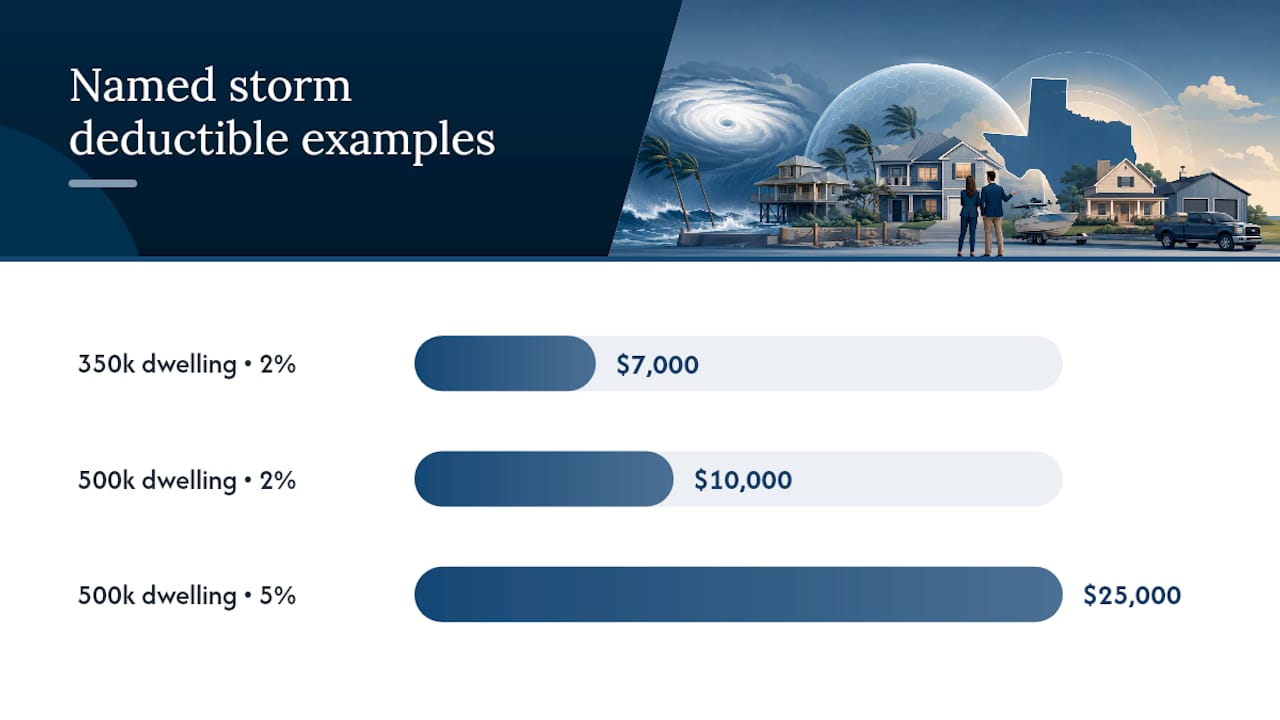
| Dwelling limit | Deductible | Math | You pay before coverage starts |
|---|---|---|---|
| $350,000 | 2% | $350,000 × 0.02 | $7,000 |
| $500,000 | 2% | $500,000 × 0.02 | $10,000 |
| $500,000 | 5% | $500,000 × 0.05 | $25,000 |
These are arithmetic examples, not quotes. Your own deductible depends on your policy, your carrier and the percentage you chose.
Why smaller claims can pay nothing. OPIC’s example uses a $200,000 home with $7,000 in storm damage. With a 1% deductible, you pay $2,000 and the company pays $5,000. With 3%, you pay $6,000 and the company pays $1,000. With 5%, the deductible is $10,000, so you pay the full $7,000 and the company pays nothing. A big percentage deductible can turn a real loss into an out-of-pocket repair.
Pro Tip: Write your named storm deductible in dollars on the front of your declarations page. If that number would strain your savings, ask your agent what a lower percentage would cost at renewal before you need it.
For more worked examples, see how percentage deductibles work on Texas homes.
Named Storm vs Wind and Hail vs Flood Deductibles
Texas homeowners can see three storm-related deductibles across their policies. They’re easy to mix up, but each one answers a different kind of damage.
| Feature | Named storm deductible | Wind and hail deductible | Flood deductible |
|---|---|---|---|
| When it applies | Damage from a storm named by the National Weather Service or National Hurricane Center | Damage from any wind or hail event, named or not | Flood and storm surge damage |
| Where it’s found | Homeowners or windstorm policy declarations page | Homeowners policy, or a TWIA or other windstorm policy on the coast | A separate NFIP or private flood policy |
| Typical form | Usually a percentage of insured value | A flat dollar amount or a percentage | Separate deductibles for building and contents |
| How often | May apply once a season | Usually per claim | Per flood claim |
The NAIC is clear on one point that surprises many homeowners: flood and storm surge are covered only by a separate flood policy, through the National Flood Insurance Program (NFIP) or a private insurer. FloodSmart, the NFIP’s consumer site, says NFIP policies cover up to $250,000 for the building and $100,000 for contents, with separate deductibles for each.
So after a hurricane, one house can face two deductibles: a wind deductible from the homeowners policy or the TWIA policy, and a flood deductible from the flood policy. If you live in West Texas, our guide to hail deductibles in Texas covers the deductible you’re most likely to use.
Coastal vs Inland Texas: Where TWIA Fits
Where you live in Texas changes which policy carries your storm deductible.
Inland Texas, including Lubbock. TDI’s windstorm insurance guide says that if you live anywhere in Texas except the coast, you probably have wind and hail coverage in your homeowners policy, “although you may have a different deductible.” For most Lubbock homeowners, that different deductible is a wind and hail deductible, and some policies also carry a named storm or hurricane deductible. Both show up on the declarations page.
The Texas coast. TDI says that along the coast, your homeowners policy might not cover wind and hail, so you’ll need a separate windstorm policy. The Texas Windstorm Insurance Association (TWIA) was created in 1971 and is the insurer of last resort for wind and hail coverage on the coast. According to TWIA’s eligibility rules, it covers all 14 first-tier coastal counties (Aransas, Brazoria, Calhoun, Cameron, Chambers, Galveston, Jefferson, Kenedy, Kleberg, Matagorda, Nueces, Refugio, San Patricio and Willacy) and parts of Harris County east of Highway 146, including La Porte, Morgan’s Point, Pasadena, Seabrook and Shore Acres. To qualify, you generally must have been turned down by at least one insurer, and the property needs a windstorm certificate of compliance (WPI-8).
A few TWIA points that affect your deductible:
- TWIA covers wind and hail only. It doesn’t provide flood coverage, so coastal homes usually need a separate flood policy, according to TWIA’s hurricane preparedness page.
- You choose the deductible when you buy. TWIA says the deductible is usually 1% to 2% of the policy limit, and if a loss is less than the deductible, no payment is made. TDI’s TWIA overview lists residential deductible options of $100, $250 or 1%, plus optional larger deductibles of 1.5%, 2%, 2.5%, 3%, 4% or 5%.
- Your lender may require it. Windstorm insurance isn’t required by Texas law, but TDI says that if you live near the coast and have a mortgage, your lender will likely require windstorm coverage. TDI also notes that many coastal Texans get that coverage from TWIA.
- You have one year to file. TDI says you have one year from the storm to file a TWIA claim.
Own a coastal home, a rental or a second place on the Gulf? It’s worth reading our guide to Texas windstorm insurance before your next renewal.
Check Your Policy Before Hurricane Season
TWIA’s hurricane preparedness page says Atlantic hurricane season runs from June 1 to November 30. The time to check your deductible is before a storm forms, because your options shrink once it does.
- Coverage freezes when a storm is in the Gulf. TWIA says most insurers, including TWIA, can’t sell a windstorm policy once a storm appears in the Gulf of Mexico. TDI’s home insurance guide says the same about TWIA.
- Flood coverage has a waiting period. FloodSmart says NFIP policies typically take 30 days to go into effect, with some exceptions.
- Find the deductible on your declarations page. OPIC says your deductibles are listed there. Look for named storm, hurricane, and wind and hail deductibles, and any endorsement that changes them.
- Keep copies where you can reach them. TWIA suggests keeping copies of your policy in a go-bag and emailing them to yourself.

A phone photo of your declarations page takes a minute and can save hours after a storm. TDI’s storm preparation tips also recommend a home inventory, with pictures or videos of each room, updated at least once a year. Our storm insurance essentials for Lubbock homeowners walks through the rest of the checklist.
5 Questions to Ask Your Agent About Your Named Storm Deductible
OPIC’s advice is simple: read your policy or talk to your agent. Bring these five questions to that conversation.
- Do I have a named storm, hurricane, or wind and hail deductible, and what is each one in dollars?
- What exactly triggers my named storm deductible, and does it apply once a season or per claim?
- If more than one deductible could apply to a loss, which one would I pay?
- What would it cost to lower my percentage at renewal, and what would I save by raising it?
- Do I need a TWIA or other windstorm policy, and do I have flood coverage in force before the 30-day wait matters?
Bring your declarations page, every endorsement, your latest renewal notice and your mortgage company’s insurance requirements. A regular policy review is the easiest place to fit these questions in.
Our Take: Know the Dollar Amount Before the Storm Has a Name
A named storm deductible isn’t a trick. The NAIC describes it as a risk-sharing tool: you carry more of the risk on the costliest storms so premiums don’t climb to unaffordable levels. The NAIC also notes that consumers often complain about a lack of meaningful disclosure. The problem is that most people think of it as “2%” instead of “$10,000,” and they find out the real number after the storm.
Turn the percentage into dollars now. Decide whether you could pay that amount from savings, and if not, ask what a lower deductible would cost. Then confirm flood coverage separately, because no wind or named storm deductible will help with rising water.
“The best independent insurance agents don’t just find you a policy. They find you the right insurance policy and then make sure it stays right as your life changes.” — Ron Hettler, CIC (Certified Insurance Counselor), Hettler Insurance Agency
How Hettler Insurance Agency Helps You Review Your Named Storm Deductible
Hettler Insurance Agency has served Lubbock and clients across Texas since 1992 and is licensed statewide. Ron Hettler, CIC (Certified Insurance Counselor), agency founder and president with 45+ years of insurance industry experience, and Meghan Harris, CIC, who co-leads the agency with Ron, help Texas homeowners read their deductibles, convert percentages into dollars, and compare options before storm season. The agency carries a 4.5-star Google rating, an A+ BBB rating, and recognition from Three Best Rated® and Expertise.com.
Hettler Insurance Agency is one of the few family-owned agencies in Texas where both principals carry the high level certification of CIC (Certified Insurance Counselor). Fewer than 2% of licensed insurance professionals in the U.S. have earned the CIC designation.

As an independent agency working with 30+ top-rated carriers, Hettler Insurance Agency can compare how different insurers set named storm, hurricane, and wind and hail deductibles, instead of fitting you into one company’s terms. Learn more about why an independent agent matters. We do not charge extra fees for ID cards or certificates of insurance. Ron calls it a fundamental customer service.
For a review, have your declarations page, any endorsements, your latest renewal notice and your lender’s insurance requirements ready. Then call (806) 798-7800, visit 4720 S Loop 289, Lubbock, TX 79414, or start your quote at Hettler Insurance Agency. Get Better. Get Hettler.
This article provides general information and is not a substitute for advice from a licensed insurance professional. Deductible types, triggers, percentages, eligibility rules, waiting periods and premiums vary by insurer, policy and property. Review your own policy and consult a licensed insurance professional before buying or changing coverage.
Sources
- NAIC: Hurricane Deductibles
- Texas Office of Public Insurance Counsel: Decoding Deductibles
- Texas Department of Insurance: Tips for Buying Home Insurance
- Texas Department of Insurance: What Is Windstorm Insurance?
- Texas Department of Insurance: Texas Windstorm Insurance Association Overview
- Texas Department of Insurance: Coastal Texans Can Turn to TWIA for Hail, Windstorm Coverage
- Texas Department of Insurance: Home Insurance Guide
- Texas Department of Insurance: Storm Preparation Tips
- Texas Windstorm Insurance Association: Overview
- Texas Windstorm Insurance Association: Coverage Eligibility
- Texas Windstorm Insurance Association: Hurricane Preparedness
- National Hurricane Center: Tropical Cyclone Naming
- FloodSmart (NFIP): Buy a Flood Insurance Policy
Frequently Asked Questions ?
Q1 ?: What is a named storm deductible in Texas?
Q2 ?: How do I calculate a 2% or 5% named storm deductible?
Q3 ?: When does a named storm deductible apply?
Q4 ?: Do I need TWIA, or does my homeowners policy cover wind?
Q5 ?: Does a named storm deductible cover flood or storm surge?
Recommended
- Texas Windstorm Insurance Explained: What Homeowners Need to Know
- How Percentage Deductibles Work on Texas Homes
- Texas Hail Deductibles Explained: 2026 Homeowner Guide
- Texas Insurance Deductible Guide: Protect Your Home and Budget
- Storm Insurance Essentials for Lubbock Homeowners
- Must-Have Home Insurance Endorsements: 7 Essential Add-Ons
- Replacement Cost vs ACV in Texas: 5 Questions to Ask Your Agent
About the Author
Ronald J. Hettler, CIC is a Certified Insurance Counselor (CIC) [a gold-standard credential in the independent insurance industry that less than 2% earn]. Ron has over 46 years of real-world experience in the insurance industry. He is the owner/president of Hettler Insurance Agency in Lubbock, Texas and is licensed by the Texas Department of Insurance (License #666862). (Why Trust Hettler Insurance Agency? It’s a Local independent insurance agency representing multiple carriers. Hettler Insurance Agency has established business roots 100+ years going back to it’s predecessor in the late 1800’s. Local expertise in Lubbock Texas and West Texas risks. Focused on clarity before a claim occurs.) Ron and his daughter Meghan, also a CIC, lead a team that represents 30+ carriers and serves clients across Texas.
Ron specializes in helping individuals, families, and small business owners understand complex insurance concepts in clear, practical terms so they can make informed decisions about their coverage. He specializes in helping individuals and families understand coverage gaps, deductible structures, and real-world claim outcomes before a loss occurs. Ron helps you to understand how insurance policies respond in real-world claim situations.
License verification available through the Texas Department of Insurance.
— Life Insurance Instant Quote and Apply Tool @ GetLifePolicy.com > * Quick self-service term life insurance quote. With or without medical exam.
— Call us about Auto, Home, Business, Life, or Health insurance. * Click to Call (806) 798-7800, Mon-Fri 8:30am-5pm (lunch closed Noon-1pm)
— Come see us @ our new address 4720 S Loop 289 Lubbock, TX 79414 (maps link), or get your online quote started at https://GetHettler.com