
TL;DR summary:
- Landlord insurance costs vary widely, primarily driven by location, property type, roof age, and coverage choices. Because premiums are set at the ZIP-code level and vary by individual property, the only reliable number is a live quote. Comparing multiple quotes through an independent agent ensures fair coverage and better value.
Landlord insurance premiums vary widely from one rental property to the next, and that spread is not random. Location, dwelling value, roof condition, deductible, and coverage endorsements drive most of the variation. Think about it: according to online sources, a property in a high-catastrophe state like Florida can cost roughly three times more to insure than a comparable home in a lower-risk state like Utah. Even within Texas, a home on the Gulf Coast typically carries a higher premium than a comparable home in the Panhandle.
A few things to know before you request a single quote:
- State matters more than most landlords expect. State averages vary widely, with some states at the lower end and others at the higher end of the spectrum, and two identical homes can quote very differently based on ZIP-level catastrophe exposure alone.
- Landlord policies cost more than homeowners policies. Landlord insurance generally costs more than comparable homeowners policies due to tenant turnover, vacancy periods, and higher liability exposure.
- Endorsements change the price. Adding loss-of-rents coverage, extended replacement cost, or water backup protection all move your premium, sometimes more than switching carriers entirely.
This guide covers how costs compare by property type and state, what a standard policy actually covers, the factors that move your premium the most, and a step-by-step checklist for comparing quotes side by side.
Table of Contents
- Key Takeaways
- What do landlord insurance rates look like by property type and state?
- What does a standard landlord policy actually cover?
- Why does your landlord insurance rate change?
- How do you get accurate quotes and compare them side by side?
- How can you lower your landlord insurance premiums without underinsuring?
- Three sample quote scenarios that show how rates vary
- Why an independent agent produces better landlord insurance quotes
- Get tailored landlord insurance quotes through Hettler Insurance Agency
- Useful sources and further reading
- Frequently Asked Questions
Key Takeaways
Landlord insurance premiums vary widely by property, and location, roof condition, and deductible choice can push your number well below or far above what a neighboring rental pays.
| Point | Details |
|---|---|
| What sets your rate | Premiums are priced at the ZIP-code level and vary by individual property. Published averages are a starting point; a live quote is the only reliable number. |
| Landlord vs. homeowners premium | According to online sources, landlord policies often cost about 15–25% more than comparable homeowners coverage due to vacancy and liability exposure. |
| Top three premium drivers | Location (ZIP-level risk), roof age and condition, and deductible level move premiums more than any other variables. |
| Deductible trade-off | A higher deductible can lower your premium, but it requires a cash reserve to cover the higher out-of-pocket cost when a claim hits. |
| Hettler Insurance Agency | Hettler Insurance Agency shops 30+ carriers as an independent agency, giving Texas landlords side-by-side quotes with verified like-for-like coverage. |
What do landlord insurance rates look like by property type and state?
Property type shapes your premium before any other variable enters the picture. A condo rental and a duplex carry fundamentally different risk profiles, and carriers price them accordingly. The table below shows how property types generally compare to one another. (For example purposes only)
| Property Type | Relative Cost to Insure | Key Driver |
|---|---|---|
| Condo rental (HO-6 style) | Lower | HOA master policy covers building shell |
| Single-family, low-risk inland | Lower to moderate | Standard dwelling exposure |
| Single-family, mid-market | Moderate | Age, location, and coverage limits |
| Duplex / small multi-unit | Moderate to higher | More units, more liability, higher rebuild cost |
| Older / coastal / high-risk | Highest | Catastrophe exposure, older systems, wind/hail |
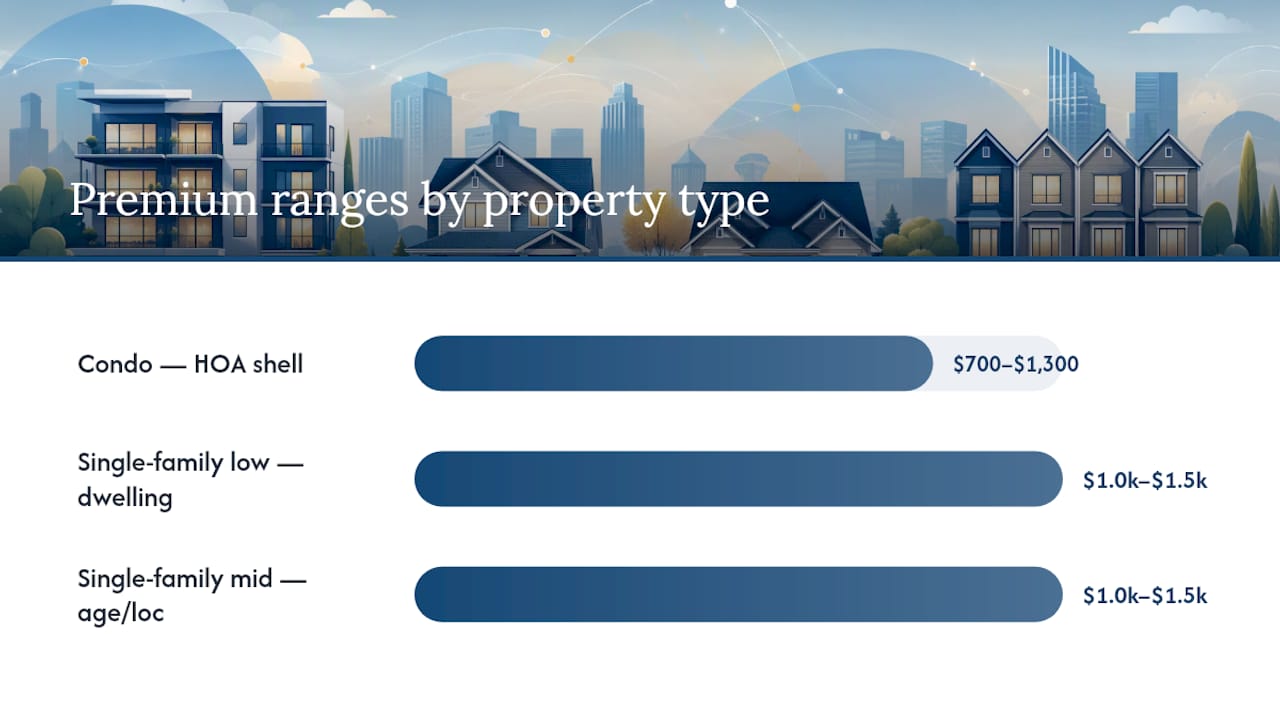
Condo rentals often fall at the lower end of the range because the HOA master policy covers the building shell, which reduces the dwelling exposure the individual owner must insure. What you are really covering is interior fixtures, personal property you supply (appliances, built-ins), and liability. Confirm exactly where your HOA master policy ends before you set your HO-6 dwelling limit — gaps between the two are a common and expensive surprise at claim time.
Short-term rentals often receive different underwriting treatment, with many standard landlord policies either excluding or heavily surcharging short-term occupancy. If you rent on a short-term platform, verify whether your policy covers that exposure before your first guest checks in.
State risk bands matter. Here is a quick reference for where states tend to fall, according to online sources:
- High-cost states: Florida, Louisiana, and Texas — driven by hurricane, wind, and hail exposure. Texas ranks among the higher-cost states overall, and Gulf Coast ZIP codes are typically the most expensive in the state.
- Mid-range states: Georgia, South Carolina, Oklahoma, and parts of the Midwest where severe weather is real but catastrophe frequency is lower.
- Lower-cost states: Oregon, Utah, Idaho, and much of the inland Northwest, where catastrophe risk and construction costs are both more moderate.
Year-over-year premium increases have been reported, reflecting construction cost inflation and catastrophe losses pushing premiums up across most states. Quotes you received 18 months ago are likely no longer accurate.
Pro Tip: Use state averages as a sanity check, not a budget number. Your actual premium is set at the ZIP code level. A ZIP in the Texas Panhandle and a ZIP on the Gulf Coast are both “Texas,” but they can produce quotes that differ by a wide margin on the same dwelling value.
What does a standard landlord policy actually cover?
Landlord insurance — formally written as a Dwelling Policy (DP-1 or DP-3, called TDP-1 and TDP-3 in Texas) rather than a homeowners HO-3 form — covers the property you own and rent to others. The distinction matters because a standard homeowners policy is not designed for tenant-occupied properties and can be voided if a carrier discovers the home is rented out.
Standard coverages on most landlord policies include:
- Dwelling coverage: Pays to repair or rebuild the structure after a covered loss. DP-3 (open-peril) is broader than DP-1 (named-peril) and is worth the modest premium difference for most landlords.
- Landlord liability: Covers bodily injury or property damage claims a tenant or visitor brings against you. Standard limits start at $100,000; most advisors recommend $300,000 or higher.
- Other structures: Covers detached garages, fences, and outbuildings on the property.
- Personal property (owner’s items): Covers appliances, tools, or furnishings you supply as the landlord — not the tenant’s belongings. Tenants need their own renters insurance for that.
Common endorsements that change your premium:
- Loss-of-rents: Typically a modest addition to your premium; pays lost rental income when a covered loss makes the unit uninhabitable.
- Building code / ordinance upgrade: Covers the added cost of bringing repairs up to current code — often required after a major loss on an older property.
- Extended replacement cost: Protects against rebuild costs that exceed your stated dwelling limit due to material or labor inflation.
- Water backup: Covers damage from backed-up drains or sump pump failure, which is excluded on most base policies.
- Umbrella liability: A separate policy that sits above your landlord liability limit, often at a relatively low cost for the added protection.
Loss-of-rents coverage only pays when a covered peril makes the unit uninhabitable. If your tenant moves out and the unit sits vacant between leases, that gap is not covered. Vacancy clauses in most policies also suspend certain coverages after 30–60 consecutive days of vacancy — read that section carefully before a long turnover period.
Flood insurance is a separate policy entirely. Standard landlord policies do not include flood coverage, and if your property sits in a FEMA-designated high-risk flood zone, a separate NFIP or private flood policy is required by most mortgage lenders. Price it separately; flood premiums are driven by flood zone designation and elevation, not by your landlord policy underwriting.
Why does your landlord insurance rate change?
Premium drivers fall into two categories: things you can control and things you cannot. Knowing which is which helps you focus your energy on the levers that actually move the number.
High-impact drivers (these move premiums the most):
- Location and ZIP-level catastrophe risk. Hurricane, tornado, hail, wildfire, and crime exposure are all priced at the address level. Two identical homes a few miles apart can carry very different premiums if one sits in a higher-risk flood or wind zone.
- Dwelling coverage limit. Your limit should reflect the full cost to rebuild the structure — labor, materials, and code upgrades — not the market value or purchase price. Basing your limit on rebuild cost rather than market value is the correct approach; underinsuring on rebuild cost is one of the most common and costly landlord mistakes.
- Roof age and condition. Carriers treat roofs over 15–20 years old as a significant risk factor. An older roof can trigger a surcharge, a reduced settlement basis (actual cash value instead of replacement cost), or a flat declination from some carriers. Roof age and condition are among the top cost drivers across virtually every carrier.
- Deductible level. According to online sources, raising your deductible from $1,000 to $2,500 may reduce premiums by roughly 10–20%, depending on the carrier and property profile. That can be a meaningful saving, but only if you hold the cash reserve to cover the higher out-of-pocket amount when a claim hits.
Medium-impact drivers:
- Property type and occupancy. Long-term single-family rentals are the most straightforward to underwrite. Multi-unit properties, short-term rentals, and properties with high tenant turnover all carry higher risk scores.
- Security measures. Deadbolts, monitored alarm systems, and fire suppression can produce modest discounts, depending on the carrier.
- Claims history. A prior water damage or fire claim on the property can trigger a surcharge or cause some carriers to decline coverage. Three or more claims in five years is a red flag in most underwriting guidelines.
- Age of major systems. HVAC, electrical panels (especially knob-and-tube or Federal Pacific), and plumbing (polybutylene pipe) all affect underwriting appetite and pricing.
Drivers that commonly surprise landlords:
Short-term rental usage, extended vacancy (beyond 30–60 days), and shifts in carrier appetite for your area can all affect your premium or your coverage terms without any obvious change to the property itself. Texas coastal markets, for example, have seen carrier pullbacks and wind/hail surcharges, and many coastal properties need separate windstorm coverage through the Texas Windstorm Insurance Association (TWIA) — factors that have nothing to do with the physical condition of a specific property.
Pro Tip: If your roof is approaching 15 years old, get a documented inspection before you shop for coverage. A clean inspection report with photos can prevent a carrier from automatically applying an actual-cash-value settlement basis to your roof — and that difference can be significant at claim time. Roof age and property condition directly affect how carriers price and settle claims.
How do you get accurate quotes and compare them side by side?
Getting three quotes and picking the lowest number is how landlords end up underinsured. The only way to compare price fairly is to force every quote to the same coverage terms first.
What to provide to every carrier or agent:
- Full property address (ZIP code is critical for catastrophe pricing)
- Construction type (frame, masonry, or mixed)
- Year built and roof age (material and year of last replacement)
- Desired dwelling limit (based on rebuild cost, not market value)
- Desired liability limit ($300,000 minimum is a reasonable starting point)
- Deductible preference ($1,000, $2,500, or wind/hail-specific deductible)
- Whether you want loss-of-rents coverage and at what limit
- Rental type (long-term, short-term, or mixed)
- Any recent claims on the property (last five years)
Quote comparison checklist — line these up before you compare price:
- Policy form: DP-3 (open-peril) vs. DP-1 (named-peril). These are not equivalent, and a lower DP-1 price is not a fair comparison to a DP-3 quote.
- Settlement basis: Replacement cost value (RCV) vs. actual cash value (ACV). ACV deducts depreciation; on a 15-year-old roof, the difference at claim time can be substantial.
- Dwelling limit: Confirm every quote uses the same rebuild-cost figure, not the market value.
- Liability limits: $100,000, $300,000, and $500,000 are common options — make sure every quote uses the same number.
- Loss-of-rents limit: Some carriers default to 10% of dwelling coverage; others offer 20% or a flat dollar amount. Confirm the limit and the trigger language.
- Named-peril vs. all-risk: Especially relevant for wind, hail, and water backup — check whether these are included, excluded, or available as endorsements.
- Deductible structure: Some carriers apply a separate wind/hail deductible, usually a percentage of the dwelling limit, on top of the base deductible. In Texas, that percentage can be higher than many landlords expect, which is a very different risk exposure than a flat $2,500 deductible.
Questions to ask when a quote looks unusually low or high:
- Is this a DP-1 or DP-3 form?
- Is the roof settled on replacement cost or actual cash value?
- Are there any underwriting surcharges applied, and if so, for what reason?
- What is the carrier’s claims-handling process for roof and water damage claims?
- Has the carrier filed for rate increases in this state in the past 12 months?
ZIP-level catastrophe exposure and carrier appetite explain most of the variation between quotes for the same building. A carrier that has taken heavy losses in a specific county may surcharge or decline that ZIP entirely, while a competitor with less exposure there prices it aggressively. That is why getting multiple quotes — especially through an independent agent who has access to several carriers — produces better results than going directly to one company.
How can you lower your landlord insurance premiums without underinsuring?
Reducing your premium is straightforward when you focus on the right levers. The goal is to lower cost without creating a coverage gap that costs you far more at claim time.
Proven ways to reduce your premium:
- Bundle with existing home and auto policies. Bundling a rental policy with personal lines at the same carrier often produces the most competitive rate for landlords who already carry personal coverage there. In Texas, bundling home and auto can save up to 26%, according to online sources — a discount that often extends to a landlord policy added to the same account.
- Raise your deductible. A higher deductible typically lowers your premium. The trade-off is real: you absorb more out-of-pocket cost on smaller claims.
- Update the roof and major systems. A new roof is the single most effective property improvement for lowering landlord premiums. Updated electrical panels and plumbing also reduce surcharges from carriers who penalize older systems.
- Add security measures. Monitored alarm systems, deadbolts, and exterior lighting produce modest discounts on most policies. They also reduce the likelihood of a claim, which protects your claims history.
- Require renters insurance in your lease. When tenants carry their own renters insurance, their policy becomes the first line of defense for their belongings and certain liability situations. This reduces the frequency of small claims against your landlord policy, which protects your claims history over time.
- Maintain a clean claims history. Avoid filing small claims you can absorb out of pocket. A single claim can trigger a surcharge at renewal; two or three can make you uninsurable with preferred carriers.
Trade-offs to understand before you act:
Raising your deductible saves money every year but requires you to hold a cash reserve equal to that deductible at all times. If you cannot cover a $2,500 repair out of pocket without financial strain, a lower deductible is the right choice even at higher cost. Similarly, removing endorsements like extended replacement cost saves premium dollars but can leave you exposed to a significant shortfall if construction costs spike after a major loss.
Pro Tip: Before raising your deductible, compare the yearly premium savings to the extra out-of-pocket cost you would take on, and only make the change if you can hold that difference in a dedicated reserve account.
Three sample quote scenarios that show how rates vary
Abstract ranges become clearer when you see how specific variables interact. The three scenarios below compare how each property’s risk profile affects its premium relative to the others — your actual quote will vary by carrier and address. (For example purposes only)
| Scenario | Location Risk | Roof Age | Dwelling Limit | Deductible | Endorsements | Relative Premium |
|---|---|---|---|---|---|---|
| A: Low-risk inland | Low (inland, low wind/hail exposure) | 5 years | Lower rebuild cost | $2,500 | None | Lowest |
| B: Mid-market | Average (moderate severe-weather exposure) | 15–20 years | Moderate rebuild cost | $1,000 | Loss-of-rents | Moderate |
| C: Coastal/high-wind | High (Texas Gulf Coast) | 8 years | Higher rebuild cost | Separate percentage-based wind/hail deductible | Loss-of-rents + extended replacement | Highest |
Scenario A is as clean as a landlord policy gets: low catastrophe exposure, a newer roof, a high deductible, and no endorsements. The property sits in an area with modest construction costs and limited storm exposure. That combination produces a premium near the bottom of the range.
Scenario B reflects the most common landlord situation. The roof is approaching the 15-year threshold where many carriers begin applying ACV settlement or surcharges. The $1,000 deductible adds cost compared to Scenario A, and the loss-of-rents endorsement adds a modest amount. The mid-range premium reflects average risk, not a problem property.
Scenario C shows what coastal exposure does to pricing. The dwelling limit is higher, the wind/hail deductible is separate and percentage-based, and two endorsements are added. The premium can be substantially higher than Scenario B despite a newer roof — because location and coverage limits are doing most of the work.
The single biggest price driver between these three scenarios is not the deductible or the endorsements — it is location. Moving Scenario A’s property to a Gulf Coast ZIP with the same roof and deductible would push the premium well above Scenario B before any endorsements are added. Location sets the floor; everything else adjusts from there.
Note: Landlord insurance premiums are generally deductible as a rental business expense. Confirm the treatment with your tax advisor for your specific situation.
Why an independent agent produces better landlord insurance quotes
Most landlords spend more than they need to on coverage — or carry the wrong coverage entirely — because they got one quote from one carrier and called it done. That is not a knock on any single company; it is just how single-carrier agents work. They have one set of rates and one underwriting appetite.
Ron Hettler, CIC (Certified Insurance Counselor), founded Hettler Insurance Agency in Lubbock, Texas, in 1992 with a straightforward premise: landlords and property owners deserve real options, not a take-it-or-leave-it price from a single carrier. With over 40 years of industry experience and the CIC credential — the gold standard in the profession — Ron built an agency that represents more than 30 top-rated carriers. His daughter Meghan Harris, also CIC credentialed, co-leads the agency with Ron and carries that same standard forward today. Hettler Insurance Agency is one of the few family-owned agencies in Texas where both principals carry the high-level certification of CIC (Certified Insurance Counselor). Fewer than 2% of licensed insurance professionals in the U.S. have earned the CIC designation.
What that means practically for a landlord shopping coverage: when you work with an independent agent, you get quotes from multiple carriers simultaneously. Quotes are all structured to the same dwelling limit, deductible, and endorsements. You see the actual spread in the market, not just one company’s number. An experienced agent also catches the details that change a quote’s real value — whether a carrier is applying ACV to your roof, whether a wind/hail deductible is percentage-based, and whether loss-of-rents language actually covers your rental scenario.
Hettler Insurance Agency holds an A+ BBB rating and has been recognized by both Three Best Rated® and Expertise.com as a leading insurance agency in Lubbock, Texas. That recognition reflects 30-plus years of client-first work, not a marketing campaign. For Texas landlords from Lubbock to Dallas to Midland-Odessa, the agency provides the kind of coverage review that a direct-to-carrier quote simply cannot replicate.
“The best independent insurance agents don’t just find you a policy. They find you the right insurance policy and then make sure it stays right as your life changes.” — Ron Hettler, CIC (Certified Insurance Counselor), Hettler Insurance Agency
Get tailored landlord insurance quotes through Hettler Insurance Agency
Texas landlords have a real advantage when they work with Hettler Insurance Agency: instead of one carrier’s rate, you get a side-by-side comparison across 30+ top-rated carriers, all quoted to the same coverage terms so the price difference is real, not a coverage gap in disguise.
Before you reach out, have these items ready: your property address, roof age and material, your target dwelling and liability limits, your preferred deductible, and any claims filed on the property in the last five years. That information lets the team structure accurate, comparable quotes from the first conversation — no back-and-forth, no surprises at binding.
Hettler Insurance Agency charges no extra fee for this service. The agency earns a commission from the carrier you choose, so the comparison costs you nothing. To get started, visit the landlord insurance page or reach out directly to the Lubbock office at (806) 798-7800.
Useful sources and further reading
The general trends and comparisons in this article draw from the following sources. Any percentages cited are suggestions according to online sources, not guarantees. For ZIP-level pricing, the only reliable number is a live quote from a carrier or independent agent — state and national averages are a starting point, not a budget.
- Insurance Information Institute — Coverage for Renting Out Your Home: The III’s overview of landlord policy basics, coverage types, and what a standard homeowners policy does and does not cover for rental properties.
- RentalRealEstate.com — 2026 Landlord Insurance Cost Data by State: State-by-state average premium data showing the full spread from Oregon to Florida.
- AllPropertyManagement — How Much Does Landlord Insurance Cost?: Year-over-year market trend data and practical guidance for property managers.
- Texas Department of Insurance — Home Insurance Guide: TDI’s consumer guide, including windstorm and hail coverage on the Texas Gulf Coast through TWIA.
For flood insurance pricing and zone lookup, start with FEMA’s Flood Map Service Center and then request a private flood quote alongside your landlord policy for comparison. An independent agent can run both simultaneously.
Frequently Asked Questions ?
Q1 ?: What factors affect landlord insurance rates the most?
Q2 ?: Why does landlord insurance cost more than homeowners insurance?
Q3 ?: What does a standard landlord insurance policy cover?
Q4 ?: Does landlord insurance cover lost rent or flood damage?
Q5 ?: How do I compare landlord insurance quotes accurately?
Recommended
About the Author
Ronald J. Hettler, CIC is a Certified Insurance Counselor (CIC) [a gold-standard credential in the independent insurance industry that less than 2% earn]. Ron has over 46 years of real-world experience in the insurance industry. He is the owner/president of Hettler Insurance Agency in Lubbock, Texas and is licensed by the Texas Department of Insurance (License #666862). (Why Trust Hettler Insurance Agency? It’s a Local independent insurance agency representing multiple carriers. Hettler Insurance Agency has established business roots 100+ years going back to it’s predecessor in the late 1800’s. Local expertise in Lubbock Texas and West Texas risks. Focused on clarity before a claim occurs.) Ron and his daughter Meghan, also a CIC, lead a team that represents 30+ carriers and serves clients across Texas.
Ron specializes in helping individuals, families, and small business owners understand complex insurance concepts in clear, practical terms so they can make informed decisions about their coverage. He specializes in helping individuals and families understand coverage gaps, deductible structures, and real-world claim outcomes before a loss occurs. Ron helps you to understand how insurance policies respond in real-world claim situations.
License verification available through the Texas Department of Insurance.
— Life Insurance Instant Quote and Apply Tool @ GetLifePolicy.com > * Quick self-service term life insurance quote. With or without medical exam.
— Call us about Auto, Home, Business, Life, or Health insurance. * Click to Call (806) 798-7800, Mon-Fri 8:30am-5pm (lunch closed Noon-1pm)
— Come see us @ our new address 4720 S Loop 289 Lubbock, TX 79414 (maps link), or get your online quote started at https://GetHettler.com