
TL;DR summary:
- General liability covers bodily injury, property damage, and personal and advertising injury caused by your business operations.
- Professional liability, also called errors and omissions (E&O), covers claims that your advice or service caused a client financial harm.
- General liability doesn’t cover professional mistakes, and a business owners policy (BOP) doesn’t include professional liability.
- Most E&O policies are claims-made, so retroactive dates and tail coverage matter when you switch insurers or close.
- Businesses that do hands-on work and give paid advice, like IT firms, engineers and home inspectors, often need both.
General vs professional liability comes down to what kind of harm someone says you caused. General liability responds when your business physically hurts someone or damages their property. Professional liability, also called errors and omissions (E&O), responds when a client says your advice or work cost them money. A Lubbock retail shop mostly needs the first, and a bookkeeper mostly needs the second. Plenty of Texas businesses, especially those that mix hands-on work with paid expertise, need both.
Table of Contents
- Key Takeaways
- General vs Professional Liability: The Quick Comparison
- How General Liability Works
- How Professional Liability (E&O) Works
- Which Policy Pays? One IT Firm, Five Claims
- Who Needs General Liability, Professional Liability or Both?
- When Texas Rules Require E&O Coverage
- Claims-Made Coverage, Retroactive Dates and Tail Coverage
- Can a BOP Cover Both?
- What Drives the Cost of Each Policy?
- 5 Questions to Ask Before You Buy
- Our Take: Match the Policy to the Claim
- How Hettler Insurance Agency Helps You Compare General and Professional Liability
- Sources
- Frequently Asked Questions
Key Takeaways
General liability and professional liability sound alike, but they answer different claims. These are the points that matter most.
| Point | Details |
|---|---|
| General liability | Covers bodily injury, property damage, and personal and advertising injury from your premises, operations, products or completed work. |
| Professional liability (E&O) | Covers claims of negligence, errors, misrepresentation or inaccurate advice that cause a client financial loss. |
| They don’t overlap | General liability doesn’t cover professional mistakes, and a BOP doesn’t include professional liability. |
| Claims-made timing | Most E&O policies are claims-made. Retroactive dates and tail coverage decide whether past work stays covered. |
| Some Texas licenses require E&O | TREC requires licensed inspectors to carry professional liability insurance, and contracts often require it too. |
General vs Professional Liability: The Quick Comparison
Both policies protect you from claims by other people, called third parties. The difference is the type of harm. The U.S. Small Business Administration describes general liability as protection against “bodily injury, property damage, medical expenses, libel, slander, defending lawsuits, and settlement bonds or judgments,” and professional liability as protection against “malpractice, errors, and negligence.”
| Feature | General liability | Professional liability (E&O) |
|---|---|---|
| Covers claims of | Bodily injury, property damage, and personal and advertising injury | Negligence, errors, omissions, misrepresentation and inaccurate advice |
| Typical harm | Physical: an injury, broken property, or a slander or false advertising claim | Financial: lost money from a mistake in your professional work |
| Example | A customer slips on a wet floor in your shop | A missed filing deadline costs a client penalties |
| Policy trigger | Can be written on an occurrence or claims-made basis | Usually claims-made, with a retroactive date |
| Included in a BOP? | Yes, a BOP bundles general liability with property coverage | No, it’s a separate policy or an endorsement on some package policies |
| Who needs it most | Businesses with customers, job sites, products or leased space | Businesses paid for advice, designs, inspections or expertise |
How General Liability Works
Commercial general liability (CGL) insurance “protects business owners against claims of liability for bodily injury, property damage, and personal and advertising injury (slander and false advertising),” according to the Texas Department of Insurance (TDI). TDI breaks it into two main parts:
- Premises and operations. Injury or damage that happens on your premises or because of your business operations, like a customer who trips over a cord in your Lubbock showroom.
- Products and completed operations. Injury or damage that happens away from your premises and is caused by your products or finished work, like a shelf you installed that later falls on someone.
General liability also has limits that surprise business owners. TDI lists several standard exclusions:
- Damage to your own work or your own product
- Liability you take on by contract, with exceptions for “insured contracts”
- The cost to recall faulty products or work
- Workers’ compensation and employer’s liability
Landlords and general contractors often ask for proof of general liability before you move in or start a job, and many want to be named as an additional insured. For a deeper look, see our Texas small business guide to general liability.
How Professional Liability (E&O) Works
Professional liability covers the financial fallout from your professional judgment. The Insurance Information Institute (Triple-I) says claims “not covered by general liability insurance that are covered by professional liability insurance include negligence, misrepresentation, violation of good faith and fair dealing, and inaccurate advice.” It pays the cost of legal defense and judgments against you, up to the policy limit.
Three examples show the kind of claim it’s built for:
- A bookkeeper misses a filing deadline, and the client is charged penalties.
- An engineer’s design error forces a costly rebuild.
- A home inspector misses a visible defect, and the buyer sues over the repair bill.
None of these involve a physical injury caused by your operations. They’re claims that your work fell short and cost someone money. Triple-I also notes that professional liability generally doesn’t extend to non-financial losses or to losses caused by intentional or dishonest acts, and that policies generally carry a deductible from $1,000 to $25,000.
Insurers write many specialized professional liability forms for different professions, so a policy built for accountants won’t read like one built for IT consultants. Our guide to professional liability coverage types walks through the main options.
Which Policy Pays? One IT Firm, Five Claims
The messiest cases come from businesses that do physical work and give professional advice under one roof. Picture a Lubbock IT firm that installs servers and configures the software running on them.
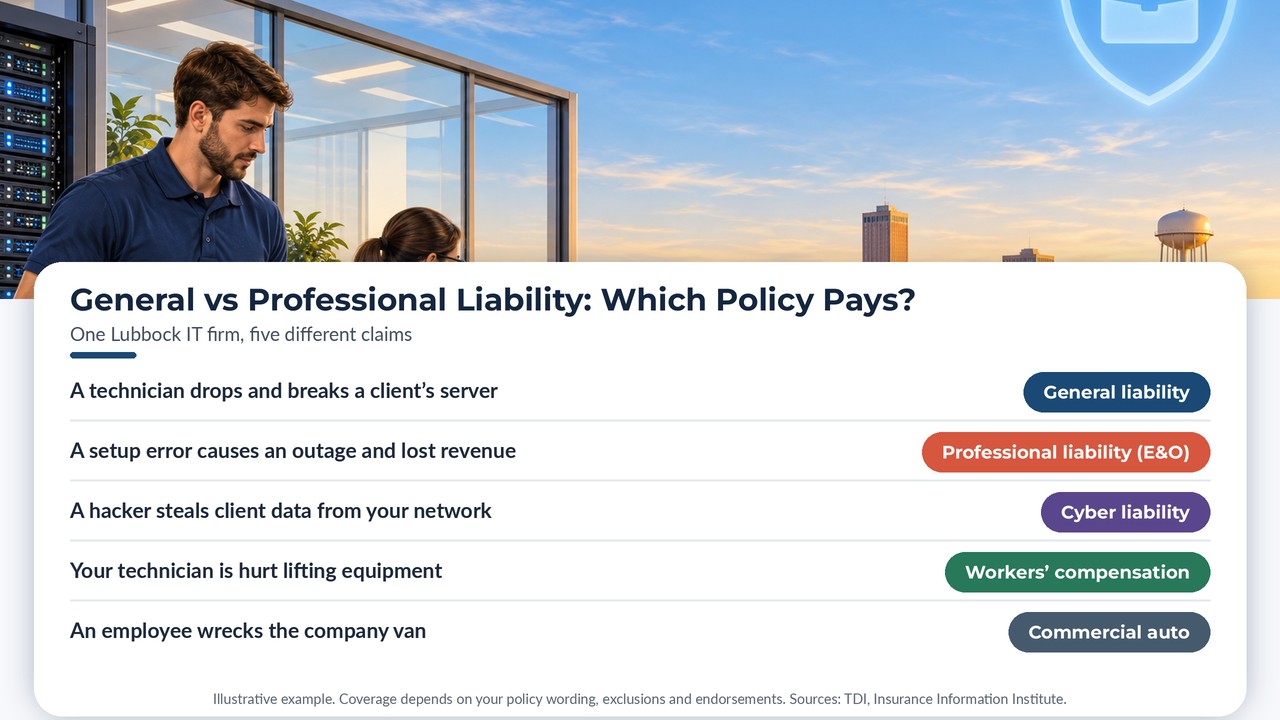
- A technician drops a client’s server. Damage to the client’s existing property is a general liability claim.
- A setup error causes an outage and lost revenue. That’s financial harm from professional work, so it goes to professional liability.
- A hacker steals client data. Data breaches usually need a separate cyber policy. See whether ransomware insurance coverage actually pays out.
- A technician is hurt on the job. TDI says CGL policies aren’t intended to cover workers’ compensation or employer’s liability. In Texas, private employers can choose whether to carry workers’ compensation, but it is not required in most cases.
- An employee wrecks the company van. Business vehicles need commercial auto coverage, and rented or personal cars used for work may need hired and non-owned auto coverage.
Same client, same week, five different policies. That’s why the question isn’t which liability policy is better. It’s which claims your business can realistically face.
Who Needs General Liability, Professional Liability or Both?
Start with three questions:
- Do customers, vendors or the public come to your location or job sites?
- Do clients pay you for advice, designs, inspections or other expertise?
- Do your contracts, leases or licenses require a specific policy?
A “yes” to the first points to general liability. A “yes” to the second points to professional liability. A “yes” to both usually means you need both. Here’s how that tends to play out by business type:
- Retail shops and restaurants usually start with general liability, since foot traffic and products are the main risks.
- Contractors and trades need general liability and often can’t bid without a certificate of insurance.
- Accountants, consultants and marketing firms usually make professional liability their core policy.
- Engineers, architects, IT firms and home inspectors often need both, since they visit sites and sell expertise.
- Healthcare practices typically need both general liability and malpractice coverage, which Triple-I describes as a special type of professional liability.
When Texas Rules Require E&O Coverage
Texas doesn’t require most businesses to carry professional liability, but some licenses do. Triple-I notes that in some states professional liability is required, especially for attorneys and doctors. Two Texas examples come from the Texas Real Estate Commission (TREC) rules:
- Home inspectors. TREC must receive proof of professional liability insurance before it issues an inspector license, and inspectors must keep coverage while the license is active. TREC’s inspector licensing page says the certificate is filed when the license is issued and with each renewal.
- Real estate brokerages. When the designated broker owns less than 10% of the business entity, TREC requires the entity to maintain E&O insurance with a minimum annual limit of $1 million per occurrence.
Contracts are the other big driver. Clients, government agencies and larger companies often require E&O with specific limits before they’ll sign. Read the insurance section of every contract and lease, and share it with your agent before you buy.
Claims-Made Coverage, Retroactive Dates and Tail Coverage
Triple-I says most professional liability policies are claims-made, meaning the policy must be in effect both when the event took place and when the claim is filed. That timing creates gaps if you aren’t careful. The TDI liability guide explains the two fixes:
- Prior acts (“nose”) coverage uses a retroactive date to cover work done before the policy began. The retroactive date usually appears on your declarations page and may be the policy’s start date or earlier.
- Tail coverage, also called an extended reporting period, covers claims made after a policy expires. TDI says a typical claims-made policy gives you only 30 or 60 days after it ends to report claims, and purchased tails may run one, three or five years, or be unlimited.
If a claims-made policy expires, cancels or nonrenews, TDI says to buy either tail coverage from your old insurer or prior acts coverage from your new one. Keep the same retroactive date when you switch carriers, and never let coverage lapse. Our guide to claims-made vs occurrence policies covers this in more detail.
Pro Tip: Before you sign a new E&O policy, put your old and new declarations pages side by side. If the new retroactive date is later than the old one, work you did in between may not be covered.
Can a BOP Cover Both?
Not by itself. A business owners policy (BOP) bundles general liability with commercial property coverage, which makes it a good fit for many small shops and offices. But Triple-I’s small business guide says a BOP does not cover professional liability, auto insurance or workers’ compensation, and its professional liability guide adds that professional liability isn’t provided under homeowners endorsements, in-home business policies or BOPs.
That leaves two common setups:
- BOP plus standalone E&O, which suits most small professional firms with an office.
- A commercial package policy (CPP), where Triple-I says professional liability may be added by endorsement.
What Drives the Cost of Each Policy?
Neither policy has a one-size price. Triple-I says the amount of professional liability you need, and what it costs, depends on the size of your business and the level of risk it poses. General liability pricing also depends on the type of work you do and how much risk it carries, along with the limits and deductible you choose.
A few levers you control:
- Limits. TDI suggests reviewing your limits as your business grows, and an umbrella or excess policy can add more above general liability.
- Deductible. TDI notes that a higher deductible may help reduce your premium.
- Accurate class codes. Describing your work correctly avoids paying for the wrong risk, or finding a gap after a claim.
For Texas general liability price ranges by industry, see our guide to Texas general liability insurance cost. For professional liability, the only reliable price is a quote based on your own profession and contracts.
5 Questions to Ask Before You Buy
Before you sign, get clear answers on how each policy behaves when a claim arrives.
- Is this E&O policy claims-made or occurrence, and what is the retroactive date?
- Do defense costs reduce my limit, or are they paid in addition to it?
- What are the per-claim and aggregate limits, and do they meet my contracts?
- Which exclusions apply, and is cyber or data breach coverage carved out?
- If I switch insurers or close, what tail coverage is available and what does it cost?
The defense-cost question matters. TDI cautions that with some policies, defense costs could be included within the limit of liability, which means legal bills shrink what’s left for a settlement. Bring your annual revenue, a sample client contract and your current declarations pages to the conversation.
Our Take: Match the Policy to the Claim
The most common mistake isn’t buying the wrong policy. It’s assuming one liability policy covers everything. A general liability certificate satisfies a landlord, but it won’t answer a client who says your advice cost them money. An E&O policy won’t pay for a customer’s broken wrist.
Map your realistic claims first, then buy the policies that answer them. For most professional firms in Lubbock and across Texas, that means general liability or a BOP for the office, plus E&O for the work itself.
“The best independent insurance agents don’t just find you a policy. They find you the right insurance policy and then make sure it stays right as your life changes.” — Ron Hettler, CIC (Certified Insurance Counselor), Hettler Insurance Agency
How Hettler Insurance Agency Helps You Compare General and Professional Liability
Hettler Insurance Agency has served Lubbock and businesses across Texas since 1992 and is licensed statewide. Ron Hettler, CIC (Certified Insurance Counselor), agency founder and president with 45+ years of insurance industry experience, and Meghan Harris, CIC, who co-leads the agency with Ron, help Texas business owners match their contracts, licenses and daily operations to the right general liability and professional liability coverage. The agency carries a 4.5-star Google rating, an A+ BBB rating, and recognition from Three Best Rated® and Expertise.com.
Hettler Insurance Agency is one of the few family-owned agencies in Texas where both principals carry the high level certification of CIC (Certified Insurance Counselor). Fewer than 2% of licensed insurance professionals in the U.S. have earned the CIC designation.

As an independent agency working with 30+ top-rated carriers, Hettler Insurance Agency can compare general liability, BOP and E&O options side by side, including retroactive dates, defense-cost terms and tail options. Learn more about why an independent agent matters. We do not charge extra fees for ID cards or certificates of insurance. Ron calls it a fundamental customer service.
If you’re just starting out, read The Minimum Insurance You Need as an Entrepreneur first. Then gather your annual revenue, a sample client contract and any current declarations pages, and call (806) 798-7800, visit 4720 S Loop 289, Lubbock, TX 79414, or start your quote at Hettler Insurance Agency. Get Better. Get Hettler.
This article provides general information and is not a substitute for advice from a licensed insurance professional. Coverage, exclusions, limits, retroactive dates, licensing requirements and premiums vary by insurer, policy, profession and contract. Review your own policies and contracts and consult a licensed insurance professional before buying or changing coverage.
Sources
- Texas Department of Insurance: Commercial General Liability Insurance
- Texas Department of Insurance, Division of Workers’ Compensation: Employer Resources
- Texas Real Estate Commission: TREC Rules
- Texas Real Estate Commission: Become an Inspector
- Insurance Information Institute: Professional Liability Insurance
- Insurance Information Institute: Do I Need Professional Liability Insurance?
- Insurance Information Institute: Small Business Insurance Basics
- U.S. Small Business Administration: Get Business Insurance
Frequently Asked Questions ?
Q1 ?: What is the difference between general vs professional liability?
Q2 ?: Does general liability cover mistakes in my professional work?
Q3 ?: Does a business owners policy include professional liability?
Q4 ?: Is professional liability insurance required in Texas?
Q5 ?: What happens to my E&O coverage if I switch insurers or close my business?
Recommended
- General Liability Coverage Examples for Small Businesses
- General Liability Insurance Process for Texas Businesses
- Insurance Tips for New Business Owners: 2026 Guide
- What Is a Commercial Umbrella Policy for Texas Businesses
- General Liability Insurance Explained for Business Owners
- Why Cyber Insurance Matters for Your Business
- What Is Workers’ Compensation: Rights, Benefits, and Next Steps
About the Author
Ronald J. Hettler, CIC is a Certified Insurance Counselor (CIC) [a gold-standard credential in the independent insurance industry that less than 2% earn]. Ron has over 46 years of real-world experience in the insurance industry. He is the owner/president of Hettler Insurance Agency in Lubbock, Texas and is licensed by the Texas Department of Insurance (License #666862). (Why Trust Hettler Insurance Agency? It’s a Local independent insurance agency representing multiple carriers. Hettler Insurance Agency has established business roots 100+ years going back to it’s predecessor in the late 1800’s. Local expertise in Lubbock Texas and West Texas risks. Focused on clarity before a claim occurs.) Ron and his daughter Meghan, also a CIC, lead a team that represents 30+ carriers and serves clients across Texas.
Ron specializes in helping individuals, families, and small business owners understand complex insurance concepts in clear, practical terms so they can make informed decisions about their coverage. He specializes in helping individuals and families understand coverage gaps, deductible structures, and real-world claim outcomes before a loss occurs. Ron helps you to understand how insurance policies respond in real-world claim situations.
License verification available through the Texas Department of Insurance.
— Life Insurance Instant Quote and Apply Tool @ GetLifePolicy.com > * Quick self-service term life insurance quote. With or without medical exam.
— Call us about Auto, Home, Business, Life, or Health insurance. * Click to Call (806) 798-7800, Mon-Fri 8:30am-5pm (lunch closed Noon-1pm)
— Come see us @ our new address 4720 S Loop 289 Lubbock, TX 79414 (maps link), or get your online quote started at https://GetHettler.com