
TL;DR summary:
- Cyber insurance protects businesses from the costs of cyberattacks and data breaches, covering both direct response and legal liabilities. It motivates improvements in security practices and provides rapid incident response support, especially for small businesses. Proper coverage depends on assessing data risks, understanding policy limits, and maintaining strong cybersecurity controls.
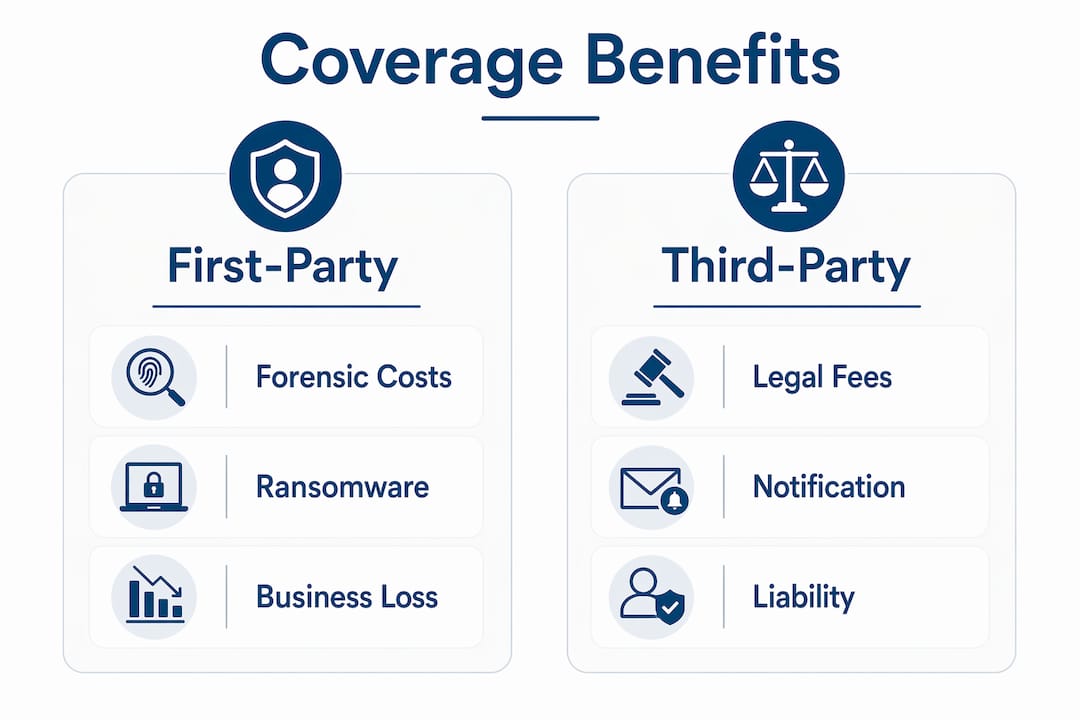
Cyber insurance is a specialized policy that protects businesses against the financial and operational costs of cyberattacks and data breaches. It covers two distinct categories: first-party costs like breach response, forensic investigation, and business interruption, and third-party liabilities like legal defense, settlements, and regulatory fines. Cyber threats are no longer a concern reserved for large corporations. Any business that stores customer data, processes payments, or relies on connected systems carries real exposure. Understanding why cyber insurance matters is the first step toward protecting what you have built.
Table of Contents
- Key Takeaways
- Why cyber insurance matters: coverage explained
- Do small businesses really need cyber insurance?
- How cyber insurance and cybersecurity work together
- How to get the right cyber insurance policy
- The part most business owners get wrong
- Cyber insurance options for Texas businesses at Hettler Insurance Agency
- Frequently Asked Questions
Key Takeaways
Cyber insurance is a financial and operational necessity for any business that stores data, processes payments, or relies on connected systems, regardless of company size.
| Point | Details |
|---|---|
| Two coverage categories | First-party covers direct breach costs; third-party covers legal and regulatory liabilities. |
| Small businesses are high-risk | Companies under 100 employees face breach rates similar to large firms, yet fewer than half carry coverage. |
| Insurance drives security improvement | 76% of insured businesses increased cybersecurity spending to improve their policy terms. |
| Incident response panels matter | Pre-vetted experts activate immediately, reducing containment time and total breach damage. |
| Review coverage annually | Cyber threats evolve quickly; policies must keep pace with changes in your technology and data environment. |
.
Why cyber insurance matters: coverage explained
Cyber insurance splits into two coverage categories, and knowing the difference determines whether your policy actually protects you when an incident hits.
First-party coverage addresses the direct costs your business absorbs immediately after a breach:
- Forensic investigation to identify how the attack happened
- Ransom payments and negotiation services
- Business interruption losses during system downtime
- Customer notification and credit monitoring costs
- Public relations support to manage reputational damage
Third-party coverage addresses the liability your business faces toward others:
- Legal defense costs and settlements from affected customers or partners
- Regulatory fines and penalties from bodies like the FTC or state attorneys general
- Costs related to privacy law violations
The financial exposure without coverage is significant. Forensic hourly rates run $300–$500, and those costs hit immediately, before you have time to plan. Cyber insurance functions as a liquidity bridge, covering those front-loaded expenses so your business does not have to drain operating capital.
One underappreciated benefit is access to your insurer’s incident response panel. Insurers provide pre-vetted forensic, legal, and PR experts who activate the moment you report an incident. That rapid mobilization is critical in the first hours of a breach, when containment decisions determine how far the damage spreads.

Pro Tip: Read your policy’s sub-limits carefully. Many cyber policies cap ransomware payments or business interruption losses at amounts far below the full policy limit. Confirm those sub-limits match your actual risk exposure before you sign.
Do small businesses really need cyber insurance?
Small businesses are targeted precisely because they tend to have weaker security controls than larger firms. Cyberattacks are largely automated. Attackers scan for vulnerabilities at scale, and a 10-person accounting firm is just as visible to a scanning bot as a Fortune 500 company.
The data supports this. The 2024 Verizon Data Breach Investigations Report found that companies under 100 employees suffer breaches at rates comparable to larger organizations, yet fewer than half carry cyber insurance. That gap represents serious financial exposure for small business owners who assume they are too small to be a target.
Recovery costs for small businesses are particularly punishing because there is no large balance sheet to absorb them. A single ransomware event can trigger:
- Days or weeks of operational downtime
- Emergency IT remediation fees
- Legal counsel for breach notification compliance
- Customer loss from reputational damage
There is a secondary benefit that often goes unnoticed. Insurers require businesses to meet minimum security standards before issuing a policy. That requirement pushes owners to formalize practices they may have been putting off, like enabling multi-factor authentication or establishing documented backup procedures. Insurance underwriting requirements drive preparedness, which reduces breach chaos when an incident does occur.
For small and medium businesses in Texas, cyber risks for small businesses are not theoretical. They are a documented, growing threat that demands a practical financial response.
How cyber insurance and cybersecurity work together
Cyber insurance does not replace cybersecurity. It reinforces it. Think of your security controls as the barrier and your insurance policy as the recovery plan when that barrier is breached.
The Geneva Association, a leading insurance research body, describes this relationship clearly:
“Cyber insurance complements cybersecurity by creating a resilience layer. Businesses with coverage recover faster, invest more in security, and approach incidents with greater organizational clarity. Insurance is not a substitute for controls. It is the structure that holds when controls fail.”
That resilience layer has measurable effects. A 2024 survey found that 76% of companies with cyber insurance increased their cybersecurity spending specifically to improve their insurance terms. Better security posture leads to lower premiums and broader coverage. That feedback loop benefits the business on both sides.
Insurers now act as de facto security gatekeepers. Lack of required controls like multi-factor authentication or endpoint detection can result in denied coverage, regardless of your willingness to pay the premium. That means your insurer is actively shaping your security posture, not just writing a check after an incident.
The practical result is that businesses with cyber insurance tend to have better documented incident response plans, clearer internal communication protocols, and faster recovery timelines. Cyber insurance incentivizes stronger controls and better planning, which improves resilience across the board. You can read more about how Hettlerinsurance approaches this layered protection model in their overview of cyber insurance benefits.
How to get the right cyber insurance policy
Getting covered is straightforward. Getting covered correctly requires attention to a few specific areas.
- Assess your data footprint. The volume and sensitivity of data you store directly affects your premium and coverage needs. A business handling medical records or payment card data faces higher exposure than one that stores only basic contact information.
- Understand first-party vs. third-party depth. Some policies offer strong direct response coverage but thin liability protection. Confirm both sides of the policy match your actual risk profile before purchasing.
- Review exclusions carefully. Common exclusions include acts of war, unencrypted device losses, and incidents involving unsupported software. Know what your policy will not cover before you need it.
- Document your cybersecurity practices. Insurers ask detailed questions during underwriting. Businesses with written security policies, employee training records, and tested backup procedures qualify for better terms.
- Set a review schedule. Cyber threats evolve faster than most annual review cycles. Revisit your coverage every 12 months or after any significant change in your technology environment.
On cost, baseline cyber coverage through a business owners policy endorsement can start at $320 per year. Standalone policies scale based on revenue, data volume, and industry. For most small businesses, the annual premium is a fraction of what a single breach event would cost in forensic fees alone.
Pro Tip: Work with an independent insurance agent who represents multiple carriers. They can compare policy terms across insurers rather than fitting you into a single carrier’s product. That comparison often reveals meaningful differences in sub-limits, response services, and exclusions.
For a broader view of what coverage a business owner needs from day one, the guide on essential entrepreneur insurance at Hettler Insurance Agency is a practical starting point.
The part most business owners get wrong
Most business owners I speak with think cyber insurance is a last resort, something you buy after you have been attacked. That thinking gets the sequence exactly backward.
The real value of a cyber policy shows up before an incident, not after. The underwriting process forces you to answer hard questions about your security posture. Do you have multi-factor authentication enabled? Do you have a tested backup and recovery plan? Do your employees receive phishing awareness training? If you cannot answer those questions confidently, the insurer will tell you. That feedback is worth something on its own.
What I have seen repeatedly is that small business owners underestimate total breach costs. They think about the ransom payment and stop there. They do not account for the forensic investigation, the legal notifications, the regulatory response, the customer communication, and the weeks of reduced productivity while systems are restored. Those costs stack fast, and they hit at the worst possible time, when your team is already in crisis mode.
Cyber insurance does not make a breach painless. Nothing does. But it gives you a structured response, a team of experts on call, and the financial capacity to recover without gutting your operating budget. That combination is what separates businesses that survive a breach from those that do not.
If you have not reviewed your cyber exposure recently, do it now. Not because a breach is inevitable, but because preparation is always cheaper than recovery.
— “The best independent agents do not just find you a policy. They find you the right policy and then make sure it stays right as your life changes.” — Ron Hettler, CIC (certified insurance counselor), Hettler Insurance Agency
Cyber insurance options for Texas businesses at Hettler Insurance Agency
Hettler Insurance has served Texas businesses since 1992, and cyber coverage is one of the fastest-growing areas of commercial insurance the agency handles. As an independent agency representing over 30 top-rated carriers, Hettler Insurance shops and compares cyber policies across multiple insurers to find coverage that fits your business size, data footprint, and budget.

Whether you run a small retail operation in Lubbock or manage a multi-location service business across West Texas, the right cyber policy exists for your situation. Start by reviewing the minimum coverage every entrepreneur needs to understand where cyber insurance fits into your overall business protection plan. Then contact Hettler Insurance Agency for a no-pressure consultation with a Certified Insurance Counselor who will walk you through your options clearly and completely.
Recommended
About the Author
Ronald J. Hettler, CIC is a Certified Insurance Counselor (CIC) [the gold-standard credential in the independent insurance industry]. Ron has over 46 years of real-world experience in the insurance industry. He is the owner/president of Hettler Insurance Agency in Lubbock, Texas and is licensed by the Texas Department of Insurance (License #666862). (Why Trust Hettler Insurance Agency? It’s a Local independent insurance agency representing multiple carriers. Hettler Insurance Agency has established business roots going back to it’s predecessor in the late 1800’s. Local expertise in Lubbock Texas and West Texas risks. Focused on clarity before a claim occurs.) Ron and his daughter Meghan, also a CIC, lead a team that represents 30+ carriers and serves clients across Texas.
Ron specializes in helping individuals, families, and small business owners understand complex insurance concepts in clear, practical terms so they can make informed decisions about their coverage. He specializes in helping individuals and families understand coverage gaps, deductible structures, and real-world claim outcomes before a loss occurs. Ron helps you to understand how insurance policies respond in real-world claim situations.
License verification available through the Texas Department of Insurance.
Frequently Asked Questions ?
Q1 ?: What does cyber insurance actually cover?
Q2 ?: How much does cyber insurance cost for a small business?
Q3 ?: Does my general liability policy cover a cyberattack?
Q4 ?: Do I need cyber insurance if I already have strong IT security?
Q5 ?: What security controls do insurers typically require?
— Life Insurance Instant Quote and Apply Tool @ GetLifePolicy.com > * Quick self-service term life insurance quote. With or without medical exam.
— Call us about Auto, Home, Business, Life, or Health insurance. * Click to Call (806) 798-7800, Mon-Fri 8:30am-5pm (lunch closed Noon-1pm)
— Come see us @ our new address 4720 S Loop 289 Lubbock, TX 79414 (maps link), or get your online quote started at https://GetHettler.com