

TL;DR summary:
- Workers’ compensation is a no-fault insurance system that covers medical costs and wage replacement for work-related injuries. Most employees are covered, but misclassification and state-specific rules affect eligibility and benefits. Proper documentation and timely filing are crucial for successful claims and dispute resolution.
Workers’ compensation is a state-mandated, employer-funded insurance program that pays for medical care and partial wage replacement when you are injured or become ill because of your job. According to the Congressional Research Service, it operates without regard to fault and is generally the exclusive remedy against the employer. Three things to know right now:
- Who pays and who is covered: Your employer funds the coverage, either through an insurance carrier or by self-insuring. Almost all U.S. workers are covered under state systems, with notable exceptions for independent contractors, certain agricultural workers, and some domestic employees.
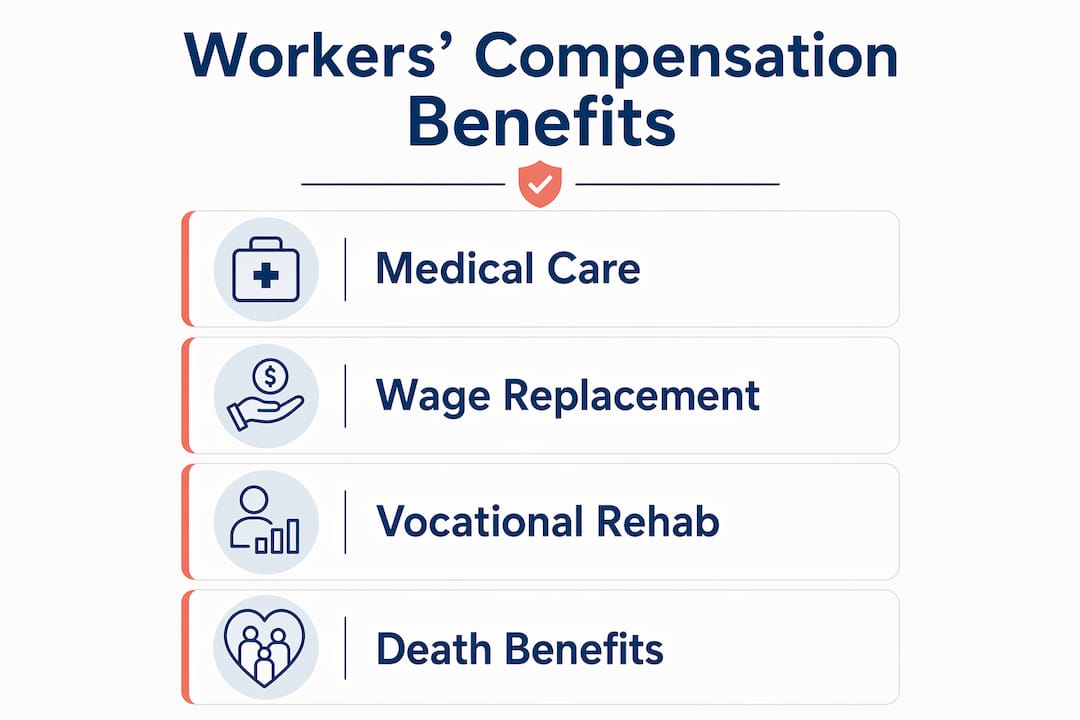
- What benefits you can receive: Medical treatment, temporary and permanent wage replacement, vocational rehabilitation, and death benefits for surviving dependents.
- The no-fault/exclusive-remedy tradeoff: You do not have to prove your employer was negligent to collect benefits. In exchange, accepting benefits generally waives your right to sue the employer in civil court.
Each state runs its own system with its own rules, forms, and benefit caps. Federal workers and certain maritime employees fall under separate federal programs. Texas is the one notable outlier: most private Texas employers may legally opt out of the state system, which changes the legal exposure for both sides significantly.
Table of Contents
- Key Takeaways
- What does workers’ compensation actually pay for?
- Who is covered, and who is not?
- How does the workers’ compensation system actually work?
- How do you file a workers’ compensation claim?
- How are benefits calculated, and how long do they last?
- Why do claims get denied, and how do you appeal?
- How does workers’ comp interact with FMLA, SSDI, and other benefits?
- How do state rules differ, and where do you find your state’s forms?
- Practical tips from an insurance professional
- Workers’ compensation: what the fine print usually leaves out
- Texas employers: get the right workers’ compensation coverage
- Useful sources and official resources
- Frequently Asked Questions
Key Takeaways
Workers’ compensation is a no-fault, employer-funded system that provides medical care and wage replacement for job-related injuries, but the benefits you receive depend entirely on how well you document your claim and meet state deadlines.
| Point | Details |
|---|---|
| No-fault coverage | You do not need to prove employer negligence; the injury must occur in the course of employment. |
| Immediate steps matter | Notify your employer in writing within 24–72 hours and get a physician’s work-related causation opinion. |
| Benefits are capped by state | Wage replacement is typically 60–67% of average weekly wage, subject to your state’s maximum weekly benefit. |
| Denials can be appealed | Most states allow 30–90 days to appeal; gather medical records, witness statements, and the denial letter. |
| Hettler Insurance for Texas employers | Hettler Insurance shops workers’ comp coverage across 30+ carriers to find compliant, cost-effective policies for Texas businesses. |
What does workers’ compensation actually pay for?
Workers’ comp covers four main categories of costs, and understanding each one helps you know exactly what to claim.
Medical treatment is typically the first benefit authorized. This includes emergency care, surgery, prescription drugs, physical therapy, and follow-up visits with approved providers. If you sprain your back lifting equipment, the insurer covers the ER visit, imaging, and any physical therapy your physician orders.

Wage replacement kicks in when your injury keeps you off work or limits your hours. The payment is calculated as a percentage of your average weekly wage, subject to a state-set maximum. A worker with a repetitive strain injury who cannot perform full duties for six weeks would receive temporary partial disability payments during that period.
Vocational rehabilitation applies when an injury permanently prevents you from returning to your previous job. The program may cover retraining, job placement assistance, or education costs. An occupational disease like work-related hearing loss, for example, could qualify a worker for retraining in a less noise-intensive role.
Death benefits cover funeral expenses and provide ongoing income to qualifying dependents when a worker dies from a job-related injury or illness. Benefit amounts and eligibility rules for survivors vary by state.
Who is covered, and who is not?
Most employees working for a private employer or state government are covered from their first day on the job. But the definition of “employee” matters, and several categories fall outside standard coverage.
Typically covered:
- Full-time and part-time employees
- Temporary agency workers (usually covered under the staffing agency’s policy)
- Leased employees (coverage depends on the leasing arrangement and state law)
- Minors employed legally
Common exclusions:
- Independent contractors (though misclassification is frequent — see below)
- Certain agricultural and domestic workers, depending on the state
- Volunteers in most states
- Federal employees (covered under the Federal Employees Compensation Act, administered by the U.S. Department of Labor)
- Maritime and longshore workers (covered under separate federal statutes)
Misclassification is one of the most consequential errors in this system. A worker labeled an independent contractor who actually functions as an employee, with set hours, employer-supplied tools, and direct supervision, may have a valid claim to workers’ comp coverage. The classification that appears on a contract does not automatically determine legal status.
Pro Tip: Check your pay stub. If your employer withholds payroll taxes (FICA, state income tax), you are almost certainly classified as an employee and covered. If you receive a 1099 instead of a W-2, ask an attorney or your state workers’ compensation board whether your actual working conditions qualify you as an employee under state law.
How does the workers’ compensation system actually work?
The system rests on two legal principles that define the relationship between injured workers and their employers.
No-fault means you do not need to prove your employer did anything wrong. A warehouse worker who slips on a dry floor with no safety violation still qualifies for benefits, as long as the injury happened in the course of employment. The no-fault structure protects workers from the burden of proving negligence and gives employers predictable liability.
Exclusive remedy is the other side of that bargain. By accepting workers’ comp benefits, you generally give up the right to sue your employer in civil court for additional damages. This limitation exists in every state, though exceptions apply for intentional acts by the employer, injuries caused by a third party (a defective piece of equipment made by another company, for example), or in Texas, where the opt-out system creates a different legal dynamic entirely.
Employer duties under the system include:
- Carrying a compliant workers’ compensation insurance policy or qualifying as a self-insurer
- Posting required state notices in the workplace
- Reporting injuries to the insurer and state board within required timeframes
- Providing the injured worker with claim forms and access to initial medical care
The insurance carrier handles claims investigation, authorizes medical treatment, calculates and issues benefit payments, and manages disputes. Insurers can lawfully suspend cash benefits during a compensability dispute, which is why preserving documentation from day one is not optional.
How do you file a workers’ compensation claim?
The process has a clear order of operations. Missing a step, especially early, can cost you the claim entirely.
- Seek medical care immediately. Tell the treating physician the injury is work-related. That notation in the medical record is critical evidence.
- Notify your supervisor in writing within 24–72 hours. Verbal notice is often not enough. Send a text, email, or written incident report and keep a copy.
- Document the scene. Photograph the hazard, note the time and location, and write down the names of any witnesses before they forget details.
- File the state claim form. In most states, the employer files a First Report of Injury with the insurer and state board. Confirm this happened. If it did not, file directly with your state workers’ compensation board.
- Obtain a physician’s work-related opinion. Your doctor must formally state that the injury or illness is causally related to your job. Without this, the insurer has grounds to deny.
- Keep copies of everything. Medical records, pay stubs (to document your average weekly wage), the incident report, and all correspondence with the insurer.
- Track deadlines. Most states require you to report the injury within 30 days and file a formal claim within one to three years. Missing the statute of limitations ends the claim permanently.
State claim forms and filing instructions are available directly from your state’s workers’ compensation board website. The U.S. Department of Labor maintains an overview of both state and federal programs and is a reliable starting point for finding your state’s specific forms.
How are benefits calculated, and how long do they last?
Benefit categories break down into four types, each with its own payment formula and duration rules.
| Benefit Type | What It Covers | Typical Payment Basis |
|---|---|---|
| Temporary Total Disability (TTD) | Fully off work during recovery | 60–67% of average weekly wage, up to state maximum |
| Temporary Partial Disability (TPD) | Working reduced hours or light duty | Percentage of wage difference between pre- and post-injury earnings |
| Permanent Partial Disability (PPD) | Lasting impairment, able to work in some capacity | Scheduled loss payments or impairment rating formula |
| Permanent Total Disability (PTD) | Unable to return to any gainful employment | Long-term or lifetime payments at a percentage of pre-injury wage |
Example calculation: A worker earning $1,000 per week before injury qualifies for TTD in a state that pays 66.7% of average weekly wage. Weekly benefit: $667, subject to the state’s maximum weekly benefit cap. New York, for instance, publishes a Schedule of Maximum Weekly Benefits by accident date, and many other states maintain similar schedules on their board websites.
Most states impose a waiting period of three to seven days before wage replacement begins. If you are disabled beyond a certain number of days (often 14–21), benefits are typically retroactive to the first day of disability. Lump-sum settlements are also possible, usually negotiated at the end of a claim to close out future benefit obligations.
Why do claims get denied, and how do you appeal?
Denial does not mean the claim is over. It means you have more work to do, and you need to move quickly.
Common denial reasons:
- Missed reporting deadline (injury not reported within the state’s required window)
- Injury deemed not work-related or outside the scope of employment
- Preexisting condition dispute (insurer argues the condition predates the job)
- Missing or insufficient medical documentation
- Intoxication or intentional self-harm at the time of injury
- Failure to obtain a physician’s formal work-related causation opinion
Appeal checklist:
- Obtain the written denial letter and identify the specific reason cited
- Gather all medical records, the physician’s causation opinion, and any imaging or test results
- Collect witness statements and the original incident report
- File a formal appeal or request a hearing with your state workers’ compensation board within the deadline stated in the denial letter (often 30–90 days)
- Request mediation if your state offers it as a faster alternative to a formal hearing
The workers’ compensation system is fundamentally legal in nature, not medical. A valid injury with poor documentation loses. A well-documented claim with a clear physician opinion wins far more often.
Pro Tip: If the insurer disputes compensability or your claim involves a permanent disability rating, consult a workers’ compensation attorney before accepting any settlement. Most workers’ comp attorneys work on contingency, meaning no upfront cost to you. An attorney can identify procedural errors in the denial and negotiate a settlement that reflects your actual losses.
How does workers’ comp interact with FMLA, SSDI, and other benefits?
Workers’ compensation does not exist in isolation. Several other programs may apply at the same time, and how they interact affects your total income and job protection.
| Program | Purpose | Pays Wages? | Job Protection | Interaction with Workers’ Comp |
|---|---|---|---|---|
| Workers’ Compensation | Job-injury medical and wage benefits | Partial (% of wages) | No federal guarantee | Primary payer for work injuries |
| FMLA | Job-protected leave for serious health conditions | No | Yes, up to 12 weeks | Can run concurrently; does not pay wages |
| SSDI | Long-term disability for those unable to work | Yes (federal formula) | No | Offset may apply; combined benefits capped |
| Private Disability Insurance | Income replacement per policy terms | Yes (per policy) | No | May be offset by workers’ comp payments |
| Personal Health Insurance | General medical coverage | No | No | Secondary payer when workers’ comp applies |
Workers’ comp benefits are generally not subject to federal income tax. SSDI and private disability payments follow different tax rules and may be partially taxable depending on how premiums were paid. For insurance planning that coordinates these benefits correctly, document every program you apply for and notify each program of payments from the others. Accepting a workers’ comp settlement without disclosing a concurrent SSDI application can trigger an offset that reduces your SSDI check.
How do state rules differ, and where do you find your state’s forms?
Workers’ compensation is a state-run system. Every state sets its own benefit formulas, waiting periods, maximum weekly payments, filing deadlines, and approved medical provider lists. What applies in California does not automatically apply in Texas or New York.
To find your state’s workers’ compensation board, official claim forms, and benefit schedules, search: “[Your state name] workers’ compensation board official site.” Every state board publishes claim forms, dispute procedures, and benefit schedules on its official website.
Federal and special programs cover workers outside the state system:
- Federal Employees Compensation Act (FECA): Covers civilian federal employees; administered by the U.S. Department of Labor.
- Longshore and Harbor Workers’ Compensation Act: Covers maritime workers on navigable waters and adjoining areas.
- Black Lung Benefits Act: Covers coal miners with occupational lung disease.
Texas remains the only state where most private employers may legally opt out of the state workers’ compensation system. Employers that opt out lose standard common-law defenses and face direct civil liability for workplace injuries. If you work in Texas, confirming whether your employer participates in the state system is a necessary first step before any injury occurs.
Practical tips from an insurance professional
Documentation is the single factor that separates paid claims from denied ones. The system is legal, not medical — procedural errors kill valid claims.
Documentation checklist:
- Written incident report filed the same day as the injury
- Photographs of the hazard, equipment, or worksite condition
- Names and contact information of all witnesses
- All medical records, including the physician’s written causation statement
- Pay stubs covering the 13 weeks before the injury (used to calculate average weekly wage)
- Copies of all correspondence with the employer and insurer
Working with claim adjusters: Adjusters open an investigation immediately after a claim is filed. They will request medical records, interview witnesses, and review the incident report. Respond to adjuster requests in writing, keep records of every communication, and never give a recorded statement without understanding your rights under state law. Adjusters follow internal timelines, and benefits can be delayed or suspended during investigation.
For employers: Choosing the right workers’ compensation policy requires more than finding the lowest premium. Coverage limits, experience modification factors, and return-to-work program provisions all affect your long-term costs. Ron Hettler, CIC, with over 40 years of insurance experience, advises Texas employers to review their payroll classifications annually. Misclassified employees are one of the most common and costly errors in commercial workers’ comp policies.
Pro Tip: Texas contractors should confirm their workers’ comp compliance before signing any commercial contract. Many general contractors require subcontractors to carry workers’ compensation as a condition of the job. Review your Texas contractor insurance compliance obligations before you bid.
Workers’ compensation: what the fine print usually leaves out
Most explainers on workers’ compensation focus on the mechanics: file the form, see the doctor, collect the check. What they understate is how adversarial the process can become the moment a claim involves a permanent disability rating or a preexisting condition dispute.
Insurers are not neutral parties. Their adjusters are trained to investigate compensability, and a claim that looks straightforward on day one can become contested by week three when a prior medical record surfaces. The exclusive-remedy doctrine protects employers from civil suits, but it does not protect workers from a prolonged dispute process that delays income for months.
The practical implication: treat your claim like a legal case from the first hour. Write everything down. Keep every receipt. Get the physician’s causation opinion in writing before you leave the appointment. Workers who approach the process casually, assuming the system will work automatically in their favor, are the ones who end up at hearings without the evidence they need.
For employers, the lesson runs in the other direction. Carrying compliant workers’ compensation coverage is not just a legal obligation; it is the mechanism that limits your financial exposure when an injury occurs. An independent agent who understands your industry’s risk profile can place coverage that actually fits your payroll and operations, not just the cheapest policy that technically satisfies the state requirement.
Texas employers: get the right workers’ compensation coverage
Texas businesses face a workers’ compensation decision that no other state requires: participate in the state system or opt out and accept direct civil liability. Neither choice is automatically right, and the wrong one can expose a business to costs that dwarf the premium savings.

Hettler Insurance Agency works with Texas employers across Lubbock, Midland-Odessa, Dallas, and the wider state of Texas to shop workers’ compensation coverage across more than 30 carriers. We match policies to actual payroll classifications, and coordinate claims when injuries occur. The agency’s state-licensed team, led by Ron Hettler and Meghan Harris, both CIC (certified insurance counselor), reviews your current coverage, identifies classification errors that inflate premiums, and explains your opt-in or opt-out options in plain language. No pressure, no guesswork on coverage gaps. Hettler Insurance Agency is one of the few family-owned agencies in Texas where both principals carry the high-level CIC (certified insurance counselor). Fewer than 2% of licensed insurance professionals in the U.S. have earned the CIC designation.
If you are a Texas business owner who has not reviewed your workers’ compensation obligations recently, now is the right time. Start with a coverage review at hettlerinsurance.com or call the Lubbock office directly to speak with a licensed agent today.
Useful sources and official resources
These official and authoritative sources provide state forms, benefit schedules, federal program details, and filing guidance:
- U.S. Department of Labor — Workers’ Compensation: Overview of both state and federal programs, with links to federal acts including FECA, the Longshore and Harbor Workers’ Compensation Act, and the Black Lung Benefits Act.
- Legal Information Institute — Workers’ Compensation (Cornell Law): Plain-language legal definitions, state statute summaries, and federal program overviews.
- NAIC — Workers’ Compensation Insurance: Industry-level overview of how workers’ comp insurance is structured, funded, and regulated across states.
- New York Workers’ Compensation Board: Example of a full state board site with claim forms, benefit schedules, and dispute procedures.
- Texas Department of Insurance — Workers’ Compensation: Texas-specific rules, opt-out information, and Division of Workers’ Compensation forms.
- USAGov — Workers’ Compensation: Federal government entry point for workers seeking state board contacts and program overviews.
This article provides general information about workers’ compensation in the United States and is not legal or professional advice. Rules, benefit amounts, and deadlines vary by state. Confirm the current requirements with your state workers’ compensation board or a qualified attorney for your specific situation.
Recommended
About the Author
Ronald J. Hettler, CIC is a Certified Insurance Counselor (CIC) [the gold-standard credential in the independent insurance industry]. Ron has over 46 years of real-world experience in the insurance industry. He is the owner/president of Hettler Insurance Agency in Lubbock, Texas and is licensed by the Texas Department of Insurance (License #666862). (Why Trust Hettler Insurance Agency? It’s a Local independent insurance agency representing multiple carriers. Hettler Insurance Agency has established business roots going back to it’s predecessor in the late 1800’s. Local expertise in Lubbock Texas and West Texas risks. Focused on clarity before a claim occurs.) Ron and his daughter Meghan, also a CIC, lead a team that represents 30+ carriers and serves clients across Texas.
Ron specializes in helping individuals, families, and small business owners understand complex insurance concepts in clear, practical terms so they can make informed decisions about their coverage. He specializes in helping individuals and families understand coverage gaps, deductible structures, and real-world claim outcomes before a loss occurs. Ron helps you to understand how insurance policies respond in real-world claim situations.
License verification available through the Texas Department of Insurance.
Frequently Asked Questions ?
Q1 ?: What is workers’ compensation?
Q2 ?: What benefits does workers’ compensation pay for?
Q3 ?: Who is not covered by workers’ compensation?
Q4 ?: How are workers’ compensation benefits calculated?
Q5 ?: Can Texas employers opt out of workers’ compensation?
— Life Insurance Instant Quote and Apply Tool @ GetLifePolicy.com > * Quick self-service term life insurance quote. With or without medical exam.
— Call us about Auto, Home, Business, Life, or Health insurance. * Click to Call (806) 798-7800, Mon-Fri 8:30am-5pm (lunch closed Noon-1pm)
— Come see us @ our new address 4720 S Loop 289 Lubbock, TX 79414 (maps link), or get your online quote started at https://GetHettler.com