
TL;DR summary:
- Understanding general liability insurance is vital for Texas small business owners and contractors to avoid catastrophic financial losses. Proper preparation, rapid incident reporting, and regular policy reviews help ensure adequate protection against common risks and contractual requirements. Working with an independent agent simplifies the coverage process and optimizes business protection tailored to your specific needs.
One lawsuit can wipe out years of hard work. For small business owners and contractors in Texas, understanding the general liability insurance process is not optional. It is the difference between absorbing a legal hit and losing everything you have built. Texas has no state law requiring most businesses to carry general liability coverage, which means many contractors operate exposed without realizing it. This guide walks you through every stage of the process, from preparing your application to managing claims, so you can protect your business with confidence and clarity.
Table of Contents
- Key takeaways
- Preparing for the general liability insurance process
- Step-by-step guide to buying liability insurance
- How to handle a general liability insurance claim
- Understanding coverage gaps and when to upgrade
- My perspective on the Texas liability insurance process
- How Hettler Insurance helps Texas businesses stay protected
- FAQ
Key takeaways
| Point | Details |
|---|---|
| Prepare before you apply | Gather business details, revenue figures, and existing policy documents before starting the insurance application process. |
| Understand your limits | Know the difference between per-occurrence and aggregate limits to choose coverage that actually protects you. |
| Report incidents immediately | Delayed reporting can result in claim denial, so document and notify your insurer the same day an incident occurs. |
| Know what is excluded | General liability does not cover professional errors, employee disputes, or commercial auto, so review gaps annually. |
| Use an independent agent | An independent agent compares multiple carriers to find the right coverage at the best price for your specific business. |
Preparing for the general liability insurance process
Before you contact a single insurer, you need to do some groundwork. Most business owners skip this step and end up with the wrong coverage or sticker shock at renewal. Taking 30 minutes to prepare can save you thousands.
Start by assessing your specific risks. A roofing contractor in Midland faces very different exposures than a retail shop owner in Lubbock. Think about the physical environments your employees work in, the types of clients you serve, and whether you regularly work on someone else’s property. Each of those details directly shapes what general liability coverage you need and how insurers will price it.
Here is what to gather before you apply:
- Business type and legal structure (LLC, sole proprietor, corporation)
- Annual gross revenue and projected payroll
- Description of all operations, including any subcontractors you hire
- Prior claims history, including incidents you may not have formally reported
- Any contracts or lease agreements that specify minimum liability insurance requirements or require you to be listed as an additional insured on a client’s policy
- Copies of existing policies to identify gaps, overlaps, and expiration dates
You also need to understand two key policy terms before you buy anything. The per-occurrence limit is the maximum the insurer will pay for a single claim. The aggregate limit is the total the insurer will pay across all claims within a policy period, typically one year. Many Texas contractors accept a $1 million per occurrence and $2 million aggregate policy without verifying whether those limits actually meet their contract requirements. Check first.
Pro Tip: Review your client contracts before requesting quotes. Some commercial contracts in Texas require contractors to carry $2 million or more per occurrence, and discovering this after you have already bound coverage means starting the process over.
Standard general liability policies commonly exclude employment practices liability (EPLI), professional services errors, and commercial auto coverage. Knowing these exclusions before you apply helps you identify which additional policies you may need from day one. For contractors who also employ workers, you will want to look at workers’ compensation coverage as a separate but equally necessary layer of protection.
Step-by-step guide to buying liability insurance
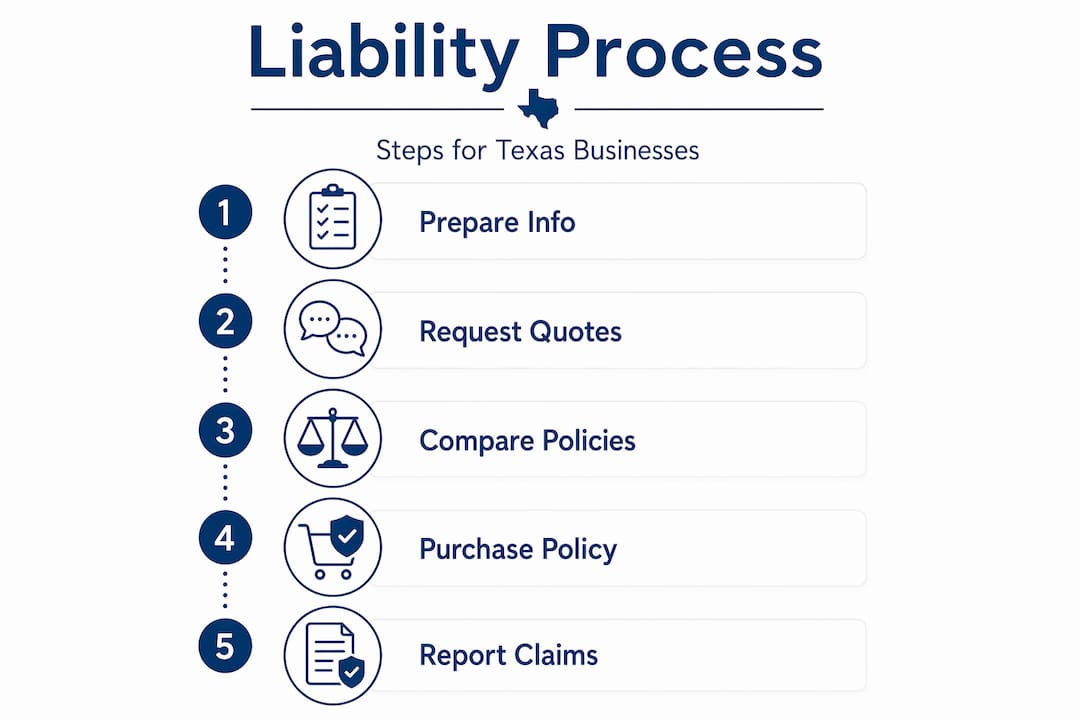
Once you have your information organized, the actual buying process follows a logical sequence. Here is how to move through it without making costly mistakes.
- Contact a licensed independent insurance agent. An independent agent represents multiple carriers, which means they shop the market on your behalf. This is particularly valuable in Texas, where premium rates and coverage terms can vary dramatically between insurers for the same business type. Learn more about why independent agents consistently deliver better outcomes than captive agents tied to one carrier.
- Request and compare multiple quotes. Do not accept the first number you see. Premium pricing for general liability coverage depends on your industry, annual revenue, claims history, number of employees, and the specific operations you perform. A landscaping contractor and a concrete subcontractor may pay very different rates even with identical revenue figures.
- Complete the insurance application accurately. The application asks detailed questions about your business operations. Answer every question honestly and thoroughly. Accurate business disclosure speeds underwriting approval and prevents coverage disputes when you need to file a claim. Omissions or inaccuracies can give an insurer grounds to deny coverage later.
- Understand the underwriting review. After you submit your application, the underwriter evaluates your business risk. They look at your industry class, payroll, gross revenue, prior claims, and the physical nature of your work. This review determines your final premium and any conditions or exclusions the insurer attaches to your specific policy.
- Review optional policy enhancements. Ask your agent about endorsements that modify or expand your base policy. Common additions include tools and equipment coverage, products and completed operations coverage (critical for contractors), and contractual liability endorsements. A Business Owners Policy (BOP) bundles general liability with commercial property coverage and often costs less than buying each separately.
- Read the policy before you sign. This sounds obvious, but most business owners never open the actual policy document. Read the declarations page, which summarizes your limits and premium, and then review the exclusions section carefully. If a term is unclear, your agent should be able to explain it in plain English before you commit.
Pro Tip: Ask your agent to run a coverage comparison that shows you exactly what each carrier includes and excludes. Some insurers bundle more generous coverage for similar premiums, and you will never know without asking.
How to handle a general liability insurance claim
An incident happens. What you do in the next 24 hours determines whether your insurance actually protects you.

The most damaging mistake contractors make is waiting to report. Delays in notifying your insurer can lead to coverage denials, even in cases where the underlying claim is clearly covered. Late notice has resulted in insurers reserving the right to deny coverage entirely, leaving business owners personally responsible for jury verdicts that run into the millions.
Follow these steps immediately after an incident occurs:
- Secure the scene and address any ongoing safety hazards first.
- Document everything. Take photos and video of the location, damage, and any contributing conditions. Capture timestamps.
- Gather witness information including names, contact numbers, and brief written statements if possible.
- Complete an internal incident report the same day, noting the time, location, and sequence of events.
- Notify your insurance agent or carrier immediately. Do not wait for legal action to be threatened. Prompt incident reporting with adequate documentation is vital to protecting your coverage and securing a legal defense.
- Designate a single point of contact. One trained person should handle all communications with the insurer and any opposing parties. Mixed messages create liability.
“Insurers generally pay covered claims quickly when documentation is clear and submitted promptly. Rushing to sue or turning to litigation first often leads to smaller claim payouts and higher future premiums.”
One behavior that consistently derails liability insurance claims is admitting fault. Do not apologize in writing, do not make statements to the other party’s attorney, and do not sign anything without your agent’s knowledge. Your insurer’s claims team is trained to handle these communications. Let them do their job while you focus on yours.
Understanding coverage gaps and when to upgrade
General liability coverage is not a catch-all policy. Treating it as one is a mistake that Texas business owners make regularly.
Here is a side-by-side look at what standard general liability covers and what it does not:
| Covered by general liability | NOT covered (requires separate policy) |
|---|---|
| Third-party bodily injury on your job site | Employee injuries (workers’ comp) |
| Property damage you cause to a client’s building | Your own tools and equipment |
| Legal defense costs for covered claims | Professional errors or bad advice (E&O) |
| Products and completed operations (if endorsed) | Employment practices disputes (EPLI) |
| Advertising injury (libel, slander) | Vehicle accidents in company vehicles |
.
Standard policies exclude employment practices claims, professional service errors, and commercial auto liability. These are not minor gaps. A Texas contractor sued for a discrimination claim has zero protection under a basic general liability policy.
When your business grows, your contracts get larger, or you take on higher-risk project types, your existing limits may no longer be adequate. This is where umbrella or excess liability policies become relevant. Umbrella policies add a layer of coverage above your general liability limits and typically cost less per coverage dollar than increasing your base policy limits alone. Most umbrella policies require you to maintain minimum underlying liability limits before they attach.
Texas-specific legal exposure is also worth understanding. The state’s courts have historically been active on construction defect litigation, and certain municipalities have local contract requirements that exceed standard insurance minimums. Review your coverage with a Texas-licensed agent at least once a year.
Pro Tip: Set a calendar reminder 60 days before your policy renewal date. That gives you enough time to shop alternatives, update your coverage for any new contracts or employees, and avoid the rushed decision that leads to underinsurance.
My perspective on the Texas liability insurance process
I have worked with enough Texas contractors and small business owners to notice a consistent pattern. The ones who struggle most with the general liability insurance process are not the ones who lack resources. They are the ones who treat insurance as a one-time transaction rather than an ongoing business practice.
I have seen a roofing contractor in West Texas lose a $200,000 claim because he waited three weeks to report a fall on a job site. The incident was clearly covered. The delay was not. His carrier denied coverage, and he paid out of pocket. That outcome was entirely preventable.
The other myth I hear constantly is that having any general liability policy is enough. It is not. A $500,000 per-occurrence policy sounds real until a client’s commercial lease requires $2 million and your certificate of insurance does not match. You lose the contract, or worse, you sign it and operate uninsured against the actual contractual requirement.
My honest advice: talk to your agent before you sign any new contract, before you add a new service line, and before you hire your first employee. The coverage process is not complicated when you approach it proactively. What is complicated is trying to fix it after something goes wrong.
Review your policy annually. Ask your agent to explain every exclusion. And if your agent cannot explain your own policy clearly, find one who can.
— Ron Hettler
How Hettler Insurance helps Texas businesses stay protected

At Hettler Insurance Agency, we work with small business owners and contractors across Texas every day, and we understand that navigating the general liability insurance process is not something most people want to spend their time on. That is exactly why we do it for you.
As an independent agency representing over 30 top-rated carriers, Hettlerinsurance shops and compares coverage options to find the right fit for your specific operations, contracts, and budget. Whether you are a solo contractor in Lubbock or managing a crew across West Texas, we tailor your coverage rather than hand you a generic policy. Start by reviewing minimum insurance requirements for Texas entrepreneurs to understand your baseline, then call us for a personalized quote comparison. There is no pressure and no extra fee.
Recommended
About the Author
Ronald J. Hettler, CIC is a Certified Insurance Counselor (CIC) [the gold-standard credential in the independent insurance industry]. Ron has over 46 years of real-world experience in the insurance industry. He is the owner/president of Hettler Insurance Agency in Lubbock, Texas and is licensed by the Texas Department of Insurance (License #666862). (Why Trust Hettler Insurance Agency? It’s a Local independent insurance agency representing multiple carriers. Hettler Insurance Agency has established business roots going back to it’s predecessor in the late 1800’s. Local expertise in Lubbock Texas and West Texas risks. Focused on clarity before a claim occurs.) Ron and his daughter Meghan, also a CIC, lead a team that represents 30+ carriers and serves clients across Texas.
Ron specializes in helping individuals, families, and small business owners understand complex insurance concepts in clear, practical terms so they can make informed decisions about their coverage. He specializes in helping individuals and families understand coverage gaps, deductible structures, and real-world claim outcomes before a loss occurs. Ron helps you to understand how insurance policies respond in real-world claim situations.
License verification available through the Texas Department of Insurance.
Frequently Asked Questions ?
Q1 ?: What does general liability insurance actually cover?
Q2 ?: How long does the insurance application process take?
Q3 ?: What happens if I report a claim late?
Q4 ?: Do Texas contractors legally have to carry general liability insurance?
Q5 ?: When should I add an umbrella policy?
— Life Insurance Instant Quote and Apply Tool @ GetLifePolicy.com > * Quick self-service term life insurance quote. With or without medical exam.
— Call us about Auto, Home, Business, Life, or Health insurance. * Click to Call (806) 798-7800, Mon-Fri 8:30am-5pm (lunch closed Noon-1pm)
— Come see us @ our new address 4720 S Loop 289 Lubbock, TX 79414 (maps link), or get your online quote started at https://GetHettler.com