
TL;DR summary:
- A named insured owns and controls the Texas business policy. An additional insured gets limited coverage through an endorsement. A certificate holder gets proof that coverage exists, nothing more.
- A certificate of insurance (COI) is not coverage. Under Texas law, a certificate cannot amend, extend, or alter the policy it describes.
- Always ask for the actual endorsement and confirm the form number, the exact legal name, limits, and dates.
- CG 20 10 covers ongoing operations; CG 20 37 covers completed operations. Construction contracts usually need both.
- The Texas Anti-Indemnity Act voids additional insured requirements in construction contracts to the extent they cover the other party’s own negligence, with limited exceptions.
- Primary and noncontributory wording decides which policy pays first. Put it in the contract and confirm it on the policy.
Additional insured vs named insured is one of the most misunderstood distinctions in commercial contracting, and Texas contractors feel it most when a claim lands. A named insured owns the policy and controls it. An additional insured borrows a slice of someone else’s coverage through an endorsement, with rights that stop at that endorsement’s wording. A certificate holder gets a piece of paper confirming coverage exists, nothing more. If you’re a contractor or small business owner looking at a certificate of insurance right now, here’s your move:
- Ask for the endorsement itself, not just the certificate of insurance (COI).
- Confirm the form number, commonly CG 20 10 for ongoing operations and CG 20 37 for completed operations.
- Check the effective dates and limits against your contract, not just the policy period on the COI.
Pro Tip: A COI is a snapshot, not a contract. It can list a party as an additional insured while the actual policy contains no such endorsement. That gap causes more coverage disputes than almost anything else in commercial contracting.
Table of Contents
- Key Takeaways
- Additional Insured vs. Named Insured: The Practical Differences
- How Additional Insured Endorsements Actually Work
- Texas Rules for Certificates of Insurance
- How the Texas Anti-Indemnity Act Limits Additional Insured Coverage
- When to Require Additional Insured Status and What to Put in the Contract
- Verifying Coverage: A Step-by-Step Checklist
- The Real Costs and Disputes Behind Additional Insured Endorsements
- How an Independent Agency Handles Endorsement Checks
- What Actually Matters Here (And What Doesn’t)
- Get Endorsement Checks Done Right With Hettler Insurance
- Sources
- Frequently Asked Questions
Key Takeaways
An additional insured gets limited coverage tied to the named insured’s operations through an endorsement, while a named insured owns and fully controls the policy.
| Point | Details |
|---|---|
| Endorsement beats certificate | Always request the actual endorsement, since a COI alone does not prove coverage exists. Texas law says a certificate is not a policy. |
| Match form to scope | Confirm CG 20 10 for ongoing operations and CG 20 37 for completed operations, or the carrier’s equivalent forms. |
| Know the Texas limits | The Texas Anti-Indemnity Act voids additional insured coverage for another party’s own negligence in most construction contracts. |
| Choose blanket for repeat work | Contractors signing multiple contracts a year should ask about blanket endorsements instead of per-project scheduled ones. |
| Add primary and noncontributory language | This wording sets the order in which policies pay, avoiding “other insurance” disputes between carriers. |
| Work with an independent agency | Hettler Insurance Agency reviews endorsement wording and compares 30+ top-rated carriers before you sign a contract. |
Additional Insured vs. Named Insured: The Practical Differences
The paperwork tells you very little about what each status actually gets you. What matters is what happens when a claim lands on someone’s desk.
A named insured is the person or business listed on the declarations page. This party owns the policy, pays the premium, and has full rights: they can change coverage, add locations, and receive notice of cancellation directly. A first named insured, when a policy lists more than one, typically handles administrative matters like cancellation and premium refunds, even though other named insureds share the coverage.
An additional insured is a different animal. IRMI defines it as “a person or organization not automatically included as an insured under an insurance policy who is included or added as an insured under the policy at the request of the named insured.” That status comes by endorsement, and the rights that come with it are tied to the named insured’s work. An additional insured typically cannot change the policy or add coverage, and does not automatically receive cancellation notices. Claims connected to the named insured’s work may be defended; claims outside that scope usually are not.
An additional named insured (ANI) sits between the two. IRMI describes an ANI as a party, other than the first named insured, identified as an insured in the policy declarations or added later “with the status of named insured.” That entity has the same rights and responsibilities as a named insured, other than those reserved to the first named insured. IRMI also notes the term “has not acquired a uniformly agreed upon meaning,” so spell out exactly what you mean in the contract. Expect underwriters to scrutinize ANI requests more closely, since the carrier is extending near-policyholder status to a second party.
A certificate holder is the simplest and most misunderstood of the group. This party receives a document confirming coverage existed when it was issued. That’s the whole relationship. A certificate holder has no defense or indemnity rights under the policy unless it is also made an additional insured through an actual endorsement. Treating the two as interchangeable is one of the costliest assumptions in commercial contracting.
| Status | Where it appears | Claims/defense rights | Who controls the policy |
|---|---|---|---|
| Named insured | Declarations page | Full rights under the policy | Owns and controls the policy |
| First named insured | Declarations page (multi-party policies) | Full rights, plus administrative duties | Handles cancellation, changes, refunds |
| Additional named insured | Added to the named insured section by endorsement | Broad rights similar to a named insured | Limited control; first named insured typically handles cancellation |
| Additional insured | Added by endorsement | Rights tied to the named insured’s work and the endorsement wording | No control over the policy |
| Certificate holder | Listed on the COI only | None unless separately endorsed | No control; notice only if the policy provides it |
Two examples show why this matters. In a landlord/tenant relationship, the landlord is often added as an additional insured on the tenant’s general liability policy, covering claims arising from the tenant’s operations in the leased space. In a general contractor/subcontractor relationship, the GC typically requires additional insured status on the sub’s policy so that claims tied to the sub’s work on the job site are handled under the sub’s coverage first. For the basics, see our earlier guide, What Is Additional Insured? A Texas Business Guide.
How Additional Insured Endorsements Actually Work
An endorsement is an amendment attached to the policy that changes what the policy covers. A COI is a summary document that shows what’s currently in force. Confusing the two is the most common and costly mistake in this area of coverage.
Two structures dominate the market:
- Scheduled endorsements name a specific party by exact legal name and usually require a new endorsement for each new contract.
- Blanket endorsements automatically extend additional insured status to any party the named insured is required, by written contract, to add.
The industry leans on standardized ISO forms. According to IRMI, ISO revised CG 20 10 in 1993 “specifically to rule out the additional insured’s protection against completed operations claims.” CG 20 37 was later introduced to restore completed operations coverage for the additional insured. Here’s what that means in practice: if a property owner or GC is an additional insured under CG 20 10 alone, it has no additional insured protection for an injury or defect claim that surfaces after the job is finished. The contractor’s own completed operations coverage still applies to the contractor, but the additional insured is left out.
Wording inside the endorsement decides everything. Current ISO editions extend coverage to the additional insured for liability “caused in whole or in part by an act or omission of the named insured,” according to IRMI’s construction risk transfer guide. That is narrower than the older “arising out of” language. “Ongoing operations” excludes anything after completion unless CG 20 37 (or an equivalent) is also attached. “Other insurance” clauses can create conflicts when two policies respond to the same claim, sometimes triggering a fight between carriers over who pays first.

The additional insured’s own negligence is where many disputes land. If the additional insured’s own employee causes an injury unrelated to the named insured’s work, the endorsement usually won’t cover it. AIG explains that “additional insured endorsements are enforceable against the insurance company itself, not the party you contracted with,” and that coverage “is determined by the language of the endorsement, not the language of your contract.”
Pro Tip: Never assume “additional insured” means blanket protection for anything that happens on a job site. Read the endorsement’s limiting language before you rely on it.
Texas Rules for Certificates of Insurance
Texas is unusually specific about what a certificate of insurance can and can’t do. Chapter 1811 of the Texas Insurance Code spells it out:
- A certificate is not a policy. It “is not a policy of insurance and does not amend, extend, or alter the coverage afforded by the referenced insurance policy” (Section 1811.152).
- A certificate can’t create new rights. It “shall not confer to a certificate holder new or additional rights beyond what the referenced policy or any executed endorsement of insurance provides” (Section 1811.153).
- A certificate can’t change the policy. An insurer or agent may not issue a certificate that “alters, amends, or extends the coverage or terms and conditions provided by the insurance policy” (Section 1811.051).
- Only approved forms count. Certificates for Texas risks must be on a form filed with and approved by TDI. Standard ACORD, AAIS, and ISO certificate forms are deemed approved once filed (Section 1811.103).
The Texas Department of Insurance certificates FAQ puts it plainly: “A certificate cannot say anything that is not the same as what is stated in the insurance policy.” TDI also notes that a certificate holder cannot require an agent to certify coverage that isn’t available in the line of insurance shown on the form.
For Texas contractors, the takeaway is simple. If a GC or property owner asks you to write special wording onto a certificate, the answer is to change the policy by endorsement first. The certificate can then reflect what the policy actually says. Our guide to the role of certificates of insurance for contractors covers the request-and-delivery side.
How the Texas Anti-Indemnity Act Limits Additional Insured Coverage
Texas also limits how far additional insured coverage can reach on construction projects. Under Chapter 151 of the Texas Insurance Code, a construction contract provision is generally “void and unenforceable” to the extent it requires one party to indemnify or defend another against a claim caused by the other party’s own negligence or fault (Section 151.102).
The law applies the same rule to insurance. Section 151.104 says a contract provision requiring additional insured coverage, or an endorsement providing it, is void “to the extent that it requires or provides coverage the scope of which is prohibited” for indemnity. In other words, a Texas GC generally can’t use a sub’s additional insured endorsement to cover the GC’s own negligence.
There are important exceptions:
- Employee injury claims. The restriction does not apply to claims for bodily injury or death of an employee of the indemnitor, its agent, or its subcontractor of any tier (Section 151.103).
- Residential projects. The chapter does not affect indemnity provisions for a single-family house, townhouse, duplex, or related land development (Section 151.105).
- Municipal public works. Public works projects of a municipality are also excluded (Section 151.105).
- Consolidated insurance programs. Endorsements under a consolidated (wrap-up) program that list, add, or delete named insureds are not affected (Section 151.104(b)).
Contract language drafted for another state may ask for broader coverage than Texas allows. Have your attorney review the indemnity clause, and have your agent confirm that the endorsement on your policy lines up with Texas law and your contract. Our Texas contractor insurance compliance guide covers the broader requirements.
When to Require Additional Insured Status and What to Put in the Contract
Some relationships almost always call for additional insured status. Get this right before signing, not after a claim.
- Subcontracts on any job with shared liability exposure. A general contractor should require additional insured status from every sub, since a sub’s mistake on site can expose the GC to a lawsuit.
- Commercial leases. Landlords typically require tenants to add them as additional insureds, protecting the landlord from claims tied to the tenant’s use of the space.
- Tenant improvement or large vendor contracts. Any project where a third party’s work could damage property or cause injury on your premises justifies the requirement.
Build your contract language around four elements: the required endorsement form (CG 20 10, CG 20 37, or both), minimum liability limits, effective dates that cover the project period plus any completed operations period, and primary and noncontributory language. IRMI explains that this term sets “the order in which multiple policies triggered by the same loss are to respond.” The contractor’s policy pays first, without seeking contribution from the additional insured’s own policy. Without it, the additional insured’s policy may end up sharing the loss, which defeats much of the purpose of the requirement.
For completed operations, the timing matters. IRMI notes that CG 20 37 “must be attached to the policy in effect at the time of completion and on all policies purchased after the project has been completed for as many years as required in the contract.”
Consider requesting additional named insured status instead of a standard additional insured endorsement when the relationship is closer to a partnership than a vendor arrangement, such as a joint venture. Expect underwriters to ask more questions about that broader status.
Pro Tip: If you’re negotiating from the subcontractor side and sign several GC contracts a year, ask about a blanket additional insured endorsement on your own policy. It saves you from processing a new scheduled endorsement every time a new contract lands on your desk.
Verifying Coverage: A Step-by-Step Checklist
A COI alone tells you very little about actual coverage. In Texas, a certificate is confirmation that the referenced policy was issued, but the policy and its endorsements control what is covered.
- Read the description of operations box carefully. This is where scope limits often show up, including project or location restrictions.
- Request the actual endorsement, not just the COI. Confirm the endorsement form number and edition, the exact legal name of the additional insured, the limits, and the effective dates all match your contract.
- Ask whether the endorsement is scheduled or blanket. Scheduled endorsements can take time to process for each new party. Blanket endorsements apply automatically when a written contract requires them, but read the blanket wording to confirm it fits your contract.
- Check for completed operations coverage. If your contract requires it, look for CG 20 37 or the carrier’s equivalent.
- Escalate if anything looks off. Contact the agent directly, and if there’s any doubt, ask for a copy of the endorsement or written confirmation from the carrier before work begins.
A common failure is checking the additional insured box on an ACORD certificate when no matching endorsement exists on the policy. That leaves the “additional insured” holding a piece of paper with no coverage behind it. Property owners hiring contractors face the same exposure from the other direction, so the same checklist applies to them. Our list of common insurance mistakes for contractors in Texas covers related gaps.
The Real Costs and Disputes Behind Additional Insured Endorsements
Cost depends on the carrier, the type of work, and whether the endorsement is scheduled or blanket. Some general liability policies include blanket additional insured wording as part of a contractor package, while others charge for each scheduled endorsement. Ask your agent to compare both structures before you sign a contract that requires one.
Claims involving an additional insured are paid under the named insured’s policy, so they can affect the named insured’s loss history and renewal even though the claim protected someone else.
Four disputes come up repeatedly:
- Mismatched entity names between the contract, the endorsement, and the COI.
- Endorsements that were never actually issued, despite a COI suggesting otherwise.
- Cancellation notice failures, where an additional insured expected notice but the policy didn’t provide it.
- “Other insurance” battles, where two policies both respond to a claim and neither carrier wants to pay first.
Primary and noncontributory wording resolves most of that last category by setting the order of payment. Aligning your indemnity language with your insurance requirements, and with Texas Chapter 151, closes most of the remaining gaps. Higher limits through a commercial umbrella policy may also be required by larger contracts.
How an Independent Agency Handles Endorsement Checks
Hettler Insurance Agency has helped Lubbock and West Texas contractors sort through endorsement confusion since 1992, and the pattern rarely changes: a signed contract requires additional insured status, a COI gets issued, and nobody checks whether an actual endorsement backs it up.
Contractors who do repeat work with the same general contractors are often better served by a blanket additional insured endorsement than by chasing a new scheduled endorsement for every job. It shortens the lag between signing a contract and having coverage confirmed in writing.
As an independent agency working with 30+ top-rated carriers, Hettler compares endorsement wording and pricing across companies rather than accepting whatever one insurer offers. Ron Hettler, CIC (Certified Insurance Counselor), agency founder and president with 45+ years of insurance industry experience, and Meghan Harris, CIC, who co-leads the agency with Ron, review commercial policies with this kind of detail in mind.
- Verify the endorsement form number before calling a requirement satisfied.
- Ask about blanket coverage for any contractor signing multiple jobs a year.
- Confirm primary and noncontributory wording is actually on the policy, not just requested.
What Actually Matters Here (And What Doesn’t)
Most advice on this topic focuses on definitions and treats the paperwork like a formality. That’s backward. The definitions matter only because they tell you what to ask for in writing, and many contractors never get past the vocabulary to the actual verification step.
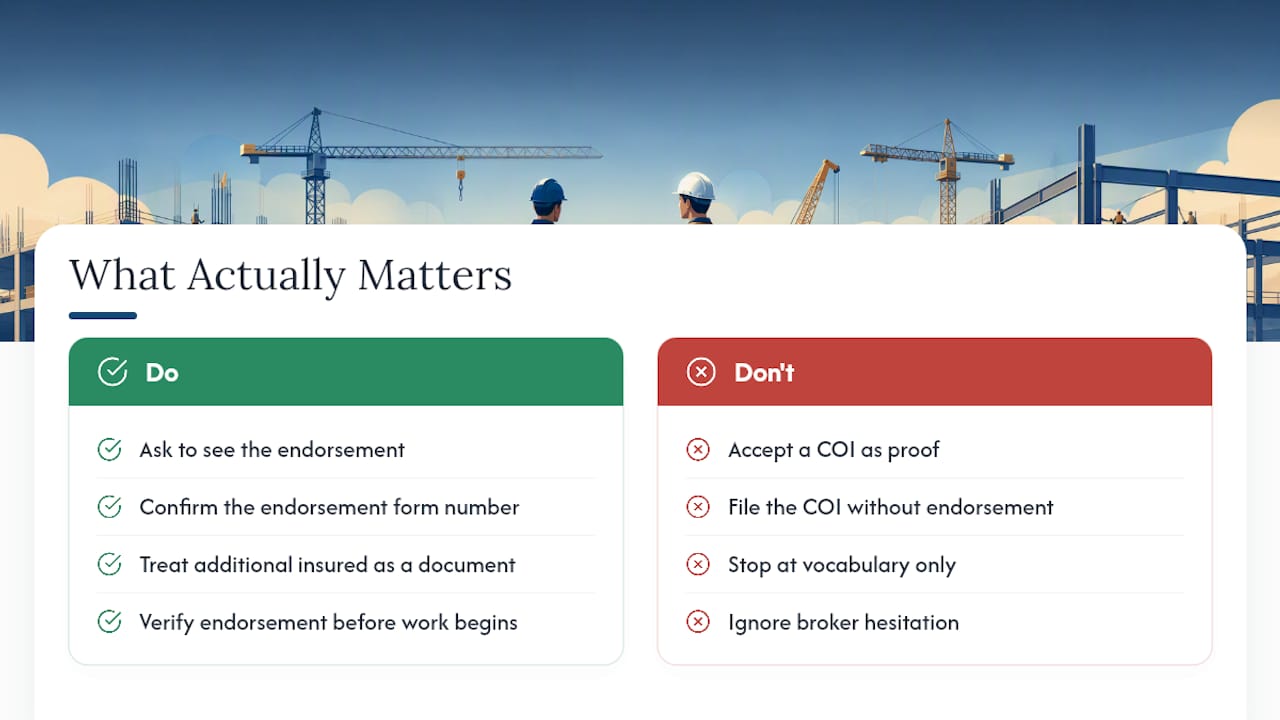
The certificate of insurance has trained many business owners to treat a piece of paper as proof of protection. It isn’t, and Texas law says so. A certificate is a summary that can be outdated or never matched by an actual endorsement. One of the most overlooked failure points in commercial contracting isn’t bad contract language. It’s accepting a COI, filing it, and never asking to see the endorsement.
If you take one thing from this article, make it this: stop treating “additional insured” as a checkbox and start treating it as a document you have the right to read before work begins. Ask for the endorsement. Confirm the form number. If the paperwork can’t be produced, that tells you something.
Get Endorsement Checks Done Right With Hettler Insurance
Hettler Insurance Agency reviews the actual endorsement, not just the certificate, before you sign a contract that puts your liability on the line. As an independent agency working with 30+ top-rated carriers, we compare endorsement wording and pricing instead of relying on a single insurer’s standard form.

Hettler Insurance Agency is one of the few family-owned agencies in Texas where both principals carry the high level certification of CIC (Certified Insurance Counselor). Fewer than 2% of licensed insurance professionals in the U.S. have earned the CIC designation.
“The best independent insurance agents don’t just find you a policy. They find you the right insurance policy and then make sure it stays right as your life changes.” — Ron Hettler, CIC (Certified Insurance Counselor), Hettler Insurance Agency
We do not charge extra fees for ID cards or certificates of insurance. Ron calls it a fundamental customer service. That matters for contractors who need certificates issued quickly every time a new job starts.
Whether you need a blanket additional insured endorsement for repeat subcontract work, a COI review before a lease renewal, or a full general liability package built for contractors, we handle the endorsement paperwork so you’re not the one discovering a gap after a claim. Review the minimum insurance coverage every entrepreneur needs, then contact Hettler Insurance Agency, call (806) 798-7800, or visit 4720 S Loop 289, Lubbock, TX 79414 to have your current certificates checked against the endorsements behind them. Get Better. Get Hettler.
This article provides general information and is not legal advice or a substitute for advice from a licensed insurance professional. Coverage depends on your actual policy, endorsements, and contract language. Talk with a licensed agent, and an attorney for contract questions, before making decisions.
Sources
- Texas Insurance Code Chapter 1811: Certificates of Property and Casualty Insurance
- Texas Insurance Code Chapter 151: Consolidated Insurance Programs (Anti-Indemnity)
- Certificates of Insurance Frequently Asked Questions | Texas Department of Insurance
- IRMI: Additional insured
- IRMI: Additional named insured
- IRMI: Primary and noncontributory
- IRMI: Additional Insureds and Completed Operations
- IRMI: Effective Contractual Risk Transfer in Construction (PDF)
- AIG: Additional Insured Endorsements (PDF)
Frequently Asked Questions ?
Q1 ?: What is the difference between an additional insured and a named insured?
Q2 ?: Does being listed on a certificate of insurance make me an additional insured?
Q3 ?: What is the difference between CG 20 10 and CG 20 37?
Q4 ?: Does Texas law limit additional insured coverage on construction projects?
Q5 ?: What does primary and noncontributory mean on an additional insured endorsement?
Recommended
- What Is Additional Insured? A Texas Business Guide
- The Role of Certificates of Insurance for Contractors
- Texas contractor insurance: complete guide for compliance
- Texas contractor insurance: Your essential compliance guide
- What is contractor insurance? Safeguard your Texas business
- HVAC Contractors in Lubbock: Call Your Insurance Agent Before Signing a Contract
About the Author
Ronald J. Hettler, CIC is a Certified Insurance Counselor (CIC) [a gold-standard credential in the independent insurance industry that less than 2% earn]. Ron has over 46 years of real-world experience in the insurance industry. He is the owner/president of Hettler Insurance Agency in Lubbock, Texas and is licensed by the Texas Department of Insurance (License #666862). (Why Trust Hettler Insurance Agency? It’s a Local independent insurance agency representing multiple carriers. Hettler Insurance Agency has established business roots 100+ years going back to it’s predecessor in the late 1800’s. Local expertise in Lubbock Texas and West Texas risks. Focused on clarity before a claim occurs.) Ron and his daughter Meghan, also a CIC, lead a team that represents 30+ carriers and serves clients across Texas.
Ron specializes in helping individuals, families, and small business owners understand complex insurance concepts in clear, practical terms so they can make informed decisions about their coverage. He specializes in helping individuals and families understand coverage gaps, deductible structures, and real-world claim outcomes before a loss occurs. Ron helps you to understand how insurance policies respond in real-world claim situations.
License verification available through the Texas Department of Insurance.
— Life Insurance Instant Quote and Apply Tool @ GetLifePolicy.com > * Quick self-service term life insurance quote. With or without medical exam.
— Call us about Auto, Home, Business, Life, or Health insurance. * Click to Call (806) 798-7800, Mon-Fri 8:30am-5pm (lunch closed Noon-1pm)
— Come see us @ our new address 4720 S Loop 289 Lubbock, TX 79414 (maps link), or get your online quote started at https://GetHettler.com