
TL;DR summary:
- Most modern Texas cyber policies cover ransomware, including forensics, system restoration, business interruption, breach notification, and an authorized ransom payment.
- The ransom itself is usually capped by a cyber extortion sublimit, commonly $50,000 to $250,000, even on a $1 million policy.
- Real incidents cost more than many owners expect: NetDiligence’s 2025 claims study puts the five-year average ransomware claim for small and mid-size companies at $631,000.
- Call your carrier’s breach hotline before you pay anyone. Paying a ransom without insurer consent can void extortion coverage.
- Texas law adds its own clock: notify affected people within 60 days and report breaches affecting 250+ Texans to the Attorney General within 30 days.
- Documented MFA, endpoint detection, and tested offline backups affect your premium, your claim, and whether you face a ransom demand at all.
Yes, ransomware insurance coverage is part of most modern Texas cyber insurance policies, but it is conditional and often capped well below what a real attack costs. Insurers typically pay for ransom negotiation, forensics, system restoration, and lost income during downtime. The catch: extortion payments are frequently sublimited to a fraction of your overall policy limit, and insurers require you to notify them and get authorization before you pay anyone.
Here’s what a typical policy covers when ransomware hits:
- Ransom negotiation and payment (subject to a sublimit, often far lower than your aggregate limit)
- Forensic investigation to identify the attacker and scope of the breach
- System and data restoration costs
- Business interruption income replacement during downtime
- Breach notification and legal fees tied to regulatory obligations
Call your insurer’s breach hotline before you pay or wire a dollar. Paying first and asking questions later is one of the fastest ways to lose your extortion coverage.
Table of Contents
- Key Takeaways
- What Does Ransomware Insurance Coverage Typically Include?
- What Do Ransomware Sublimits and Premiums Typically Look Like?
- How Do Insurers Handle a Ransomware Claim in Practice?
- What Texas Law Requires After a Ransomware Attack
- What Exclusions and Denial Reasons Should You Watch For?
- How Should You Evaluate and Buy a Ransomware Insurance Policy?
- Why an Independent Agent Matters for Cyber Coverage
- What the Conventional Advice Gets Wrong
- Get Cyber Coverage Built for the Way Ransomware Actually Works
- Sources
- Frequently Asked Questions
Key Takeaways
Texas ransomware insurance coverage pays for real losses, but only when your sublimits fit your exposure, you meet the notice window, and you get authorization before you pay anyone.
| Point | Details |
|---|---|
| Coverage is conditional | Ransom payments, forensics, and restoration are commonly covered, but extortion payments are usually sublimited well below your aggregate limit. |
| Sublimits often fall short | Default extortion sublimits commonly run $50,000 to $250,000, while NetDiligence’s 2025 study puts the five-year average SME ransomware claim at $631,000 across all cost categories. |
| Authorization is non-negotiable | Paying a ransom before your insurer consents can void extortion coverage entirely. |
| Texas has its own deadlines | Affected individuals must be notified within 60 days, and breaches affecting 250+ Texans must be reported to the Attorney General within 30 days. |
| Controls change outcomes | Documented MFA, endpoint detection (EDR), and tested offline backups affect both your premium and whether a claim gets paid. |
| Work with an independent agent | Hettler Insurance Agency compares extortion sublimits and endorsements across 30+ top-rated carriers to match coverage to your actual risk. |
What Does Ransomware Insurance Coverage Typically Include?
Texas cyber policies split coverage into two buckets: first-party and third-party. First-party coverage pays for your own losses, the costs your business absorbs directly from the attack. Third-party coverage responds when someone else, such as a customer, vendor, or regulator, comes after you because their data was exposed on your watch. Both matter, and a policy that’s strong on one but thin on the other leaves a real gap.
Within first-party coverage, insurers generally structure ransomware response into distinct cost categories:
- Cyber extortion and ransom payment. This includes the ransom itself if authorized, plus professional negotiation services. Carriers often work with negotiators who talk demands down and handle the exchange, including cryptocurrency logistics, so you don’t have to.
- Digital forensics. Investigators determine how attackers got in, what they touched, and whether data actually left your network. This step also feeds your legal notification obligations.
- System restoration and data recovery. Rebuilding servers, restoring from backup, and hardening systems against reinfection.
- Business interruption. Lost income and extra expenses while your systems are down, usually after a waiting period.
- Breach notification and legal defense. Costs to notify affected customers and regulators, plus attorney fees for compliance and any resulting litigation.
- Crisis communications. PR support to manage reputational fallout, particularly for customer-facing businesses.
Hypothetical example: Picture a 40-employee Lubbock manufacturer hit with a $180,000 ransom demand. The policy might cover $75,000 of negotiated ransom, $40,000 in forensics, $60,000 in restoration, and three weeks of business interruption income replacement, each bucket drawing from its own sublimit on the same policy. The figures are illustrative, not drawn from a real claim.
What Do Ransomware Sublimits and Premiums Typically Look Like?
The number that trips up most small business owners isn’t the premium. It’s the cyber extortion sublimit on the declarations page. A policy can carry a $1 million aggregate limit while capping the actual ransom payment at a fraction of that.
Sublimits you’re likely to see for a small or mid-size business:
- $50,000 to $250,000 as a common cyber extortion sublimit, even under a $1 million policy, according to Daily Insurance News
- Endorsement options to raise that sublimit to $250,000 or higher for an added premium
- Separate, often lower sublimits for social engineering and funds-transfer fraud
- A business interruption waiting period before income replacement begins
NetDiligence’s 2025 Cyber Claims Study, built from real insurance claims, puts the five-year average ransomware incident cost for small and mid-size enterprises (under $2 billion in revenue) at $631,000, and $663,000 for 2024 incidents. That total spans forensics, restoration, business interruption, and legal costs, which is why every sublimit on the policy matters, not just the ransom cap.
Premiums move based on a handful of factors: what security controls you already run (multi-factor authentication and endpoint detection carry real weight), your revenue band, your industry’s risk profile, whether you’ve had a prior incident, and the limits you select. A retail business with no MFA and one prior breach generally pays more than a professional services firm with tested backups and a clean claims history.
Raising the extortion sublimit through an endorsement adds premium, so ask your agent to quote it side by side with your current terms. Self-insuring that gap instead, betting you’ll never need it, is a bet most small businesses can’t afford to lose.

How Do Insurers Handle a Ransomware Claim in Practice?
Coverage on paper and coverage in practice are two different things, and the difference comes down to timing and authorization. Many policies require notice within a defined window, commonly 24 to 72 hours of discovering the attack, according to Uprite’s guide to the first 72 hours of ransomware recovery. Check the notice condition in your own policy, because that clock starts the moment you know something’s wrong, not when you’ve confirmed how bad it is.
Consent and cooperation clauses are the fine print that decides whether extortion coverage actually applies. Pay a ransom on your own before looping in your insurer, and you’ve likely voided that portion of coverage, regardless of how justified the payment felt in the moment.
Once you report the incident, here’s what a carrier’s incident response panel typically does:
- Deploys forensic investigators to confirm scope and identify the threat actor
- Screens the attacker against sanctions lists, since the U.S. Treasury’s OFAC advisory warns that ransomware payments to sanctioned parties can violate federal law on a strict liability basis
- Handles negotiation directly; Daily Insurance News reports carrier-led negotiations routinely cut demands by 30 to 60 percent
- Manages cryptocurrency logistics if payment is authorized
- Coordinates restoration once the immediate threat is contained
Keep in mind that the same OFAC advisory states the U.S. government strongly discourages paying ransom or extortion demands and encourages victims to report attacks to law enforcement as soon as possible.
Pro Tip: Print your carrier’s 24/7 breach hotline number and tape it near your server closet or main workstation. In the panic of a ransomware lockout, nobody remembers where they filed the policy documents, and every hour of delay works against your claim.
What Texas Law Requires After a Ransomware Attack
If ransomware attackers access or steal sensitive personal information, Texas’s data breach law applies on top of your policy conditions. According to the Texas Attorney General, businesses must:
- Notify affected individuals no later than 60 days after determining the breach occurred
- Report a breach affecting 250 or more Texans to the Attorney General as soon as practicable and no later than 30 days after that determination, using the online Data Breach Reporting Form
The Attorney General’s office notes civil penalties of $2,000 to $50,000 per violation, plus up to $250,000 per breach for failing to take reasonable action to notify consumers. That’s one reason breach notification and legal costs belong on your ransomware coverage checklist, not just the ransom itself.
What Exclusions and Denial Reasons Should You Watch For?
Every cyber policy carries exclusions, and reading them before an incident, not during one, is the difference between a smooth claim and a fight with your carrier.
Common exclusions and carve-outs:
- Payments to sanctioned actors or comprehensively sanctioned jurisdictions
- War and nation-state cyberattack exclusions, an increasingly contested gray area as attribution gets murkier
- Intentional criminal acts by an employee or insider
- Social engineering gaps, where a wire fraud loss falls outside standard cyber coverage and needs its own endorsement
Reasons insurers most often reduce or deny ransomware claims:
- Notice filed after the policy’s required window
- Ransom paid without insurer consent
- Missing security controls that were required at underwriting, especially MFA
- Backups that were never tested or were encrypted along with production systems, meaning they offered no real fallback
Documented security controls aren’t just underwriting paperwork. MFA logs, EDR alert histories, backup test reports, patch and asset inventories, and employee security training records shape whether an attack succeeds in the first place and whether your carrier honors the claim once it happens. The CISA #StopRansomware Guide is a free, practical checklist for offline backups, incident response planning, and access controls.
If you don’t have every required control in place yet, say so upfront. Ask your agent about negotiating a reasonable remediation timeline into the policy rather than letting an underwriter discover the gap after a claim.
How Should You Evaluate and Buy a Ransomware Insurance Policy?
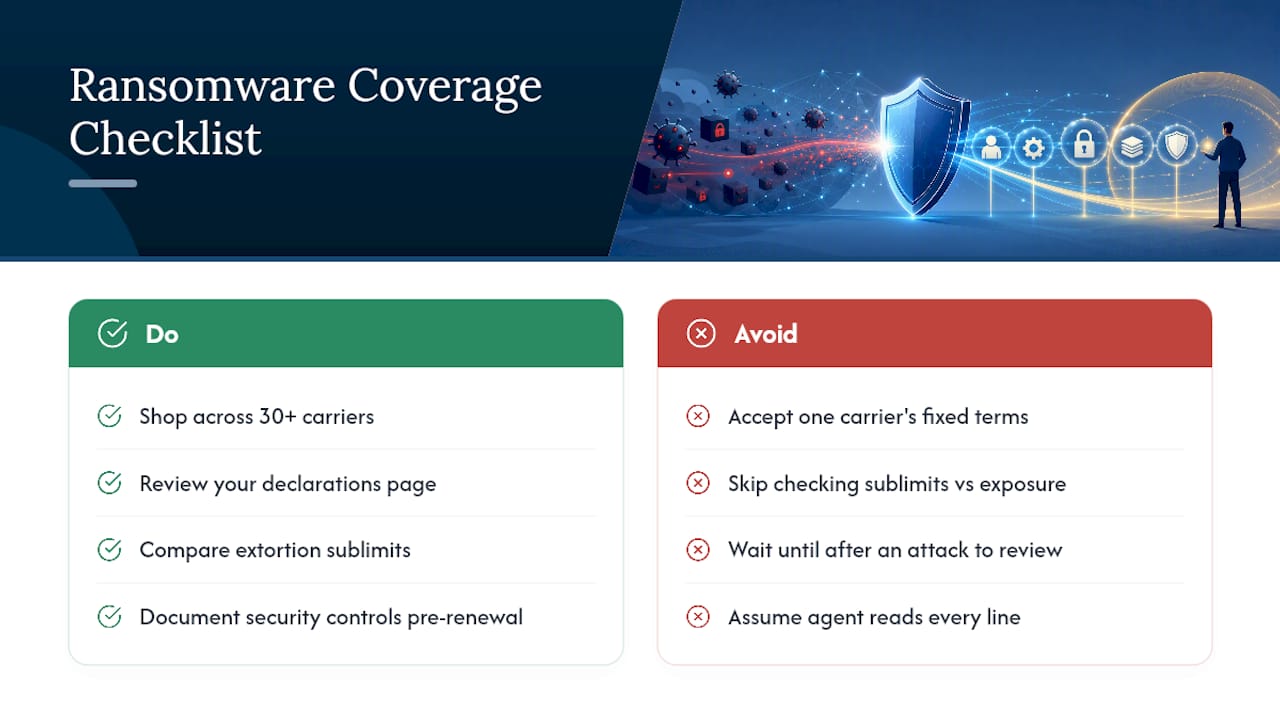
Shopping for cyber coverage isn’t about finding the lowest premium. It’s about matching sublimits and conditions to your actual exposure. Here’s a practical process:
- Pull the declarations page first. Check the aggregate limit, the cyber extortion sublimit specifically, the business interruption waiting period, and your retention (deductible).
- Check for social engineering and funds-transfer fraud coverage. These often sit outside standard cyber extortion language entirely.
- Ask who’s on the incident response panel. Confirm the carrier has vetted forensics firms, negotiators, and legal counsel ready to move within your notice window.
- Confirm the sanctions screening process. Ask how the carrier verifies a threat actor isn’t sanctioned before authorizing payment.
- Ask about claims-handling history. A carrier’s track record on cyber claims tells you more than its marketing copy.
Questions worth asking your agent directly:
- What’s the exact authorization process if we’re hit tomorrow?
- Which vendors sit on the incident response panel, and can we review their track record?
- What’s a realistic timeline from notice to claim resolution?
- Should we raise our extortion sublimit given recent average incident costs in our industry?
An independent agent who represents multiple carriers can shop these specifics across insurers rather than presenting you with one company’s fixed terms. For a broader look at why this coverage matters, see 5 reasons a business and its employees can benefit from cyber insurance. If average incident costs in your industry have climbed, that’s the signal to raise your sublimit before renewal, not after a claim.
Why an Independent Agent Matters for Cyber Coverage
Cyber policies vary enormously between carriers on the exact language that decides whether a claim gets paid. That’s where working with an established independent agency pays off.
Hettler Insurance Agency has served Lubbock and Texas businesses since 1992. Ron Hettler, CIC (Certified Insurance Counselor), agency founder and president with 45+ years of insurance industry experience, and Meghan Harris, CIC, who co-leads the agency with Ron, represent 30+ top-rated carriers, which means real comparison shopping instead of a single company’s take-it-or-leave-it terms.
What that looks like in practice:
- Comparing extortion sublimits and endorsement pricing across multiple carriers instead of one
- Helping document the security controls (MFA, EDR, backup testing) that improve both pricing and claim outcomes
- Walking through the declarations page line by line before you sign anything
- Supporting you at claim time with carrier relationships built over decades, not a first-time call to a stranger
The agency holds an A+ BBB rating and a 4.5-star Google rating, with recognition from Three Best Rated® and Expertise.com.
What the Conventional Advice Gets Wrong
Most guidance on ransomware insurance coverage focuses on whether you have a policy at all. That’s the wrong question. The real question is whether your extortion sublimit and your notice-window compliance line up with how attackers and insurers behave right now.
Business owners treat the declarations page like boilerplate. It isn’t. The aggregate limit is the headline. The extortion sublimit, the business interruption waiting period, and the consent clause are where claims actually get decided. A $1 million policy with a $75,000 extortion sublimit and a strict authorization requirement isn’t a full safety net. It’s a partial one, and most owners don’t find that out until they’re mid-crisis.
The control requirements insurers push, such as MFA, tested backups, and EDR, aren’t red tape. They’re the difference between needing to pay a ransom and having a clean restore path that makes the whole question moot. If there’s one thing worth prioritizing above raising limits, it’s closing those control gaps first.
Get Cyber Coverage Built for the Way Ransomware Actually Works
Hettler Insurance Agency shops your cyber and ransomware coverage across 30+ top-rated carriers instead of locking you into one company’s fixed sublimits and authorization terms. That matters because the gap between a policy that pays and one that leaves you exposed almost always comes down to line-by-line details most business owners never get help reading.

Hettler Insurance Agency is one of the few family-owned agencies in Texas where both principals carry the high level certification of CIC (Certified Insurance Counselor). Fewer than 2% of licensed insurance professionals in the U.S. have earned the CIC designation.
“The best independent insurance agents don’t just find you a policy. They find you the right insurance policy and then make sure it stays right as your life changes.” — Ron Hettler, CIC (Certified Insurance Counselor), Hettler Insurance Agency
We do not charge extra fees for ID cards or certificates of insurance. Ron calls it a fundamental customer service.
If your current cyber policy has never had its sublimits checked against your real exposure, that’s the conversation to have before renewal, not after an attack. Start with the minimum coverage every entrepreneur should carry, then contact Hettler Insurance Agency, call (806) 798-7800, or visit 4720 S Loop 289, Lubbock, TX 79414 to request a cyber policy review. Get Better. Get Hettler.
This article provides general information and is not a substitute for advice from a licensed insurance professional. Coverage, sublimits, and conditions vary by insurer and policy, and figures cited are third-party industry data, not quotes. Consult a licensed insurance professional about your own circumstances before acting.
Sources
- NetDiligence: Cyber Claims Study 2025 Report
- Daily Insurance News: Your Cyber Policy May Not Cover the Ransom Even When It Covers the Breach
- Uprite: Ransomware Recovery in Texas: What the First 72 Hours Decide
- U.S. Treasury OFAC: Updated Advisory on Potential Sanctions Risks for Facilitating Ransomware Payments
- Texas Attorney General: Identity Theft Enforcement and Protection Act
- CISA: #StopRansomware Guide
Frequently Asked Questions ?
Q1 ?: Does cyber insurance cover ransomware attacks?
Q2 ?: What is a cyber extortion sublimit?
Q3 ?: Can paying a ransom before calling my insurer void my coverage?
Q4 ?: How fast must a Texas business report a ransomware attack?
Q5 ?: Why do insurers deny or reduce ransomware claims?
Recommended
About the Author
Ronald J. Hettler, CIC is a Certified Insurance Counselor (CIC) [a gold-standard credential in the independent insurance industry that less than 2% earn]. Ron has over 46 years of real-world experience in the insurance industry. He is the owner/president of Hettler Insurance Agency in Lubbock, Texas and is licensed by the Texas Department of Insurance (License #666862). (Why Trust Hettler Insurance Agency? It’s a Local independent insurance agency representing multiple carriers. Hettler Insurance Agency has established business roots 100+ years going back to it’s predecessor in the late 1800’s. Local expertise in Lubbock Texas and West Texas risks. Focused on clarity before a claim occurs.) Ron and his daughter Meghan, also a CIC, lead a team that represents 30+ carriers and serves clients across Texas.
Ron specializes in helping individuals, families, and small business owners understand complex insurance concepts in clear, practical terms so they can make informed decisions about their coverage. He specializes in helping individuals and families understand coverage gaps, deductible structures, and real-world claim outcomes before a loss occurs. Ron helps you to understand how insurance policies respond in real-world claim situations.
License verification available through the Texas Department of Insurance.
— Life Insurance Instant Quote and Apply Tool @ GetLifePolicy.com > * Quick self-service term life insurance quote. With or without medical exam.
— Call us about Auto, Home, Business, Life, or Health insurance. * Click to Call (806) 798-7800, Mon-Fri 8:30am-5pm (lunch closed Noon-1pm)
— Come see us @ our new address 4720 S Loop 289 Lubbock, TX 79414 (maps link), or get your online quote started at https://GetHettler.com