

TL;DR summary:
- Most Texas businesses are not legally required to carry general liability insurance, but many contracts and leases demand it for protection.
- General liability covers third-party bodily injury, property damage, and advertising injury, while excluding employee injuries, auto accidents, cyber breaches, and professional errors.
Running a small business in Texas means managing more than payroll and customers. One wrong move, and a single lawsuit could wipe out everything you’ve built. Many Texas business owners assume general liability insurance is legally required across the board, or they assume it covers every possible risk they face. Both assumptions are wrong, and either mistake can cost you. General liability is usually not required by Texas law for most businesses, yet the financial exposure from going without it can be devastating. This guide breaks down exactly what general liability insurance is, when you need it, what it covers, what it doesn’t, and how to build smarter coverage for your Texas business.
Table of Contents
- What is general liability insurance?
- Is general liability insurance required in Texas?
- What does general liability insurance cover—and what does it NOT cover?
- How much does general liability insurance cost in Texas?
- What else do Texas small businesses need besides general liability coverage?
- A Texas agent’s perspective: Don’t buy a “one size fits all” policy
- Get covered: Start building your Texas business protection
- Frequently asked questions
Key Takeaways
| Point | Details |
|---|---|
| Not legally required in Texas | Most Texas businesses do not need general liability insurance by law, but it’s often required by contracts. |
| Covers major third-party risks | General liability insurance protects against common lawsuits and claims like customer injuries and property damage. |
| Major exclusions exist | It does not cover employee injuries, professional mistakes, auto claims, or cyber risk—additional policies are needed. |
| Cost varies by industry | Average premium in Texas is $122 per month, but your price depends on your business type and operations. |
| Review coverage gaps | Do not assume GL covers every risk—know your exclusions and layer coverage for best protection. |
What is general liability insurance?
General liability insurance, sometimes called a commercial general liability policy or CGL, is one of the most fundamental forms of business insurance available. It protects your business from financial losses caused by certain third-party claims. Third party means someone who is not your employee.
At its core, general liability insurance covers three main categories of risk:
- Bodily injury: A customer, vendor, or visitor is physically hurt because of your business operations. Think of a customer slipping on a wet floor in your retail store.
- Property damage: Your business accidentally damages someone else’s property. For example, a plumber accidentally breaks a client’s pipe and floods their kitchen.
- Personal and advertising injury: This covers things like libel, slander, copyright infringement in your ads, and false advertising claims. It’s broader than most owners realize.
Beyond those three categories, your CGL policy also pays your legal defense costs, including attorney fees, court fees, and settlements. This is critical. Even if a claim against you is completely groundless, defending yourself in court is expensive. Your policy covers that too.
General liability insurance is a business policy covering certain third-party claims for bodily injury, property damage, and personal or advertising injury, plus legal costs, even when claims are without merit.
Understanding this matters because many Texas business owners think they only need liability coverage if they’re in a “risky” industry. The truth is that any business that interacts with the public, leases space, or advertises its services has real exposure. Even a basic misunderstanding with a landlord can spiral into a liability dispute. Reviewing a landlord liability guide can help you understand how property-related liability claims develop before you sign your next lease.
Is general liability insurance required in Texas?
This is the question we hear most often, and the answer surprises people. At the state level, Texas law generally does not mandate general liability insurance for most private businesses. There is no blanket statewide requirement saying your LLC must carry a CGL policy to legally operate.
However, “not legally required” does not mean “optional in practice.” Requirements come from the people and organizations you do business with. GL is usually not required by Texas law, but contracts, client agreements, and lease agreements frequently demand it.
Here are the most common situations where general liability is contractually required for Texas small businesses:
- Commercial leases: Most Texas landlords require tenants to carry a minimum level of general liability coverage before signing a lease, often $1 million per occurrence.
- Vendor and event permits: If you set up at markets, fairs, or city events in Texas, the venue or permitting authority often requires proof of GL coverage.
- Government and public contracts: If you contract with a Texas city, county, or state agency, GL is almost always required, with specific limits spelled out in the contract.
- Client contracts: Many larger clients, especially in construction, healthcare, or professional services, require subcontractors and service vendors to carry GL before they can be hired.
- Franchise agreements: Franchise operators frequently require franchisees to maintain GL coverage as part of the franchise agreement.
When you provide proof of coverage, you’ll often hear the terms “certificate holder” and “additional insured.” These are not the same thing. A certificate holder receives a copy of your insurance certificate for documentation purposes. An additional insured is actually added to your policy and can be covered under your GL policy for certain claims. Contracts sometimes require you to list the other party as an additional insured, not just a certificate holder. Get this wrong and you could lose a contract or face a coverage dispute.
Knowing how Texas insurance laws interact with your business obligations helps you understand why reading every contract matters before you sign.
Pro Tip: Before signing any lease, vendor agreement, or client contract, read the insurance requirements section carefully. Bring that language directly to your agent so they can confirm your current policy meets those requirements or adjust it accordingly.
The most common limit structure you’ll see requested in Texas contracts is $1 million per occurrence / $2 million aggregate. Per occurrence means the maximum the insurer pays for a single claim. Aggregate means the total maximum paid across all claims during the policy period.
What does general liability insurance cover—and what does it NOT cover?
Knowing what your GL policy actually covers is just as important as knowing you have one. Many business owners are surprised when a claim is denied because it falls outside the policy’s scope.
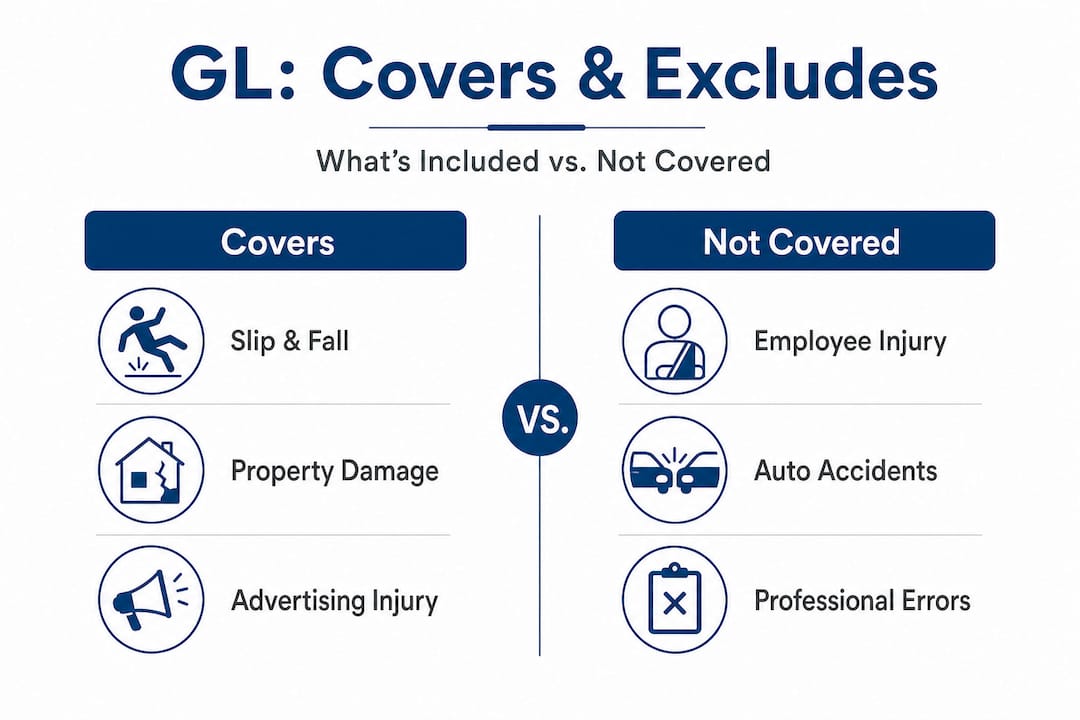
Here’s a clear comparison to help you see exactly what GL does and does not cover:
| Situation | Covered by GL? |
|---|---|
| Customer slips and falls at your location | Yes |
| You accidentally damage a client’s property | Yes |
| A competitor sues you over a misleading ad | Yes (advertising injury) |
| An employee is injured on the job | No (workers’ comp handles this) |
| A professional error causes client financial loss | No (E&O/professional liability needed) |
| One of your company vehicles causes an accident | No (commercial auto needed) |
| A data breach exposes customer information | No (cyber liability needed) |
| Pollution or environmental damage from your work | No (pollution coverage is separate) |
As you can see, general liability commonly does not cover employee injuries, professional errors, auto accidents, cyber incidents, or pollution. These are major exclusions that can catch business owners off guard.
The most significant gaps to watch out for include:
- Employee injury exclusion: If your employee is hurt at work, GL won’t pay. Workers’ compensation is the correct coverage for that. In Texas, most private employers are not required to carry workers’ comp, but skipping it is a significant financial gamble.
- Professional liability exclusion: If you give advice, design something, or provide a service and a client claims your mistake cost them money, GL doesn’t respond. You need errors and omissions (E&O) or professional liability insurance.
- Cyber liability exclusion: A customer data breach, ransomware attack, or payment system hack is not covered by a standard GL policy. Cyber liability is now a separate and increasingly important coverage.
- Your own property: GL covers damage you cause to other people’s property. It does not cover damage to your own business equipment, inventory, or building.
Pro Tip: Walk through your daily business operations and identify every activity where something could go wrong. Then map those risks to your coverage. Look at other smart insurance types that may address gaps your GL policy leaves open. Some businesses also find value in reviewing compare rental insurance options when they rent commercial space.
How much does general liability insurance cost in Texas?
Cost is always a key concern for small business owners, and the good news is that general liability insurance is often more affordable than people expect. The bad news is that pricing varies widely based on your specific situation.
The average cost in Texas is approximately $122 per month or $1,462 per year for a standard general liability policy. However, that number is just a starting point.

Here’s what drives your premium up or down:
| Factor | Impact on premium |
|---|---|
| Industry and risk level | High-risk trades (roofing, electrical) pay more than low-risk offices |
| Annual revenue | Higher revenue usually means higher premiums |
| Number of employees | More employees generally increases premium |
| Coverage limits | Higher limits ($2M/$4M) cost more than $1M/$2M |
| Claims history | Prior claims push your premium higher |
| Location | Urban areas or high-crime ZIP codes can affect pricing |
| Deductible amount | Higher deductibles lower your premium |
Callout: The most commonly requested coverage structure in Texas contracts is $1 million per occurrence / $2 million aggregate. Make sure your policy meets that standard before signing.
To keep costs manageable, there are a few practical steps you can take. First, bundle your GL with other business coverages. A Business Owners Policy, or BOP, typically combines GL and commercial property coverage at a lower combined rate than buying each separately. Second, maintain a clean claims history. Even one claim can push your renewal premium significantly higher. Third, work with an independent agent who can shop your coverage across multiple carriers to find the best rate for your specific business profile.
What else do Texas small businesses need besides general liability coverage?
General liability is an important foundation, but it is not a complete risk management strategy on its own. Think of GL as your baseline, not your ceiling. GL does not cover employee injuries, professional mistakes, auto, or cyber risk, so each of those exposures requires its own policy.
Here are the coverage types every Texas small business owner should evaluate:
- Workers’ compensation: Covers medical bills and lost wages when an employee is injured on the job. Even though Texas doesn’t require most private employers to carry it, going without leaves you fully exposed to lawsuits from injured workers.
- Commercial auto: If you or your employees drive vehicles for business, personal auto policies usually won’t cover accidents that happen during business use. A separate commercial auto policy is essential.
- Professional liability (E&O): Critical for consultants, accountants, architects, engineers, real estate professionals, and anyone else who provides advice or design services. One professional mistake claim can exceed your net worth.
- Cyber liability: Data breaches, ransomware, and digital fraud are growing threats for small Texas businesses. A cyber liability policy covers your notification costs, legal fees, and recovery expenses.
- Commercial property: Covers your building, equipment, inventory, and business personal property from fire, theft, storms, and other covered perils. West Texas businesses face particular risk from hailstorms and severe weather.
- Surety bonds: Some Texas contractors and licensed professionals are required by law or contract to carry surety bonds, which guarantee performance of a contract or compliance with regulations.
Review your minimum coverage options for entrepreneurs to understand the baseline every Texas business should have in place. You can also explore unusual insurance types that address specific risks you may not have considered. For businesses that rent or lease commercial space, comparing business insurance options can reveal coverage combinations that provide stronger protection.
A Texas agent’s perspective: Don’t buy a “one size fits all” policy
After decades of helping Texas businesses get covered, we’ve watched too many owners make the same mistake. They buy a basic GL policy online, feel protected, and then get blindsided when a real claim hits and they find out their coverage doesn’t apply.
Here’s the honest truth: the price-driven approach to buying insurance almost always leaves gaps. A policy that costs $50 per month less might have exclusions that cost you $50,000 when something goes wrong. That’s not a trade-off worth making.
The businesses that handle claims well are the ones that did the work upfront. They sat down with an agent, walked through their operations in detail, identified their actual exposures, and built coverage around those realities. Not around the cheapest option online.
Our practical advice is straightforward. Map out everything your business does: where you work, who you serve, what you handle, and what could go wrong at each step. Then compare those exposures to what your policy actually covers. You’ll almost always find gaps. Those gaps are where you focus.
The other piece of advice we give every business owner: don’t wait for a contract to force the conversation. Review your essential coverages proactively so you’re never scrambling to add a coverage endorsement the night before a job starts.
The right approach to business insurance is not “what’s the minimum I can buy?” It’s “what are my real risks, and am I actually covered for them?”
GL is your foundation. Build thoughtfully on top of it.
Get covered: Start building your Texas business protection
A single lawsuit, slip-and-fall claim, or property damage incident can threaten everything you’ve worked to build. Acting before a loss happens is always less painful, less expensive, and far less stressful than trying to recover from one without the right coverage in place.

At Hettler Insurance Agency, we’ve been helping Texas small businesses build smart, customized coverage since 1992. As an independent agency representing over 30 top-rated carriers, we shop the market to find the right fit for your business, at the right price, with no extra fees. Whether you need a standalone GL policy, a Business Owners Policy, workers’ comp, cyber liability, or all of the above, we’ll help you understand your options and make a confident decision. Start by reviewing your minimum coverage options or contact our Lubbock office today for a no-pressure consultation tailored to your Texas business.
Frequently asked questions
What are the most common claims covered by general liability insurance?
The most common claims include slip-and-fall injuries, accidental damage to a client’s property, and advertising injury lawsuits such as copyright infringement in your marketing materials. General liability covers third-party bodily injury and property damage as its primary functions.
Does general liability insurance cover employee injuries?
No. Employee injuries on the job are handled by workers’ compensation insurance, not general liability. GL does not cover employee injuries, which is why workers’ comp is a separate and critically important policy for Texas businesses with employees.
How do I add a landlord or client as additional insured?
You need to request an additional insured endorsement from your insurer, which formally extends your policy’s coverage to that party. Simply listing them as a certificate holder does not extend coverage to them, and some contracts specifically require the additional insured status.
Is general liability required for a Texas LLC?
Generally, no. Texas law typically doesn’t mandate GL for most private business entities, including LLCs. However, your clients, commercial landlords, or government contracts may require it as a condition of doing business with you.
Can I increase my insurance limits as my business grows?
Yes. You can adjust your general liability limits at renewal or mid-term through an endorsement to match your growing business needs or meet new contract requirements. Talk to your agent before signing any contract that specifies higher limits than your current policy provides.
About the Author
Ronald J. Hettler, CIC is a Certified Insurance Counselor (CIC) [the gold-standard credential in the independent insurance industry]. Ron has over 46 years of real-world experience in the insurance industry. He is the owner/president of Hettler Insurance Agency in Lubbock, Texas and is licensed by the Texas Department of Insurance (License #666862). (Why Trust Hettler Insurance Agency? It’s a Local independent insurance agency representing multiple carriers. Hettler Insurance Agency has established business roots going back to it’s predecessor in the late 1800’s. Local expertise in Lubbock Texas and West Texas risks. Focused on clarity before a claim occurs.) Ron and his daughter Meghan, also a CIC, lead a team that represents 30+ carriers and serves clients across Texas.
Ron specializes in helping individuals, families, and small business owners understand complex insurance concepts in clear, practical terms so they can make informed decisions about their coverage. He specializes in helping individuals and families understand coverage gaps, deductible structures, and real-world claim outcomes before a loss occurs. Ron helps you to understand how insurance policies respond in real-world claim situations.
License verification available through the Texas Department of Insurance.
Enhanced Frequently Asked Questions ?
Q1 ?: What are the most common claims covered by general liability insurance?
Q2 ?: Does general liability insurance cover employee injuries?
Q3 ?: How do I add a landlord or client as additional insured?
Q4 ?: Is general liability required for a Texas LLC?
Q5 ?: Can I increase my insurance limits as my business grows?
— Life Insurance Instant Quote and Apply Tool @ GetLifePolicy.com > * Quick self-service term life insurance quote. With or without medical exam.
— Call us about Auto, Home, Business, Life, or Health insurance. * Click to Call (806) 798-7800, Mon-Fri 8:30am-5pm (lunch closed Noon-1pm)
— Come see us @ our new address 4720 S Loop 289 Lubbock, TX 79414 (maps link), or get your online quote started at https://GetHettler.com