
TL;DR summary:
- Most drivers overpay simply because they never asked for a full discount review. The biggest examples of insurance discounts available to U.S. drivers right now include bundling home and auto, safe-driver and usage-based telematics programs, multi-vehicle, paid-in-full, good-student, low-mileage, anti-theft and vehicle safety features, military and affinity group memberships, and administrative savings like autopay and paperless billing. WalletHub documents that stacked discounts can approach 40% in select cases, though realistic combined savings for most households vary widely depending on the carrier and which discounts apply.
Here are the top discounts to ask for at your next renewal or quote call:
- Bundling (multi-policy): combine auto with home, renters, or life insurance
- Safe-driver / accident-free: typically 3–5 years claim-free required
- Usage-based / telematics: app or plug-in device tracks driving behavior
- Multi-vehicle: two or more cars on one policy
- Paid-in-full: pay the full six- or twelve-month premium upfront
- Good-student: usually a 3.0 GPA or better for full-time students
- Low-mileage: annual mileage below a carrier-set threshold
- Anti-theft and vehicle safety features: factory-installed systems qualify most reliably
- Military and veteran: active duty, reserve, and honorably discharged veterans
- Affinity / employer / association: AARP, alumni groups, employer benefit programs
Pro Tip: The single fastest move is to call an independent agent and ask for a full discount audit before your next renewal. An independent agent can compare discount structures across multiple carriers simultaneously, which often surfaces savings a single-company agent cannot.
Table of Contents
- Key Takeaways
- Common examples of insurance discounts, grouped by category
- How usage-based and safe-driver discounts actually work
- Which vehicle features qualify you for discounts?
- How to qualify for and claim your discounts, step by step
- How much can you realistically save by stacking discounts?
- When should you re-shop your policy and audit your discounts?
- How an independent agent finds discounts you would miss on your own
- What most drivers get wrong about insurance discounts
- Hettler Insurance Agency can audit your discounts across 30+ carriers
- Sources
- Frequently Asked Questions
Key Takeaways
Stacking three to five discounts correctly is how most U.S. drivers achieve meaningful premium reductions, and an independent agent audit is the most reliable way to confirm you are receiving every discount you qualify for.
| Point | Details |
|---|---|
| Bundling delivers the largest single discount | Combining auto and homeowners averages a 14% reduction on the auto premium, per Insure.com. |
| Telematics can outperform all other driver discounts | Usage-based programs could reach up to 35–40% for safe, low-mileage drivers in select carrier programs, according to online sources. |
| Re-shop every 1–3 years and at life events | AARP guidance recommends comparing multiple carriers at least every three years or after major changes. |
| Ask for a full discount audit, not just a rate check | Many discounts require documentation you must provide; carriers do not always apply them automatically. |
| Hettler Insurance Agency compares 30+ carriers at no fee | The agency’s independent model lets it test discount stacks across multiple carriers in one appointment. |
Common examples of insurance discounts, grouped by category
Understanding the types of insurance discounts available helps you target the ones that fit your situation. Insurers generally organize discounts into five categories: policy-level, driver behavior, vehicle features, payment and administrative, and affinity or occupation. The Texas Department of Insurance Auto Insurance Guide notes that each company decides which discounts to offer and the amount of each discount, which is why comparing carriers matters.
Policy-level discounts
These apply to how your coverage is structured, not how you drive.
- Bundling (multi-policy): Combine auto with homeowners, renters, condo, or life insurance. Bundling auto and homeowners averages a 14% discount on auto premiums, according to Insure.com.
- Multi-vehicle: Add a second or third car to the same policy.
- Continuous coverage: Maintain uninterrupted insurance history without lapses.
- New customer / switch discount: Some carriers reward drivers who switch before their current policy expires.
- Student away at school: If a student on your policy attends school more than 100 miles from home without a car, many carriers reduce the premium for that vehicle.
Driver behavior discounts
- Good driver / accident-free: No at-fault accidents or moving violations for 3–5 years.
- Defensive driving course: Complete an approved defensive driving or driver education course. According to TDI, companies often offer discounts for completing these courses, and each company sets its own discount terms. AARP’s Smart Driver course is one widely accepted option for older drivers.
- Good student: Full-time students with a B average or better (typically a 3.0 GPA).
- Usage-based / telematics: Enroll in a carrier’s monitoring program; safe driving habits produce the discount.
- Low-mileage: Drive fewer than a carrier-set annual threshold (often 7,500–10,000 miles).
Vehicle feature discounts
- Anti-theft devices: Factory-installed alarms, GPS tracking, and immobilizers.
- Passive restraints / airbags: Front and side airbags, especially factory-installed.
- Anti-lock brakes (ABS): Standard on virtually all new vehicles since the 2012 model year.
- Daytime running lights: Factory-installed systems may qualify at some carriers.
- New vehicle: Cars less than one to three model years old often qualify.
- Hybrid or electric vehicle (EV): Several carriers offer a small discount for lower-emission vehicles.
Payment and administrative discounts
- Paid-in-full: Pay the entire six- or twelve-month premium at once. Insure.com puts this at roughly 9%.
- Autopay: Automatic bank draft or credit card payment, roughly 4% according to Insure.com.
- Paperless billing: Electronic statements add roughly 3% more, per Insure.com.
- Early renewal / advance quote: Bind a new policy 7–10 days before your current one expires.
Affinity and occupation discounts
- Military and veteran: Active duty, National Guard, reserve, and honorably discharged veterans. Some carriers extend the discount to spouses.
- Employer group: Many large employers negotiate group rates with specific carriers.
- Professional associations: Engineers, teachers, nurses, and similar groups often qualify.
- Alumni associations: Graduates of certain universities may access negotiated rates.
- AARP membership: Drivers 50 and older who are AARP members can access discounts through AARP-affiliated programs.
A typical Texas household with two vehicles, a homeowners policy, and one college-age student could realistically stack bundling, multi-vehicle, good-student, and paid-in-full discounts.
How usage-based and safe-driver discounts actually work
Driver behavior discounts are among the most impactful examples of auto insurance savings available, and they reward what you already do well behind the wheel.

Telematics programs use a smartphone app or a small plug-in OBD-II device to monitor driving habits: hard braking, rapid acceleration, late-night driving, phone use while moving, and total mileage. The monitoring period typically runs 30–90 days, after which the carrier assigns a discount based on your score. Driver-focused discounts commonly range from about 5% to 30%, and usage-based programs can deliver larger savings for safe drivers, according to Insurance.com.
Safe-driver discounts work differently. They rely on your motor vehicle record (MVR) rather than real-time data. Most carriers require 3–5 years without an at-fault accident or moving violation. A single speeding ticket can disqualify you for the full period, so maintaining a clean record is the qualification strategy.
Who benefits most from telematics? Drivers who commute short distances, retirees with low annual mileage, and anyone who avoids late-night driving tend to score well. High-mileage commuters who drive during peak hours often see smaller gains or, in some programs, a slight surcharge if the data reveals risky patterns.
Pro Tip: Before committing to a telematics program, ask the carrier two questions: (1) Can the data raise my premium, not just lower it? (2) What is the opt-out window if I change my mind? Some programs lock in your rate after the trial; others let you exit with no penalty. Knowing the data retention and opt-out mechanics protects you from an unpleasant surprise. IIHS research on vehicle safety and driver behavior informs how insurers interpret driving data, so understanding what they measure matters.
Which vehicle features qualify you for discounts?
Vehicle-based discounts reward the safety and security technology already built into your car. IIHS vehicle safety data informs insurer assessments of safety feature value, which is why factory-installed systems almost always qualify more reliably than aftermarket add-ons.
Common vehicle discounts and what typically qualifies:
- Anti-theft systems: Factory-installed alarms, GPS vehicle recovery systems (like OnStar), and electronic immobilizers. Aftermarket systems may qualify but require documentation.
- Airbags and passive restraints: Front driver and passenger airbags have been required on all new U.S. passenger cars since the 1998 model year and on light trucks since the 1999 model year. Side-curtain airbags may earn an additional credit at some carriers.
- Anti-lock brakes (ABS): Universally available on modern vehicles; carriers verify via VIN.
- Daytime running lights: Factory-installed; may earn a credit at some carriers.
- New car discount: Typically applies to vehicles less than three model years old.
- Hybrid or EV discount: Available at select carriers; the discount reflects lower average mileage and, in some cases, lower repair frequency.
How to prove eligibility: Your VIN is the primary tool. Carriers run it through a vehicle history and build-sheet database to confirm factory-installed features. For aftermarket anti-theft devices, bring the installation receipt and the device’s certification number to your agent. A window sticker or dealer invoice works as backup documentation for new vehicles.
How to qualify for and claim your discounts, step by step
Knowing a discount exists is only half the work. Here is how to actually claim it.
Documents and data to gather before you call:
- Proof of student status: current transcript showing GPA of 3.0 or better, or an enrollment verification letter
- Military ID or DD-214 (Certificate of Release or Discharge from Active Duty) for veteran discounts
- Vehicle VIN for all cars on the policy
- Odometer reading or a 12-month mileage log for low-mileage discounts
- Completion certificate from a defensive driving or AARP Smart Driver course
- Membership card or account number for employer, alumni, or association discounts
Sample questions to ask your agent:
- “Can you run a full discount audit on my current policy and tell me which ones I’m not receiving?”
- “Does your carrier offer a telematics program, and can the data raise my rate or only lower it?”
- “If I bundle my homeowners policy here, what does the combined premium look like versus keeping them separate?”
Automatic vs. requested discounts. Some discounts apply automatically at quote time (ABS, airbags, multi-vehicle). Others require you to ask and provide documentation (good-student, military, defensive driving). Never assume you are receiving every discount you qualify for. The Triple-I recommends proactively asking insurers about available discounts at renewal rather than waiting for the carrier to apply them.
Timing matters. The best moments to claim or add discounts are: (1) when you first get a new quote, (2) at your six- or twelve-month renewal, and (3) immediately after a qualifying life change such as a student earning a B average, a move, or a new vehicle purchase. Mid-term additions are possible, but timing varies by carrier, so ask your agent when a new discount will take effect.
How much can you realistically save by stacking discounts?
Savings vary by carrier, state, and individual risk profile. The ranges below are reported by online industry sources and are shown for example purposes only; your actual discounts will vary.
| Discount Category | Savings Range Reported by Online Sources |
|---|---|
| Bundling (auto + home) | 10–18% on auto premium |
| Multi-vehicle | 10–25% |
| Safe-driver / accident-free | 10–30% |
| Usage-based / telematics | Up to 35–40% in select programs |
| Good-student | 8–25% |
| Low-mileage | 5–30% |
| Paid-in-full | ~9% |
| Anti-theft / vehicle safety | 5–20% |
| Autopay + paperless | ~7% combined (about 4% autopay + 3% paperless) |
| Military / affinity | 5–15% |
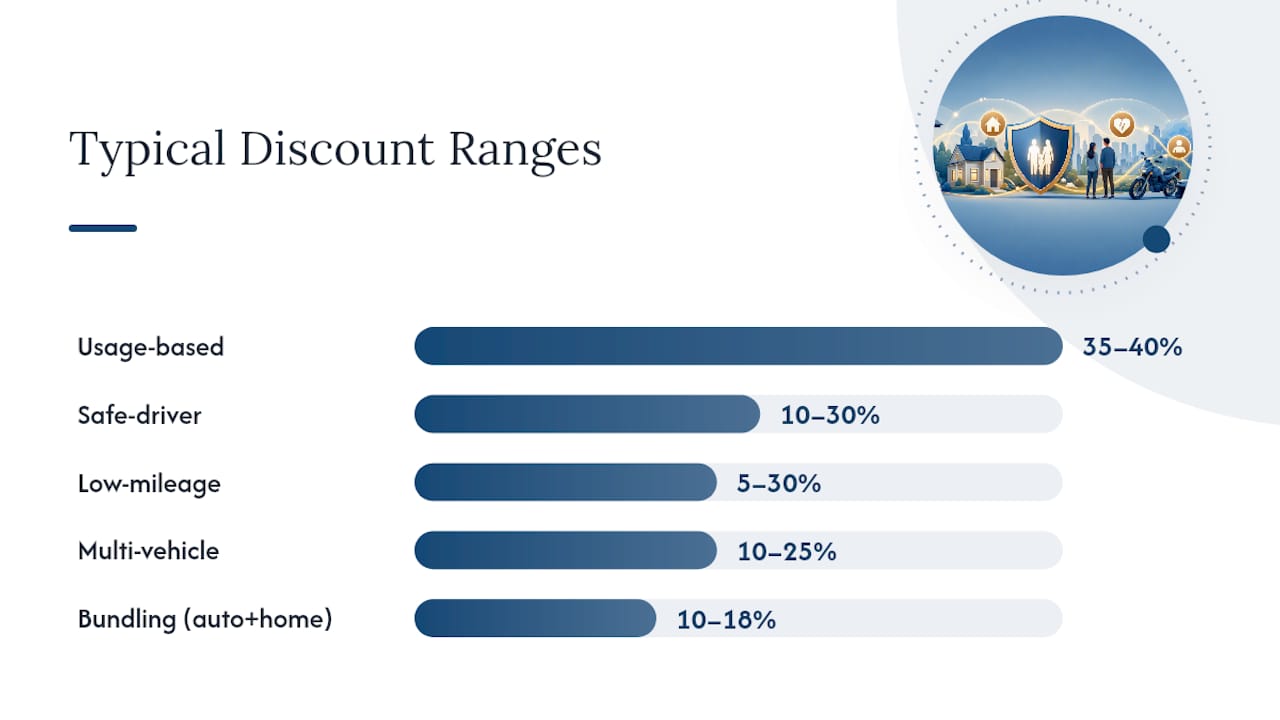
According to Insure.com, bundling auto and homeowners averages a 14% discount on auto premiums, paid-in-full saves roughly 9%, and digital discounts like autopay and paperless add roughly 7% combined. Industry sources commonly identify bundling and safe-driver discounts as the two largest common savings sources, with usage-based programs capable of producing outsized savings for the right driver profile.
Stacking has limits. Carriers generally apply discounts sequentially, not additively. The practical result is still meaningful, but the math is not linear. Some carriers also cap total discounts, so your premium may not keep dropping no matter how many discounts you qualify for.
Key insight: WalletHub notes that combined discounts can approach 40% in specific stacking scenarios, but that ceiling requires qualifying for nearly every available discount simultaneously. Realistic combined savings vary widely by carrier and household, which is why comparing the final premium across carriers matters more than any single discount percentage.
When should you re-shop your policy and audit your discounts?
Discounts are not permanent. Your eligibility changes as your life changes, and carrier pricing shifts every rate cycle. AARP recommends re-evaluating coverage and requesting quotes from multiple carriers at least every three years or after major life changes to keep discounts competitive.
Triggers that should prompt an immediate re-shop or audit:
- Moving to a new ZIP code or state (see our mover’s insurance checklist)
- Buying, leasing, or selling a vehicle
- A significant drop in annual mileage (remote work, retirement)
- Marriage or divorce
- A student on your policy earning a qualifying GPA or leaving for college
- Military deployment or return from active duty
- Turning 25 (rates often drop) or 65 (senior defensive driving discounts may apply)
- A prior at-fault accident or violation falling off your MVR after the carrier’s lookback period (usually 3–5 years)
Beyond life events, a routine audit every 12–24 months is worth scheduling even when nothing has changed. Carriers adjust their discount structures, and a competitor may now offer a better stack for your profile than your current carrier does. Our guide on how to review your auto policy and save money walks through what to check at each renewal.
Pro Tip: An independent agent can re-shop your risk across 30 or more carriers in a single call, comparing each carrier’s discount architecture against your specific profile. That is something a single-company agent structurally cannot do. See why an independent agent gives you real carrier choice before your next renewal.
How an independent agent finds discounts you would miss on your own
An independent agent’s core advantage is carrier breadth. Where a captive agent can only apply one company’s discount schedule, an independent agent tests your profile against multiple carriers’ discount structures and identifies which combination produces the lowest net premium.
Here is what a discount audit with an independent agent typically looks like:
- Profile review: The agent collects your driving history, vehicle VIN(s), household members, current coverage limits, and any affiliations (military, employer, alumni).
- Carrier comparison: The agent runs quotes across multiple carriers, specifically noting which ones offer the strongest discount for your dominant category (e.g., bundling vs. telematics vs. military).
- Stacking test: The agent identifies which discounts are stackable at each carrier and calculates the net premium after sequential application.
- Telematics recommendation: If a usage-based program looks favorable, the agent explains the monitoring terms, data retention policy, and opt-out window before recommending enrollment.
- Paperwork handling: The agent submits documentation (student transcripts, military ID, course certificates) directly to the carrier, reducing the chance of a discount being missed due to missing proof.
What clients often discover: A household that has been with the same carrier for eight years frequently finds that a competitor now offers a better bundling discount or a more favorable telematics program for their current mileage. The savings from switching, combined with a fresh discount audit, can outweigh any loyalty credit the existing carrier provides. Shopping around and actively asking for discounts are among the most effective ways to lower your auto insurance costs, according to the Insurance Information Institute (Triple-I).
How long the quote and comparison process takes depends on how quickly your documentation is ready. Bundling home and auto through a single agency is often the fastest single action that produces the largest combined discount, and an independent agent can structure both policies simultaneously. For local options, see Lubbock TX Auto Insurance: Compare Local Rates and Save.
What most drivers get wrong about insurance discounts
The conventional wisdom says: “Call your insurer and ask for discounts.” That advice is not wrong, but it misses the more important half of the equation.
Most drivers who call their existing carrier and ask for discounts receive the discounts that carrier already has on file for them. What they do not receive is a comparison of whether a different carrier’s discount architecture would produce a lower net premium even before any discounts are applied. The discount percentage is not the number that matters. The final premium is.
The second mistake is treating discounts as a one-time event. Drivers qualify for and lose discounts constantly: a student graduates, a violation drops off an MVR, annual mileage drops after a job change. The drivers who consistently pay less are the ones who audit their policy at every renewal and re-shop every two to three years, not the ones who locked in a good rate five years ago and assumed it held.
One more thing worth saying plainly: telematics programs are not right for every driver. If your commute involves heavy highway driving at peak hours, late-night trips, or frequent hard braking in stop-and-go traffic, the monitoring data may not work in your favor. Ask the carrier whether the program can raise your rate before you enroll, and read the data retention terms carefully.
Hettler Insurance Agency can audit your discounts across 30+ carriers
Hettler Insurance Agency is a family-owned independent agency in Lubbock, Texas, that has been placing auto, home, and commercial policies for Texans since 1992. Because the agency represents more than 30 top-rated carriers, the team can run a full discount audit across multiple companies in a single appointment, something a single-company agent cannot offer. Hettler Insurance Agency is one of the few family-owned agencies in Texas where both principals carry the high level certification of CIC (Certified Insurance Counselor). Fewer than 2% of licensed insurance professionals in the U.S. have earned the CIC designation.

The process is straightforward. You provide your driving history, vehicle VINs, and any qualifying documentation (student transcripts, military ID, course certificates, current policy declarations page). The Hettler Insurance Agency team compares carrier discount structures, tests bundling combinations, and identifies the net premium after stacking. There is no fee for the comparison, and there is no pressure to switch. Ron Hettler, CIC (Certified Insurance Counselor), agency founder and president with 45+ years of insurance industry experience, and Meghan Harris, CIC, who co-leads the agency with Ron, guide every review. The agency carries an A+ BBB rating and a 4.5-star Google rating.
To schedule your free discount audit or get a bundled home and auto quote, call the Lubbock office directly at (806) 798-7800 or submit a request through Hettler Insurance Agency.
Sources
- Auto Insurance Guide — Texas Department of Insurance
- FAQ: Auto insurance, claims, coverage issues, and more — Texas Department of Insurance
- Great ways to save on insurance — AARP
- Policy-Based Car Insurance Discounts: How to Save Up to 15% — Insure.com
- Auto insurance discounts guide: How to get the best discounts in 2026 — Insurance.com
- Nine ways to lower your auto insurance costs — Triple-I®
- IIHS — Insurance Institute for Highway Safety
- Car Insurance Discounts Explained: Save Up to 40% — WalletHub
This article provides general information and is not a substitute for advice from a licensed insurance professional. Discounts, eligibility, and amounts vary by carrier and state.
Frequently Asked Questions ?
Q1 ?: What are the most common examples of insurance discounts?
Q2 ?: Do insurance discounts apply automatically?
Q3 ?: How do telematics or usage-based discounts work?
Q4 ?: Can you stack multiple insurance discounts?
Q5 ?: How often should I audit my discounts or re-shop my policy?
Recommended
About the Author
Ronald J. Hettler, CIC is a Certified Insurance Counselor (CIC) [a gold-standard credential in the independent insurance industry that less than 2% earn]. Ron has over 46 years of real-world experience in the insurance industry. He is the owner/president of Hettler Insurance Agency in Lubbock, Texas and is licensed by the Texas Department of Insurance (License #666862). (Why Trust Hettler Insurance Agency? It’s a Local independent insurance agency representing multiple carriers. Hettler Insurance Agency has established business roots 100+ years going back to it’s predecessor in the late 1800’s. Local expertise in Lubbock Texas and West Texas risks. Focused on clarity before a claim occurs.) Ron and his daughter Meghan, also a CIC, lead a team that represents 30+ carriers and serves clients across Texas.
Ron specializes in helping individuals, families, and small business owners understand complex insurance concepts in clear, practical terms so they can make informed decisions about their coverage. He specializes in helping individuals and families understand coverage gaps, deductible structures, and real-world claim outcomes before a loss occurs. Ron helps you to understand how insurance policies respond in real-world claim situations.
License verification available through the Texas Department of Insurance.
— Life Insurance Instant Quote and Apply Tool @ GetLifePolicy.com > * Quick self-service term life insurance quote. With or without medical exam.
— Call us about Auto, Home, Business, Life, or Health insurance. * Click to Call (806) 798-7800, Mon-Fri 8:30am-5pm (lunch closed Noon-1pm)
— Come see us @ our new address 4720 S Loop 289 Lubbock, TX 79414 (maps link), or get your online quote started at https://GetHettler.com