

TL;DR summary:
- Life insurance paid by employer, formally called group-term life insurance, is a valuable no-cost benefit, but it usually equals only one to two times your salary, while financial planners commonly recommend about ten times your income for families with dependents or a mortgage. Under IRS Section 79, the first $50,000 of employer-paid coverage is tax-free; anything above that adds imputed income to your W-2. Group coverage also ends when your job ends, and conversion to an individual policy is typically priced at much higher individual rates. Next step: ask HR for your certificate of coverage, run the coverage worksheet below, update your beneficiaries, and talk with an independent agency like Hettler Insurance Agency about an individual term policy you own.
Life insurance paid by employer plans, formally called group-term life insurance, is a genuine benefit but rarely a complete financial safety net. Most employers provide basic coverage equal to one to two times your annual salary, and BLS data confirm that group life insurance is one of the most widely offered workplace benefits across private-sector employers. That coverage costs you nothing and requires no medical exam for the basic amount. The problem: for most employees with a mortgage, dependents, or significant debt, that baseline falls well short of what their family would actually need.
Before you assume you’re covered, take three quick steps:
- Check with HR for your exact coverage amount or formula (flat dollar amount vs. salary multiple).
- Confirm the tax treatment: under IRS Section 79, the first $50,000 of employer-paid group-term coverage is excluded from your income; anything above that generates imputed income on your W-2.
- Run a simple needs calculation (covered in detail below) to see how far your employer’s benefit actually goes.
Table of Contents
- Key Takeaways
- How does life insurance paid by employer plans actually work?
- How is employer-paid life insurance taxed?
- Is your employer’s life insurance coverage actually enough?
- What are your options for filling the coverage gap?
- Questions to ask HR about your employer life insurance
- When should you consult an independent agent or Certified Insurance Counselor?
- How we advise clients about employer-paid life insurance
- Hettler Insurance Agency can help you close the coverage gap
- Sources
- Frequently Asked Questions
Key Takeaways
Employer-paid group-term life insurance is a valuable baseline benefit, but for most employees with dependents, a mortgage, or significant debt, it covers only a fraction of the coverage a family actually needs.
| Point | Details |
|---|---|
| IRS $50,000 exclusion | Employer-paid coverage up to $50,000 is tax-free; amounts above that generate imputed income on your W-2 under Section 79. |
| Coverage gap is common | Most employer plans provide 1x–2x salary; financial planners typically recommend a total benefit closer to 10x annual income. |
| Coverage ends with your job | Group-term life insurance terminates when employment ends; conversion rights exist but carry significantly higher individual-rate premiums. |
| Update beneficiaries regularly | The plan pays whoever is on file; review your designation after every marriage, divorce, birth, or death in the family. |
| Hettler Insurance Agency compares multiple carriers | An independent benefits review with Hettler Insurance Agency shows you individual term options across multiple carriers to close your coverage gap. |
How does life insurance paid by employer plans actually work?
Your employer holds a single master policy with a carrier. You are a certificate holder under that policy, not the policy owner. That distinction matters more than most employees realize.
Group life insurance is almost always yearly-renewable term coverage, which means there is no cash value, no investment component, and no equity building over time. The employer pays the premium for the basic benefit, and coverage is typically guaranteed-issue up to the basic amount, meaning you qualify without answering health questions. That guaranteed-issue feature is one of the most underappreciated advantages of workplace life insurance, especially for employees who might not qualify for individual coverage at standard rates.
Basic vs. supplemental vs. voluntary coverage
Most employer plans offer three tiers:
| Coverage Type | Who Pays | Underwriting | Typical Amount |
|---|---|---|---|
| Basic employer-paid | Employer | Guaranteed-issue | Flat amount or 1x–2x salary |
| Supplemental/voluntary | Employee (payroll deduction) | Guaranteed-issue up to a limit; health questions above that | Additional multiples of salary |
| Dependent/spouse coverage | Employee | Often guaranteed-issue for modest amounts | Flat amount, varies by plan |
Employers typically offer a basic benefit equal to a flat amount or a salary multiple, most commonly one to two times annual salary. Supplemental coverage lets you buy additional protection through payroll deductions, often at group rates that are lower than what you’d find on the open market in the short term. The catch: both basic and supplemental coverage are tied to your employment. Leave the job, and the coverage ends.
Group-term vs. individual policies: the key differences
Group-term coverage is employer-controlled, meaning the employer can change carriers, reduce benefits, or terminate the plan. An individual policy you own cannot be changed by anyone except you. Group plans also lack portability in most cases; coverage generally terminates when employment ends, and conversion options, while available, come with significant cost increases. Individual term policies travel with you regardless of where you work, and they lock in your premium at the rate set when you bought the policy.
Eligibility note: Most employers require full-time status and a waiting period, typically 30 to 90 days, before group life coverage takes effect. Part-time employees and contractors are often excluded entirely.
How is employer-paid life insurance taxed?
The IRS rule is straightforward: up to $50,000 of employer-paid group-term life insurance is excluded from your gross income. Coverage above $50,000 is treated as imputed income under Section 79 and must be reported on your W-2.
How imputed income is calculated using Table I rates
The IRS publishes Table I, which assigns a monthly cost per $1,000 of excess coverage based on your age bracket. Here is how the math works for a concrete example (for example purposes only):
Scenario: You are 45 years old. Your employer provides $150,000 of group-term life insurance at no cost to you.
| Step | Calculation | Amount |
|---|---|---|
| Excess coverage | $150,000 − $50,000 | $100,000 |
| Table I rate (age 45–49) | $0.15 per $1,000/month | $0.15 |
| Monthly imputed income | ($100,000 ÷ $1,000) × $0.15 | $15.00/month |
| Annual imputed income | $15.00 × 12 | $180.00/year |
That $180 is added to your taxable wages and appears in Box 1 of your W-2. Your employer also withholds Social Security and Medicare (FICA) taxes on that imputed income, so you may notice a small deduction on your paystub labeled “GTL” (group-term life). The actual tax hit is modest for most employees at standard coverage levels, but it grows quickly if your employer provides coverage at three or four times a high salary.
The death benefit itself is generally income-tax-free to your beneficiaries under IRC Section 101(a), regardless of how much coverage you had. The imputed income rules apply only to the premium cost while you are alive, not to the payout.
Key tax points to keep in mind:
- Imputed income applies only to the employer-paid portion above $50,000; employee-paid supplemental premiums are handled differently.
- If you pay any portion of the premium yourself, that reduces the imputed income calculation.
- Retirees who retain group coverage through a former employer are subject to the same Section 79 rules.
- Find the current Table I rates and worked examples directly in IRS Publication 15-B (Table 2-2, Cost Per $1,000 of Protection for 1 Month).
Is your employer’s life insurance coverage actually enough?
For most employees, the honest answer is no. Group life insurance typically provides modest coverage, and financial planners commonly recommend a total death benefit equal to roughly ten times your annual income when you factor in income replacement, debt payoff, and future obligations like college funding. A one-times or two-times salary benefit closes a fraction of that gap.
A quick coverage worksheet
Use this formula to estimate your actual need:
(Annual income × 10) + Outstanding debts + Future major expenses − Liquid assets = Coverage target
Run it against your employer benefit to find the gap. If your employer provides $80,000 and your coverage target is $900,000, you have an $820,000 gap to fill.
Three scenarios where employer coverage falls short
Young single employee, no dependents: Even here, coverage should account for student loans, credit card debt, and final expenses. A $50,000 flat benefit may be adequate for now, but it will not be when circumstances change.
Primary earner with children and a mortgage: A $75,000 salary with a $300,000 mortgage and two children produces a coverage target well above $750,000. A one-times salary benefit of $75,000 leaves the family exposed by hundreds of thousands of dollars.
Single-income household with a stay-at-home spouse: The working spouse’s employer coverage addresses income replacement, but the stay-at-home spouse’s economic contribution (childcare, household management) is largely uninsured. Replacing those services costs real money, and spouse coverage, where an employer offers it, is usually a modest flat amount.
Pro Tip: Lock in an individual term policy while you are young and healthy. Rates are set at the time of application, so a 30-year-old buying a 20-year term policy today pays a fraction of what a 45-year-old would pay for the same coverage. Waiting costs more than most people expect.
What are your options for filling the coverage gap?
Employees seeking permanent coverage or policy flexibility should compare individual-market options with a licensed broker, since employer plans restrict both carrier choice and product types. Three practical paths exist.
Supplemental coverage through payroll. Many employers let you buy additional multiples of salary through the same group plan. This is often the easiest short-term option: no separate application, payroll-deducted premiums, and guaranteed-issue up to a plan-defined limit (commonly three to five times salary). The downside is that this coverage is still tied to your job. If you leave, you lose it, and the group rates that made it affordable disappear.
Conversion or portability. When you leave a job, most group plans offer a conversion right, which lets you convert your group coverage to an individual policy without medical underwriting. Portability, where available, lets you continue the group-term policy at your own expense. Both options sound appealing until you see the price. Conversion typically avoids underwriting but is priced at individual rates, which can be significantly higher than what you paid under the group plan. You must also request conversion within the plan’s window, usually 31 days of termination, or you lose the right entirely.
Individual term life insurance. Buying a standalone policy through an independent agent gives you ownership, portability, and a locked-in premium. You choose the carrier, the term length, and the coverage amount. If your employer’s plan changes or disappears, your individual policy is unaffected. For most employees with long-term dependents or a mortgage, this is the most reliable path to closing the gap. Use Hettler Insurance Agency’s GetLifePolicy.com instant quote tool to get a side-by-side look at individual term options before your agent meeting.
Decision guidance: Supplemental payroll coverage makes sense as a short-term bridge or when you need guaranteed-issue amounts quickly. Individual term coverage is the right call when you need protection that outlasts your current job, when your coverage gap is large, or when you want to lock in rates while your health is favorable.
Questions to ask HR about your employer life insurance
Most employees never read their certificate of coverage. That document contains the details that determine whether your family is actually protected. Before your next open enrollment, send HR a short email with these questions:
- What is my exact coverage amount or the formula used to calculate it?
- Does the plan provide coverage above $50,000, and if so, does my employer report imputed income on my W-2?
- Are my spouse and dependents eligible for coverage, and what are those amounts?
- What is the waiting period before coverage begins for new employees?
- What does supplemental coverage cost per pay period, and what are the guaranteed-issue limits?
- Do I have conversion or portability rights if I leave the company, and what is the deadline to exercise them?
- How do I update my beneficiary designation, and where is the current designation on file?
- What documentation does my beneficiary need to file a claim, and what is the typical payout timeline?
Sample email to HR: “Hi [Name], I’m reviewing my life insurance benefits and have a few questions about my current coverage. Could you share my exact coverage amount, the supplemental options available, and whether I have conversion rights if I leave the company? I’d also like to confirm my beneficiary designation is current. Thank you.”
Your certificate of coverage is the controlling document for all of these answers. Ask HR for a copy if you don’t already have one. That document also specifies the conversion window and the claim process, both of which are time-sensitive if you ever need them.
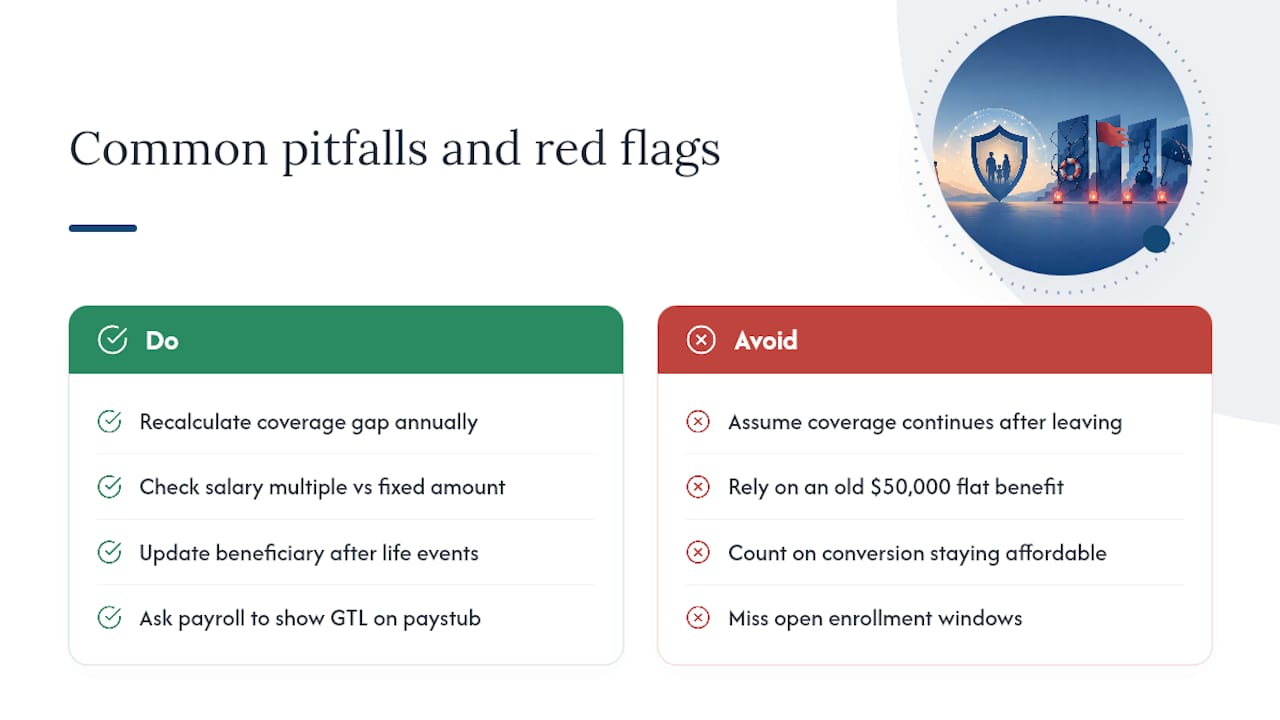
Common pitfalls and red flags to watch for
Several mistakes consistently leave families underinsured, and most of them are avoidable with a single conversation.
Assuming coverage follows you after leaving. It doesn’t. Group life coverage terminates when employment ends, and the conversion window is short. Employees who leave a job expecting to convert later often miss the deadline.
Relying on a low flat amount. A $50,000 flat benefit may have been set years ago and never adjusted for inflation or salary growth. Check whether your plan uses a salary multiple or a fixed dollar amount, and recalculate your gap annually.
Ignoring the imputed income surprise. Employees with high salaries and large employer-paid benefits sometimes discover a meaningful W-2 addition they didn’t expect. If your employer provides more than $50,000 of coverage, ask payroll to show you the GTL line on your paystub.
Forgetting to update beneficiaries. A beneficiary designation made at hire may name an ex-spouse, a deceased parent, or no one at all. The plan pays whoever is on file, regardless of your current wishes. Review and update your designation after every major life event.
Assuming convertible coverage stays affordable. Conversion rights are valuable, but the premium at individual rates can be significantly higher than what you paid under the group plan. Don’t count on conversion as your primary long-term strategy.
Plan-level red flags: Watch for age-reduction schedules (coverage often drops at age 65 or 70), benefit reductions at retirement, and guaranteed-issue windows that close after initial enrollment. Missing an open enrollment window can mean medical underwriting is required for any increase, which matters if your health has changed.
Exclusions and claims: Some group policies, particularly supplemental coverage, include a suicide exclusion (often two years) and other limitations, so check your certificate of coverage for the exact terms. Claims require a certified death certificate, the completed claim form, and sometimes additional documentation; beneficiaries should contact the employer’s HR department promptly to start the process.
When should you consult an independent agent or Certified Insurance Counselor?
Talk to a licensed agent when your coverage gap is large, when your health may complicate future underwriting, or when you need coverage that is not tied to your job. Those three situations describe a significant share of working adults.
Here is what an independent agent will do in a typical consultation:
- Run a needs analysis. The agent calculates your actual coverage target using your income, debts, dependents, and liquid assets, then compares that against your current employer benefit.
- Compare individual term rates across carriers. Because employer plans restrict carrier choice, an independent agent can show you options from multiple insurers, not just the one your employer chose.
- Explain conversion and portability options in your current plan and whether they are worth using or whether a new individual policy is more cost-effective.
- Provide actual premium quotes for the coverage amount and term length that match your needs, so you can make a decision based on real numbers.
Pro Tip: Bring these four things to your agent consultation: a recent pay stub (to confirm your salary and the GTL deduction), your certificate of coverage from HR, a list of your current debts and major future expenses, and your intended beneficiary names. The meeting will be faster and the quotes more accurate.
Ron Hettler, CIC (Certified Insurance Counselor), agency founder and president with 45+ years of insurance industry experience, and Meghan Harris, CIC, who co-leads the agency with Ron, lead Hettler Insurance Agency’s life insurance consultations. The CIC designation is the gold standard credential in the insurance industry, requiring ongoing education and demonstrated expertise across all lines of coverage. Hettler Insurance Agency is one of the few family-owned agencies in Texas where both principals carry the high level certification of CIC (Certified Insurance Counselor). Fewer than 2% of licensed insurance professionals in the U.S. have earned the CIC designation.
How we advise clients about employer-paid life insurance
At Hettler Insurance Agency, we treat employer-paid coverage as a baseline, not a plan. The first thing we tell clients is that their group benefit is a starting point worth keeping, but ownership and portability matter for long-term security.
A common client path looks like this: an employee in their early 30s enrolls in the basic employer benefit at hire, takes the supplemental option for an additional salary multiple, and assumes they are covered. A few years later, after a mortgage and a child, they run the worksheet and find a gap of $600,000 or more. At that point, we help them buy an individual 20-year term policy to cover the long-term need and keep the employer benefit as a secondary layer. The convertibility right on the group plan becomes a safety net rather than a primary strategy.
That approach, combining a portable individual policy with the employer baseline, is what we recommend to most working Texans with dependents. It keeps costs manageable and ensures coverage does not disappear the next time the job market shifts. For more on building a family plan, see Life Insurance Steps for Families in Texas.
Hettler Insurance Agency can help you close the coverage gap
If your employer’s group life benefit leaves a gap, the right next step is a no-pressure benefits review with an independent agent who can compare real options across multiple carriers.

Hettler Insurance Agency is an independent agency with access to multiple top-rated life insurance carriers, which means we shop the individual term market on your behalf rather than steering you toward a single company. A benefits review with us is quick and straightforward. To get accurate quotes, bring your age, the coverage amount you need, your employer certificate if available, and basic health information. From there, we compare individual term options across carriers and show you what closing your gap actually costs.
Hettler Insurance Agency serves clients across Texas, from Lubbock to Dallas to Midland-Odessa, with no-pressure consultations and no extra fees. To get started, review how insurance protects your family or contact the agency directly at Hettler Insurance Agency to schedule your benefits review.
Sources
The following sources provide the primary official and high-authority guidance referenced throughout this article:
- Group-term life insurance | Internal Revenue Service
- Publication 15-B, Employer’s Tax Guide to Fringe Benefits | Internal Revenue Service
- Group Life Insurance Explained: Types, Benefits, and Drawbacks
- How Does Employer Life Insurance Work: Coverage and Taxes – LegalClarity
- Group life insurance: What it is, how it works, pros and cons
- Employee benefits in the United States — BLS (EBS)
- Group life insurance through work — NerdWallet
This article provides general information about employer-paid life insurance and is not a substitute for professional insurance or tax advice. Confirm current IRS rules and your specific plan terms with a qualified professional or your plan administrator.
Frequently Asked Questions ?
Q1 ?: Is life insurance paid by my employer taxable?
Q2 ?: How much life insurance does an employer usually provide?
Q3 ?: What happens to my employer life insurance if I leave my job?
Q4 ?: Should I buy supplemental life insurance through work or an individual term policy?
Q5 ?: What should I ask HR about my employer life insurance?
Recommended
About the Author
Ronald J. Hettler, CIC is a Certified Insurance Counselor (CIC) [a gold-standard credential in the independent insurance industry that less than 2% earn]. Ron has over 46 years of real-world experience in the insurance industry. He is the owner/president of Hettler Insurance Agency in Lubbock, Texas and is licensed by the Texas Department of Insurance (License #666862). (Why Trust Hettler Insurance Agency? It’s a Local independent insurance agency representing multiple carriers. Hettler Insurance Agency has established business roots 100+ years going back to it’s predecessor in the late 1800’s. Local expertise in Lubbock Texas and West Texas risks. Focused on clarity before a claim occurs.) Ron and his daughter Meghan, also a CIC, lead a team that represents 30+ carriers and serves clients across Texas.
Ron specializes in helping individuals, families, and small business owners understand complex insurance concepts in clear, practical terms so they can make informed decisions about their coverage. He specializes in helping individuals and families understand coverage gaps, deductible structures, and real-world claim outcomes before a loss occurs. Ron helps you to understand how insurance policies respond in real-world claim situations.
License verification available through the Texas Department of Insurance.
— Life Insurance Instant Quote and Apply Tool @ GetLifePolicy.com > * Quick self-service term life insurance quote. With or without medical exam.
— Call us about Auto, Home, Business, Life, or Health insurance. * Click to Call (806) 798-7800, Mon-Fri 8:30am-5pm (lunch closed Noon-1pm)
— Come see us @ our new address 4720 S Loop 289 Lubbock, TX 79414 (maps link), or get your online quote started at https://GetHettler.com