


TL;DR summary:
- Fiduciary coverage, formally called fiduciary liability insurance, pays defense costs, settlements, and judgments when plan participants or the Department of Labor allege a breach of fiduciary duty under ERISA. Anyone with discretionary control over a benefit plan can be personally liable, regardless of job title. Watch for key exclusions such as intentional fraud, criminal acts, failure to fund, and prior-known circumstances, and confirm whether defense costs sit inside or outside your limit. Next step: identify everyone in your organization who holds a fiduciary role, gather your most recent Form 5500, plan documents, and participant count, then contact an independent agency like Hettler Insurance Agency for a policy review.
If you sponsor an employee benefit plan or exercise discretionary control over plan investments, fees, or administration, you need fiduciary coverage, formally called fiduciary liability insurance. This coverage pays your legal defense, settlements, and judgments when participants or the Department of Labor allege you mismanaged the plan. Without it, ERISA allows claimants to pursue your personal assets directly.
Table of Contents
- Key Takeaways
- What is fiduciary coverage and how does ERISA create the risk?
- What does a fiduciary policy actually pay?
- Who does the policy protect?
- Real-world claims that fiduciary coverage addresses
- How fiduciary policy mechanics work
- Standalone policy versus a management-liability package
- How to shop for fiduciary coverage and what to ask your agent
- Why independent agency advice matters for fiduciary risk
- Hettler Insurance Agency can review your fiduciary exposure today
- Useful sources for further reading
- Frequently Asked Questions
Key Takeaways
Fiduciary liability insurance protects plan sponsors and individual fiduciaries from personal financial exposure when ERISA-covered benefit plans face claims of mismanagement.
| Point | Details |
|---|---|
| Confirm fiduciary status | Anyone with discretionary authority over plan assets or administration is personally exposed under ERISA. |
| Check defense-cost placement | Outside-the-limit defense preserves your full policy limit; inside-the-limit (shrinking limits) erodes it with every legal bill. |
| Verify prior-acts coverage | Switching insurers without tail coverage or a prior-acts endorsement can leave earlier acts uninsured. |
| Review exclusions carefully | Intentional fraud, failure to fund, and prior-known acts are standard exclusions that can void coverage if not disclosed. |
| Get quotes through Hettler Insurance Agency | As an independent agency, Hettler Insurance Agency compares policy wording and limits across multiple insurers to find the right fit for your plan. |
What is fiduciary coverage and how does ERISA create the risk?
Fiduciary liability insurance protects plan sponsors, trustees, investment committee members, and plan administrators against claims that they breached their fiduciary duties in managing an employee benefit plan. The U.S. Department of Labor’s Employee Benefits Security Administration defines fiduciary duties under ERISA as the obligations to act prudently, diversify plan investments, follow plan documents, and act solely in participants’ interests. Anyone who exercises discretionary authority over plan management or assets qualifies as a fiduciary under ERISA, regardless of their job title.
That last point surprises many business owners. A CFO who approves the investment menu, an HR director who determines eligibility, and a committee that selects the recordkeeper can all be fiduciaries. Each one is personally exposed if a participant or the DOL alleges a breach. For a broader look at the rules Texas employers must follow, see Why Insurance Compliance Matters: A 2026 Guide.
According to IRMI, fiduciary liability claims arise from discretionary acts governed by ERISA, while employee benefits E&O (errors and omissions) covers nondiscretionary administrative mistakes governed by common law. The distinction matters because the legal theories, damages, and defenses differ. Many modern policies bundle both exposures under a single insuring agreement, which simplifies coverage but requires careful wording review to confirm both are actually included.
One more distinction worth knowing: fiduciary liability insurance is separate from the ERISA fidelity bond. The fidelity bond, required by ERISA for every person who handles plan funds and generally set at no less than 10% of the funds handled, protects plan assets from theft and employee dishonesty. Fiduciary liability insurance protects the people managing the plan from liability claims. They are not interchangeable, and you likely need both.
What does a fiduciary policy actually pay?
A well-structured policy covers the following:
- Defense costs — attorney fees and court costs to defend alleged breaches of fiduciary duty, even when the allegations are groundless.
- Settlements and judgments — amounts the fiduciaries are legally obligated to pay participants or the plan.
- DOL and IRS investigation costs — legal representation during audits and voluntary correction programs. DOL investigations can be expensive even when resolved without litigation, and most fiduciary policies include this defense coverage.
How defense costs are treated inside the policy is one of the most consequential decisions you will make when comparing quotes. Policies with defense costs outside the limit preserve the full policy limit for settlements and judgments. Policies with defense costs inside the limit, sometimes called “shrinking limits,” reduce your available coverage every time the insurer pays a legal bill. A $1 million policy with inside-the-limit defense can be substantially eroded before a case ever reaches settlement. Outside-the-limit defense is superior, though it typically carries a higher premium.
Who does the policy protect?
Most fiduciary policies define covered persons broadly to include:
- Individual fiduciaries (trustees, named fiduciaries, investment committee members)
- Plan administrators and HR personnel with discretionary authority
- The plan-sponsoring organization itself
- Former fiduciaries for acts committed during their tenure
- In some policies, employee benefit plans as named insureds
Severability language (also called innocent-insured provisions) is worth verifying. This wording prevents one fiduciary’s alleged dishonest or fraudulent act from voiding coverage for other, innocent insureds on the same policy. Without it, a single bad actor’s conduct could strip coverage from everyone else named on the policy.
Check the policy’s definition of “Insured Person” carefully. Narrow definitions that omit committee members or outside plan administrators are a common wording trap, and one of the four items that most frequently cause coverage disputes, per IRMI’s analysis of fiduciary policy wording.

In Lubbock, Texas, calculating on insurance paperwork considering fiduciary coverage.
Real-world claims that fiduciary coverage addresses
Understanding the abstract risk is one thing. Seeing how claims actually develop is what makes plan sponsors take action.
- Excessive plan fees — Participants allege the plan paid unreasonable recordkeeping or investment fees because fiduciaries never benchmarked them against the market.
- Imprudent investment options — Participants allege the committee kept underperforming or high-cost funds on the menu without a documented review process.
- Failure to timely remit contributions — Employee payroll deferrals are deposited late, even by a few days. Under ERISA, late deposits are a fiduciary breach. They can trigger IRS excise taxes and require correction, often through the DOL’s Voluntary Fiduciary Correction Program.
Pro Tip: Document every investment decision, vendor selection, and fee benchmarking review in writing. A well-maintained investment policy statement and committee meeting minutes are your first line of defense. Insurers and courts both look for evidence of a prudent process, not just a good outcome.
How fiduciary policy mechanics work
Claims-made trigger
Fiduciary policies are written on a claims-made basis. Coverage applies when both the wrongful act and the claim fall within the policy period, or when the wrongful act occurred after the retroactive date and the claim is made during the policy period. Switching insurers without securing tail coverage or a prior-acts endorsement creates a gap: a claim for acts committed before the new policy’s retroactive date, filed after the old policy expires, may be uninsured.
Retention and deductible structure
Retentions (deductibles) apply per claim or per suit, depending on the policy. A per-claim retention means you pay the retention amount for each separate claim, which can multiply quickly in a class action. Confirm which structure applies before binding.
Limits and premium guidance
As general market context, many plan sponsors start at $1 million in limits and scale upward in $1 million increments as plan assets and participant counts grow. Smaller plans typically see lower annual premiums; mid-size and large plans face materially higher premiums and higher recommended limits. The table below shows general starting points (for example purposes only); your agent should size limits to your actual plan.
| Plan Size | General Starting Limit | Key Premium Drivers |
|---|---|---|
| Small (under 100 participants) | $1 million | Plan assets, claims history |
| Mid-size (100–several hundred participants) | $2–5 million | Assets, industry, vendor oversight |
| Large (1,000 participants and above) | $5 million+ | Assets, participant count, prior claims |
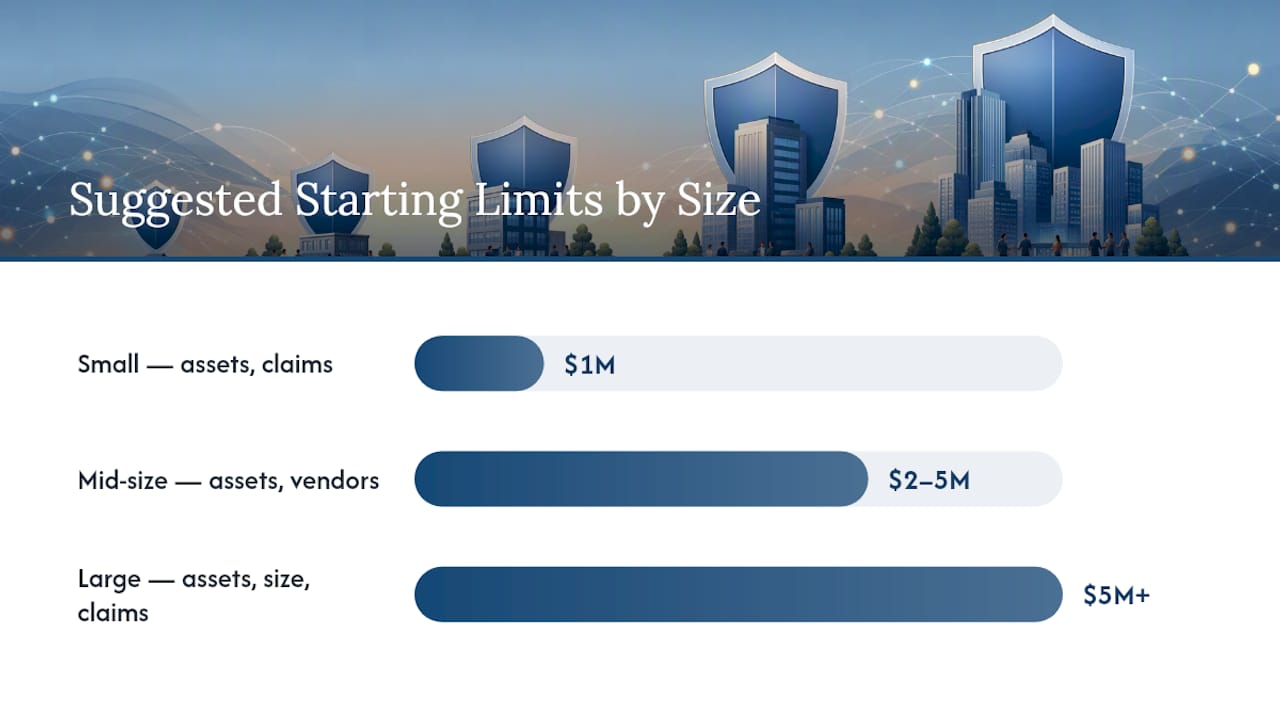
Defense-cost placement matters more than premium in many claims. Defense spending can quickly erode settlement capacity when costs are inside the limit. Outside-the-limit defense preserves your full limit for judgments and settlements, but expect to pay more for it.
Standalone policy versus a management-liability package
Fiduciary coverage is sold two ways: as a standalone policy or as part of a management-liability package that bundles directors and officers (D&O), employment practices liability (EPL), and sometimes cyber coverage under one program.
| Factor | Standalone Fiduciary Policy | Management-Liability Package |
|---|---|---|
| Coverage control | Dedicated wording, full limit for fiduciary claims | Shared aggregate limit across D&O, EPL, fiduciary, cyber |
| Cost | Higher standalone premium | Often lower combined premium |
| Limit erosion risk | Low — limit reserved for fiduciary claims only | High — one large D&O or EPL claim can exhaust shared limits |
| Wording flexibility | Easier to negotiate specific endorsements | Carrier may resist modifying one line within a package |
| Best for | Large plans, complex benefit programs, prior claims | Small plans, cost-sensitive buyers, simpler benefit structures |
Bundling is common practice among large brokers and carriers, and it can make sense for smaller organizations with straightforward plans. The risk is shared limits: a significant D&O claim can consume the aggregate before a fiduciary claim is ever filed. For plans with substantial assets or a history of participant complaints, a standalone policy with its own dedicated limit is the safer structure. Also consider how employment practices liability (EPL) coverage interacts with your overall management-liability program, since employee benefit exposures and employment practices exposures often arise from the same workforce events.
How to shop for fiduciary coverage and what to ask your agent
What to gather before you call
- Most recent Form 5500 (or draft if not yet filed)
- Plan documents and summary plan descriptions
- Investment policy statement
- Current participant count and total plan assets
- Five-year claims and DOL inquiry history
- List of all persons serving in a fiduciary capacity
Questions to ask every agent or broker
- Are defense costs inside or outside the policy limit?
- What is the retroactive date, and does it cover prior acts?
- Is there a settlement-control clause (hammer clause), and what are its terms?
- How is “Insured Person” defined, and does it include committee members and outside administrators?
- What is the sublimit for DOL or IRS voluntary correction programs?
- What tail options are available if we switch carriers?
Red flags in quotes and policy language
- A narrow definition of “Insured Person” that excludes committee members
- A broad prior-knowledge exclusion with no carve-back for innocent insureds
- Defense costs inside the limit with no option to move them outside
- No retroactive date or a retroactive date that does not reach back to the plan’s inception
Pricing factors that materially affect your premium include plan assets, participant count, industry type, claims history, and the quality of your vendor oversight documentation. A plan with a documented investment policy statement and regular fee benchmarking reviews typically presents better to underwriters than one without.
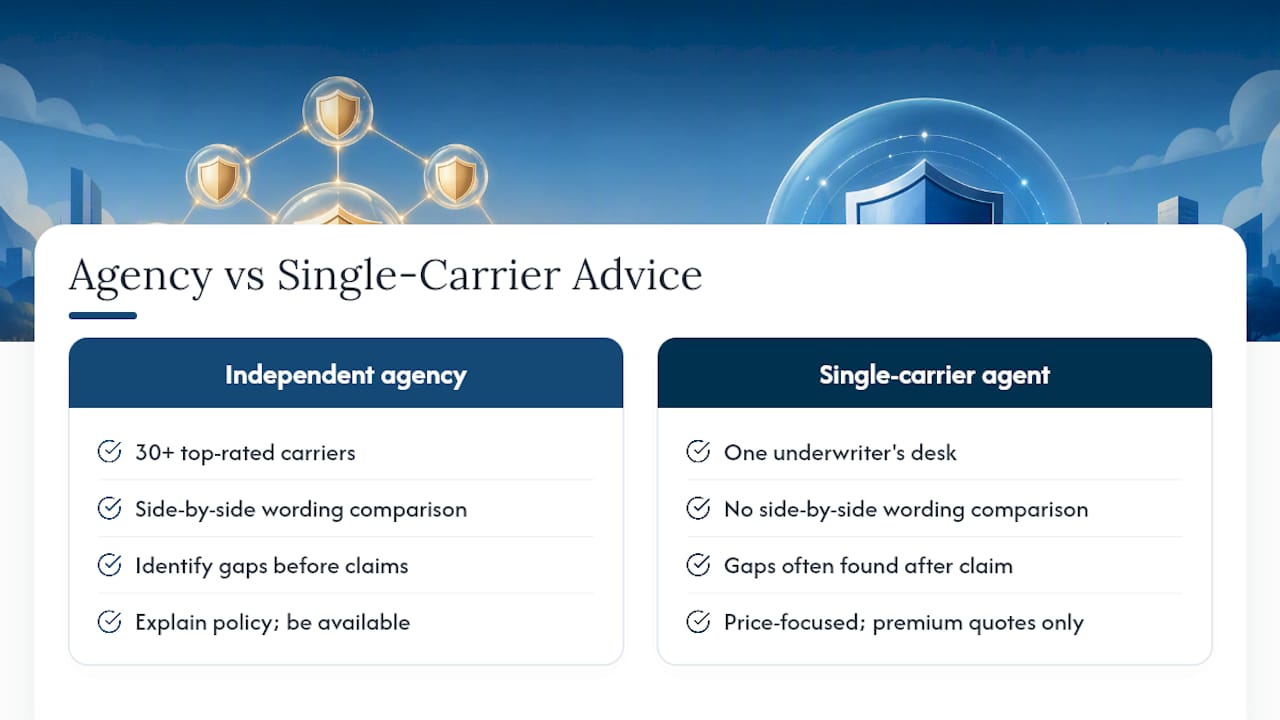
Pro Tip: Use an independent agency to shop fiduciary coverage. An independent broker can submit your application to multiple carriers, compare policy wording side by side, and flag the specific provisions — defense-cost placement, prior-acts coverage, severability — that most buyers miss when reviewing a quote alone. For context on why higher limits and outside-the-limit defense matter, the same financial logic that applies to higher liability limits in other lines applies here: the cost difference between adequate and inadequate limits is small at purchase and enormous at claim time.
Why independent agency advice matters for fiduciary risk
Most plan sponsors buy fiduciary coverage once and assume it is adequate until a claim arrives. That assumption is where gaps form. The four policy items that most frequently cause coverage disputes are the definition of “Insured Person,” prior-knowledge language, whether defense costs are within limits, and settlement-control clauses. These are not details you can evaluate by comparing premium quotes alone.
Working with an independent agency that understands both the insurance market and the ERISA regulatory environment gives you something a single-carrier agent cannot: a side-by-side comparison of wording, not just price. Ron Hettler, CIC (Certified Insurance Counselor), and Meghan Harris, CIC, who co-leads the agency with Ron, have spent decades helping Texas business owners identify coverage gaps before they become claim problems. The agency’s independent access to multiple carriers that write management liability means your application goes to the market, not to one underwriter’s desk.
Hettler Insurance Agency is one of the few family-owned agencies in Texas where both principals carry the high level certification of CIC (Certified Insurance Counselor). Fewer than 2% of licensed insurance professionals in the U.S. have earned the CIC designation.
Hettler Insurance Agency has earned recognition from Three Best Rated® and Expertise.com as a leading insurance agency in Lubbock, and holds an A+ BBB rating. That track record reflects a straightforward commitment: find the right coverage at the right price, explain what the policy actually does, and be available when questions arise.
Hettler Insurance Agency can review your fiduciary exposure today
Texas plan sponsors who manage employee benefit plans face real personal liability under ERISA, and the right fiduciary policy is the difference between a manageable claim and an out-of-pocket judgment. Hettler Insurance Agency is an independent agency, which means no single-carrier bias and no pressure to fit your plan into one product. The team shops your application across multiple carriers, compares policy wording on the items that matter most (defense-cost placement, prior-acts coverage, severability), and delivers a clear recommendation.

Ron Hettler and Meghan Harris are both CIC (Certified Insurance Counselors), the gold standard credential in the industry, with a combined depth of experience that covers commercial lines, employee benefits liability, and specialty coverages. Whether you are buying fiduciary coverage for the first time or reviewing an existing policy for gaps, the process is straightforward: gather your Form 5500, participant count, and plan asset total, then reach out for a policy review. Start with the core commercial coverages every Texas business owner needs as a baseline, then add fiduciary liability on top. Contact Hettler Insurance Agency today to request your fiduciary coverage review.
Useful sources for further reading
- U.S. Department of Labor — EBSA: Plan Administration and Compliance: The primary federal resource for ERISA fiduciary duties, plan administration requirements, and DOL enforcement priorities. Start here to understand what regulators expect of plan sponsors.
- U.S. Department of Labor — Field Assistance Bulletin 2008-04: ERISA Fidelity Bonding: The DOL’s guidance on who must be bonded under ERISA section 412 and how much bond coverage is required.
- IRMI — Fiduciary Liability Insurance Basics: A detailed technical breakdown of insuring agreements, the fiduciary liability vs. employee benefits E&O distinction, claims-made mechanics, and the four policy wording items most likely to cause disputes.
- BenefitsLink — Fiduciary Insurance Overview (PDF): Clarifies the critical distinction between fiduciary liability insurance and the ERISA-required fidelity bond, a point that confuses many first-time buyers.
- Travelers — Fiduciary Liability Coverage 101 (PDF): Carrier-produced policy highlight sheet illustrating settlement-program sublimits, duty-to-defend language, and coverage examples. Helpful when reviewing your own policy wording.
This article provides general information about fiduciary liability insurance and is not legal, financial, or professional advice. ERISA rules and policy terms vary; confirm current requirements with the DOL, a qualified ERISA attorney, or a licensed insurance professional before making coverage decisions.
Frequently Asked Questions ?
Q1 ?: What is fiduciary coverage?
Q2 ?: Who counts as a fiduciary under ERISA?
Q3 ?: Is fiduciary liability insurance the same as an ERISA fidelity bond?
Q4 ?: Why does it matter whether defense costs are inside or outside the policy limit?
Q5 ?: Should I buy a standalone fiduciary policy or a management-liability package?
Recommended
About the Author
Ronald J. Hettler, CIC is a Certified Insurance Counselor (CIC) [a gold-standard credential in the independent insurance industry that less than 2% earn]. Ron has over 46 years of real-world experience in the insurance industry. He is the owner/president of Hettler Insurance Agency in Lubbock, Texas and is licensed by the Texas Department of Insurance (License #666862). (Why Trust Hettler Insurance Agency? It’s a Local independent insurance agency representing multiple carriers. Hettler Insurance Agency has established business roots 100+ years going back to it’s predecessor in the late 1800’s. Local expertise in Lubbock Texas and West Texas risks. Focused on clarity before a claim occurs.) Ron and his daughter Meghan, also a CIC, lead a team that represents 30+ carriers and serves clients across Texas.
Ron specializes in helping individuals, families, and small business owners understand complex insurance concepts in clear, practical terms so they can make informed decisions about their coverage. He specializes in helping individuals and families understand coverage gaps, deductible structures, and real-world claim outcomes before a loss occurs. Ron helps you to understand how insurance policies respond in real-world claim situations.
License verification available through the Texas Department of Insurance.
— Life Insurance Instant Quote and Apply Tool @ GetLifePolicy.com > * Quick self-service term life insurance quote. With or without medical exam.
— Call us about Auto, Home, Business, Life, or Health insurance. * Click to Call (806) 798-7800, Mon-Fri 8:30am-5pm (lunch closed Noon-1pm)
— Come see us @ our new address 4720 S Loop 289 Lubbock, TX 79414 (maps link), or get your online quote started at https://GetHettler.com