

TL;DR summary:
- West Texas property owners face increasing insurance risks due to severe weather, wildfire, and flooding. Many policies contain gaps like underinsurance, exclusions, and market withdrawal, heightening vulnerability. Proactive coverage reviews and supplemental policies are essential to protect against escalating losses.
West Texas property owners are facing a reality that many didn’t see coming: the top insurance risks in West Texas have multiplied, and the cost of being unprepared has never been higher. Texas homeowners already pay 26% above the national average for home insurance premiums, and 2025 brought a 14% year-over-year spike driven by severe weather events. Whether you own a home in Lubbock, run a business in Midland-Odessa, or farm outside Amarillo, your exposure to loss is real, growing, and worth understanding before your next renewal.
Table of Contents
- Key takeaways
- 1. Severe hail storms: the single biggest claims driver
- 2. Tornadoes and high-wind events
- 3. Wildfires and drought-related property damage
- 4. Flooding: the coverage gap most people don’t see coming
- 5. Wildfire smoke and air quality liability for commercial properties
- 6. Insurer withdrawal and market tightening
- 7. Underinsurance after property value increases
- 8. Workers’ compensation gaps for seasonal and agricultural workers
- 9. Cyber liability for small businesses
- 10. Coverage strategy: matching protection to your actual risk
- My take on what West Texas property owners are getting wrong
- Protect your West Texas assets with the right coverage
- FAQ
Key takeaways
| Point | Details |
|---|---|
| Severe weather tops claims | Thunderstorms and tornadoes drive the majority of insurance claims and premium increases across West Texas. |
| Standard policies have gaps | Flood, wildfire, and drought damage are often excluded from basic homeowners and commercial policies. |
| Insurers are pulling back | Major carriers are tightening underwriting or exiting Texas, limiting your options and raising costs. |
| Underinsurance is widespread | Homes are frequently insured for 20% less than true replacement cost, leaving owners exposed after a disaster. |
| Supplemental coverage fills gaps | Lump-sum disaster insurance can cover what traditional policies miss, including income loss and out-of-pocket costs. |
1. Severe hail storms: the single biggest claims driver
Hail is the defining weather threat across West Texas. The Lubbock-to-Amarillo corridor sits in one of the most active hail corridors in the entire country, and the insurance numbers reflect that reality. Thunderstorms alone account for 52% of home insurance claims in Texas, with tornadoes adding another 23%.
For homeowners, a single severe hail event can total a roof, destroy gutters, shatter skylights, and damage HVAC units simultaneously. For commercial property owners, the losses scale dramatically. Flat commercial roofs are especially vulnerable, and many business owners only discover their true exposure after filing a claim.
Key insurance challenges tied to hail in West Texas:
- Wind and hail deductibles are frequently separate from your standard deductible and calculated as a percentage of your home’s insured value, often 1% to 3%.
- Actual cash value vs. replacement cost clauses matter. Policies that pay actual cash value after depreciation can leave you thousands short on a new roof.
- Coverage exclusions for pre-existing damage or “cosmetic” hail damage are becoming more common in policy language.
Pro Tip: Ask your agent specifically whether your policy pays replacement cost value or actual cash value on the roof. That single clause can be the difference between a check that covers your new roof and one that covers half of it.
2. Tornadoes and high-wind events
West Texas sits squarely in the path of one of the most active tornado regions in North America, and the risk zone is actively expanding southward. Tornadoes cause structural damage that goes well beyond roof damage. Foundation displacement, total structure loss, and extended business interruption are all on the table.
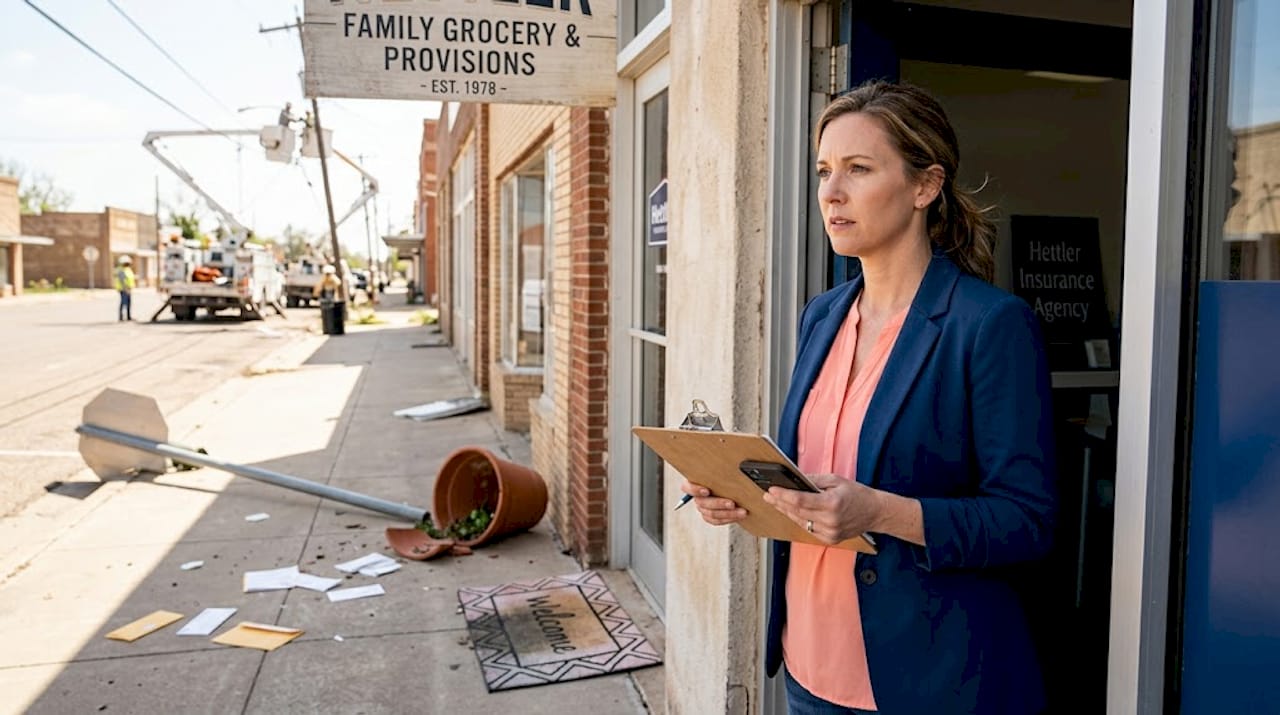
For business owners, the financial exposure extends beyond the physical building. A tornado that closes your location for six weeks means six weeks of revenue gone, payroll obligations that don’t stop, and customer relationships at risk. Business interruption coverage is not automatically included in every commercial policy. You have to ask for it and confirm the waiting period and payout limits align with your actual operational risk.
3. Wildfires and drought-related property damage
Wildfire risk in West Texas has moved from a fringe concern to a front-line threat. Changing climate patterns are increasing both wildfire frequency and drought severity across the region, creating a compounding risk profile for property owners and agricultural operators alike.
A fast-moving grass fire can reach a structure in minutes under the right wind conditions. Standard homeowners policies do typically cover wildfire damage to the structure, but gaps appear quickly when you look closely:
- Outbuildings and fences are often sub-limited or excluded entirely.
- Agricultural equipment and crops require separate coverage, typically through a federal crop insurance program or private policy.
- Business interruption from wildfire smoke or evacuation orders may not be covered without a specific endorsement.
Farmers and ranchers face a separate layer of exposure. Drought-triggered crop losses require specific crop insurance products, and the indemnity triggers in those policies are not always intuitive. Understanding exactly when and how a claim pays out is critical before a bad season hits.
4. Flooding: the coverage gap most people don’t see coming
Flood damage is one of the most misunderstood insurance challenges in West Texas. Many residents assume they are not at significant flood risk because the region is semi-arid. That assumption is wrong. Heavy rainfall events cause rapid runoff in flat terrain with limited drainage infrastructure, and flash flooding can inundate properties with no prior warning.
Standard homeowners policies exclude flood damage. Full stop. That includes water that enters your home from overflowing streets, drainage ditches, or storm surge. If you do not have a separate flood insurance policy, that damage comes out of your pocket.
What you need to know about flood coverage in West Texas:
- NFIP policies (National Flood Insurance Program) are available through participating insurers and cover up to $250,000 on structure and $100,000 on contents.
- Private flood insurance often provides higher limits, broader coverage, and faster claims processing than NFIP.
- Mortgage lenders in designated flood zones require flood insurance. But even outside those zones, the financial exposure is real.
Pro Tip: Even if your property is not in a FEMA-designated Special Flood Hazard Area, you can still experience flood damage. Roughly 25% of flood claims come from outside high-risk flood zones. Supplemental flood coverage is worth the premium.
5. Wildfire smoke and air quality liability for commercial properties
This one catches business owners off guard. When regional wildfires send smoke into populated areas, businesses face liability exposure they have not accounted for. If a customer or employee experiences a health event on your property during a smoke event, and you have not taken documented steps to address air quality, you may be looking at a general liability claim. This is an emerging West Texas liability risk that most commercial policies were not written with in mind. Speak with your agent about general liability language around environmental conditions.
6. Insurer withdrawal and market tightening
The insurance market challenges in West Texas are not just about weather. They are about carrier behavior. Progressive stopped selling new homeowners policies in Texas in 2026, citing the fact that Texas accounted for roughly 40% of the company’s total storm losses in Q2 2024. Progressive is not alone in tightening its Texas position.
When fewer carriers are willing to write policies in your area, the ones who remain have less incentive to compete on price or terms. That means higher premiums, higher deductibles, and more restrictive policy language for property owners who have fewer options.
What this means practically for you:
- Shopping your policy annually is no longer optional. Carrier appetite changes, and loyalty rarely translates to better rates in a tightening market.
- Independent agents have access to multiple carriers and can find options that a single-carrier agent simply cannot offer.
- Non-renewal notices are increasing across Texas. Have a backup carrier identified before you receive one.
Insurance market tightening makes proactive planning essential, not optional.
7. Underinsurance after property value increases
This is the silent risk that most policyholders do not discover until they file a claim. Homes are frequently underinsured by 20% or more of their actual replacement cost, and construction costs in West Texas have risen sharply since 2020. Your policy might show a coverage limit that looks reasonable. But if that limit is based on a valuation from three years ago, you are exposed.
The fix is straightforward: request a replacement cost estimator review with your agent. This is not the same as your home’s market value. Replacement cost is what it actually costs to rebuild your home with current labor and material prices. For commercial properties, this gap can be even wider when specialized equipment, HVAC systems, and tenant improvements are factored in. Review the factors behind policy increases to understand how this number should be growing over time.
8. Workers’ compensation gaps for seasonal and agricultural workers
West Texas employers in agriculture, oil field services, and construction face a workers’ compensation exposure that does not always match the coverage they carry. Seasonal workers, subcontractors, and rotating crew arrangements create classification and coverage gaps that come to light only after an injury occurs.
If a worker is injured on your property and your workers’ comp policy does not correctly classify them, you may face uncovered claims, fines, and litigation. Review your policy classifications with your agent before each busy season, not after.
9. Cyber liability for small businesses
Small and mid-size businesses in West Texas are not too small to be targeted by a data breach or ransomware event. In fact, smaller operations are frequently targeted precisely because their defenses are thinner. A cyber event can shut down point-of-sale systems, expose customer data, and trigger notification requirements under Texas law.
Standard business owners policies do not include cyber liability coverage. It requires a separate endorsement or standalone policy. The costs of a breach, including forensic investigation, customer notification, and regulatory fines, typically exceed what most small business owners expect.
10. Coverage strategy: matching protection to your actual risk
Understanding the risks is step one. Building a coverage strategy around them is what protects your financial position. The table below outlines the top coverage categories relevant to West Texas property owners, along with key considerations.
| Coverage type | What it covers | Key gap or consideration |
|---|---|---|
| Standard homeowners | Dwelling, personal property, liability | Excludes flood, earthquake, sewer backup by default |
| Wind and hail endorsement | Roof and structure from storm damage | Separate deductible often applies; watch ACV vs. RCV |
| Flood insurance (NFIP or private) | Flood damage to structure and contents | Must be purchased separately; 30-day waiting period for NFIP |
| Wildfire / extended perils | Fire and smoke damage to structure | Confirm outbuildings and equipment are included |
| Business interruption | Lost revenue during covered closure | Confirm waiting period and maximum benefit period |
| Supplemental disaster insurance | Lump-sum cash after federal disaster declaration | Flexible; covers expenses traditional policies miss |
| Cyber liability | Data breach response, ransomware, notification costs | Not included in standard BOP; requires add-on |
.
Supplemental disaster insurance deserves special attention. Unlike standard policies that reimburse itemized losses, supplemental disaster policies pay a lump sum directly to you after a declared disaster. You decide how to use those funds, whether for immediate living expenses, temporary business space, or lost income. That flexibility matters when traditional policies have gaps that leave you with out-of-pocket costs that don’t fit neatly into a claims category.
Read through the Texas homeowners insurance guide to understand how these coverage layers work together before you sit down with your agent.
My take on what West Texas property owners are getting wrong
I’ve spent years working with homeowners and business owners across this region, and the pattern I see most often is not recklessness. It’s outdated assumptions. People believe their area is “not that risky” because nothing bad has happened yet. But nearly every Texas county has received a federal disaster declaration since 1953. There are no safe zones left.
What I’ve learned is that the financial disruption after a disaster often causes more lasting damage than the physical event itself. A family can replace a roof. They struggle to recover from six months of carrying two households, a FEMA application backlog, and a contractor market that has tripled its prices. That’s where supplemental coverage and accurate replacement cost valuations do the most work.
My advice is this: treat your insurance review like a financial audit, not a renewal checkbox. Prices are rising, carriers are retreating, and the storms are not getting smaller. The time to find gaps in your coverage is before you need to file a claim.
— Ron Hettler
Protect your West Texas assets with the right coverage
If this article has you questioning whether your current policy actually covers what you think it does, that instinct is worth acting on. Hettler Insurance Agency has served West Texas property owners since 1992, and as an independent agency, the team shops across more than 30 carriers to find coverage that fits your actual risk profile, not just the easiest option to quote.

Whether you are a homeowner in Lubbock concerned about hail season, a business owner in Midland evaluating commercial coverage, or an entrepreneur wondering about the minimum business insurance you need to operate safely, Hettler Insurance can walk you through your options with no pressure and no extra fees. Call the agency or visit hettlerinsurance.com to schedule a personalized coverage review today.
Recommended
About the Author
Ronald J. Hettler, CIC is a Certified Insurance Counselor (CIC) [the gold-standard credential in the independent insurance industry]. Ron has over 46 years of real-world experience in the insurance industry. He is the owner/president of Hettler Insurance Agency in Lubbock, Texas and is licensed by the Texas Department of Insurance (License #666862). (Why Trust Hettler Insurance Agency? It’s a Local independent insurance agency representing multiple carriers. Hettler Insurance Agency has established business roots going back to it’s predecessor in the late 1800’s. Local expertise in Lubbock Texas and West Texas risks. Focused on clarity before a claim occurs.) Ron and his daughter Meghan, also a CIC, lead a team that represents 30+ carriers and serves clients across Texas.
Ron specializes in helping individuals, families, and small business owners understand complex insurance concepts in clear, practical terms so they can make informed decisions about their coverage. He specializes in helping individuals and families understand coverage gaps, deductible structures, and real-world claim outcomes before a loss occurs. Ron helps you to understand how insurance policies respond in real-world claim situations.
License verification available through the Texas Department of Insurance.
Frequently Asked Questions ?
Q1 ?: What are the top insurance risks in West Texas?
Q2 ?: Does standard homeowners insurance cover flood damage in Texas?
Q3 ?: Why are home insurance premiums rising so fast in West Texas?
Q4 ?: What is supplemental disaster insurance and do I need it in Texas?
Q5 ?: How do I know if my West Texas home or business is underinsured?
— Life Insurance Instant Quote and Apply Tool @ GetLifePolicy.com > * Quick self-service term life insurance quote. With or without medical exam.
— Call us about Auto, Home, Business, Life, or Health insurance. * Click to Call (806) 798-7800, Mon-Fri 8:30am-5pm (lunch closed Noon-1pm)
— Come see us @ our new address 4720 S Loop 289 Lubbock, TX 79414 (maps link), or get your online quote started at https://GetHettler.com