

TL;DR summary:
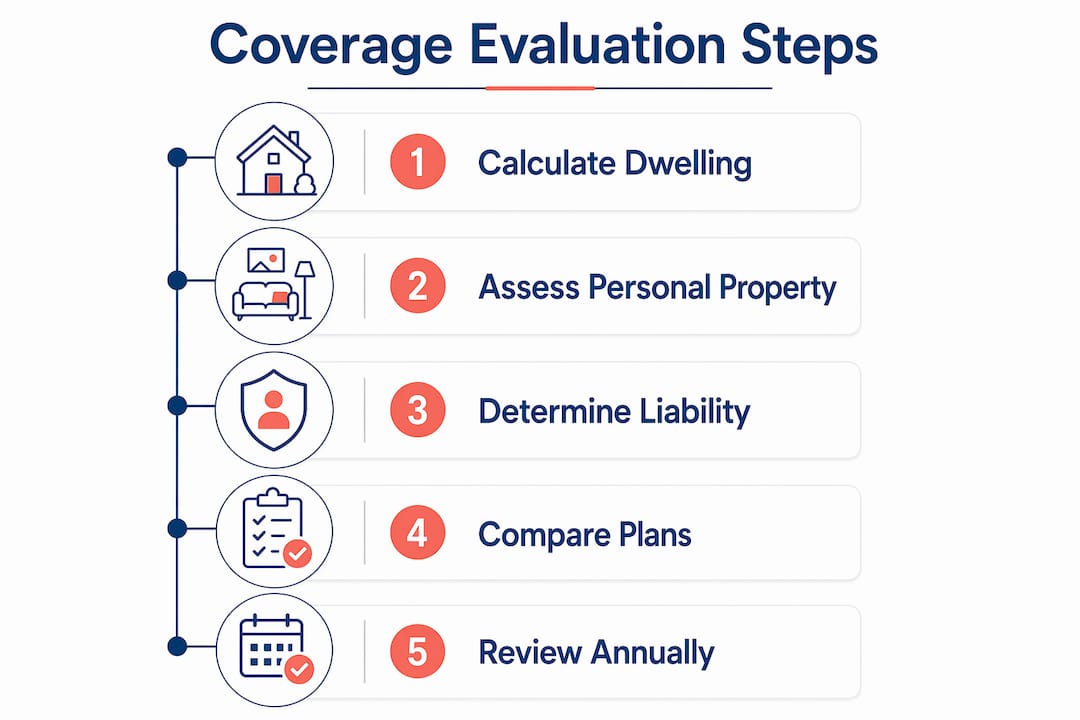
- Evaluating home insurance needs involves calculating replacement costs for full protection without gaps. First-time Texas buyers should focus on accurate dwelling coverage, personal property limits, and liability protection to avoid costly underinsurance. Comparing policies carefully and reviewing coverage annually ensures their protection aligns with current risks and rebuild costs.
Evaluating home insurance needs is defined as calculating the right coverage amounts to fully protect your dwelling, personal property, and liability without leaving dangerous gaps. For Texas first-time buyers, this process is especially critical. The average American homeowner paid $2,802 annually for coverage as of late 2025, with an 8% rate increase projected. That number means nothing if your policy doesn’t actually cover what it costs to rebuild your home. This guide walks you through every step of a proper home insurance assessment, from dwelling calculations to liability limits, using Texas-specific examples.
Table of Contents
- Key takeaways
- How to evaluate home insurance needs: start with dwelling coverage
- What personal property and loss of use coverage do you need?
- How do you assess adequate liability coverage?
- How to compare home insurance plans without missing what matters
- What I’ve learned working with Texas first-time buyers
- Let Hettler Insurance Agency help you get the coverage right
- Frequently Asked Questions
Key takeaways
Accurate home insurance evaluation requires calculating rebuild costs, not market value, then matching personal property, liability, and endorsements to your actual risk profile.
| Point | Details |
|---|---|
| Use replacement cost for dwelling | Multiply square footage by local rebuild costs, not your purchase price or market value. |
| Set personal property at 50–70% | Complete a home inventory to verify your belongings match your policy’s coverage limit. |
| Raise liability above $100,000 | Increasing to $300,000–$500,000 costs roughly $10 per $100,000 and protects your assets. |
| Compare policies on equal terms | Check deductibles, endorsements, and settlement types, not just the monthly premium. |
| Review coverage every year | Major purchases, renovations, and rising rebuild costs can leave you underinsured fast. |
.
How to evaluate home insurance needs: start with dwelling coverage

Dwelling coverage is the foundation of any home insurance policy. It pays to rebuild your home from the ground up if a covered event destroys it. The most common mistake Texas homeowners make is confusing market value with replacement cost. These are two different numbers, and insuring for market value risks serious underinsurance.
The correct method is straightforward. Multiply your home’s square footage by the local per-square-foot rebuilding cost for your Texas region. In Lubbock and West Texas, rebuilding costs typically run $130–$180 per square foot for standard construction. In Dallas or Austin, that figure can reach $200–$250 per square foot due to higher labor and material costs.
Here is a simple example for a 2,000-square-foot home in Lubbock:
| Factor | Low Estimate | High Estimate |
|---|---|---|
| Square footage | 2,000 sq ft | 2,000 sq ft |
| Cost per sq ft (West TX) | $130 | $180 |
| Estimated dwelling coverage | $260,000 | $360,000 |
.
Your home’s features matter too. Custom cabinetry, hardwood floors, brick exteriors, and vaulted ceilings all increase rebuild costs above the baseline estimate. Get a local contractor or a licensed appraiser to verify your number before you finalize a policy.
One more critical detail: the 80% rule. If your dwelling coverage falls below 80% of your home’s actual replacement cost, your insurer can limit your payout on any claim, not just a total loss. That means a $50,000 hail repair claim could result in a partial payment if you are underinsured.
Pro Tip: Ask your insurer about inflation guard or extended replacement cost endorsements. These adjust your coverage limits automatically as building costs rise, protecting you from the gap that opens up between your policy and actual rebuild costs every year.
What personal property and loss of use coverage do you need?
Personal property coverage pays to replace your belongings after a covered loss, things like furniture, electronics, clothing, and appliances. Personal property coverage is typically set at 50–70% of your dwelling coverage. That means a $300,000 dwelling policy would carry $150,000–$210,000 in personal property protection.
The problem is that most first-time buyers accept the default percentage without checking whether it actually matches what they own. A home inventory fixes that. Walk through every room and document what you have, including model numbers, purchase prices, and photos. Apps like Encircle or the NAIC’s free home inventory tool make this process faster.
Key points to keep in mind when assessing personal property coverage:
- High-value items need scheduled coverage. Jewelry, firearms, art, and musical instruments often exceed standard policy sub-limits. Schedule these items separately to guarantee full replacement.
- Replacement cost vs. actual cash value matters. Replacement cost pays what it costs to buy a new item today. Actual cash value deducts depreciation. Always choose replacement cost if you can.
- Review your limits annually. Major purchases like a new TV, laptop, or furniture set can push your belongings above your current coverage limit without you realizing it.
- Inventorying personal property is the single most reliable way to set an accurate coverage amount. Guessing almost always results in underinsurance.
Loss of use coverage, also called additional living expenses (ALE), pays your hotel, meals, and temporary housing costs if your home becomes uninhabitable during repairs. This coverage is typically set at around 30% of your dwelling limit. On a $300,000 dwelling policy, that is $90,000 in ALE protection. For Texas homeowners dealing with extended hail or storm damage repairs, that buffer can be the difference between financial stability and serious hardship.
Pro Tip: Review your personal property coverage every year, especially after the holiday season when new electronics and gifts have entered your home.
How do you assess adequate liability coverage?
Liability coverage protects your financial assets if someone is injured on your property and sues you. Standard policies often start at $100,000 in liability protection. That limit is insufficient for most Texas homeowners.
Increasing liability coverage to $300,000–$500,000 costs approximately $10 per additional $100,000 of coverage annually. That is one of the best values in all of personal insurance. For less than $40 per year, you can triple your liability protection from $100,000 to $400,000.
Consider these factors when determining your liability limits:
- Net worth and assets. Your liability coverage should be at least equal to your total net worth. If you own a home, vehicles, and savings, $100,000 covers almost nothing in a serious lawsuit.
- Pool, trampoline, or dog ownership. Texas courts regularly see premises liability claims tied to these. Each one raises your exposure significantly.
- Umbrella insurance. A personal umbrella policy adds $1,000,000 or more in liability coverage above your home and auto policies. Annual premiums typically run $150–$300. For first-time buyers with growing assets, this is worth serious consideration.
- Texas lawsuit frequency. Texas is one of the most litigious states in the country. Higher liability limits are not paranoia. They are practical protection.
Liability coverage increments are inexpensive and provide critical asset protection that first-time buyers rarely fully understand until they need it. Do not skip this part of your home insurance assessment.
How to compare home insurance plans without missing what matters
Comparing quotes is the final step in a complete home insurance evaluation. The most common mistake is comparing monthly premiums without checking whether the underlying coverage is equivalent. A cheaper policy that carries a higher deductible, lower limits, or missing endorsements is not a better deal.
Align coverage limits, deductibles, endorsements, and settlement types before you compare prices. Here is what a proper apples-to-apples comparison looks like:
| Coverage Element | What to Check | Why It Matters |
|---|---|---|
| Dwelling limit | Matches your rebuild cost estimate | Prevents underinsurance and 80% rule penalties |
| Deductible | Dollar amount vs. percentage | Percentage deductibles spike out-of-pocket costs on large claims |
| Personal property | Replacement cost vs. actual cash value | Replacement cost pays significantly more after a loss |
| Endorsements | Sewer backup, flood, extended replacement | Standard policies exclude many common Texas risks |
| Liability limit | $300,000 minimum recommended | Protects assets in a lawsuit |
.
The typical home insurance deductible is $1,135, with about half of policyholders carrying deductibles between $500 and $1,499. In Texas, many policies carry a separate wind and hail deductible expressed as a percentage of your dwelling coverage, often 1–2%. On a $300,000 home, a 2% hail deductible means $6,000 out of pocket before your insurer pays anything. Understanding your Texas deductible options before you sign is non-negotiable.
Two endorsements every Texas homeowner should ask about: sewer backup coverage (excluded from standard policies) and flood insurance through the National Flood Insurance Program (NFIP) or a private carrier. Standard homeowners policies do not cover flood damage, period.
Pro Tip: Comparing multiple insurers and reviewing your coverage annually, especially after renovations or major purchases, is the most reliable way to stay properly protected without overpaying.
What I’ve learned working with Texas first-time buyers
Most first-time buyers walk into the insurance process focused on one thing: the monthly premium. That instinct is understandable. You have just taken on a mortgage, and every dollar counts. But focusing on price before coverage is the fastest way to end up with a policy that fails you when you need it most.
The single most common problem I see is homeowners who insured their home for its purchase price or tax-assessed value rather than its actual rebuild cost. These are almost never the same number. A home in Lubbock that sold for $220,000 might cost $310,000 to rebuild from scratch after a total loss. That $90,000 gap is not covered. It comes out of your pocket.
The second issue is skipping the home inventory. People assume they know what they own. They do not. Sit down and actually document your belongings room by room. You will almost always discover your personal property coverage needs to be higher than the default percentage your insurer assigned.
My advice to every Texas first-time buyer is this: start with how much home insurance you actually need, then shop for price. Get your dwelling number right. Set your liability at $300,000 minimum. Confirm your deductible is one you can genuinely afford to pay. Then compare quotes across multiple carriers. That sequence protects you. Reversing it does not.
— Ron
Let Hettler Insurance Agency help you get the coverage right

Hettler Insurance has been helping Texas homeowners get their coverage right since 1992. As an independent agency representing over 30 top-rated carriers, Hettler Insurance Agency shops the market on your behalf, comparing dwelling limits, deductibles, endorsements, and liability options across multiple insurers at no extra fee. Ron Hettler and Meghan Hettler are both Certified Insurance Counselors (CIC), the gold standard credential in the industry. They know Texas risks, from West Texas hail to flood exposure in the Hill Country, and they build policies around your actual needs. If you are a first-time buyer or simply want a second opinion on your current policy, contact Hettler Insurance Agency for a personalized home insurance review today. You can also review guidance on minimum coverage essentials to understand the baseline protections every Texas homeowner should carry.
Recommended
About the Author
Ronald J. Hettler, CIC is a Certified Insurance Counselor (CIC) [the gold-standard credential in the independent insurance industry]. Ron has over 46 years of real-world experience in the insurance industry. He is the owner/president of Hettler Insurance Agency in Lubbock, Texas and is licensed by the Texas Department of Insurance (License #666862). (Why Trust Hettler Insurance Agency? It’s a Local independent insurance agency representing multiple carriers. Hettler Insurance Agency has established business roots going back to it’s predecessor in the late 1800’s. Local expertise in Lubbock Texas and West Texas risks. Focused on clarity before a claim occurs.) Ron and his daughter Meghan, also a CIC, lead a team that represents 30+ carriers and serves clients across Texas.
Ron specializes in helping individuals, families, and small business owners understand complex insurance concepts in clear, practical terms so they can make informed decisions about their coverage. He specializes in helping individuals and families understand coverage gaps, deductible structures, and real-world claim outcomes before a loss occurs. Ron helps you to understand how insurance policies respond in real-world claim situations.
License verification available through the Texas Department of Insurance.
Frequently Asked Questions ?
Q1 ?: What is the correct way to calculate dwelling coverage?
Q2 ?: How much personal property coverage do I need?
Q3 ?: What liability limit should a Texas homeowner carry?
Q4 ?: Does standard home insurance cover flood damage in Texas?
Q5 ?: How often should I review my home insurance policy?
— Life Insurance Instant Quote and Apply Tool @ GetLifePolicy.com > * Quick self-service term life insurance quote. With or without medical exam.
— Call us about Auto, Home, Business, Life, or Health insurance. * Click to Call (806) 798-7800, Mon-Fri 8:30am-5pm (lunch closed Noon-1pm)
— Come see us @ our new address 4720 S Loop 289 Lubbock, TX 79414 (maps link), or get your online quote started at https://GetHettler.com