
TL;DR summary:
- Flood insurance in Texas is a separate policy that covers property damage caused by flooding and is required for some homeowners with federally backed mortgages. Many claims come from outside high-risk flood zones, making it essential for all homeowners to assess their true flood risk using tools like elevation certificates and updated flood maps. Buyers should compare NFIP and private options, purchase coverage well in advance of storm season, and regularly review their policy to ensure adequate protection.
Texas flood insurance is a standalone policy that covers property damage caused by flooding. It is entirely separate from your standard homeowners insurance, which does not pay for flood damage under any circumstances. If you want to understand Texas flood insurance, you need to know two things upfront: your homeowners policy will not save you after a flood, and nearly every major Texas city carries at least moderate flood risk. The two primary coverage options are the National Flood Insurance Program (NFIP), administered by FEMA, and private flood insurance offered through independent carriers.
Table of Contents
- Key takeaways
- How to understand Texas flood insurance coverage and who needs it
- How do you assess your flood risk and read Texas flood zone maps?
- NFIP vs. private flood insurance: which is right for Texas homeowners?
- How to purchase and maintain your Texas flood insurance policy
- How are Texas flood insurance costs calculated?
- What I’ve learned after years of watching Texas homeowners get this wrong
- How Hettler Insurance Agency helps Texas homeowners get flood coverage right
- Frequently Asked Questions
Key Takeaways
Texas flood insurance is a separate, mandatory purchase for high-risk zone homeowners with federally backed mortgages, and a financially critical choice for all Texas homeowners regardless of zone designation.
| Point | Details |
|---|---|
| Flood insurance is separate | Your homeowners policy never covers flood damage. Buy flood coverage independently. |
| Risk exists outside high-risk zones | 40% of NFIP claims come from outside Special Flood Hazard Areas. |
| NFIP has a 30-day waiting period | Purchase well before storm season. Coverage does not activate immediately. |
| Private insurance fills NFIP gaps | Private policies offer higher limits and additional living expenses coverage NFIP excludes. |
| Elevation certificates reduce costs | A survey documenting your home’s elevation can lower premiums and remove zone requirements. |
How to understand Texas flood insurance coverage and who needs it
Flood insurance covers two distinct categories of loss: the physical structure of your home and your personal belongings inside it. Building coverage under an NFIP policy pays for damage to your foundation, electrical systems, plumbing, HVAC equipment, and permanently installed fixtures. Contents coverage pays for furniture, clothing, electronics, and other personal property. These two coverages are purchased separately under NFIP, so you must actively elect both.

Flood insurance is legally required if your home sits in a Special Flood Hazard Area (SFHA) and you carry a federally backed mortgage from lenders such as those backed by Fannie Mae, Freddie Mac, or the FHA. Your lender will not close the loan without proof of flood coverage. That requirement is non-negotiable.
What surprises most homeowners is this: 40% of NFIP claims come from properties outside high-risk flood zones. That single fact should change how you think about flood coverage. Living outside a designated SFHA does not mean you are safe. It means FEMA has not classified your area as the highest risk. Texas geography, with its clay soils, flat terrain, and intense rainfall events, creates flood conditions almost anywhere in the state.
Pro Tip: Check whether your property sits in a Lubbock-area floodplain even if your lender has never required flood insurance. Flood zone boundaries shift, and your risk may be higher than your mortgage documents suggest.
Key exclusions to know before you buy:
- Damage to vehicles (covered under auto insurance, not flood policies)
- Landscaping, decks, patios, and fences
- Temporary housing costs while your home is being repaired (NFIP does not cover additional living expenses)
- Basement contents in most NFIP policies
- Mold or moisture damage not directly caused by a covered flood event
How do you assess your flood risk and read Texas flood zone maps?
FEMA flood zone maps, formally called Flood Insurance Rate Maps (FIRMs), classify land into zones that indicate relative flood risk. FEMA flood zones include Zone A and Zone V (high-risk), Zone X (moderate to low risk), and Zones B, C, and D (lower risk designations). Zone V applies specifically to coastal areas with wave action risk, which matters significantly for Texas Gulf Coast homeowners in cities like Galveston, Corpus Christi, and Beaumont.
Relying solely on FEMA maps is a mistake. Maps are updated infrequently and often lag behind actual development, drainage changes, and climate patterns. Texas sits within what meteorologists call “Flash Flood Alley,” a corridor stretching from the Hill Country through Central Texas where rainfall can exceed the ground’s absorption capacity within minutes. Austin, San Antonio, and Houston all sit within or near this zone.
Two tools give you a more accurate picture of your specific risk:
- Elevation Certificate: A survey document prepared by a licensed surveyor that records your home’s elevation relative to the Base Flood Elevation (BFE) on FEMA maps. A higher elevation relative to BFE directly lowers your flood insurance premium.
- Letter of Map Amendment (LOMA) or Letter of Map Revision (LOMR): Official FEMA documents that can correct your flood zone designation if your property was incorrectly mapped. Elevation certificates and LOMAs can remove mandatory purchase requirements entirely for some homeowners.
Pro Tip: Order an elevation certificate before you buy or renew flood insurance. The cost is typically a few hundred dollars, and the premium savings can pay for it within the first year.
NFIP vs. private flood insurance: which is right for Texas homeowners?
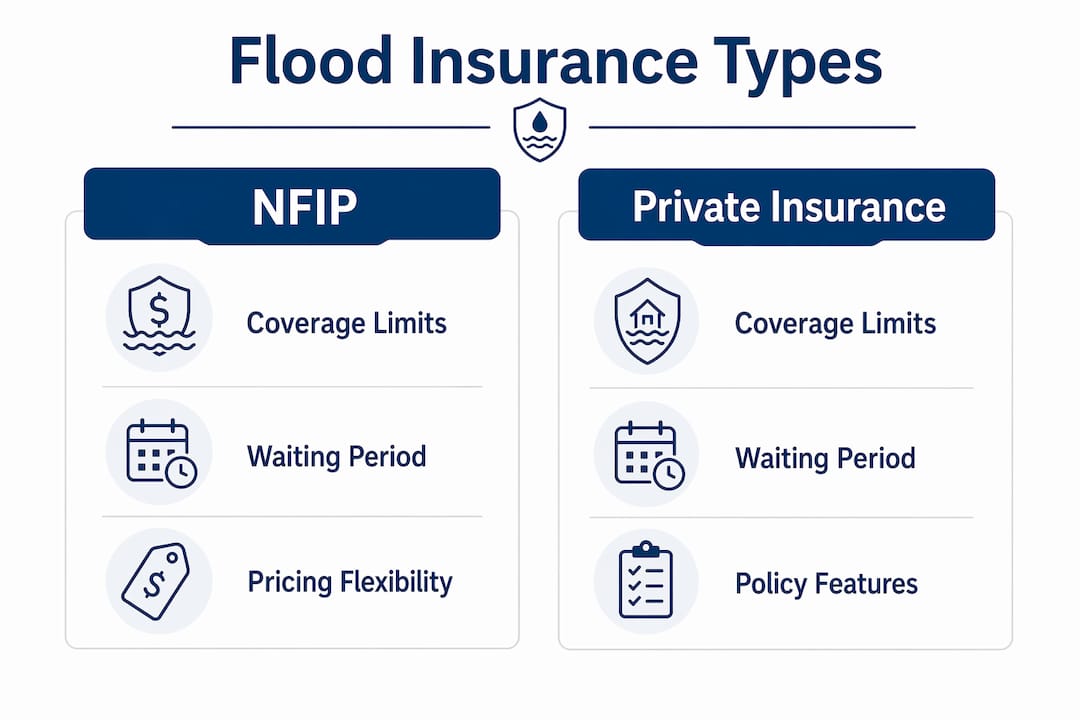
The NFIP and private flood insurance serve the same core purpose but differ significantly in coverage limits, pricing flexibility, and policy terms. Understanding these differences is central to any Texas flood insurance guide.
| Feature | NFIP | Private flood insurance |
|---|---|---|
| Building coverage limit | $250,000 | Often $500,000 or higher |
| Contents coverage limit | $100,000 | Often $250,000 or higher |
| Additional living expenses | Not covered | Covered by many private policies |
| Waiting period | 30 days | Often 10–14 days |
| Renewal guarantee | Yes, federally backed | Varies by carrier |
| Premium stability | Regulated | Market-driven, can fluctuate |
| Availability | Nationwide | Varies by insurer and zone |
.
NFIP policies carry a 30-day waiting period before coverage activates. That means if you purchase a policy on june 1 and a storm floods your home on june 20, you have no coverage. The only exceptions are policies required at mortgage closing. This waiting period is one of the most financially damaging surprises homeowners face.
Private flood insurance offers higher coverage limits, additional living expenses (ALE) coverage, and shorter waiting periods. For homeowners with homes valued above $250,000 or with significant personal property, private insurance fills gaps that NFIP simply cannot. The tradeoff is that private insurers can change rates or exit markets more freely than the federally backed NFIP.
Private flood insurance is gaining traction as a real alternative to NFIP, particularly for homeowners outside high-risk zones where private carriers price competitively. If your home is in Zone X and your lender does not require NFIP specifically, a private policy may offer better value.
How to purchase and maintain your Texas flood insurance policy
Buying flood insurance is more straightforward than most homeowners expect. Follow these steps to get coverage in place correctly.
- Determine your flood zone. Use FEMA’s Flood Map Service Center at msc.fema.gov to look up your property’s current zone designation.
- Get an elevation certificate if applicable. If your home is in or near Zone A, an elevation certificate gives you accurate pricing and may lower your premium significantly.
- Compare NFIP and private options. Contact an independent insurance agent who can quote both. NFIP policies are sold through licensed agents, not directly through FEMA.
- Select building and contents coverage amounts. Do not underinsure. Calculate the replacement cost of your structure and the value of your contents separately.
- Understand your waiting period. Purchase well in advance of storm season. Do not wait until a named storm is in the Gulf of Mexico. Coverage will not activate in time.
- Review your policy annually. Flood maps change. Your home’s value changes. Your contents change. Review coverage every year at renewal.
Common mistakes to avoid:
- Buying only building coverage and skipping contents (a separate election under NFIP)
- Assuming your homeowners policy covers flooding after a pipe bursts or a storm surge enters your home
- Waiting until a storm watch is issued to purchase coverage
- Ignoring coverage limits that fall short of your home’s actual replacement value
Pro Tip: Ask your agent about deductible options for flood coverage. A higher deductible lowers your annual premium, but you must be able to cover that amount out of pocket after a loss.
How are Texas flood insurance costs calculated?
Texas flood insurance premiums vary based on several specific factors. Texas homeowners pay an average NFIP premium of $779 annually, which sits slightly below the national average. That number is a starting point, not a ceiling.
Factors that directly affect your premium:
- Flood zone designation: Zone A and Zone V properties pay significantly more than Zone X properties.
- Elevation relative to BFE: Homes built above the Base Flood Elevation pay lower premiums. Each foot above BFE can reduce your premium meaningfully.
- Home construction type: Slab foundations generally carry lower premiums than homes with basements or crawl spaces.
- Coverage amounts: Higher building and contents limits increase premiums proportionally.
- Deductible selection: Higher deductibles reduce premiums. NFIP offers deductible options ranging from $1,000 to $10,000.
- Community Rating System (CRS): If your city or county participates in FEMA’s CRS program, you may qualify for a discount of up to 45% on NFIP premiums. Houston, San Antonio, and Austin all participate.
Annual premiums typically range from $400 to $1,200 for most Texas homeowners, with high-risk coastal or Zone A properties potentially exceeding $1,500 to $5,000 per year. Review Texas insurance premium factors to understand how your full insurance picture fits together.
What I’ve learned after years of watching Texas homeowners get this wrong
The most consistent mistake I see is timing. Homeowners call after a storm watch is issued, and there is nothing anyone can do. The 30-day waiting period is not a technicality. It is a hard stop. The time to buy flood insurance is now, not when the radar looks threatening.
The second mistake is treating flood insurance as something only coastal homeowners need. I have seen claims from Lubbock, Midland, and Amarillo. Flash flooding does not respect flood zone maps. Texas weather is unpredictable, and the financial consequences of an uninsured flood loss are severe enough to wipe out years of equity.
My honest advice: treat flood insurance the same way you treat your homeowners policy. It is not optional protection for high-risk properties. It is standard financial protection for any Texas homeowner who cannot afford to rebuild out of pocket. Review your coverage every year. Flood maps change, home values change, and a policy that was adequate three years ago may leave you underinsured today. If you are weighing NFIP against private options, talk to an independent agent who can quote both without steering you toward one carrier. That conversation is worth more than any online calculator.
— Ron
How Hettler Insurance Agency helps Texas homeowners get flood coverage right
Hettler Insurance has served Texas homeowners since 1992, and flood coverage is one of the most common gaps the team identifies during policy reviews. As an independent agency representing over 30 top-rated carriers, Hettler Insurance Agency can quote both NFIP and private flood insurance options side by side, so you see exactly what you are getting and what you are paying for.

Ron Hettler and Meghan Hettler are both Certified Insurance Counselors (CIC), the gold standard credential in the industry. That expertise matters when flood zone maps, elevation certificates, and coverage limits are all in play at once. Whether you are in Lubbock, Dallas, or along the Gulf Coast, Hettler Insurance will assess your property’s actual risk and recommend coverage that fits your budget. Learn more about protecting your home and finances with the right coverage in place before the next storm season arrives.
Recommended
About the Author
Ronald J. Hettler, CIC is a Certified Insurance Counselor (CIC) [the gold-standard credential in the independent insurance industry]. Ron has over 46 years of real-world experience in the insurance industry. He is the owner/president of Hettler Insurance Agency in Lubbock, Texas and is licensed by the Texas Department of Insurance (License #666862). (Why Trust Hettler Insurance Agency? It’s a Local independent insurance agency representing multiple carriers. Hettler Insurance Agency has established business roots going back to it’s predecessor in the late 1800’s. Local expertise in Lubbock Texas and West Texas risks. Focused on clarity before a claim occurs.) Ron and his daughter Meghan, also a CIC, lead a team that represents 30+ carriers and serves clients across Texas.
Ron specializes in helping individuals, families, and small business owners understand complex insurance concepts in clear, practical terms so they can make informed decisions about their coverage. He specializes in helping individuals and families understand coverage gaps, deductible structures, and real-world claim outcomes before a loss occurs. Ron helps you to understand how insurance policies respond in real-world claim situations.
License verification available through the Texas Department of Insurance.
Frequently Asked Questions ?
Q1 ?: Does homeowners insurance cover flood damage in Texas?
Q2 ?: How long does it take for Texas flood insurance to go into effect?
Q3 ?: Do I need flood insurance if I am not in a high-risk flood zone?
Q4 ?: What is the average cost of flood insurance in Texas?
Q5 ?: What is the difference between NFIP and private flood insurance?
— Life Insurance Instant Quote and Apply Tool @ GetLifePolicy.com > * Quick self-service term life insurance quote. With or without medical exam.
— Call us about Auto, Home, Business, Life, or Health insurance. * Click to Call (806) 798-7800, Mon-Fri 8:30am-5pm (lunch closed Noon-1pm)
— Come see us @ our new address 4720 S Loop 289 Lubbock, TX 79414 (maps link), or get your online quote started at https://GetHettler.com