
TL;DR summary:
- A consumer directed health plan (CDHP) pairs a high deductible health plan with a tax-advantaged health savings account (HSA). You pay lower monthly premiums but take on more out-of-pocket cost before insurance shares the bill. HSA contributions, growth, and qualified withdrawals are tax-advantaged, and unused funds roll over every year. A CDHP fits best if you rarely need major care, can cover your full deductible in a bad year, and will actually fund the HSA. Before you enroll, run the three-number test: expected medical spend, premium savings, and any employer HSA contribution. Hettler Insurance Agency compares CDHP and traditional options across 30+ carriers at no extra fee.
A consumer directed health plan (CDHP) is a high deductible health plan paired with a tax advantaged savings account, usually a health savings account (HSA), that shifts cost timing from monthly premiums to out of pocket responsibility while building long term tax benefits. It suits people who rarely need major medical care and want to bank the premium savings, and it fits less comfortably for anyone who cannot absorb a large deductible bill in a bad year. Here’s the quick math behind that verdict, backed by IRS rules.
- Lower monthly premiums than traditional copay plans
- Higher deductible and out-of-pocket exposure before insurance kicks in
- HSA funds are tax advantaged, roll over every year, and never expire
Table of Contents
- Key Takeaways
- How Does a Consumer Directed Health Plan Work?
- What Are the Benefits and Drawbacks of a CDHP?
- Who Is Eligible to Open an HSA?
- How Much Will a CDHP Cost You?
- How Do You Get the Most Value From an HSA?
- Is a Consumer Directed Health Plan Right for You?
- A Practical View From Hettler Insurance Agency
- How Hettler Insurance Agency Helps You Choose the Right Plan
- Sources
- Frequently Asked Questions
Key Takeaways
A consumer directed health plan trades lower monthly premiums for higher deductible exposure, and it pays off most reliably when paired with disciplined HSA funding and investment.
| Point | Details |
|---|---|
| Three-tier structure | Funds flow from your pretax HSA, to your out-of-pocket deductible payments, to insurer cost-sharing. |
| HSA triple tax advantage | Pretax contributions, tax-free growth, and tax-free qualified withdrawals, and balances roll over yearly. |
| Eligibility hinges on HDHP enrollment | Medicare enrollment or non-HDHP coverage disqualifies you from new HSA contributions. Starting in 2026, bronze and catastrophic Marketplace plans count as HSA-compatible. |
| Run the three-number test | Compare expected medical spend, premium savings, and employer HSA contributions before enrolling. |
| Get expert plan comparison | Hettler Insurance Agency shops CDHP and traditional options across 30+ carriers at no extra fee. |
*
* This article is general information, not a substitute for advice from a qualified financial advisor. Consult a qualified financial professional about your own circumstances before acting on anything here.
How Does a Consumer Directed Health Plan Work?
A CDHP runs on three tiers, and understanding the order matters more than memorizing the definitions. First, you or your employer fund a pretax account, typically an HSA, though some employers use an HRA or FSA instead. Second, you pay out of pocket for care until you hit your deductible, drawing from that account if it has money in it. Third, once the deductible is met, standard insurance cost sharing takes over until you reach your out-of-pocket maximum.
HSA eligibility is tied directly to enrollment in a qualifying HDHP, and employer contributions made early in the plan year change your cash flow immediately by giving you spendable funds before you have contributed a dime yourself.
Here is how that plays out with a $2,000 procedure (for example purposes only):
- You have $800 sitting in your HSA from a mix of payroll deductions and an employer deposit.
- That $800 covers part of the deductible tax free, leaving $1,200 owed toward your deductible out of pocket.
- Once your deductible is satisfied for the year, coinsurance applies to any remaining balance, and the insurer starts sharing the cost according to your plan’s structure.
What Are the Benefits and Drawbacks of a CDHP?
The trade-off is straightforward on paper and less comfortable in practice. Lower premiums free up cash every month, and the HSA tax break (pretax contributions, tax-free growth, and tax-free qualified withdrawals) makes the account one of the few genuine triple tax advantages available to individual filers.
Benefits:
- Lower monthly premiums than PPO or copay-based plans
- Triple tax advantage on HSA contributions, growth, and withdrawals
- Unused HSA balances roll over indefinitely, unlike most FSAs
- Preventive care is typically covered in full before the deductible applies
Drawbacks:
- A bad health year means a much larger bill before insurance shares the cost
- Negotiated rates can still produce sticker shock when you are paying the full amount
- Some people delay care they need to avoid the upfront cost
Research on CDHP enrollees generally finds modest spending reductions compared to lower-deductible plans, with estimates that vary by study, but that reduction is concentrated among healthier people cutting back on routine outpatient visits and prescriptions, not necessarily on low-value care.
Pro Tip: Treat your HSA like a retirement account, not a checking account. Every dollar you leave invested instead of spending on small medical bills compounds tax free for decades.

Hands scanning meds at pharmacy counter. Can a consumer directed health plan work?
Who Is Eligible to Open an HSA?
You can only open and fund an HSA if you are enrolled in a qualifying HDHP. A handful of common situations disqualify you even if your plan otherwise fits the definition: enrolling in Medicare, carrying other non-HDHP coverage like a spouse’s traditional plan, or being claimed as someone else’s dependent.
Good news for individual and family buyers: under the One Big Beautiful Bill, bronze and catastrophic plans purchased through the Marketplace are treated as HSA-compatible as of January 1, 2026, even if they don’t meet the traditional HDHP definition. That opens HSA savings to many Texans who buy their own coverage.
Your plan documents or your employer’s benefits portal will state clearly whether a plan is “HSA-eligible.” If that language is missing, call HR before you assume you can contribute.
Enrollment usually follows a simple sequence: open enrollment arrives, you select the HDHP option, and then you set up the HSA separately, often through a bank or brokerage your employer designates. Employer contribution amounts and plan design vary widely, so check your specific documents rather than assuming your coworker’s terms apply to you.
- HSA requires active HDHP enrollment
- Medicare enrollment disqualifies new HSA contributions
- Being claimed as a dependent disqualifies HSA eligibility
- Bronze and catastrophic Marketplace plans are HSA-compatible starting in 2026
How Much Will a CDHP Cost You?
Three numbers drive every CDHP decision: the premium, the deductible, and the out-of-pocket maximum. Premium is what you pay monthly no matter what. Deductible is what you pay before insurance starts sharing costs. Out-of-pocket maximum is the hard ceiling on what you’ll pay in a given year, after which insurance covers everything.
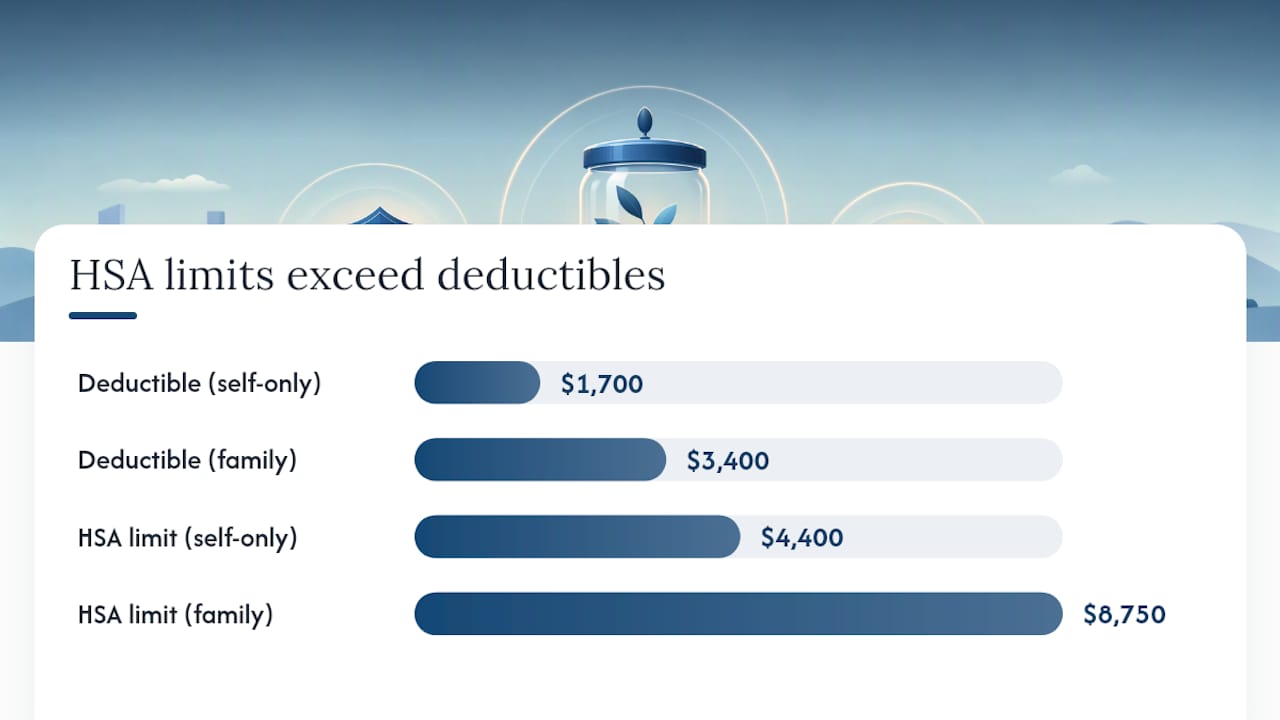
The IRS sets the HDHP and HSA limits each year. Because open enrollment this fall is for 2027 coverage, here are both years side by side, based on IRS Notice 2026-05 (2026) and IRS Revenue Procedure 2026-24 (2027):
| IRS Limit | 2026 | 2027 |
|---|---|---|
| Minimum HDHP deductible | $1,700 self-only / $3,400 family | $1,750 self-only / $3,500 family |
| Maximum HDHP out-of-pocket (excluding premiums) | $8,500 self-only / $17,000 family | $8,700 self-only / $17,400 family |
| Maximum HSA contribution | $4,400 self-only / $8,750 family | $4,500 self-only / $9,000 family |
| HSA catch-up contribution (age 55+) | $1,000 | $1,000 |
These are federal limits, not premiums. Your actual premium, deductible, and out-of-pocket maximum depend on the plan you choose, so always confirm the current year’s numbers with the IRS and your plan documents before you enroll.
Pro Tip: Run this three-number test before choosing a plan: estimate your expected annual medical spend, calculate the premium difference between your CDHP option and a traditional plan, then add any employer HSA contribution. If the premium savings plus employer HSA money covers most of your expected spend, the CDHP usually wins.
- Premium: fixed monthly cost regardless of usage
- Deductible: what you pay before coinsurance begins
- Out-of-pocket max: the most you’ll pay in a plan year
How Do You Get the Most Value From an HSA?
Getting real value from an HSA takes a bit of strategy beyond just opening the account. Prioritize any employer contribution first, since that’s free money that reduces your effective deductible before you’ve spent anything. If your budget allows, fund your HSA early in the year rather than spreading contributions out, so the money has more time to sit and, if invested, grow.
- Capture the full employer contribution, including any match tied to your own contributions
- Front-load contributions early in the year when possible
- Invest funds beyond your near-term deductible need for long-term growth
- Keep every receipt for qualified expenses in case of an IRS audit
For short-term cash flow, most people rely on a combination of payroll HSA deductions, planned monthly contributions timed to bills, and a small emergency reserve outside the HSA for the months before the account builds real balance. Ron Hettler, CIC (Certified Insurance Counselor), founder and president of Hettler Insurance Agency, has guided Texas families through exactly this kind of plan comparison for decades, and the consistent lesson is that the deductible you accept is the price of the tax advantage, not a flaw in the design. To see which expenses qualify for tax-free HSA withdrawals, check IRS Publication 502 (Medical and Dental Expenses).
Is a Consumer Directed Health Plan Right for You?
Run through these five questions honestly before you commit to a CDHP during open enrollment:
- How often do you or your family actually use medical care in a typical year?
- Could you cover your full deductible in cash if a major expense hit tomorrow?
- Does your employer contribute to the HSA, and how much?
- Do you want a long-term, tax-advantaged medical savings vehicle beyond this year?
- Are you comfortable with the plan’s provider network restrictions?
More “yes” answers point toward a CDHP fitting your situation well. More “no” answers, especially on the deductible question, suggest a lower-deductible plan may serve you better. If your answers split down the middle, go back and run the three-number test above using your actual numbers.
A Practical View From Hettler Insurance Agency
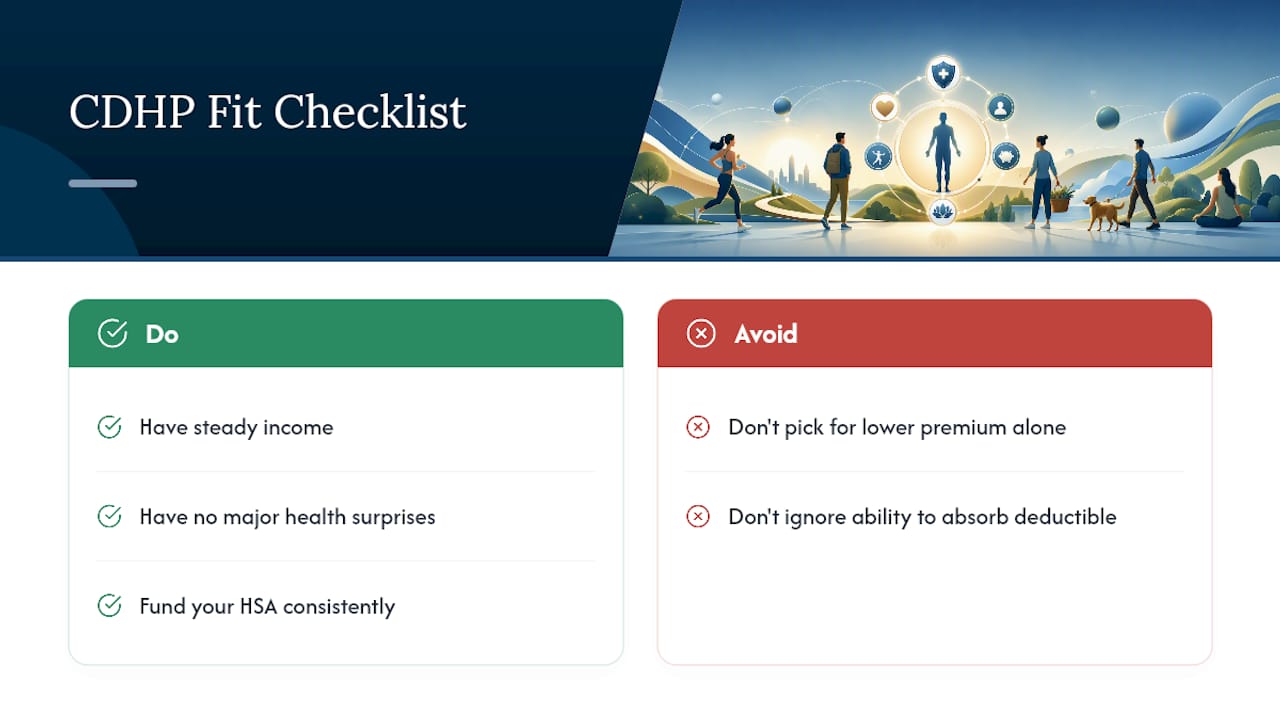
CDHPs work best for people with steady income, a health history without major surprises, and the discipline to actually fund the HSA rather than treat it as an afterthought. We see the plan fail most often when someone picks it purely for the lower premium without checking whether they can absorb the deductible.
How Hettler Insurance Agency Helps You Choose the Right Plan
Hettler Insurance Agency is the alternative to guessing your way through open enrollment. Instead of comparing plan brochures alone, we run the side-by-side premium versus deductible math for your actual household, explain the fine print your employer’s benefits portal glosses over, and help you estimate total annual cost across every carrier option available to you. “The best independent insurance agents don’t just find you a policy. They find you the right insurance policy and then make sure it stays right as your life changes.” — Ron Hettler, CIC (Certified Insurance Counselor), Hettler Insurance Agency

As an independent agency representing more than 30 carriers, we’re not selling you the one plan we happen to offer. We compare HDHP options, HSA provider choices, and enrollment timing across the whole market, then walk you through claims questions after you’re enrolled, all at no extra fee to you. If you’re weighing a CDHP against a traditional plan for this year’s open enrollment window, call Hettler Insurance Agency for a personalized comparison, or explore our full range of coverage options to see where a CDHP fits into your broader insurance picture.
Hettler Insurance Agency is one of the few family-owned agencies in Texas where both principals, Ron Hettler and his daughter Meghan Harris, who co-leads the agency with Ron, carry the high-level certification of CIC (Certified Insurance Counselor). Fewer than 2% of licensed insurance professionals in the U.S. have earned the CIC designation.
Sources
- HealthCare.gov — High Deductible Health Plan (HDHP)
- IRS Publication 969 — Health Savings Accounts and Other Tax-Favored Health Plans
- CONSUMER‐DIRECTED HEALTH PLANS: A REVIEW OF THE EVIDENCE — Journal of Risk and Insurance
- Consumer-Driven Health Care: What Is It, and What Does It Mean for Employees and Employers? — BLS
- IRS Notice 2026-05 — 2026 HSA and HDHP Limits
- IRS Revenue Procedure 2026-24 — 2027 HSA and HDHP Limits
- IRS — Guidance on New HSA Benefits Under the One Big Beautiful Bill
- IRS Publication 502 — Medical and Dental Expenses
- University of Washington Benefits — How Consumer-Directed Health Plans Work
This article provides general information for educational purposes. Plan terms, limits, and eligibility vary by plan and employer. Confirm current rules and details with a licensed insurance professional or qualified tax advisor before making coverage decisions.
Frequently Asked Questions ?
Q1 ?: What is a consumer directed health plan?
Q2 ?: How does a consumer directed health plan work?
Q3 ?: Who is eligible to open a health savings account?
Q4 ?: How do I know if a CDHP is right for me?
Q5 ?: How do I get the most value from an HSA?
Recommended
About the Author
Ronald J. Hettler, CIC is a Certified Insurance Counselor (CIC) [a gold-standard credential in the independent insurance industry that less than 2% earn]. Ron has over 46 years of real-world experience in the insurance industry. He is the owner/president of Hettler Insurance Agency in Lubbock, Texas and is licensed by the Texas Department of Insurance (License #666862). (Why Trust Hettler Insurance Agency? It’s a Local independent insurance agency representing multiple carriers. Hettler Insurance Agency has established business roots 100+ years going back to it’s predecessor in the late 1800’s. Local expertise in Lubbock Texas and West Texas risks. Focused on clarity before a claim occurs.) Ron and his daughter Meghan, also a CIC, lead a team that represents 30+ carriers and serves clients across Texas.
Ron specializes in helping individuals, families, and small business owners understand complex insurance concepts in clear, practical terms so they can make informed decisions about their coverage. He specializes in helping individuals and families understand coverage gaps, deductible structures, and real-world claim outcomes before a loss occurs. Ron helps you to understand how insurance policies respond in real-world claim situations.
License verification available through the Texas Department of Insurance.
— Life Insurance Instant Quote and Apply Tool @ GetLifePolicy.com > * Quick self-service term life insurance quote. With or without medical exam.
— Call us about Auto, Home, Business, Life, or Health insurance. * Click to Call (806) 798-7800, Mon-Fri 8:30am-5pm (lunch closed Noon-1pm)
— Come see us @ our new address 4720 S Loop 289 Lubbock, TX 79414 (maps link), or get your online quote started at https://GetHettler.com