
TL;DR summary:
- All risk insurance covers property damage caused by any peril not explicitly excluded in the policy. The insurer must prove an exclusion to deny a claim, giving policyholders a burden-of-proof advantage. Buyers should carefully review exclusions, sub-limits, and limits before purchasing or renewing coverage.
All risk insurance, also called open-perils or special form coverage, protects your property against direct physical loss from any cause that the policy does not expressly exclude. The ISO Causes of Loss — Special Form defines covered causes as “direct physical loss unless the loss is excluded or limited in this policy.” That single sentence is the foundation of the entire coverage structure. The practical bottom line: read the exclusion list carefully, confirm your limits and mortgagee requirements, and never assume “all risk” means every possible loss is covered.
Key facts to keep in mind before you read further:
- Coverage trigger: direct physical loss to insured property during the policy period
- Common exclusions: flood, earthquake, wear and tear, gradual seepage, pests, war, nuclear hazard, intentional acts, government seizure
- Terminology: industry practice shifted from “all-risk” to “open perils” or “special form” to avoid implying absolute protection
- Lender requirement: mortgage lenders in the United States commonly require open-perils coverage to protect their financial interest in the property
- Next step: verify your exclusion list, sub-limits, and any state-specific guidance from your state’s Department of Insurance
Table of Contents
- How does all risk insurance actually work?
- What does an all-risk policy typically cover?
- What all-risk policies do not cover
- All-risk vs. named-perils: which one do you need?
- Real-world scenarios: covered vs. excluded
- Your practical checklist for buying an all-risk policy in the U.S.
- Key Takeaways
- Why policy wording matters more than the label
- Get a free policy review from Hettlerinsurance
- Useful sources and where to go next
Key Takeaways
All risk insurance covers direct physical loss to property unless the policy expressly excludes the cause, and the insurer bears the burden of proving an exclusion applies to deny your claim.
| Point | Details |
|---|---|
| Open-perils definition | Covers all direct physical loss unless a specific exclusion in the policy applies. |
| Burden-of-proof advantage | Once you show a loss occurred, the insurer must cite a specific exclusion to deny coverage. |
| Flood and earthquake are excluded | Both perils require separate policies or endorsements; never assume they are included. |
| Sub-limits apply to valuables | Jewelry, art, and similar items often need a scheduled floater to be fully covered. |
| Hettler Insurance policy review | Hettler Insurance reviews your policy form, exclusions, and limits to close gaps before a claim. |
How does all risk insurance actually work?
The policy language is straightforward: everything is covered unless the policy says otherwise. That is the opposite of a named-perils policy, where coverage exists only for causes the contract specifically lists.
The claims flow, step by step
- You report a direct physical loss to your insurer, showing the property was covered under a valid policy during the policy period.
- The insurer investigates the cause and extent of the damage.
- If the insurer wants to deny the claim, it must point to a specific exclusion in the policy language. Courts describe this as a heavy burden on the insurer once you establish the basic loss.
That burden-of-proof shift is the most valuable practical feature of open-perils wording. Under a named-perils policy, you must prove the cause of loss matches a listed peril. Under an open-perils form, you prove the loss happened and the insurer must prove an exclusion applies. That distinction often determines the outcome of a disputed claim.
Pro Tip: Document the damage immediately with time-stamped photos and video. Start mitigation steps (drying out water, boarding broken windows) right away. Insurers can reduce or deny recovery if you allow damage to worsen after the initial loss event.
What does an all-risk policy typically cover?
The core coverage is direct physical loss to insured property: the building structure, business personal property, or personal contents, depending on the policy type. All-risk policies can be customized with riders or floaters to cover high-value items and certain excluded perils for an additional premium.

Common covered losses include burst pipes, accidental vehicle impact on a structure, theft, fire, lightning, windstorm (where not excluded), and vandalism. The policy examples brokers use consistently show coverage for sudden, accidental physical damage versus excluded gradual or environmental events.
| Policy Type | Typical Covered Perils | Common Add-Ons |
|---|---|---|
| Homeowners (special form) | Fire, theft, windstorm, burst pipes, vandalism | Scheduled jewelry/art floater, water backup endorsement |
| Commercial special form | Fire, theft, accidental damage, equipment breakdown | Business income, equipment floater, earthquake endorsement |
| Scheduled personal property floater | Accidental loss, mysterious disappearance, breakage | Higher limits, agreed value option |
.
One cost reality worth knowing: broader coverage usually commands higher premiums than named-perils policies because the insurer carries more underwriting exposure. Lenders may require the broader form regardless of cost, so that trade-off is sometimes not optional.
For small-business owners evaluating how property coverage fits into a broader program, the minimum insurance for entrepreneurs guide covers the baseline requirements worth understanding before you shop.
What all-risk policies do not cover
“All risk” is a marketing term, not a guarantee of complete protection. The IRMI notes that the name change to “open perils” was specifically intended to set realistic expectations. The exclusion list is where the real boundaries live.
Standard exclusions to expect
- Flood: Almost universally excluded. Separate coverage through the National Flood Insurance Program (NFIP) or a private flood endorsement is required.
- Earthquake: Excluded in most standard forms; a standalone earthquake policy or endorsement is needed.
- Wear and tear / deterioration: Gradual breakdown of materials is not a fortuitous loss and is never covered.
- Long-term water seepage: Slow leaks that develop over weeks or months are typically excluded, even if the final damage looks similar to a burst pipe.
- Pests and vermin: Termite damage, rodent damage, and similar infestations are excluded.
- Intentional acts: Damage you cause deliberately is not covered.
- War and nuclear hazard: Standard exclusions across virtually all property forms.
- Government seizure: Loss from confiscation or regulatory action is excluded.
Sub-limits and scheduled items
Standard policies often apply sub-limits to valuables. Jewelry, fine art, furs, and firearms frequently carry per-item or category caps well below their actual value. If you own items that exceed those caps, a scheduled personal property floater or endorsement is the fix.
Pro Tip: If your home sits in a FEMA-designated flood zone, your mortgage lender will likely require NFIP coverage separately. Do not wait for a storm to discover the gap. Contact your agent before closing or at renewal.
Coinsurance clauses add another layer of complexity. If you insure your property for less than the required percentage of its replacement value (often 80%), your recovery on a partial loss can be reduced proportionally. Time-based exclusions and coinsurance provisions are among the most common sources of reduced claim recoveries.
All-risk vs. named-perils: which one do you need?
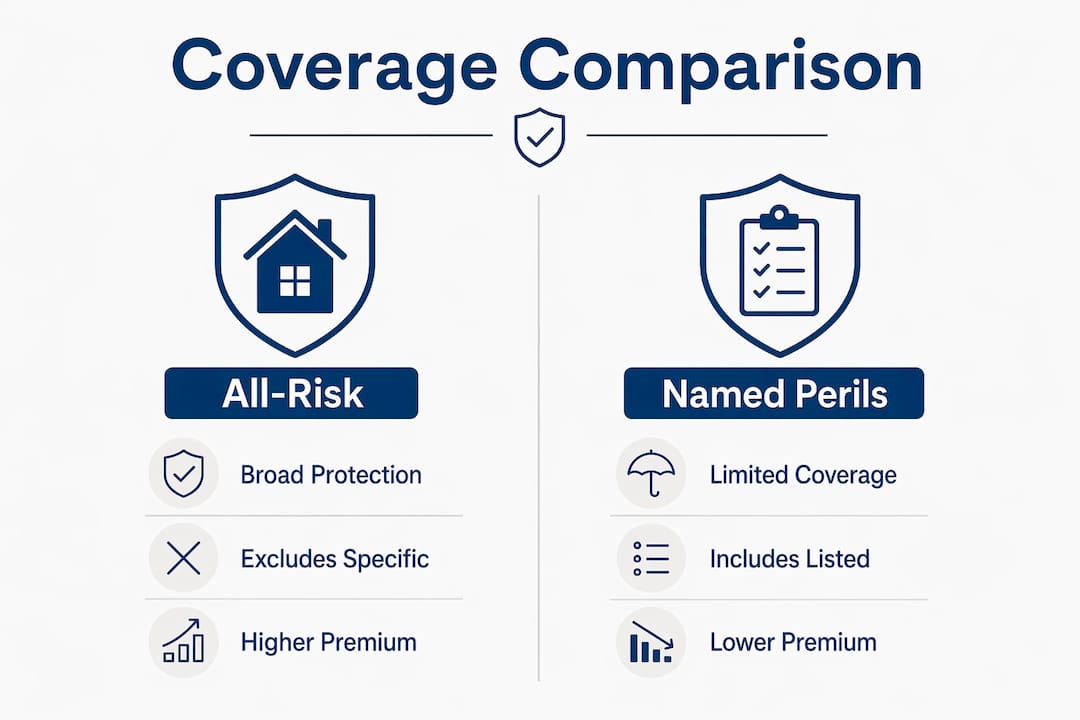
The core difference is simple: open-perils covers everything not excluded; named-perils covers only what is listed. Everything else, including premium, burden of proof, and lender acceptance, flows from that distinction.
Choose open-perils coverage when:
- A mortgage lender requires it
- You own high-value personal property or commercial equipment
- You want the burden-of-proof advantage in a dispute
- Your property faces a wide range of potential physical risks
A named-perils approach may work when:
- You own a secondary property with limited exposure
- Budget is the primary constraint and the covered perils list matches your actual risk profile
- Your state DOI guidance confirms the named-perils form satisfies any applicable requirements
For contractors and commercial property owners, understanding how property coverage interacts with liability is worth a separate look. The general liability guide for commercial contractors covers that intersection in detail.
| Factor | All-Risk (Open Perils) | Named-Perils |
|---|---|---|
| Coverage approach | All causes unless excluded | Only listed causes |
| Burden of proof | Insurer must prove exclusion applies | Insured must prove cause matches a listed peril |
| Typical premium direction | Higher | Lower |
| Lender acceptance | Generally preferred or required | May not satisfy lender requirements |
| Best for | Homeowners, commercial property, high-value assets | Lower-risk properties, budget-conscious buyers |
Real-world scenarios: covered vs. excluded
These short examples show how policy language plays out in practice.
- Burst pipe (covered): A supply line fails overnight, flooding the kitchen. The loss is sudden, accidental, and direct physical damage. The insurer must cover it unless it can point to a specific exclusion. Document the damage before cleanup begins.
- Stolen laptop from a locked vehicle (likely covered, subject to limits): Many homeowners and renters policies extend off-premises theft coverage to personal property. Check your policy’s off-premises sub-limit, which may limit coverage for theft from vehicles.
- Long-term slow leak behind a wall (often excluded): A pinhole leak drips for six weeks before you notice the mold. Because the damage was gradual, not sudden, the long-term seepage exclusion typically applies. The insurer does not need to pay, and failing to mitigate damage can reduce any recovery.
- Flood after a heavy storm in a flood zone (excluded without NFIP): Rainwater that enters through overland flooding is not a covered peril under a standard homeowners form. Without a separate NFIP policy or private flood endorsement, the loss is entirely out of pocket.
Each scenario reinforces the same discipline: know your exclusions before the loss happens, not after.
Your practical checklist for buying an all-risk policy in the U.S.
Before you sign or renew, work through this list. Each item can affect how much you actually recover on a claim.
- Verify the policy form: Confirm it is labeled “special form,” “open perils,” or “all risk,” not a basic or broad named-perils form.
- Read the exclusion list in full: Flood and earthquake are almost always excluded. Texas DOI explicitly warns homeowners to verify exclusions for wind, hail, and other location-specific risks.
- Check limits and sub-limits: Confirm the dwelling limit, contents limit, and any per-category caps on valuables.
- Replacement cost vs. ACV: Replacement cost pays to rebuild or replace at today’s prices, while Actual Cash Value deducts depreciation, affecting your settlement amount.
- Deductible structure: Some policies carry separate, higher deductibles for wind or hail. Know what you owe before a claim.
- Coinsurance clause: Understand the required insured-to-value percentage and what happens if you fall short.
- Mortgagee / loss-payee language: Confirm your lender is listed correctly. A missing mortgagee clause can complicate or delay a claim settlement.
- Scheduled items: If you own jewelry, art, or other valuables above policy sub-limits, add a floater or endorsement now.
- State DOI guidance: Check your state Department of Insurance for any state-specific requirements. Texas readers can start at the Texas Department of Insurance tips page.
Pro Tip: Create a home or business inventory with photos, serial numbers, and recent appraisals. Store a copy offsite or in cloud storage. An evidence folder speeds every step of the claims process and protects you if records are destroyed in the same loss.
Flood and earthquake coverage are excluded from virtually every standard property policy in the United States. If your property sits in a flood-prone area or a seismically active region, treat those as separate line items in your coverage budget, not optional extras.
Why policy wording matters more than the label
Most people buy insurance and file it away. The problem is that the label on the policy, “all risk,” “special form,” “open perils,” tells you almost nothing about whether your specific loss is covered. The exclusion list, the sub-limits, the coinsurance clause, and the deductible structure are where coverage is actually defined. By the time a claim happens, it is too late to fix the wording.
At Hettler Insurance Agency, the most common pattern we see is a policyholder who assumed “all risk” meant complete protection, then discovered a gap at the worst possible moment. A homeowner with a flooded basement who did not know flood was excluded. A small-business owner whose equipment loss was capped at a sub-limit half the replacement cost. A property owner whose coinsurance shortfall reduced a fire claim by a third.
The fix is a policy review before the loss, not after. Hettler Insurance Agency has been doing exactly that for Texas property owners and businesses since 1992. Ron Hettler, CIC (certified insurance counselor), founded the agency with over 40 years of industry experience, and his daughter Meghan Harris, also CIC credentialed, leads the team today. The CIC designation is the gold standard in insurance credentials. The agency represents over 30 top-rated carriers, holds an A+ BBB rating, and carries a 4.5-star Google rating built on decades of client relationships across West Texas.
A policy review from an independent agent who can compare forms across dozens of carriers is a different experience than talking to a single-company representative. You get real options, not a single product. “The best independent insurance agents don’t just find you a policy. They find you the right insurance policy and then make sure it stays right as your life changes.” — Ron Hettler, CIC (certified insurance counselor), Hettler Insurance Agency
Get a free policy review from Hettler Insurance Agency
If you finished this article and realized you are not sure whether your current policy is a special form, what your flood exclusion says, or whether your jewelry is scheduled, that uncertainty is worth resolving before a loss forces the question.
Hettler Insurance offers a no-pressure coverage review for homeowners, renters, and small-business owners across Texas. Bring your declarations page, a rough inventory of high-value items, and any recent appraisals. The team will check your policy form, exclusions, limits, and mortgagee language, then compare options across more than 30 carriers to find the right fit at the right price. There is no extra fee for the comparison.
For small-business owners, the minimum insurance guide is a good starting point before your review. To schedule a coverage conversation with the Hettler Insurance team, visit hettlerinsurance.com or call the Lubbock office directly @ 806-798-7800.
This article is general information, not professional legal or insurance advice. Coverage terms vary by policy, carrier, and state. Confirm your specific coverage with a licensed agent or your state Department of Insurance.
Useful sources and where to go next
The following authoritative sources back the claims in this article and are worth bookmarking for your own research:
- Texas Department of Insurance: All Risk or Named Peril — State-specific guidance on policy types, lender requirements, and location-specific exclusions. Texas readers should start here.
- Investopedia: All Risk Insurance Explained — Concise definition, exclusions list, and overview of endorsements and floaters.
- IRMI: All Risks Coverage Definition — Industry-standard definition and explanation of the terminology shift from “all-risk” to “open perils.”
- LegalClarity: What Is All Risk Insurance? — Detailed explanation of the burden-of-proof shift, ISO Special Form language, and time-based exclusions.
- National Flood Insurance Program (NFIP): Contact your agent or visit FloodSmart.gov for flood zone maps and coverage options.
- Your state Department of Insurance: For state-specific requirements, lender mandates, and complaint resources, go directly to your state DOI website. For Texas, that is tdi.texas.gov.
Save your declarations page, keep a current property inventory, and contact a licensed independent agent for a tailored review of your specific policy form and exclusions.
Recommended
About the Author
Ronald J. Hettler, CIC is a Certified Insurance Counselor (CIC) [the gold-standard credential in the independent insurance industry]. Ron has over 46 years of real-world experience in the insurance industry. He is the owner/president of Hettler Insurance Agency in Lubbock, Texas and is licensed by the Texas Department of Insurance (License #666862). (Why Trust Hettler Insurance Agency? It’s a Local independent insurance agency representing multiple carriers. Hettler Insurance Agency has established business roots going back to it’s predecessor in the late 1800’s. Local expertise in Lubbock Texas and West Texas risks. Focused on clarity before a claim occurs.) Ron and his daughter Meghan, also a CIC, lead a team that represents 30+ carriers and serves clients across Texas.
Ron specializes in helping individuals, families, and small business owners understand complex insurance concepts in clear, practical terms so they can make informed decisions about their coverage. He specializes in helping individuals and families understand coverage gaps, deductible structures, and real-world claim outcomes before a loss occurs. Ron helps you to understand how insurance policies respond in real-world claim situations.
License verification available through the Texas Department of Insurance.
Frequently Asked Questions ?
Q1 ?: What is all risk insurance?
Q2 ?: How is all risk insurance different from named-perils coverage?
Q3 ?: What does an all-risk policy not cover?
Q4 ?: Are my jewelry and other valuables fully covered under an all-risk policy?
Q5 ?: What should I check before buying or renewing an all-risk policy?
— Life Insurance Instant Quote and Apply Tool @ GetLifePolicy.com > * Quick self-service term life insurance quote. With or without medical exam.
— Call us about Auto, Home, Business, Life, or Health insurance. * Click to Call (806) 798-7800, Mon-Fri 8:30am-5pm (lunch closed Noon-1pm)
— Come see us @ our new address 4720 S Loop 289 Lubbock, TX 79414 (maps link), or get your online quote started at https://GetHettler.com