

TL;DR summary:
- Excess liability insurance raises the coverage limits of your primary policy after exhaustion, following exact terms and exclusions. It provides targeted protection on one policy, unlike umbrella insurance, which offers broader coverage across multiple policies and claim types. For most homeowners and renters, umbrella coverage is preferable, but excess liability is essential when higher limits are contractually required or for stacking policies in a liability tower.
Excess liability insurance is defined as a policy that extends the coverage limits of your existing liability policy once those limits are fully exhausted. Unlike adding a new type of coverage, it simply raises the ceiling on what your insurer will pay for a covered claim. If a lawsuit judgment exceeds your homeowners or renters policy limit, excess liability coverage steps in to cover the remaining amount. Hettler Insurance Agency, a Certified Insurance Counselor (CIC)-led independent agency serving Texas since 1992, regularly helps homeowners and renters understand how this coverage fits into a sound risk management plan.
Table of Contents
- Key takeaways
- What is excess liability insurance and how does it work?
- How does excess liability compare to umbrella insurance?
- What are the real benefits of excess liability coverage?
- How to decide if you need excess liability insurance
- Why excess liability deserves more attention than it gets
- Get the right liability coverage with Hettler Insurance
- Frequently Asked Questions
Key takeaways
Excess liability insurance is the most direct way to raise your liability coverage limit without changing your underlying policy’s terms or scope.
| Point | Details |
|---|---|
| Following form policy | Excess liability mirrors your primary policy exactly, covering nothing the underlying policy excludes. |
| Triggered after exhaustion | Coverage only activates after your primary policy’s limit is completely paid out. |
| Different from umbrella | Umbrella covers multiple policies and broader claims; excess raises one policy’s limit only. |
| Real financial exposure | Serious injury lawsuits routinely exceed standard homeowners limits of $100,000 to $300,000. |
| Documentation matters | Claim payment requires proof of primary limit exhaustion; keep all payment records organized. |
What is excess liability insurance and how does it work?
Excess liability insurance is a following form policy, meaning it mirrors the exact terms, conditions, and exclusions of the underlying policy it attaches to. It does not expand your coverage. It only raises the dollar limit available to pay a covered claim. That distinction matters more than most homeowners realize.
Here is how the trigger works in practice. Say your homeowners policy carries $300,000 in personal liability coverage. A guest suffers a serious injury on your property, and the court awards $500,000 in damages. Your primary policy pays its $300,000 limit. Your excess liability policy then covers the remaining $200,000, up to its own limit. Without that extra layer, the $200,000 shortfall comes directly out of your pocket.
The policy attaches to specific underlying policies, most commonly:
- Homeowners liability coverage for property-related incidents
- Renters liability coverage for tenant-caused damage or injury
- Auto liability coverage for vehicle-related claims
- Boat or recreational vehicle liability where applicable
One critical rule governs every excess liability claim: if a claim is excluded by the underlying policy, the excess policy excludes it too. There is no drop-down coverage, no independent insuring agreement, and no gap-filling. The excess policy follows the primary policy exactly.
Pro Tip: Before purchasing excess liability coverage, read your primary policy’s exclusions carefully. Any gap in your underlying coverage will not be filled by an excess policy. Address exclusions at the primary level first.
How does excess liability compare to umbrella insurance?
This is the question most homeowners get wrong. Excess liability and umbrella insurance both provide coverage above your primary policy limits, but they work very differently. Understanding the distinction helps you choose the right tool for your actual risk exposure.

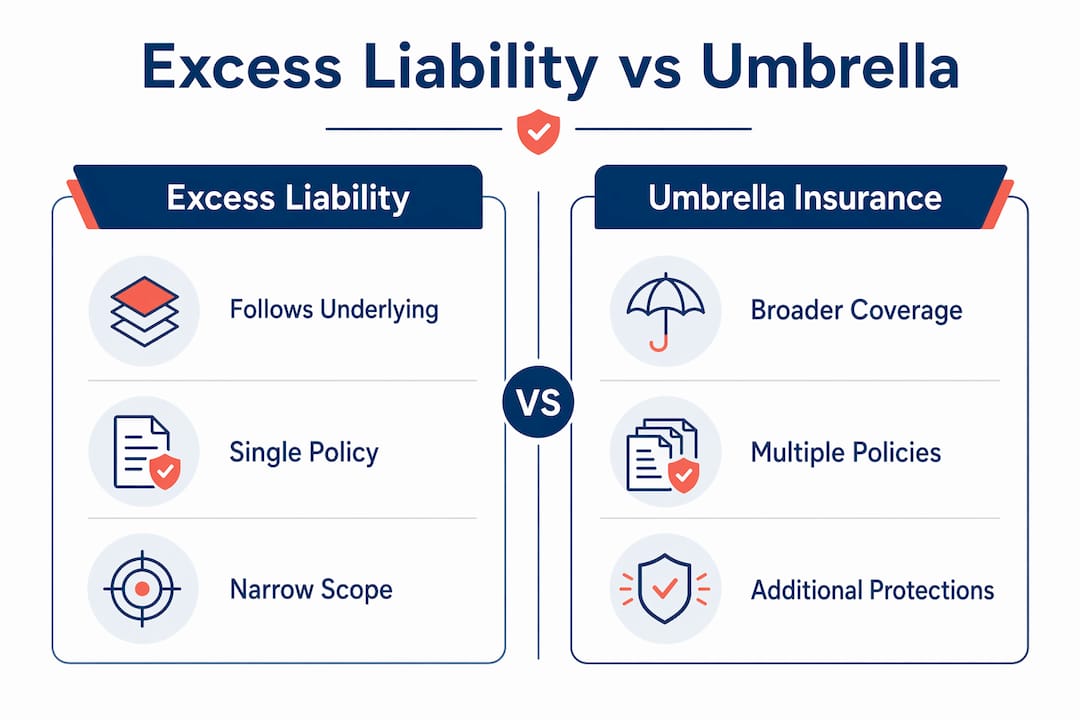
Umbrella insurance is broader. It can cover claims that your underlying policies do not, such as personal injury claims like defamation or false arrest. It also applies across multiple underlying policies, including homeowners, auto, and watercraft, under one umbrella limit. Umbrella policies often include a self-insured retention (essentially a deductible) of $10,000 to $25,000 that applies specifically to drop-down coverage scenarios. That retention does not apply to standard claims that simply exceed the underlying limit.
Excess liability is narrower. It attaches to one specific underlying policy, raises only that policy’s limit, and follows that policy’s terms without exception. It carries no self-insured retention because there is no drop-down coverage to trigger one.
| Feature | Excess liability | Umbrella insurance |
|---|---|---|
| Coverage scope | Mirrors underlying policy exactly | Broader, may cover additional claim types |
| Policies covered | One specific underlying policy | Multiple underlying policies |
| Drop-down coverage | None | Yes, fills gaps in underlying coverage |
| Self-insured retention | Generally none | $10,000 to $25,000 for drop-down claims |
| Best use case | Higher limits on a single policy | Broad extra protection across all policies |
.
For most homeowners and renters, umbrella insurance is the preferred choice because it covers more ground for a relatively low premium. Excess liability becomes the right tool when a specific contract requires higher limits on one policy, or when a client needs to stack additional limits above an existing umbrella policy. Insurance brokers refer to this stacking structure as a “liability tower,” where the primary policy sits at the base, the umbrella sits above it, and excess liability layers stack on top.
Pro Tip: If you already carry umbrella insurance and a contract requires higher limits than your umbrella provides, an excess liability policy placed above the umbrella is often the most cost-effective solution. Ask your agent about layered liability coverage before purchasing a new umbrella at a higher limit.
What are the real benefits of excess liability coverage?
The core benefit of excess liability insurance is financial protection against catastrophic liability claims that exceed your primary policy limits. For homeowners and renters, those claims are more common than most people expect.
Consider these practical scenarios where excess liability coverage delivers real value:
- Serious injury on your property. A contractor falls from a ladder at your home and sustains permanent injuries. Medical costs, lost wages, and pain-and-suffering damages can easily exceed $300,000 in a single lawsuit.
- Dog bite liability. Dog bites account for a significant share of homeowners liability claims. Severe bites involving children can result in judgments well above standard policy limits.
- Swimming pool accidents. Pools are classified as “attractive nuisances” under Texas law, meaning you carry heightened liability if a neighbor’s child is injured, even without an invitation.
- Rental property incidents. Renters face liability exposure for damage they cause to the property or injuries to guests. Standard renters policies often carry limits of $100,000 or less.
- Contractual requirements. Some landlords, homeowners associations, or lenders require tenants or owners to carry liability limits above what a standard policy provides.
Premium costs vary significantly based on risk factors, from a few hundred dollars annually for individuals to considerably more for higher-risk profiles. That cost is modest compared to the financial exposure of a six-figure judgment. Industry best practice often advises $1 million per occurrence as a minimum coverage threshold for individuals with significant assets to protect. That figure reflects the reality that serious injury lawsuits routinely reach seven figures in states like Texas.
How to decide if you need excess liability insurance
Deciding whether to add excess liability coverage starts with an honest assessment of your current policy limits and your personal risk exposure. Most homeowners and renters underestimate both.
Start by reviewing your existing liability coverage in Texas and answering these questions:
- What are your current liability limits? Standard homeowners policies in Texas typically carry $100,000 to $300,000 in personal liability coverage. That may not be enough.
- What assets do you own? If a judgment exceeds your policy limit, creditors can pursue your savings, investments, and property. Higher net worth means higher exposure.
- What risk factors exist at your property? Pools, trampolines, dogs, and frequent guests all increase the probability of a liability claim.
- Do any contracts require specific limits? Lease agreements, HOA rules, or lender requirements may mandate coverage levels above your current policy.
- Do you already carry umbrella insurance? If yes, evaluate whether your umbrella limit is sufficient or whether an excess policy stacked above it makes sense.
Filing a claim under excess liability insurance requires documented proof that the underlying policy limits have been fully exhausted, including payment records or exhaustion letters from the primary insurer. Missing documentation can delay or deny a claim. That means your record-keeping practices matter as much as the policy itself.
Policies follow standardized ISO forms or are custom-tailored for specific needs, so the exact terms vary by carrier. Working with an independent agent who represents multiple carriers, like Hettler Insurance with access to over 30 top-rated insurers, gives you the ability to compare policy language and pricing rather than accepting a single carrier’s offering.
Why excess liability deserves more attention than it gets
Most homeowners I speak with have never heard the term “excess liability insurance” until they need it. That gap in awareness is a real problem. People assume their homeowners policy will handle any lawsuit that comes their way, and that assumption holds right up until the moment a judgment comes back at $450,000 and their policy limit is $300,000.
The honest truth is that umbrella insurance handles most situations for everyday homeowners and renters. It is broader, covers more scenarios, and is typically the right starting point. But excess liability fills a specific and important role. If your umbrella limit is $1 million and a contract requires $2 million on a single underlying policy, an excess policy is the precise tool for that job. Stacking excess above umbrella is a standard practice in layered insurance programs, and it is not just for commercial clients with large risk profiles.
What I tell clients at Hettler Insurance is this: the cost of adding excess liability coverage is almost always smaller than the cost of one uninsured judgment. Review your limits honestly, factor in your assets, and talk to an agent who can compare options across carriers. Do not wait for a contract requirement or a lawsuit to start that conversation.
— Ron Hettler
Get the right liability coverage with Hettler Insurance Agency in Lubbock Texas

Hettler Insurance Agency has helped Texas homeowners and renters build the right coverage stack since 1992. As an independent agency representing over 30 top-rated carriers, the team compares excess liability options across the market to find the right fit at the right price. Whether you need to raise limits on a single policy, layer coverage above an existing umbrella, or start from the ground up, Hettler’s CIC-credentialed advisors give you clear, no-pressure guidance. Start by reviewing your foundational coverage needs and then contact Hettler Insurance to discuss how excess liability fits your specific situation. Call or connect online today.
Recommended
About the Author
Ronald J. Hettler, CIC is a Certified Insurance Counselor (CIC) [the gold-standard credential in the independent insurance industry]. Ron has over 46 years of real-world experience in the insurance industry. He is the owner/president of Hettler Insurance Agency in Lubbock, Texas and is licensed by the Texas Department of Insurance (License #666862). (Why Trust Hettler Insurance Agency? It’s a Local independent insurance agency representing multiple carriers. Hettler Insurance Agency has established business roots going back to it’s predecessor in the late 1800’s. Local expertise in Lubbock Texas and West Texas risks. Focused on clarity before a claim occurs.) Ron and his daughter Meghan, also a CIC, lead a team that represents 30+ carriers and serves clients across Texas.
Ron specializes in helping individuals, families, and small business owners understand complex insurance concepts in clear, practical terms so they can make informed decisions about their coverage. He specializes in helping individuals and families understand coverage gaps, deductible structures, and real-world claim outcomes before a loss occurs. Ron helps you to understand how insurance policies respond in real-world claim situations.
License verification available through the Texas Department of Insurance.
Frequently Asked Questions ?
Q1 ?: What is the difference between excess liability and umbrella insurance?
Q2 ?: Does excess liability insurance cover claims my primary policy excludes?
Q3 ?: How much does excess liability insurance cost for homeowners?
Q4 ?: When does excess liability insurance actually pay out?
Q5 ?: Do renters need excess liability insurance?
— Life Insurance Instant Quote and Apply Tool @ GetLifePolicy.com > * Quick self-service term life insurance quote. With or without medical exam.
— Call us about Auto, Home, Business, Life, or Health insurance. * Click to Call (806) 798-7800, Mon-Fri 8:30am-5pm (lunch closed Noon-1pm)
— Come see us @ our new address 4720 S Loop 289 Lubbock, TX 79414 (maps link), or get your online quote started at https://GetHettler.com