
TL;DR summary:
- Blanket insurance covers multiple properties or assets under ONE pooled limit instead of a fixed cap per location — so the full policy limit is available for any single loss. The tradeoff: higher premiums, stricter 90–100% coinsurance, and margin clauses that can quietly cap per-site payouts.
If you own more than one property — rental homes across Lubbock, warehouses across West Texas, retail locations across multiple cities — you have probably wondered whether one policy could cover them all. That’s exactly what blanket insurance does. But the way blanket coverage handles limits, coinsurance, and margin clauses is fundamentally different from a standard scheduled policy, and Texas property owners get caught off guard by that difference every single week. Blanket insurance is a single policy that covers multiple properties or assets under one combined limit, rather than assigning a separate dollar cap to each location. When a loss occurs at any covered site, the full pooled limit is available to pay the claim, not just the amount originally assigned to that address. This flexibility is the defining feature that separates blanket coverage from standard scheduled policies. Hettler Insurance Agency has helped Texas property owners and business clients navigate exactly this decision for over 30 years.
Table of Contents
- How does blanket insurance differ from scheduled insurance?
- Who typically needs blanket insurance?
- Advantages and disadvantages of blanket insurance
- How to decide on appropriate blanket insurance coverage limits
- Expert insights on selecting and managing blanket policies
- Blanket insurance across different industries
- How blanket insurance handles common claims
- How to purchase blanket insurance
- Key Takeaways
- Frequently Asked Questions
Key Takeaways
Blanket insurance protects multiple properties under one pooled limit, but it demands accurate valuations and coinsurance compliance to deliver that protection when a loss occurs.
| Point | Details |
|---|---|
| Pooled coverage limit | The full blanket limit is available for any single loss, unlike scheduled policies that cap payouts per location. |
| Coinsurance threshold | Blanket policies typically require 90%–100% coinsurance, compared to 80% in standard scheduled policies. |
| Margin clause risk | A margin clause caps per-site payouts at a set percentage above each location’s listed value, even within the blanket limit. |
| Valuation accuracy | Under-reporting one property’s value can trigger coinsurance penalties across the entire portfolio, not just that location. |
| Best candidates | Business owners, landlords, and investors with multiple properties or frequently moving assets benefit most from blanket coverage. |
.
Main features of blanket insurance at a glance:
- Single aggregate limit covers all listed properties or asset categories
- Pooled coverage means no individual location is capped at its scheduled value
- Coinsurance requirements typically run 90%–100%, higher than the 80% standard in scheduled policies
- Margin clauses may limit per-site payouts to a set percentage above each location’s listed value
- Premiums tend to run higher than scheduled policies due to broader coverage scope
How does blanket insurance differ from scheduled insurance?
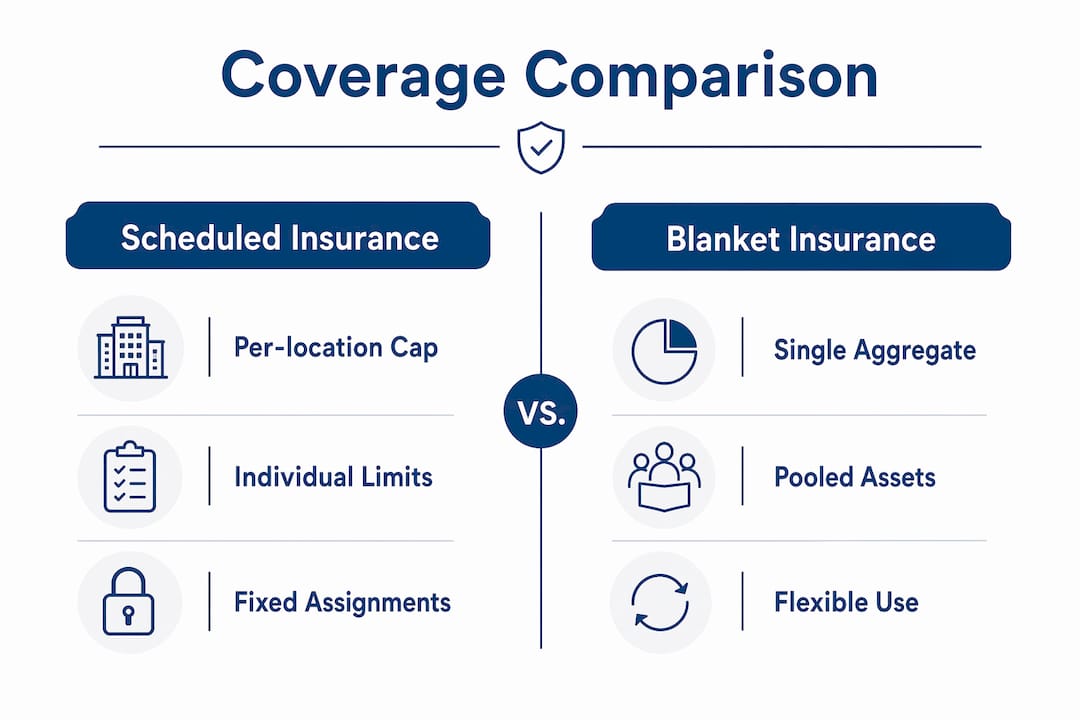
Standard scheduled insurance assigns a fixed dollar limit to each property or asset individually. If a warehouse listed at $1.5 million suffers $2 million in damage, the insurer pays only $1.5 million. The gap is your problem.
A blanket policy works differently. It groups all covered properties under one aggregate limit. That same $2 million loss gets paid in full, as long as it falls within the blanket policy’s total limit and no margin clause restricts it. The funds are not locked to individual locations.
| Feature | Scheduled Insurance | Blanket Insurance |
|---|---|---|
| Coverage limit | Per-location cap | Single aggregate limit |
| Payout flexibility | Capped at each site’s value | Full limit available for any one loss |
| Coinsurance requirement | Typically 80% | Typically higher than in scheduled policies |
| Underinsurance risk | Higher at individual sites | Lower across portfolio |
| Premium cost | Generally lower | Generally higher |
| Valuation strictness | Moderate | High |
| Margin clause | Uncommon | Often present |
The coinsurance gap is where most policyholders get caught off guard. Blanket policies require your total insured value to equal at least 90% of the actual value of all covered property, sometimes 100%. Fall short, and the insurer applies a proportional penalty to every claim.
Who typically needs blanket insurance?
Business owners, landlords, and commercial property managers with multiple locations are the most common candidates. So are individuals who own property at more than one address.
Common user profiles include:
- Multi-site business owners operating warehouses, retail locations, or office buildings across several addresses
- Residential landlords with rental properties spread across a city or region
- Commercial real estate managers overseeing mixed-use or multi-building complexes
- Contractors and developers with equipment or materials stored at rotating job sites
- Investors holding diversified real estate portfolios where individual property values shift frequently
The operational driver matters here. If your assets move between locations, or if a catastrophic loss at one site could exceed that site’s scheduled value, blanket coverage gives you a safety net that scheduled policies simply cannot provide. Hettler Insurance regularly works with West Texas landlords and commercial clients who fit exactly this profile. Explore how landlord insurance coverage applies to your specific portfolio.

Advantages and disadvantages of blanket insurance
Advantages:
- Eliminates underinsurance risk at any single location by making the full limit available for one loss
- Simplifies policy administration by consolidating multiple properties under one document
- Provides flexibility when asset values shift or new properties are added mid-term
- Protects against catastrophic single-site losses that exceed a location’s scheduled value
Disadvantages:
- Premiums are generally higher than scheduled policies due to broader coverage and stricter valuation requirements
- Coinsurance thresholds demand precise, current valuations across every covered asset
- Margin clauses can cap per-site payouts, limiting recovery even within the blanket limit
- Under-reporting any single property’s value can trigger coinsurance penalties affecting the entire portfolio
Pro Tip: Before choosing blanket coverage, ask your agent to run a coinsurance penalty calculation using your current property values. A small valuation gap can produce a large reduction in your claim payout, and knowing that number upfront changes the conversation entirely.
The margin clause detail deserves attention. If your policy sets a margin clause set at a certain percentage above a location’s listed value can limit the maximum payout for that site, regardless of the total blanket limit. Check your policy language before you assume the full limit is available.
How to decide on appropriate blanket insurance coverage limits
Accurate valuation is the foundation. Every property in your portfolio needs a current replacement cost estimate, not a market value figure or an outdated appraisal. Replacement cost and market value often differ significantly, and insurers use replacement cost.
Key steps for setting your coverage limits:
- Appraise all covered assets at current replacement cost, not purchase price or tax-assessed value
- Total the replacement costs across every location to establish your minimum insured value
- Apply the coinsurance threshold (90% or 100%, per your policy) to confirm your blanket limit meets the requirement
- Account for margin clauses by verifying each location’s listed value is close to its actual replacement cost
- Review limits annually or whenever you acquire, sell, or significantly improve a covered property
Underinsuring even one location creates exposure across the whole portfolio. Because blanket policies require precise, updated valuations on all covered assets, a single under-reported property can trigger coinsurance penalties that reduce payouts on unrelated claims. Review your business insurance options to understand how blanket coverage fits your broader risk picture.
Expert insights on selecting and managing blanket policies
Risk managers consistently point to the pooled limit as the primary reason to choose blanket coverage. The protection against underinsurance at any single site is real and measurable, particularly for portfolios where one location holds a disproportionate share of total value.
Expert recommendations for policyholders:
- Treat valuation as ongoing work, not a one-time task at policy inception
- Request a Statement of Values (SOV) review with your agent each renewal cycle
- Understand your margin clause terms before a loss occurs, not after
- Confirm your coinsurance percentage in writing and calculate whether your current limit meets it
- Document all property improvements immediately so your SOV stays current
The decision to go blanket should center on operational need. Frequent asset movement, portfolio growth, or exposure to catastrophic single-site loss are legitimate drivers. Choosing blanket coverage purely for administrative convenience, without accounting for the higher premiums and valuation discipline it demands, can create more risk than it removes.
Blanket insurance across different industries
Blanket policies appear across a wide range of sectors, each with distinct coverage needs.
Commercial real estate: A property management company overseeing 12 office buildings across three cities carries one blanket policy rather than 12 separate scheduled policies. If a fire destroys the largest building, the full blanket limit covers reconstruction without a per-site cap.

Retail and hospitality: A restaurant group with locations in multiple cities uses blanket coverage to protect kitchen equipment, fixtures, and building improvements. Equipment values shift as locations are renovated, and the pooled limit absorbs those changes without requiring mid-term policy amendments.
Manufacturing and warehousing: A manufacturer storing raw materials and finished goods across several distribution centers benefits from blanket coverage when inventory moves between sites. Scheduled policies would require constant updates to reflect where inventory sits on any given day.
Residential real estate investors: A landlord with 20 rental homes across a metro area consolidates coverage under one blanket policy. A single severe hail event damaging five properties gets paid from one limit rather than five separate claims with five separate deductibles.
Healthcare and education: Group health plans for university students or employees of a large organization are sometimes structured as blanket health policies, covering all eligible members under one agreement rather than individual enrollment.
How blanket insurance handles common claims
When a covered loss occurs, the insurer draws from the total blanket limit rather than a location-specific sub-limit. A fire at one warehouse, a theft at a retail location, or storm damage across multiple rental properties all pull from the same pool.
The practical difference shows up clearly in multi-site events. If a hailstorm damages three of your rental properties simultaneously, a scheduled policy pays each claim up to that property’s individual limit. A blanket policy pays all three losses from the aggregate limit, which means no single property runs out of coverage mid-claim.
Margin clauses create the main exception. If your policy includes one, the insurer caps the payout for any single location at the clause percentage above that location’s SOV value, regardless of how much remains in the blanket limit. Reviewing your policy for margin clause language before filing a claim prevents surprises during an already stressful process.
How to purchase blanket insurance
Start with a complete inventory of every property or asset you want covered. Each location needs a current replacement cost estimate, not a market value figure.
Steps to follow when purchasing:
- Compile a Statement of Values listing every property, its address, and its replacement cost
- Calculate your total insured value and confirm it meets the policy’s coinsurance threshold (90% or 100%)
- Ask about margin clause terms and how they would affect a large single-site loss
- Compare carriers through an independent agent who can access multiple markets
- Review the policy language on coinsurance, margin clauses, and covered perils before binding
Working with an independent agent gives you access to multiple carriers and policy structures. A single-company agent can only offer what their employer sells. Hettler Insurance Agency represents over 30 carriers, which means real comparison shopping rather than a take-it-or-leave-it quote.

Blanket insurance decisions carry real financial consequences, and getting the coverage limit wrong in either direction costs money. Hettler Insurance Agency has guided Texas property owners and business clients through these decisions since 1992. Ron and Meghan Hettler are both Certified Insurance Counselors (CIC), the gold standard credential in the industry, and the agency holds an A+ BBB rating. Whether you own two rental properties or a portfolio of commercial buildings, the team will shop your coverage across 30+ carriers and explain every term before you sign. Start with the minimum coverage every entrepreneur needs and build from there.
Recommended
About the Author
Ronald J. Hettler, CIC is a Certified Insurance Counselor (CIC) [the gold-standard credential in the independent insurance industry]. Ron has over 46 years of real-world experience in the insurance industry. He is the owner/president of Hettler Insurance Agency in Lubbock, Texas and is licensed by the Texas Department of Insurance (License #666862). (Why Trust Hettler Insurance Agency? It’s a Local independent insurance agency representing multiple carriers. Hettler Insurance Agency has established business roots going back to it’s predecessor in the late 1800’s. Local expertise in Lubbock Texas and West Texas risks. Focused on clarity before a claim occurs.) Ron and his daughter Meghan, also a CIC, lead a team that represents 30+ carriers and serves clients across Texas.
Ron specializes in helping individuals, families, and small business owners understand complex insurance concepts in clear, practical terms so they can make informed decisions about their coverage. He specializes in helping individuals and families understand coverage gaps, deductible structures, and real-world claim outcomes before a loss occurs. Ron helps you to understand how insurance policies respond in real-world claim situations.
License verification available through the Texas Department of Insurance.
Frequently Asked Questions ?
Q1 ?: What is blanket insurance in simple terms?
Q2 ?: How is a blanket policy different from a scheduled policy?
Q3 ?: What is a margin clause and why does it matter?
Q4 ?: What coinsurance percentage does a blanket policy typically require?
Q5 ?: Who is the best candidate for blanket insurance?
— Life Insurance Instant Quote and Apply Tool @ GetLifePolicy.com > * Quick self-service term life insurance quote. With or without medical exam.
— Call us about Auto, Home, Business, Life, or Health insurance. * Click to Call (806) 798-7800, Mon-Fri 8:30am-5pm (lunch closed Noon-1pm)
— Come see us @ our new address 4720 S Loop 289 Lubbock, TX 79414 (maps link), or get your online quote started at https://GetHettler.com