
TL;DR summary:
- Insurance endorsements are legal modifications that add or change coverage in an existing policy and take effect immediately. They control over conflicting policy language and can be issued at renewal or mid-term, with costs varying based on type and timing. Regular review and proper management of endorsements prevent coverage gaps, denial of claims, and ensure compliance with contractual and legal requirements.
An insurance endorsement is defined as a legally binding modification to an existing insurance policy that adds, removes, or changes coverage terms. Also called a rider or addendum, an endorsement takes effect immediately upon issuance and controls over any conflicting language in the base policy. For Texas homeowners and business owners, understanding the role of insurance endorsements is the difference between a claim that pays out and one that gets denied. Your standard policy is a starting point, not a finished product.
Table of Contents
- Key Takeaways
- How do insurance endorsements work to change coverage terms?
- What are common insurance endorsement examples for Texas homeowners and businesses?
- What is the cost impact of adding insurance endorsements?
- Why are endorsements critical for legal protection and compliance?
- How can you effectively manage and review your insurance endorsements?
- Why endorsements are the part of your policy that actually matters
- Hettler Insurance Agency: your endorsement review starts here
- Frequently Asked Questions
Key Takeaways
Insurance endorsements are the controlling legal amendments to your policy, and managing them proactively is the most direct way to prevent denied claims and coverage gaps.
| Point | Details |
|---|---|
| Endorsements override base policy | When endorsement language conflicts with the base policy, the endorsement controls. |
| COI is not coverage proof | Only an endorsement legally extends protection; a COI alone does not satisfy contract requirements. |
| Costs range from modest to significant | Homeowners water backup runs $30–$75 annually; commercial additional insured can cost under $50. |
| Timing determines claim eligibility | Endorsements must be in place before a loss occurs to apply; retroactive additions are not effective. |
| Annual review prevents exposure | Outdated or missing endorsements create gaps that surface only when a claim is denied. |
.
How do insurance endorsements work to change coverage terms?
Endorsements legally modify existing policies by adding, removing, or changing coverage terms. They are not suggestions or summaries. They are formal contract amendments that your insurer attaches to your policy document.
The most important legal principle here is precedence. Endorsement language controls over base policy language when a conflict exists. Courts treat endorsements as more authoritative because they address specific circumstances after the original policy was issued. That means if your base policy says one thing and an endorsement says another, the endorsement wins.
Endorsements can be issued at two points: at renewal or mid-term. A mid-term endorsement takes effect on a specific date during your active policy period. When that happens, your insurer calculates a prorated premium adjustment for the remaining days in the policy term.
.

Here is what endorsements can actually do to your coverage:
- Add new coverage not included in the base policy, such as water backup protection or identity theft coverage
- Remove existing coverage to lower your premium, such as dropping glass replacement on a commercial policy
- Change coverage limits by increasing or decreasing the dollar amount the insurer will pay
- Add an additional insured, extending liability protection to a third party like a landlord or general contractor
- Impose exclusions that restrict coverage for specific risks, locations, or activities
- Clarify ambiguous terms in the base policy to prevent disputes at claim time
Your declarations page lists the endorsements attached to your policy. Review that page every time your policy renews. If an endorsement appears that you did not request, call your agent immediately.
What are common insurance endorsement examples for Texas homeowners and businesses?
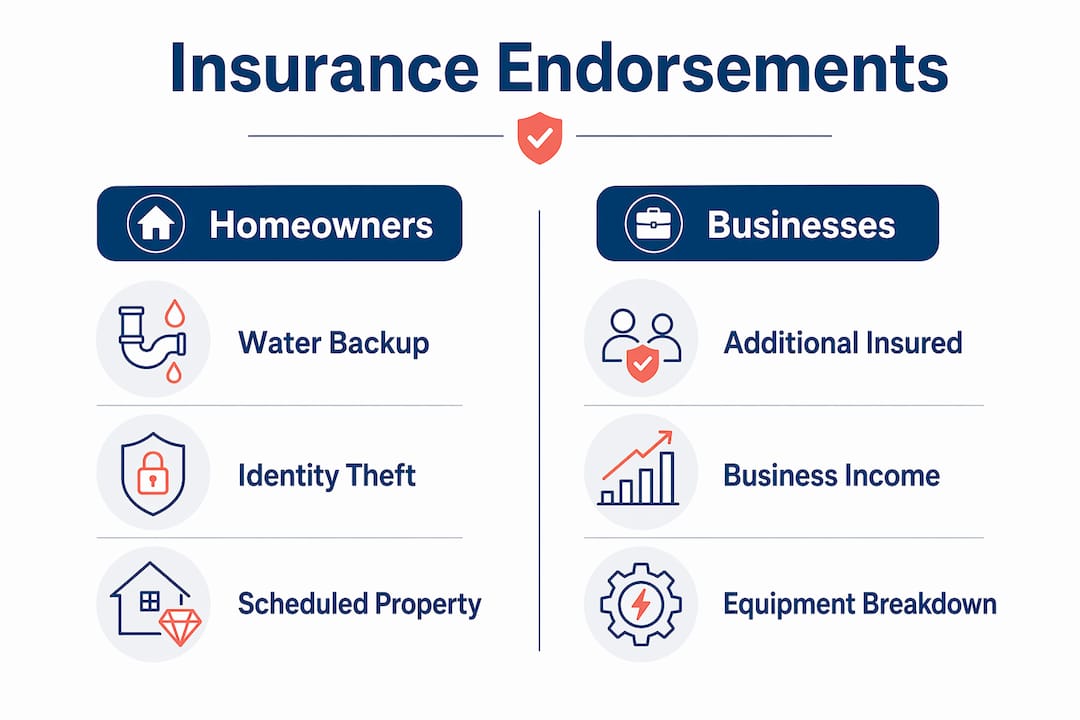
Texas presents specific risks that make certain endorsements non-negotiable for many policyholders. Common endorsement types include additional insured, water backup, hired and non-owned auto, identity theft, and exclusions for specific risks. Each one serves a distinct purpose.
For Texas homeowners:
- Water backup and sump pump endorsement: Standard homeowners policies exclude water that backs up through drains or sewers. This endorsement fills that gap. West Texas flooding events have made this coverage increasingly relevant.
- Identity theft endorsement: Covers expenses related to restoring your identity after fraud, including legal fees and lost wages.
- Scheduled personal property endorsement: Increases coverage limits for high-value items like jewelry, firearms, or art that exceed standard sub-limits.
- Ordinance or law endorsement: Pays the added cost of rebuilding to current building codes after a covered loss. Older Texas homes often require this.
For Texas business owners:
- Additional insured endorsement: Extends your liability coverage to a client, landlord, or general contractor. Most commercial contracts in Texas require this.
- Hired and non-owned auto endorsement: Covers liability when employees drive personal or rented vehicles for business purposes. A standard commercial general liability policy does not include this.
- Cyber liability endorsement: Adds coverage for data breaches and network attacks. Small businesses are frequent targets.
- Waiver of subrogation endorsement: Prevents your insurer from pursuing a third party for reimbursement after paying a claim, which many vendor contracts require.
| Endorsement Type | Who Needs It | Primary Benefit |
|---|---|---|
| Additional insured | Business owners with contracts | Extends liability to required third parties |
| Water backup | Texas homeowners | Covers sewer and drain backup losses |
| Hired/non-owned auto | Businesses with employees driving | Covers liability for non-company vehicles |
| Scheduled personal property | Homeowners with valuables | Raises sub-limits for high-value items |
| Waiver of subrogation | Contractors and vendors | Satisfies common contract requirements |
What is the cost impact of adding insurance endorsements?
Endorsement costs vary widely based on the type of coverage, the risk profile of the property or business, and the insurer. Endorsements can cost from under $50 for a commercial additional insured to $30–$75 annually for a homeowners water backup endorsement. That is a modest price for coverage that can pay thousands in a single claim.
Not every endorsement raises your premium. Some endorsements reduce it. Removing a coverage you no longer need, raising a deductible, or narrowing the scope of a covered risk all lower the insurer’s exposure. That reduction passes to you as a lower premium.
When you add an endorsement mid-term, your insurer applies a prorated calculation. If you add water backup coverage six months into a 12-month policy, you pay roughly half the annual endorsement premium for the remaining term. Proration applies when endorsements are added mid-term, affecting premium calculations for that policy period.
Pro Tip: Ask your agent to run a cost comparison before adding multiple endorsements at once. Bundling coverage changes at renewal often costs less than adding them one at a time mid-term.
Understanding how Texas insurance premiums are calculated helps you negotiate endorsement costs more effectively. Insurers weigh your claims history, property characteristics, and coverage selections together, not in isolation.
Why are endorsements critical for legal protection and compliance?
The biggest misconception in business insurance is that a Certificate of Insurance (COI) proves coverage. It does not. A COI without an endorsement leaves organizations exposed to financial and legal liabilities. The COI reflects existing coverage. Only the endorsement legally modifies the policy and extends protection to additional parties.
This distinction matters most in business-to-business contracts. When a general contractor requires you to name them as an additional insured, they need the endorsement on your policy, not just a COI showing your limits. Without the endorsement, a claim involving that contractor may be denied entirely.
Without proper endorsements, businesses face denied claims or coverage gaps that no amount of documentation can fix after the fact.
The hard truth: A COI is a snapshot. An endorsement is a contract. Relying on one without the other is a compliance failure waiting to become a financial loss.
The compliance stakes extend beyond individual contracts. Texas businesses operating across multiple industries face vendor agreements, lease requirements, and licensing conditions that all specify endorsement requirements. Missing one can mean breaching a contract, losing a client, or voiding coverage on an active claim.
Endorsements applied before a loss are effective. Those added after a loss do not apply retroactively. Timing is not a technicality. It is the entire point. Review your endorsements before you sign a new contract, not after a claim is filed.
Key compliance risks to watch for:
- Signing a vendor contract that requires additional insured status without confirming the endorsement is in place
- Assuming a COI satisfies contractual insurance requirements
- Letting endorsements lapse at renewal without reviewing whether they still match your operations
- Ignoring exclusionary endorsements that quietly restrict coverage added by a prior underwriter
How can you effectively manage and review your insurance endorsements?
Outdated endorsements can unnecessarily restrict coverage or create exposure. Managing endorsements is not a one-time task. It is an ongoing responsibility tied directly to your risk profile.
Follow this process to stay current:
- Review your declarations page at every renewal. Confirm that every listed endorsement still reflects your current operations, property, and contracts.
- Read endorsement language directly. Do not rely on a summary. The actual wording controls your coverage. If a term is unclear, ask your agent to explain it in plain language.
- Audit endorsements after any operational change. Hiring employees, adding a vehicle, signing a new lease, or expanding services all create new coverage needs.
- Request endorsements in writing before signing contracts. If a client or landlord requires specific endorsements, confirm with your insurer that the endorsement is issued and effective before you sign.
- Remove endorsements you no longer need. An endorsement for a property you sold or a coverage line you discontinued still appears on your policy until you remove it. Removing it lowers your premium.
- Keep copies of all endorsements. Store them with your policy documents and update your records each time a change is made.
Pro Tip: Set a calendar reminder 60 days before your policy renewal date. That window gives you time to request changes, compare options, and avoid rushed decisions.
Consulting a licensed insurance professional is the most reliable way to customize your business insurance and confirm your endorsements match your actual exposure. An independent agent who represents multiple carriers can identify gaps that a single-carrier agent may overlook.
Why endorsements are the part of your policy that actually matters
Most policyholders spend their energy comparing premium quotes and coverage limits. That focus makes sense on the surface. But in my experience working with Texas homeowners and business owners, the claims that go sideways almost never involve the base policy limits. They involve endorsements, or the absence of them.
A business owner signs a contract requiring additional insured status. They hand over a COI and assume the box is checked. Six months later, a claim is filed and the insurer denies it because the endorsement was never issued. That is not a coverage limit problem. That is an endorsement management problem. And it is entirely preventable.
The fine print in endorsements deserves the same attention you give to your deductible or your premium. Reviewing your endorsements annually is not optional if you want your policy to perform when it counts. Operational changes, new contracts, and regulatory shifts all create new endorsement needs that your original policy never anticipated.
My advice is direct: do not wait for a claim to find out what your endorsements actually say. Read them now. If something does not make sense, call your agent and get a plain-language explanation. If your agent cannot provide one, that is also useful information.
— Ron
Hettler Insurance Agency: your endorsement review starts here
Texas homeowners and business owners trust Hettler Insurance to cut through the fine print and build coverage that actually holds up. Founded by Ron Hettler, a CIC (Certified Insurance Counselor) with over 40 years of experience, and led today alongside his daughter Meghan (also CIC credentialed), the agency represents over 30 top-rated carriers statewide.

Whether you need to add an additional insured, close a water backup gap, or confirm your endorsements match your current contracts, the Hettler Insurance team reviews your full policy, not just your limits. Business owners can start with the minimum insurance for entrepreneurs guide to understand which endorsements belong in your coverage from day one. Call Hettler Insurance Agency or visit hettlerinsurance.com to schedule your policy review today.
Recommended
About the Author
Ronald J. Hettler, CIC is a Certified Insurance Counselor (CIC) [the gold-standard credential in the independent insurance industry]. Ron has over 46 years of real-world experience in the insurance industry. He is the owner/president of Hettler Insurance Agency in Lubbock, Texas and is licensed by the Texas Department of Insurance (License #666862). (Why Trust Hettler Insurance Agency? It’s a Local independent insurance agency representing multiple carriers. Hettler Insurance Agency has established business roots going back to it’s predecessor in the late 1800’s. Local expertise in Lubbock Texas and West Texas risks. Focused on clarity before a claim occurs.) Ron and his daughter Meghan, also a CIC, lead a team that represents 30+ carriers and serves clients across Texas.
Ron specializes in helping individuals, families, and small business owners understand complex insurance concepts in clear, practical terms so they can make informed decisions about their coverage. He specializes in helping individuals and families understand coverage gaps, deductible structures, and real-world claim outcomes before a loss occurs. Ron helps you to understand how insurance policies respond in real-world claim situations.
License verification available through the Texas Department of Insurance.
Frequently Asked Questions ?
Q1 ?: What is the role of insurance endorsements in a policy?
Q2 ?: How do insurance endorsements differ from a Certificate of Insurance?
Q3 ?: What are the most common endorsement examples for Texas homeowners?
Q4 ?: How much do insurance endorsements cost?
Q5 ?: How often should you review your insurance endorsements?
— Life Insurance Instant Quote and Apply Tool @ GetLifePolicy.com > * Quick self-service term life insurance quote. With or without medical exam.
— Call us about Auto, Home, Business, Life, or Health insurance. * Click to Call (806) 798-7800, Mon-Fri 8:30am-5pm (lunch closed Noon-1pm)
— Come see us @ our new address 4720 S Loop 289 Lubbock, TX 79414 (maps link), or get your online quote started at https://GetHettler.com