

TL;DR summary:
- Loss assessment coverage pays homeowners’ shares of assessments when HOA insurance falls short during covered damage. Texas homeowners should increase limits well beyond the default $1,000 to protect against large assessments caused by storms or liability claims. Regular review of HOA policies and personal coverage ensures protection matches evolving risks and deductibles. “The best independent agents do not just find you a policy. They find you the right policy and then make sure it stays right as your life changes.” — Ron Hettler, CIC (certified insurance counselor), Hettler Insurance Agency
Loss assessment coverage is an insurance endorsement that pays your share of a special assessment charged by a homeowners association (HOA) or condo association when their master policy falls short. Texas homeowners in HOA communities face real financial exposure every time a major storm, fire, or liability claim exceeds what the association’s collective insurance can cover. The role of loss assessment coverage is to absorb that gap before it hits your personal bank account. Without it, a single assessment can run into the tens of thousands of dollars with no warning.
Table of Contents
- Key Takeaways
- What is the role of loss assessment coverage for Texas homeowners?
- What are the key limitations and exclusions you need to know?
- How much loss assessment coverage do Texas homeowners actually need?
- Practical steps to secure and maintain effective loss assessment coverage
- What I’ve seen Texas homeowners get wrong about loss assessment coverage
- How Hettler Insurance Agency helps Texas homeowners get this right
- Frequently Asked Questions
Key Takeaways
Loss assessment coverage is the only direct financial protection a homeowner has against special assessments when an HOA’s master policy falls short, and the default $1,000 limit is almost never adequate for Texas property owners.
| Point | Details |
|---|---|
| Default limits are too low | Standard HO-6 policies include only $1,000, far below typical real-world assessments. |
| Coverage has strict triggers | Only assessments from covered perils under your own policy qualify for reimbursement. |
| Exclusions are significant | Floods, earthquakes, deferred maintenance, and capital improvements are not covered. |
| Sizing requires HOA data | Match your limit to your HOA’s master policy deductible and reserve fund health. |
| Annual review is required | HOA deductibles and local risk factors change; your coverage must keep pace. |
.
What is the role of loss assessment coverage for Texas homeowners?
Loss assessment coverage is a provision found in HO-6 condo policies and some standard homeowners policies that reimburses you for your proportional share of a special assessment. When your HOA’s master insurance policy cannot fully pay for damage to shared property or a liability judgment, the association divides the remaining cost among all unit owners. That division is the special assessment, and it is your legal obligation to pay it.

Texas homeowners face this risk more often than many realize. Severe hailstorms, windstorms, and liability claims against HOAs are common triggers. A hailstorm that destroys a shared roof, a fire in a common hallway, or a slip-and-fall lawsuit against the association can all produce a special assessment. Master policy deductibles can reach $100,000 or more, and that entire deductible amount gets split among unit owners when a covered loss occurs. That split is exactly what loss assessment insurance is designed to cover.
The coverage responds only when the underlying event is a peril already covered by your own homeowners policy. Common covered triggers include:
- Fire or smoke damage to shared structures
- Windstorm or hail damage to common areas, a major risk in West Texas
- Liability judgments against the HOA that exceed the master policy limits
- Master policy deductible shortfalls after a covered property loss
Pro Tip: Review your HOA’s master policy deductible every year. If it increased, your loss assessment exposure increased with it.
What are the key limitations and exclusions you need to know?
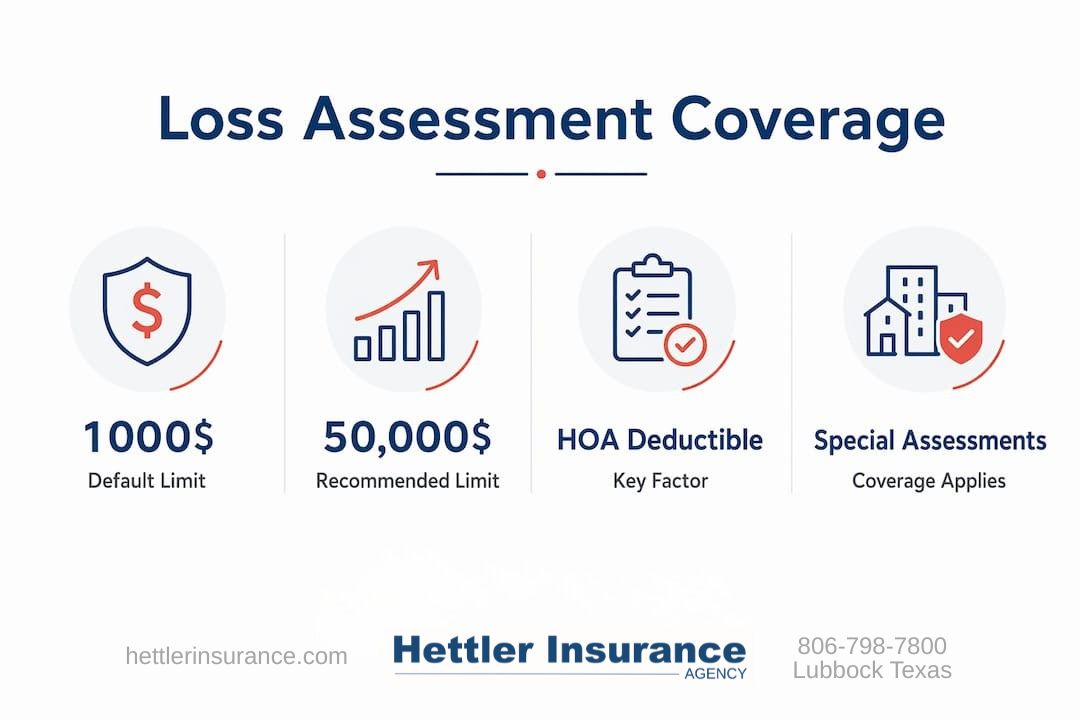
Loss assessment coverage has firm boundaries, and standard HO-6 policies typically come with only $1,000 in default loss assessment coverage. Real-world special assessments after major property damage or liability claims routinely exceed that default limit by ten times or more, leaving homeowners exposed to thousands in out-of-pocket costs.
The most common exclusions are:
- Deferred maintenance and capital improvements. If the HOA assesses owners to replace aging pipes, repave parking lots, or fund a renovation project, loss assessment coverage does not apply. These are business decisions, not insured losses.
- Non-covered perils. Flood and earthquake damage are excluded from standard policies. If your HOA is assessed after a flood, your loss assessment coverage will not respond unless you carry a separate flood policy.
- Procedurally invalid assessments. HOA governing documents and statutory voting requirements affect whether an assessment is legally enforceable. If the HOA failed to follow its own rules when levying the assessment, your insurer may deny the claim.
- Timing and reporting failures. Coverage is tied to the date the assessment is levied, not the date the damage occurred. If your policy lapsed or was not in force when the assessment was issued, you have no claim.
- Assessments exceeding your policy limit. If the assessment is $30,000 and your limit is $1,000, you pay the difference yourself.
Pro Tip: Request a copy of your HOA’s governing documents and confirm the association followed proper voting procedures before any assessment is levied. Your insurer will check this before paying.
Understanding loss assessment insurance means accepting that it is not a catch-all. It covers a specific, narrow set of situations. Knowing those boundaries protects you from false confidence.
How much loss assessment coverage do Texas homeowners actually need?
The default $1,000 limit is almost never enough. About 68% of condo owners are underinsured regarding loss assessments, creating serious personal financial exposure when master policies fall short. That statistic reflects a widespread assumption that the HOA’s policy handles everything. It does not.
The right coverage amount depends on three factors specific to your situation:
- Your HOA’s master policy deductible. This is the single most important number. If the deductible is $50,000 and there are 50 units, each owner could owe $1,000 per incident. If the deductible is $500,000, the math changes dramatically.
- Your HOA’s reserve fund health. A well-funded reserve can absorb some shortfalls. A depleted reserve means every gap becomes a special assessment.
- Local weather risk. Texas homeowners, particularly in West Texas, face frequent hail and windstorm events. Higher weather risk means higher probability of a large assessment. The Texas homeowners insurance environment reflects this reality in both premiums and deductible structures.
Homeowners must actively increase loss assessment limits, often raising from $1,000 to $50,000 or $100,000 for meaningful protection. The cost of increasing your limit is typically modest compared to the risk. A $100,000 loss assessment endorsement often adds only a small amount to your annual premium, while the protection it provides can prevent a financial crisis.
| Coverage limit | Realistic protection level | Best suited for |
|---|---|---|
| $1,000 (default) | Covers minor administrative assessments only | No HOA or very low-deductible master policy |
| $10,000–$25,000 | Covers moderate assessments from smaller events | HOAs with deductibles under $25,000 per unit |
| $50,000–$100,000 | Covers major storm or liability assessments | Texas HOAs with high deductibles or large common areas |
.
Knowing how much home insurance is enough requires looking beyond your unit’s walls. The shared structures your HOA owns are part of your financial exposure too.
Practical steps to secure and maintain effective loss assessment coverage
Securing adequate coverage is a process, not a one-time decision. Start by confirming whether your current policy includes loss assessment coverage at all. Many homeowners assume it is included. Check the declarations page and look for a specific dollar limit listed under “loss assessment.”
Once you confirm coverage exists, take these steps:
- Request your HOA’s master policy. Ask the association manager for a copy. Look at the deductible, the coverage limits, and what perils are covered. This document tells you exactly how large your potential exposure is.
- Compare the master policy deductible to your current loss assessment limit. If the deductible is $100,000 and you have 20 units, your share could be $5,000 per event. Your coverage limit should match or exceed that number.
- Add or increase coverage through a policy endorsement. Increasing those limits requires a policy endorsement purchased proactively. This is not automatic. You must ask your agent to add it.
- Review annually. HOA deductibles change. Reserve fund balances change. Your coverage should reflect current conditions, not the conditions from three years ago. Regular policy reviews protect you from gaps that develop silently over time.
- Document everything if assessed. When a special assessment is levied, collect the HOA board meeting minutes, the association’s insurance claim documentation, and the written assessment notice. Insurance carriers verify assessment validity and require proof that the underlying loss was a covered peril before paying.
- File promptly. Report the assessment to your insurer as soon as you receive written notice. Delays can jeopardize your claim given the date-of-levy rule.
Pro Tip: Ask your HOA board to notify all owners immediately when a special assessment is being considered. Early notice gives you time to review your coverage before the formal levy date.
What I’ve seen Texas homeowners get wrong about loss assessment coverage
The most common mistake I see is treating loss assessment coverage as a checkbox rather than a real financial decision. Homeowners buy the minimum, file it away, and never think about it again until an assessment arrives in the mail.
The second mistake is assuming the HOA’s master policy is someone else’s problem. It is not. When that policy falls short, the shortfall becomes your bill. I have watched homeowners in well-maintained Texas communities receive assessments of $15,000 or more after a single hailstorm because the master policy deductible was enormous and the reserve fund was thin. Their $1,000 loss assessment limit covered almost nothing.
Texas is not an average insurance market. Hail, wind, and severe weather events are frequent and expensive. HOA master policy deductibles have been rising as carriers respond to increased claims. That trend directly increases your personal exposure as a unit owner. Proactive coverage review and adjustment is not optional in this environment. It is the only way to stay ahead of a risk that changes every year.
The benefits of loss coverage become obvious the moment you need it. The problem is that most homeowners only realize they needed more coverage after the assessment arrives.
— Ron Hettler, CIC (certified insurance counselor), Hettler Insurance Agency
How Hettler Insurance Agency helps Texas homeowners get this right
Texas homeowners in HOA communities carry real financial exposure every time their association’s master policy falls short. Hettler Insurance has been helping Texans close that gap since 1992.

Ron Hettler and his team, both Certified Insurance Counselors (CIC), review your current policy, request your HOA’s master policy details, and recommend the right loss assessment limit for your specific situation. As an independent agency representing over 30 top-rated carriers, Hettler Insurance Agency shops the market to find the best coverage at the best price. There is no extra fee for that service. Whether you are in Lubbock, Midland, or anywhere across Texas, the team is ready to help you build a policy that actually protects you. Start with a coverage review and find out where your gaps are before an assessment finds them first.
Recommended
About the Author
Ronald J. Hettler, CIC is a Certified Insurance Counselor (CIC) [the gold-standard credential in the independent insurance industry]. Ron has over 46 years of real-world experience in the insurance industry. He is the owner/president of Hettler Insurance Agency in Lubbock, Texas and is licensed by the Texas Department of Insurance (License #666862). (Why Trust Hettler Insurance Agency? It’s a Local independent insurance agency representing multiple carriers. Hettler Insurance Agency has established business roots going back to it’s predecessor in the late 1800’s. Local expertise in Lubbock Texas and West Texas risks. Focused on clarity before a claim occurs.) Ron and his daughter Meghan, also a CIC, lead a team that represents 30+ carriers and serves clients across Texas.
Ron specializes in helping individuals, families, and small business owners understand complex insurance concepts in clear, practical terms so they can make informed decisions about their coverage. He specializes in helping individuals and families understand coverage gaps, deductible structures, and real-world claim outcomes before a loss occurs. Ron helps you to understand how insurance policies respond in real-world claim situations.
License verification available through the Texas Department of Insurance.
Frequently Asked Questions ?
Q1 ?: What does loss assessment coverage actually pay for?
Q2 ?: Is loss assessment coverage included in standard Texas homeowners policies?
Q3 ?: How do I know if my loss assessment limit is high enough?
Q4 ?: Can my insurer deny a loss assessment claim?
Q5 ?: How often should I review my loss assessment coverage?
— Life Insurance Instant Quote and Apply Tool @ GetLifePolicy.com > * Quick self-service term life insurance quote. With or without medical exam.
— Call us about Auto, Home, Business, Life, or Health insurance. * Click to Call (806) 798-7800, Mon-Fri 8:30am-5pm (lunch closed Noon-1pm)
— Come see us @ our new address 4720 S Loop 289 Lubbock, TX 79414 (maps link), or get your online quote started at https://GetHettler.com