
TL;DR summary:
- Insurance aggregators quickly compare insurance quotes from multiple carriers in one step, helping consumers save up to 40%.
- HOWEVER, they only provide estimates and lack personalized advice. Compare that to working with a licensed independent insurance agent that offers ongoing support and coverage tailored to individual needs. Some, not all, independent insurance agencies even have Certified Insurance Counselors (CIC). And yes, Hettler Insurance Agency has certified insurance counselors. “The best independent agents do not just find you a policy. They find you the right policy and then make sure it stays right as your life changes.” — Ron Hettler, CIC, Hettler Insurance Agency
Insurance aggregators are defined as digital platforms that collect and display insurance quotes from multiple carriers in one place, letting you compare coverage, premiums, and policy features side by side. The role of insurance aggregators has grown significantly as families and individuals look for faster, more transparent ways to shop for coverage. Platforms of this type can help consumers save up to 40% on premiums by comparing multiple carriers in a single session. That number matters because most people contact only one or two insurers before buying, which means they leave real money on the table. Understanding how these platforms work, what they can and cannot do, and when to use a licensed insurance agent instead gives you a real advantage when selecting coverage.
Table of Contents
- Key Takeaways
- How do insurance aggregators work?
- What are the benefits of using insurance aggregators?
- What are the limitations of insurance aggregators?
- How do insurance aggregators compare with brokers and agents?
- Best practices for using insurance aggregators
- Why I think aggregators are a starting point, not a finish line
- Hettler Insurance Agency: expert guidance after your aggregator research
- Frequently Asked Questions
Key Takeaways
Insurance aggregators are most effective as a research and benchmarking tool, not as a replacement for personalized advice from a licensed independent agent.
| Point | Details |
|---|---|
| Core function | Aggregators standardize data from multiple carriers and display quotes side by side after one user input. |
| Potential savings | Comparing carriers through aggregators can reduce premiums by up to 40% versus contacting insurers individually. |
| Two platform types | Licensed agencies earn commissions on sales; lead generators sell your contact data to third parties. |
| Key limitation | Aggregator quotes are estimates. Final premiums change after the carrier completes full underwriting. |
| Best strategy | Use aggregators to benchmark pricing, then work with a licensed independent agent for personalized coverage advice. |
.
How do insurance aggregators work?
Insurance aggregators operate as digital marketplaces that standardize data from multiple insurers, then generate side-by-side quotes after a single user input. You enter your details once, and the platform sends that data to its network of carriers through direct API connections. Each carrier returns a rate, and the aggregator displays them in a uniform format so you can compare apples to apples. The whole process typically takes only a few minutes, compared to the hours you would spend calling individual insurers.
The user experience follows a predictable sequence:
- Enter your information. You provide personal details, coverage needs, and property or vehicle specifics.
- Platform standardizes the data. The aggregator formats your inputs to match each carrier’s requirements.
- Carriers return quotes. Direct data feeds from insurers populate the results in real time.
- You compare and select. Quotes appear side by side, sorted by price, coverage level, or carrier rating.
- You apply or get redirected. Licensed aggregators complete the sale; lead generators send your data to agents who then contact you.
That last step is where most consumers get surprised. There are two distinct platform types: licensed online agencies that earn a commission when you buy a policy, and lead generators that sell your contact information to third-party agents. The experience after you submit your quote looks identical on both, but the outcome is very different.
Pro Tip: Before you enter your phone number on any insurance comparison platform, search the company name plus “lead generator” or “licensed agency” to confirm which type you are dealing with.

What are the benefits of using insurance aggregators?
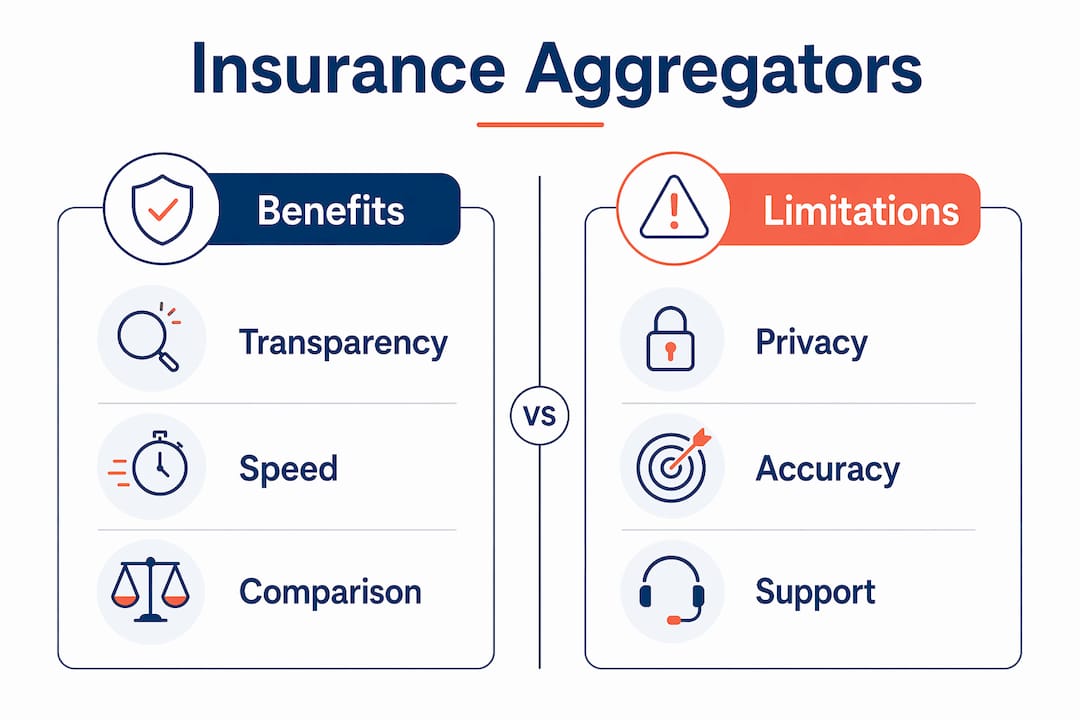
Insurance aggregator services deliver clear, practical advantages for families shopping for coverage. The core benefits include:
- Cost savings. Comparing multiple carriers in one session can cut premiums by up to 40%, according to data from insurance comparison platforms. Most consumers never see those savings because they do not shop broadly enough.
- Speed. Getting quotes from a dozen carriers used to take days. Aggregators compress that process into minutes.
- Market transparency. You see real pricing from real carriers, which makes it harder for any single insurer to charge above-market rates without you noticing.
- Broad policy access. A single session on a well-connected aggregator can surface auto, home, life, and health options from dozens of providers. That breadth is genuinely difficult to replicate on your own.
- Lower effort. You avoid the repetitive process of filling out the same form on ten different insurer websites.
The transparency benefit deserves special attention. When you can see 15 quotes ranked by price and coverage, you develop a clear picture of what the market actually charges for your risk profile. That knowledge is useful even if you ultimately buy through an independent agent, because you walk into that conversation already informed.
Pro Tip: Use aggregator results as a benchmark before meeting with an agent. If an agent’s quote is significantly higher than what you saw online, ask them to explain the difference. There may be a legitimate reason, or there may not be.
What are the limitations of insurance aggregators?
Aggregators are useful tools, but they carry real limitations that families need to understand before relying on them for critical coverage decisions.
- No personalized advice. Aggregators display prices. They do not assess your specific risk profile, recommend appropriate coverage limits, or flag gaps in your protection.
- Incomplete carrier panels. Aggregators often exclude direct-writing carriers and local specialized agencies. If you rely solely on one platform, you may miss competitive options entirely.
- Estimated premiums only. The price you see on an aggregator is not a final offer. Final premiums change once the carrier completes a full underwriting review, which includes credit checks, claims history, and property inspections.
- Data privacy risks. Lead generator platforms collect your contact information and sell it to multiple agents. The result is a surge of calls, texts, and emails that can last for weeks (sometimes for years).
- No claims support. When you file a claim, an aggregator provides no assistance. You are on your own navigating the carrier’s process.
Consumers who mistake a lead generator for a licensed agency often find themselves fielding dozens of unsolicited calls after submitting a single quote request. The platform looks identical, but the business model is completely different. Always verify the platform’s license status before entering personal information.
Pro Tip: Read the privacy policy before submitting any form. Look for explicit language stating that your data will not be sold to third parties. If that language is absent, treat the platform as a lead generator.
How do insurance aggregators compare with brokers and agents?
The function of insurance aggregators and the role of independent brokers overlap in one area: both help you find coverage from multiple carriers. Beyond that, the two approaches diverge significantly.
| Feature | Insurance aggregators | Independent brokers and agents |
|---|---|---|
| Speed of quotes | Minutes | Hours to days |
| Number of carriers | Varies by platform | Varies by agency |
| Personalized advice | None | Full risk assessment |
| Claims support | None | Active advocacy |
| Ongoing relationship | None | Long-term client service |
| Licensing | Varies (agency or lead gen) | Licensed and regulated |
| Cost to consumer | Free (commission or data sale) | Free (commission-based) |
.
Brokers offer tailored coverage advice and claims support that aggregators simply do not provide. That difference matters most when something goes wrong. An independent agent who knows your policy can call the carrier on your behalf, push back on a denied claim, and explain your rights under your specific contract. An aggregator cannot do any of that.
The practical answer for most families is to use both. Start with an aggregator to understand the market and establish a price benchmark. Then work with a licensed independent agent to get personalized advice, fill coverage gaps, and secure ongoing support. The two approaches complement each other rather than compete.
Best practices for using insurance aggregators
Getting real value from insurance comparison platforms requires a disciplined approach. Follow these steps to protect yourself and get accurate results.
- Verify the platform type first. Confirm whether the site is a licensed agency or a lead generator before entering any personal information. A licensed agency will display its license number and state of operation.
- Check the privacy policy. Look for a clear statement that your data will not be sold. If the policy is vague or absent, use a different platform.
- Use no more than two platforms. Using two aggregator tools gives you a broader market view without triggering excessive marketing contacts from multiple lead generators.
- Cross-check results with an independent agent. Experts recommend verifying aggregator quotes with an independent agency to confirm you are seeing the full market. Local carriers and specialty insurers often do not appear on national aggregator platforms.
- Research carrier reputation separately. A low premium means nothing if the carrier has poor claims handling. Check ratings from AM Best and customer satisfaction scores before selecting a policy.
- Treat aggregator quotes as a starting point. The importance of insurance aggregators lies in education and benchmarking, not final purchasing. Use the data to inform your conversation with a licensed agent.
Pro Tip: Bundle your home and auto policies through a single carrier for additional discounts. Aggregators rarely surface bundled pricing accurately, so ask your agent to run a bundled quote comparison after you have your baseline numbers.
Why I think aggregators are a starting point, not a finish line
I have watched the insurance comparison space grow from a novelty into a mainstream shopping tool, and, if done right, the technology genuinely helps consumers. The speed alone is remarkable. Getting 15 quotes in four minutes used to be impossible. That access levels the playing field for families who previously had no idea whether they were overpaying.
That said, I see one consistent mistake: people treat the lowest aggregator quote as the final answer. They buy the cheapest policy they find online, skip the fine print, and discover the coverage gaps only when they file a claim. A low premium on a policy with a $10,000 deductible or excluded flood coverage is not a deal. It is a liability.
The families I have seen navigate insurance well, use aggregators the way a smart shopper uses a price comparison site before walking into a store. They arrive informed, they ask better questions, and they push back when something does not add up. Then they close the deal with a licensed professional who can actually be held accountable. That combination, digital speed plus human judgment, produces the best outcomes. Aggregator technology will keep improving, and regulation around data privacy will tighten. But the need for a trusted advisor who knows your specific situation will not go away.
— Ron Hettler, CIC (certified insurance consultant)
Hettler Insurance Agency: expert guidance after your aggregator research
Aggregator research gives you a price benchmark. Hettler Insurance gives you the expertise to act on it correctly.

Hettler Insurance is a family-owned independent agency in Lubbock, Texas, representing over 30 top-rated carriers. Ron Hettler and his daughter Meghan are both Certified Insurance Counselors (CIC), the gold standard credential in the industry. The agency shops and compares home, auto, commercial, life, and specialty coverage across dozens of providers at no extra fee to you. Whether you need to understand your minimum coverage requirements or want a full policy review after running aggregator quotes, the Hettler Insurance Agency team delivers the personalized guidance that no digital platform can replicate. Call or visit to get started.
Recommended
- Hettler Insurance Agency, Inc. Celebrates 25 Years in Lubbock – Hettler Insurance Agency
- Power of Insurance FAQs & Insurance SAQs – Hettler Insurance Agency
- Small vs. Large Insurance Carriers – Hettler Insurance Agency
- Essential Guide to Auto Insurance: Understanding, Customizing, and Optimizing Your Policy – Hettler Insurance Agency
About the Author
Ronald J. Hettler, CIC is a Certified Insurance Counselor (CIC) [the gold-standard credential in the independent insurance industry]. Ron has over 46 years of real-world experience in the insurance industry. He is the owner/president of Hettler Insurance Agency in Lubbock, Texas and is licensed by the Texas Department of Insurance (License #666862). (Why Trust Hettler Insurance Agency? It’s a Local independent insurance agency representing multiple carriers. Hettler Insurance Agency has established business roots going back to it’s predecessor in the late 1800’s. Local expertise in Lubbock Texas and West Texas risks. Focused on clarity before a claim occurs.) Ron and his daughter Meghan, also a CIC, lead a team that represents 30+ carriers and serves clients across Texas.
Ron specializes in helping individuals, families, and small business owners understand complex insurance concepts in clear, practical terms so they can make informed decisions about their coverage. He specializes in helping individuals and families understand coverage gaps, deductible structures, and real-world claim outcomes before a loss occurs. Ron helps you to understand how insurance policies respond in real-world claim situations.
License verification available through the Texas Department of Insurance.
Frequently Asked Questions ?
Q1 ?: What is the role of insurance aggregators?
Q2 ?: Are insurance aggregator quotes accurate?
Q3 ?: What is the difference between a licensed aggregator and a lead generator?
Q4 ?: Should I use an aggregator or an independent agent?
Q5 ?: Do insurance aggregators cover all carriers?
— Life Insurance Instant Quote and Apply Tool @ GetLifePolicy.com > * Quick self-service term life insurance quote. With or without medical exam.
— Call us about Auto, Home, Business, Life, or Health insurance. * Click to Call (806) 798-7800, Mon-Fri 8:30am-5pm (lunch closed Noon-1pm)
— Come see us @ our new address 4720 S Loop 289 Lubbock, TX 79414 (maps link), or get your online quote started at https://GetHettler.com