
TL;DR summary:
- Auto insurance fraud involves intentionally providing false or misleading information to gain unjust benefits and is a serious crime nationwide. Recognizing common schemes and red flags helps prevent victimization and supports law enforcement efforts. Reporting suspected fraud anonymously to insurers, the NICB, and authorities safeguards your community’s premiums and integrity.
Auto insurance fraud is any deliberate act of providing false or misleading information to an insurer to obtain a benefit you are not entitled to, whether that means filing a fake claim, staging a crash, or misrepresenting your policy application. It is a serious crime in every U.S. state, carrying criminal charges, fines, restitution orders, and potential prison time. If you suspect fraud right now, take these steps immediately:
- Contact your insurer’s Special Investigation Unit (SIU) to report the suspected incident before saying anything else to third parties.
- Call the National Insurance Crime Bureau (NICB) at 1-800-TEL-NICB or text “Fraud” to 847411 to file an anonymous tip.
- Preserve all evidence — photographs, dashcam footage, police reports, and written estimates — without altering anything.
- Notify local police if a staged accident, physical threat, or immediate safety risk is involved.
The sections below walk through every type of scheme, the red flags investigators watch for, the legal stakes, and exactly how to report what you find.
Table of Contents
- Key Takeaways
- What auto insurance fraud actually means, and why intent matters
- Common auto insurance fraud schemes you need to recognize
- How to spot insurance fraud: red flags and detection methods
- Legal consequences of auto insurance fraud in the United States
- What evidence investigators need to prove auto insurance fraud
- Practical steps to avoid becoming a victim or being wrongly accused
- How to report suspected auto insurance fraud, step by step
- How an independent agent helps you prevent and respond to fraud
- Why fraud prevention is a community issue, not just a claims problem
- Hettler Insurance Agency can verify your coverage and support you through a fraud concern
- Useful sources for reporting and further reading
Key Takeaways
Auto insurance fraud is a crime that raises premiums for every honest driver, and the best defense is knowing the schemes, verifying your coverage, preserving evidence, and reporting anything suspicious.
| Point | Details |
|---|---|
| Intent is what makes it fraud | Fraud means knowingly making a false statement or hiding a material fact. An honest mistake on an application is not fraud; deliberately understating mileage is. |
| Soft fraud is still a crime | Padding a legitimate claim is soft fraud; staging a crash or inventing a theft is hard fraud. Both can bring criminal charges, fines, and restitution. |
| Know the common schemes | Watch for swoop-and-squat and drive-down crashes, ghost brokers selling fake policies, inflated repair and towing bills, and “free” windshield offers. |
| Verify before you pay | Check an agent’s license with the Texas Department of Insurance, never pay for insurance through a payment app, and confirm with the carrier that your policy was issued. |
| Preserve the evidence | Save original, unedited dashcam footage, photograph every angle, get the police report number, and contact your insurer and agent the same day. |
| Report it, even anonymously | Contact your insurer’s Special Investigation Unit, the NICB at 800-TEL-NICB or by texting FRAUD to 847411, and your state Department of Insurance. |
| Hettler Insurance Agency verifies your coverage | With 30+ carriers and CIC-credentialed leadership, Hettler Insurance Agency can confirm your policy is real and help route a fraud concern to the right SIU contact. |
What auto insurance fraud actually means, and why intent matters
Auto insurance fraud occurs when someone knowingly makes a false statement or conceals a material fact to obtain an insurance payment, reduce a premium, or avoid a coverage denial. That word “knowingly” is the legal hinge: an honest mistake on your application is not fraud, but deliberately understating your annual mileage to lower your premium is.
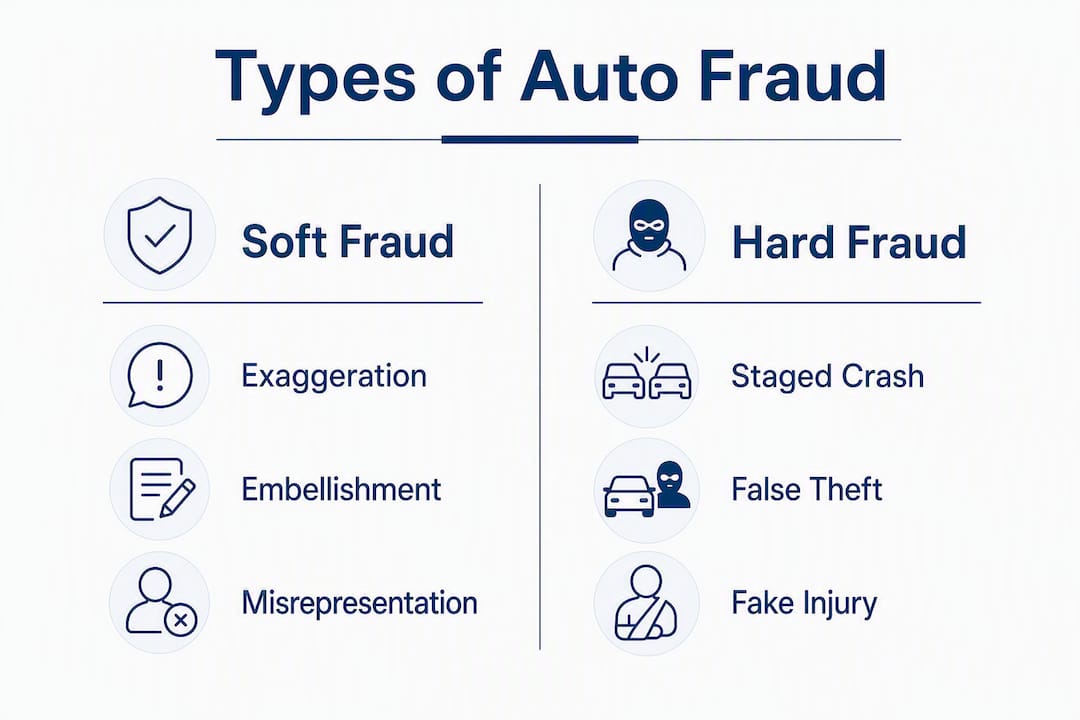
Investigators and prosecutors draw a line between two categories.
Soft fraud involves exaggerating or embellishing an otherwise legitimate claim. A driver who genuinely rear-ends another car but then inflates the repair estimate by $2,000 is committing soft fraud. It feels minor, but it is still a crime.
Hard fraud is a planned scheme with no legitimate underlying event. Staging a crash that never happened, filing a theft claim for a car you sold, or inventing injuries from an accident that did not occur all fall here. Hard fraud tends to draw felony charges and longer sentences.
The Texas Department of Insurance and the California Department of Insurance Fraud Division both treat automobile insurance fraud as a priority enforcement area, coordinating with local district attorneys, state agencies, and federal law enforcement. On the industry side, insurer Special Investigation Units (SIUs) handle internal claim reviews, while the National Insurance Crime Bureau (NICB) maintains national databases and supports law enforcement referrals. State Departments of Insurance (DOIs) license agents, investigate complaints, and can revoke licenses or refer cases for prosecution.
Common auto insurance fraud schemes you need to recognize
Car insurance scams range from solo opportunists padding a claim to organized criminal rings running coordinated crash operations. Knowing the names and mechanics of each scheme helps you spot one before you become a victim.
- Swoop-and-squat / staged rear-end crash: A vehicle cuts in front of you and brakes suddenly, forcing you to rear-end it. The “victims” then file injury and vehicle damage claims. Organized rings sometimes use a second car to block your lane escape.
- Drive-down: A driver waves you into traffic, then deliberately hits your car and denies ever signaling. Witnesses planted at the scene back the fraudster’s version.
- Phantom vehicle or ghost theft: A claim is filed for a vehicle that was never stolen, never damaged, or does not exist. Sometimes the car was already sold or totaled before the claim.
- False or inflated injury claims: Passengers in a minor fender-bender suddenly report whiplash, back injuries, or soft-tissue damage that cannot be easily disproved. Medical providers sometimes participate by billing for treatments never rendered.
- Application fraud / premium fraud: A policyholder lists a different garaging address, omits a high-risk driver from the policy, or understates annual mileage to reduce the premium. When a claim is filed, the insurer may deny coverage entirely.
- Ghost broker / fake agent fraud: A scammer poses as a licensed agent, collects your premium payment, and either issues a forged policy document or never purchases coverage at all. The Texas Department of Insurance warns that these scams frequently appear on social media and via third-party payment apps, leaving buyers completely uninsured.
- Fraudulent repair and towing charges: A body shop inflates the repair invoice, bills for parts never installed, or uses counterfeit components. Unsolicited tow-truck operators at crash scenes sometimes steer vehicles to shops that participate in these schemes.
- Windshield replacement scams: A contractor approaches you in a parking lot, offers a “free” windshield replacement using your insurance, and then files an inflated claim. Some use your policy information to bill for work that was never done.
- Chop-shop and parts fraud: A vehicle is reported stolen, then dismantled and sold for parts. The owner collects the insurance payout while the parts generate additional income.
Industry cost snapshot: MoneyGeek’s analysis shows that a single staged accident can push an honest driver’s annual premium significantly higher, illustrating the financial impact of being the apparent at-fault party in a manufactured crash.
| Cost dimension | Estimated impact |
|---|---|
| Annual premium increase after a staged-crash at-fault finding | MoneyGeek example: $1,623 jumps to $2,363 (+45%) |
| Fraud’s effect on honest policyholders | Costs passed through higher premiums industry-wide |
| Ghost-broker victim outcome | Pays premium, receives no coverage, uninsured at claim time |
The Coalition Against Insurance Fraud and FBI figures cited by MarketWatch consistently rank auto insurance fraud among the most costly white-collar crimes in the United States, with losses passed directly to consumers through rate increases.
How to spot insurance fraud: red flags and detection methods
Insurers do not wait for fraud to be reported. Every claim enters a screening process the moment it is filed.

The detection workflow typically starts with the claims adjuster, who reviews the first notice of loss for inconsistencies. Claims that trigger algorithmic flags, such as a high-dollar injury claim on a low-speed impact, are routed to the insurer’s Special Investigation Unit. The SIU may order an independent medical examination, commission a vehicle inspection, pull NICB database records, review telematics data from the vehicle, and interview witnesses. If the SIU finds sufficient evidence, it refers the case to the state DOI or local law enforcement for prosecution.
Red flags investigators watch for include:
- Damage patterns inconsistent with the described impact (e.g., mechanical damage on a claimed rear-end collision)
- Injury claims filed days or weeks after the accident, with no emergency room visit at the time
- Witnesses who cannot be independently located or who share addresses with the claimant
- Prior theft or total-loss claims on the same vehicle within a short window
- Repair invoices with unusually round numbers or line items for parts that do not match the vehicle’s damage
- Unsolicited tow-truck or repair-shop contact at the scene before the insurer is notified
- Policy purchased very recently before a major claim, especially for comprehensive or theft coverage
Alpine Intel’s investigator guidance notes that mechanical damage inconsistent with the claimed crash scenario is one of the most reliable physical indicators, because impact physics leave predictable marks that a fabricated story often cannot match.
Technology has sharpened detection considerably. Telematics devices and smartphone apps record speed, braking force, and GPS position at the moment of impact. Vehicle history databases cross-reference VINs against prior claims across carriers. Medical billing analytics flag providers whose billing patterns deviate from regional norms. Dashcam footage, when preserved, often resolves disputed liability within minutes.
Pro Tip: Install front and rear dashcams and set them to overwrite-protect footage automatically after a collision event. Preserved dashcam video is frequently the single piece of evidence that ends a staged-crash dispute in your favor, according to MoneyGeek’s consumer guidance.
Legal consequences of auto insurance fraud in the United States
The penalties for committing car insurance fraud are serious, and they scale with the dollar amount involved and the state where the offense occurs.
Criminal consequences vary by state but generally follow this pattern:
- Texas, Penal Code §35.02 grades insurance fraud by the value of the claim, from a Class C misdemeanor for claims under $100 to a first-degree felony for claims of $300,000 or more, or when the fraud puts someone at risk of death or serious injury.
- Misdemeanor charges for lower-value soft fraud (typically under $950–$1,000 in many states), carrying fines and up to one year in county jail.
- Felony charges for organized schemes, hard fraud, or claims above state thresholds. In California, Penal Code sections 548–550 make automobile insurance fraud a felony prosecuted by the district attorney or U.S. Attorney’s Office, with prison terms and substantial fines possible. In Texas, the fraud felony starts fines at $2,500.
- Michigan treats application fraud, misreported drivers, and exaggerated injury claims as felonies carrying multi-year prison sentences and large fines, per Michigan DIFS guidance.
- The Sonoma County District Attorney’s Insurance Fraud Unit lists crash-and-buy schemes, paper collisions, and organized rings as prosecuted felonies, with restitution orders requiring defendants to repay the full amount defrauded.
Civil and administrative consequences add another layer:
- Insurers can sue to recover payments made on fraudulent claims.
- Policyholders found to have committed fraud typically face immediate policy cancellation and may be placed on industry databases that make obtaining future coverage difficult or more expensive.
- Licensed insurance agents or adjusters who participate in fraud face license revocation by the state DOI, in addition to criminal charges.
Collateral consequences matter too. A fraud conviction creates a permanent criminal record, which can affect employment, professional licensing in other fields, and the ability to obtain bonding or certain government contracts. If you are charged, consult a licensed attorney familiar with your state’s insurance fraud statutes before making any statements.
This article provides general information, not legal advice. Confirm current statutes and penalties with your state’s Department of Insurance or a qualified attorney.
What evidence investigators need to prove auto insurance fraud
Fraud cases live and die on documentation. Investigators need a chain of evidence that connects the false statement to the financial benefit obtained, and that chain has to hold up in court.
Key evidence types:
- Photos and video taken at the scene, including dashcam footage with timestamps and GPS metadata intact
- Police report filed at the time of the incident, not days later
- Medical records and billing statements showing treatment dates, providers, and diagnoses
- Repair invoices with part numbers, labor hours, and shop contact information
- Witness contact information and written or recorded statements taken promptly
- Phone and text records when communications between parties suggest coordination
- Premium payment receipts and policy documents confirming coverage was in force
- Vehicle maintenance and inspection history to establish pre-existing condition versus new damage
Chain of custody matters for digital media. Do not edit, crop, or filter dashcam footage before submitting it. Save the original file to a separate drive and provide a copy to your insurer and, if applicable, law enforcement. Altering evidence, even to “clean it up,” can undermine your credibility and potentially expose you to obstruction charges.
Immediate steps after a suspected incident: photograph every angle of both vehicles, note the exact time and location, preserve dashcam footage before the loop overwrites it, obtain the police report number, and contact your insurer and independent agent the same day. Write down your own account of events while the details are fresh. Avoid discussing fault or agreeing to any informal settlement at the scene.
Practical steps to avoid becoming a victim or being wrongly accused
Most fraud victims did not see it coming. A few consistent habits reduce your exposure significantly.
Prevention checklist:
- Verify any agent’s license through your state DOI before paying a premium.
- Never pay for insurance through a third-party payment app (Venmo, Cash App, Zelle). Legitimate carriers and licensed agents do not require this, as the Texas Department of Insurance explicitly warns.
- After purchasing a policy, call the carrier directly to confirm the policy was issued in your name.
- Be skeptical of unusually cheap auto insurance offers, especially those with same-day pressure to buy. Legitimate carriers do not push “buy now or lose this price” urgency.
- Install front and rear dashcams and keep them functioning.
- Maintain a following distance that gives you time to stop without rear-ending the car ahead.
- At any accident scene, document everything before moving vehicles if it is safe to do so.
- Decline unsolicited tow-truck or repair-shop offers at the scene. Call your insurer first.
- Always get written repair estimates and use shops your insurer recommends or approves.
- Keep copies of all policy documents, premium receipts, and correspondence with your insurer.
To avoid being wrongly accused:
- Do report the accident to police and your insurer promptly. Delayed reporting raises flags.
- Do document the scene thoroughly with photos and your own written account.
- Don’t admit fault at the scene if you are uncertain about what happened.
- Don’t agree to any statement, settlement, or repair arrangement before speaking with your insurer.
- Don’t coach or ask witnesses to change their accounts.
Pro Tip: Keep a folder, physical or digital, with your current policy declarations page, your insurer’s claims number, and your agent’s direct contact. After a crash, common post-accident mistakes often come down to not having this information on hand when it matters most.
How to report suspected auto insurance fraud, step by step
Reporting is straightforward, and you can do it anonymously. Here is the sequence that gives investigators the best chance of acting on your tip.
Step 1: Contact your insurer’s SIU. Call the claims number on your policy card and ask to speak with the Special Investigation Unit. Provide your claim number if one exists and describe specifically what you observed or suspect.
Step 2: File a tip with the NICB. The National Insurance Crime Bureau accepts tips online at nicb.org or by texting “Fraud” to 847411. Tips can be submitted anonymously. The NICB cross-references tips against its national database and shares findings with member insurers and law enforcement, as MarketWatch’s consumer guide confirms.
Step 3: Notify your state Department of Insurance. Every state DOI operates a fraud hotline. In Texas, the TDI fraud division accepts complaints online and by phone (report fraud online or call 800-252-3439). Per TDI (Texas Dept. of Insurance), Texas law requires you to report known or suspected insurance fraud within 30 days. In California, the Department of Insurance Fraud Division coordinates directly with district attorneys and federal prosecutors.
Step 4: Involve local law enforcement if the fraud involved a staged crash, physical threat, or immediate public safety risk. File a police report and request a copy for your records.
What to include in your report:
- Date, time, and exact location of the incident
- Policy number(s) involved
- Vehicle descriptions and license plate numbers
- Names and contact information for any witnesses
- Photos, video, or dashcam footage
- Copies of any invoices, receipts, or communications you received
- A clear statement of why you believe fraud occurred
Anonymous tips are accepted by both the NICB and most state DOI hotlines. If you include contact information, investigators can follow up for clarification, which often strengthens the case.
How an independent agent helps you prevent and respond to fraud
Working with a licensed independent agent adds a verification layer that direct-to-consumer channels simply cannot replicate.
When you purchase a policy through an independent agent, that agent confirms the carrier relationship and verifies that your policy was actually issued, which is the exact gap that ghost brokers exploit. Independent agents have direct relationships with multiple carriers and can call the carrier’s underwriting or service desk to confirm your coverage is active, something a scammer posing as an agent cannot fake for long.
During a suspected fraud incident, your agent can:
- Pull your policy declarations and confirm coverage limits with the carrier immediately
- Route your claim to the insurer’s SIU with the appropriate documentation
- Recommend authorized repair shops that use verified parts and transparent invoicing
- Help you organize and preserve documentation before submitting it
- Escalate to the state DOI or NICB if the insurer’s response is inadequate
Hettler Insurance Agency, based in Lubbock and licensed statewide in Texas, represents over 30 top-rated carriers. That carrier access means the agency can confirm policy issuance across multiple companies and identify discrepancies that a single-carrier agent would never see. Ron Hettler and Meghan Harris are both Certified Insurance Counselors (CIC), the industry’s high-level professional credential, and the agency has served Texas policyholders since 1992. When a client calls with a fraud concern, the team knows exactly which SIU contact to reach and which documentation the insurer will need.
Hettler Insurance Agency is one of the few family-owned agencies in Texas where both principals carry the high level certification of CIC (certified insurance counselor). Fewer than 2% of licensed insurance professionals in the U.S. have earned the CIC designation.
Why fraud prevention is a community issue, not just a claims problem
Staged accidents are not victimless paperwork crimes. When a swoop-and-squat ring operates in a city, real drivers get rear-ended at highway speeds. Real injuries happen. The fraud claim that follows is a financial crime layered on top of a physical one, and the cost gets distributed across every policyholder in that market through rate increases.
From where I sit, the most underappreciated aspect of auto insurance fraud is how normalized soft fraud has become. Padding a repair estimate or exaggerating an injury feels like “getting even” with a large insurer, but the insurer simply adjusts its loss ratios and raises rates for everyone in the zip code. The honest driver two streets over pays for it.
Reporting matters more than most people realize. Anonymous tips to the NICB and state DOI hotlines have contributed to the takedown of organized fraud rings that were operating across multiple states. A single dashcam video or a tip about a suspicious tow-truck operator can be the thread that unravels a much larger scheme. If you suspect fraud, report it. The process is straightforward, it can be anonymous, and it directly protects your neighbors’ premiums.
If you are uncertain whether what you witnessed rises to the level of fraud, call your agent. That conversation costs nothing and could prevent a significant claim from being filed against your policy.
“The best independent insurance agents don’t just find you a policy. They find you the right insurance policy and then make sure it stays right as your life changes.” — Ron Hettler, CIC (certified insurance counselor), Hettler Insurance Agency
Hettler Insurance Agency can verify your coverage and support you through a fraud concern
Hettler Insurance gives Texas drivers something most online-only options cannot: a licensed, credentialed agent who picks up the phone, confirms your policy is real, and stands with you if a suspicious claim lands on your record. With access to over 30 top-rated carriers, the agency can verify coverage directly with the issuing company, recommend authorized repair shops, and route your documentation to the right SIU contact, all without charging you an extra fee for the advocacy.
If you bought a policy recently and want to confirm it is legitimate, or if you were involved in an accident that felt staged, reach out to Hettler Insurance for a straightforward policy review. The team is licensed statewide in Texas and has been protecting local policyholders since 1992. Call the Lubbock office or start online today.
Useful sources for reporting and further reading
These are the authoritative resources to bookmark for reporting, verification, and deeper research on auto insurance fraud in the United States.
- National Insurance Crime Bureau (NICB): The primary industry organization for fraud reporting; accepts anonymous tips online and by text (847411). Maintains national claims databases used by insurers and law enforcement.
- TDI Fraud
- TDI’s fake-policy warning
- Texas Penal Code Ch. 35
Recommended
About the Author
Ronald J. Hettler, CIC is a Certified Insurance Counselor (CIC) [the gold-standard credential in the independent insurance industry]. Ron has over 46 years of real-world experience in the insurance industry. He is the owner/president of Hettler Insurance Agency in Lubbock, Texas and is licensed by the Texas Department of Insurance (License #666862). (Why Trust Hettler Insurance Agency? It’s a Local independent insurance agency representing multiple carriers. Hettler Insurance Agency has established business roots going back to it’s predecessor in the late 1800’s. Local expertise in Lubbock Texas and West Texas risks. Focused on clarity before a claim occurs.) Ron and his daughter Meghan, also a CIC, lead a team that represents 30+ carriers and serves clients across Texas.
Ron specializes in helping individuals, families, and small business owners understand complex insurance concepts in clear, practical terms so they can make informed decisions about their coverage. He specializes in helping individuals and families understand coverage gaps, deductible structures, and real-world claim outcomes before a loss occurs. Ron helps you to understand how insurance policies respond in real-world claim situations.
License verification available through the Texas Department of Insurance.
Frequently Asked Questions ?
Q1 ?: What is the difference between soft fraud and hard fraud?
Q2 ?: What is a swoop-and-squat staged crash?
Q3 ?: How can I tell if an insurance agent or policy is fake?
Q4 ?: What evidence should I preserve after a suspicious accident?
Q5 ?: How do I report suspected auto insurance fraud?
— Life Insurance Instant Quote and Apply Tool @ GetLifePolicy.com > * Quick self-service term life insurance quote. With or without medical exam.
— Call us about Auto, Home, Business, Life, or Health insurance. * Click to Call (806) 798-7800, Mon-Fri 8:30am-5pm (lunch closed Noon-1pm)
— Come see us @ our new address 4720 S Loop 289 Lubbock, TX 79414 (maps link), or get your online quote started at https://GetHettler.com


