
TL;DR summary:
- Review your auto insurance policy at least once a year — ideally 30 days before renewal — and immediately after any major life event like buying a vehicle, adding a teen driver, moving, or changing your commute. Start with the declarations page, then read the full policy for exclusions. State minimums rarely protect your assets; liability of at least 100/300/100 is generally recommended. Ask about every discount, keep uninsured motorist coverage, document each review, and let an independent agent compare carriers for you.
Reviewing your auto insurance policy once a year, and immediately after any major life change, is the single most reliable way to avoid being underinsured and to catch savings you are currently leaving on the table. Policyholders who never review their coverage are often underinsured by 20 to 40%. That gap does not show up until a claim, and by then it is too late to fix it.
Table of Contents
- How to review your auto policy: the core framework
- What life events should trigger an immediate policy review?
- How to read your auto insurance policy documents effectively
- Strategies to save money without cutting the wrong coverage
- Is your current auto insurance coverage actually adequate?
- Expert insights on personalized auto insurance reviews from Hettlerinsurance
- Ready to review your auto policy with a certified expert?
- Key Takeaways
Key Takeaways
Reviewing your auto insurance policy annually and after major life events is the most reliable way to maintain adequate coverage and avoid paying for protection that no longer fits your situation.
| Point | Details |
|---|---|
| Annual review timing | Review at least once a year, ideally 30 days before your renewal date, to allow time for changes. |
| Life events require immediate action | Buying a vehicle, adding a driver, moving, or changing your commute all require a prompt policy update. |
| Liability limits matter | Coverage exceeding state minimums is recommended to protect your assets after a serious accident. |
| Document every review | Recording dates, decisions, and rationale speeds up future reviews and supports you in any claim dispute. |
| Independent agents add real value | An independent agent compares options across multiple carriers, finding discounts and coverage a single-company agent cannot. |
.
How to review your auto policy: the core framework
Think of your auto policy as a living document, not a one-time purchase. Your life changes. Your coverage should keep pace. A structured annual review, tied to your renewal date, gives you a reliable checkpoint to catch gaps, update information, and confirm you are not paying for coverage that no longer fits.
Here is what a complete policy review covers:
- Renewal date: Schedule your review 30 days before renewal so you have time to make changes or shop for better rates before the policy automatically renews.
- Declarations page: Start here. It summarizes your coverage types, limits, deductibles, listed drivers, and vehicles in one place.
- Coverage limits: Confirm your liability, collision, comprehensive, and uninsured motorist limits still match your current financial exposure.
- Deductibles: Verify the amounts you would owe out of pocket on a claim and decide if they are still affordable.
- Listed drivers and vehicles: Any driver in your household and every vehicle you own should appear correctly on the policy.
- Discounts: Ask your agent to run through every discount you might qualify for. Many go unclaimed simply because no one asked.
- Agent consultation: An independent insurance agent can compare options across multiple carriers, something a single-company agent cannot do.
Most people treat auto insurance like a static contract. The smarter approach is to treat it as a dynamic agreement that needs regular tuning as your life and finances evolve.
What life events should trigger an immediate policy review?
Your renewal date is the routine checkpoint, but certain changes in your life require a review right away, not months from now. Major life events often shift both your coverage needs and your eligibility for discounts simultaneously.
- Buying or selling a vehicle: A new car may need gap insurance or higher comprehensive limits. A sold vehicle should be removed immediately to avoid paying for coverage you no longer need.
- Adding a teen or new driver: Young drivers change your risk profile and your premium. Confirm they are listed and that your liability limits are high enough to protect your assets.
- Moving to a new address: Your ZIP code directly affects your rate. A move across town, let alone across Texas, can change your premium and your coverage requirements.
- Change in commute or working from home: Fewer miles driven can qualify you for a low-mileage discount. If you have shifted to remote work, report it.
- Income or asset growth: Higher net worth means more exposure in a serious accident. Your liability limits should reflect what you actually have to protect.
- Change in driving habits: More road trips, a new side job involving driving, or a rideshare arrangement all affect what your policy covers and what it excludes.
- Renewal date: Even without a triggering event, treat renewal as a non-negotiable annual review appointment.
None of these changes are automatic. Your insurer will not update your policy unless you tell them something has changed.

How to read your auto insurance policy documents effectively
The declarations page is where most people stop, and that is a mistake. It is a useful summary, but the full policy contract contains the exclusions and conditions that actually determine what gets paid on a claim. Both documents matter.
- Start with the declarations page: Confirm the policy period, named insured, vehicle descriptions, coverage types, limits, and deductibles. Any error here should be corrected in writing immediately.
- Review each coverage type: Liability covers damage you cause to others. Collision covers your vehicle in an at-fault crash. Comprehensive covers theft, weather, fire, and animal strikes. Uninsured motorist coverage protects you when the other driver has no insurance.
- Check deductibles carefully: A $500 deductible and a $1,500 deductible carry very different out-of-pocket consequences. Make sure the number on the page matches what you agreed to.
- Verify all listed drivers: Anyone in your household who drives your vehicle should be listed. An unlisted driver involved in a claim can trigger a coverage dispute.
- Read the exclusions section: This is where most surprises live. Commercial use, rideshare driving, and certain vehicle modifications are commonly excluded from standard personal auto policies.
- Keep a review record: Document the date, what you checked, what you changed, and why. A documented review record speeds up future reviews and provides clarity if a claim dispute arises.
Pro Tip: Tie your annual review to a fixed personal date, such as your birthday or a tax filing deadline. Anchoring it to something you already track makes it far less likely to slip.
Strategies to save money without cutting the wrong coverage
Saving on auto insurance does not mean dropping coverage and hoping nothing goes wrong. It means making sure every dollar you spend is working for your actual situation.
- Ask about every available discount: The Texas Department of Insurance lists safe driver, low mileage, defensive driving course, good student, automatic payment, and paperless billing discounts as commonly available. Most policyholders miss at least one.
- Bundle home and auto: Combining your home and auto policies with the same carrier typically produces a meaningful discount on both. Bundling policies is one of the fastest ways to lower your total insurance spend without reducing coverage.
- Report updated driving habits: If you are now working from home or driving significantly fewer miles, updating your mileage can unlock usage-based savings that automatic renewals never capture.
- Reconsider collision and comprehensive on older vehicles: Review whether your premium cost for collision and comprehensive justifies the coverage, especially on older vehicles you could afford to repair yourself.
- Raise your deductible if your emergency fund supports it: A higher deductible lowers your premium. The tradeoff only works if you can genuinely cover that amount without financial strain after a claim.
- Shop for quotes periodically: Accepting an automatic renewal without comparing rates means you may be paying more than necessary. An independent agent can run those comparisons across multiple carriers at no extra cost to you.
- Never drop coverage without evaluating the risk first: Removing uninsured motorist coverage to save a few dollars a month is a common mistake in Texas, where uninsured drivers are a real exposure.
Pro Tip: When you make a coverage change, write down the reason. “Dropped collision because vehicle value is under $4,000 and I have savings to cover repairs” is the kind of note that prevents second-guessing at next year’s review.
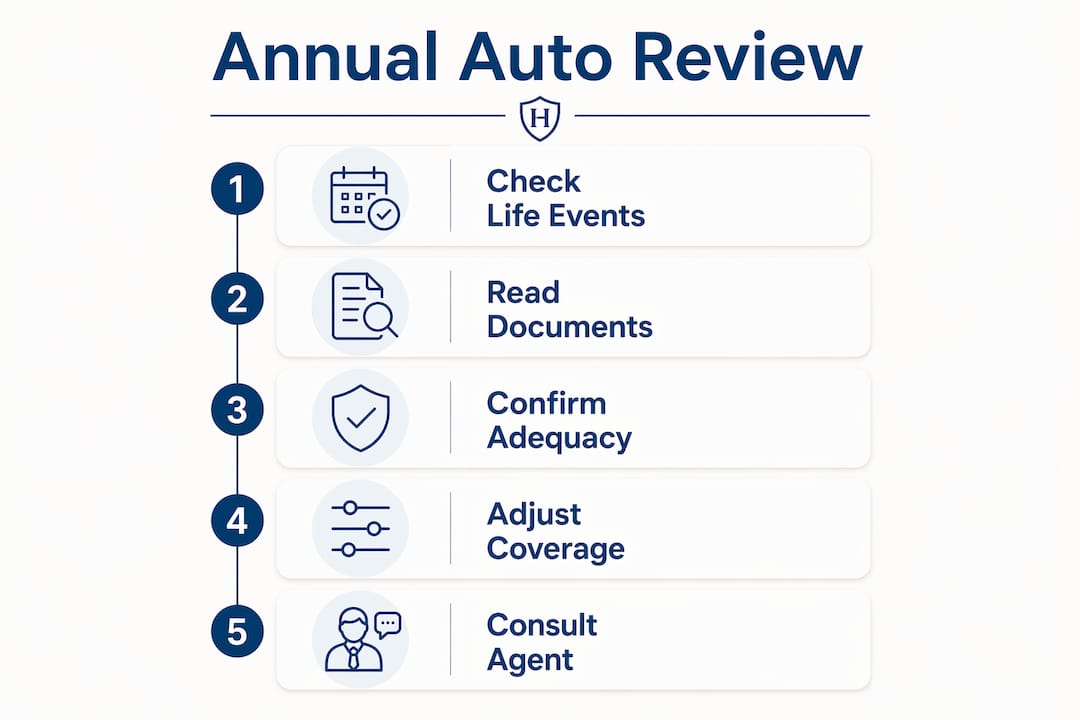
Is your current auto insurance coverage actually adequate?
Most drivers assume their coverage is fine until they file a claim and discover it is not. The auto policy evaluation guide below walks through the key adequacy questions to ask at every review.
- Liability limits: State minimums are rarely sufficient. Liability coverage should generally be at least 100/300/100 (meaning $100,000 per person, $300,000 per accident, $100,000 for property damage) to meaningfully protect your income and assets after a serious accident. Minimum liability in many states covers as little as $25,000 in total damage, which a single medical bill can exceed.
- Collision and comprehensive alignment: If your vehicle is newer or financed, these coverages are likely required by your lender. For older vehicles with low market value, reassess annually whether the premium cost still justifies the coverage.
- Uninsured motorist coverage: Texas has a notable share of uninsured drivers on the road. If you are hit by one without this coverage, you absorb the cost of your own repairs and medical bills.
- Deductible affordability: Your deductible is what you pay before insurance covers the rest. If your current deductible would create a financial hardship after a claim, it is set too high regardless of the premium savings.
- State minimums vs. recommended coverage: Meeting the legal minimum keeps you street-legal. It does not protect your savings account, your home equity, or your wages from a lawsuit after a serious at-fault accident.
- Coverage gaps from outdated information: An old address, a missing driver, or a vehicle listed incorrectly can all create gaps that surface only when you need the coverage most. Verify every detail at each review.
Understanding auto insurance adequacy is not about buying the most expensive policy. It is about matching your coverage to your actual financial exposure, and adjusting it as that exposure changes.
Expert insights on personalized auto insurance reviews from Hettler Insurance
Hettler Insurance Agency has been helping Texans protect their vehicles and assets since 1992. Ron Hettler, the agency’s founder, holds the Certified Insurance Counselor (CIC) designation, the gold standard credential in the insurance industry, and brings over 40 years of hands-on experience to every client conversation. His daughter Meghan, also CIC credentialed, leads the agency alongside him today.
What that depth of experience produces is a clear, consistent message: reviewing your car insurance is not a one-time task. It is an annual discipline, and the drivers who treat it that way consistently carry better coverage at better prices than those who let policies auto-renew without a second look.
- Treat the review as a fixed annual appointment: Tying it to a personal landmark date, your renewal notice, or your tax filing season increases the likelihood that it actually happens every year.
- Document every review: Record what you checked, what changed, and why. That record supports faster future reviews and provides useful context if a claim dispute ever arises.
- Leverage CIC-credentialed expertise: Working with a certified counselor means your coverage recommendations come from someone trained to assess risk, not just sell a policy.
- Account for Texas-specific factors: West Texas hail storms, high uninsured driver rates, and regional weather exposures all affect what adequate coverage looks like for a Texas driver. Generic national policy templates do not account for those realities.
- Use an independent agent to compare carriers: As an independent agency, Hettlerinsurance shops across carriers to find the right fit at the right price. That comparison is something a captive, single-company agent simply cannot offer.
- Stay informed between reviews: Reading your policy documents, understanding your coverage types, and knowing what questions to ask your agent all reduce the chance of an unpleasant surprise at claim time.
Pro Tip: The renewal period is the best time to ask your agent whether any new discounts or coverage options have become available since your last review. Carriers update their offerings regularly, and proactive conversations often surface savings that automatic renewals miss.
Ready to review your auto policy with a certified expert?
Hettler Insurance Agency makes the review process straightforward. Whether you want to confirm your current coverage is adequate, find discounts you may be missing, or compare rates across more than 30 top-rated carriers, the team is ready to help. Ron Hettler and Meghan Harris bring combined CIC (certified insurance counselor) credentials and decades of Texas insurance experience to every client conversation, at no extra fee.
Call Hettler Insurance Agency at 806-798-7800 or visit hettlerinsurance.com to schedule your annual policy review. Get Hettler, Get Better.
Recommended
About the Author
Ronald J. Hettler, CIC is a Certified Insurance Counselor (CIC) [the gold-standard credential in the independent insurance industry]. Ron has over 46 years of real-world experience in the insurance industry. He is the owner/president of Hettler Insurance Agency in Lubbock, Texas and is licensed by the Texas Department of Insurance (License #666862). (Why Trust Hettler Insurance Agency? It’s a Local independent insurance agency representing multiple carriers. Hettler Insurance Agency has established business roots going back to it’s predecessor in the late 1800’s. Local expertise in Lubbock Texas and West Texas risks. Focused on clarity before a claim occurs.) Ron and his daughter Meghan, also a CIC, lead a team that represents 30+ carriers and serves clients across Texas.
Ron specializes in helping individuals, families, and small business owners understand complex insurance concepts in clear, practical terms so they can make informed decisions about their coverage. He specializes in helping individuals and families understand coverage gaps, deductible structures, and real-world claim outcomes before a loss occurs. Ron helps you to understand how insurance policies respond in real-world claim situations.
License verification available through the Texas Department of Insurance.
Frequently Asked Questions ?
Q1 ?: How often should I review my auto insurance policy?
Q2 ?: What life events should trigger an immediate auto policy review?
Q3 ?: Is the declarations page enough to understand my coverage?
Q4 ?: Are Texas state minimum liability limits enough?
Q5 ?: How can I save money on auto insurance without cutting the wrong coverage?
— Life Insurance Instant Quote and Apply Tool @ GetLifePolicy.com > * Quick self-service term life insurance quote. With or without medical exam.
— Call us about Auto, Home, Business, Life, or Health insurance. * Click to Call (806) 798-7800, Mon-Fri 8:30am-5pm (lunch closed Noon-1pm)
— Come see us @ our new address 4720 S Loop 289 Lubbock, TX 79414 (maps link), or get your online quote started at https://GetHettler.com


