
TL;DR summary:
- Motorcycle insurance protects riders, their bikes, and others by covering liability and physical damages on the road. A proper policy is essential for financial security, especially since standard auto policies do not cover motorcycles, and legal minimums often leave gaps.
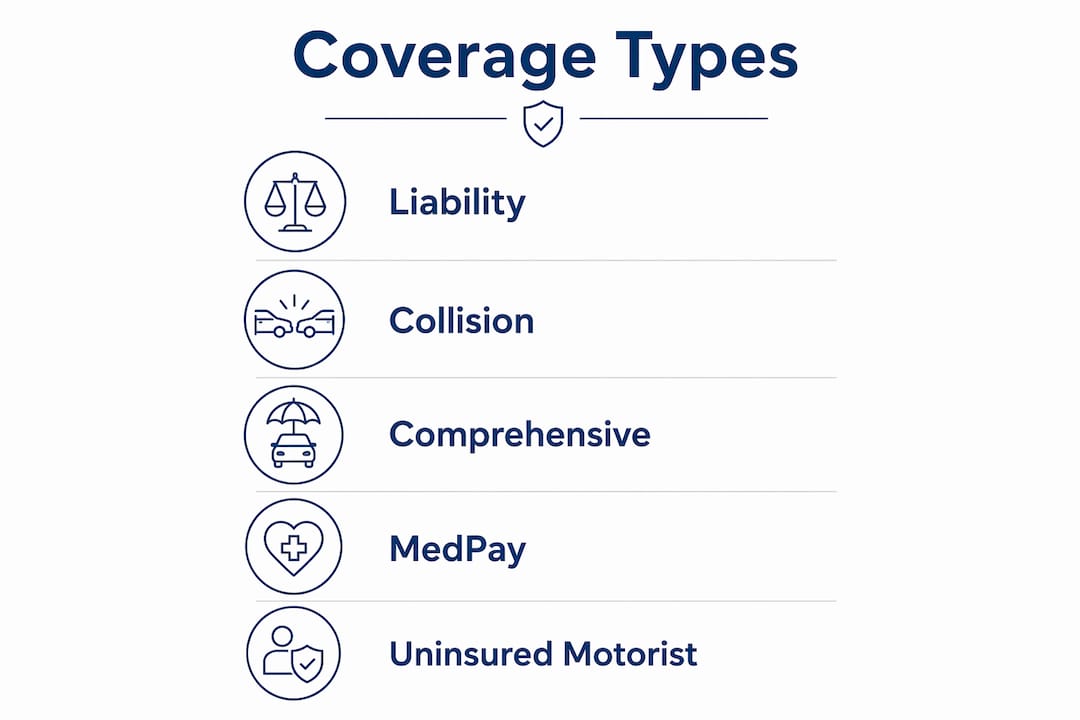
Motorcycle insurance is a policy that protects you, your bike, and other people on the road by covering bodily injury liability, property damage liability, and physical damage to your motorcycle. It is legally required in most U.S. states, and riding without it puts your finances and your license at serious risk. A standard motorcycle policy typically includes bodily injury liability, property damage liability, collision, comprehensive, and optional coverages such as medical payments (MedPay) and uninsured motorist protection.
Here is what motorcycle insurance generally covers at a glance:
- Bodily injury liability: Pays for injuries you cause to others in an accident
- Property damage liability: Covers damage you cause to someone else’s vehicle or property
- Collision: Repairs your bike after a crash, regardless of fault
- Comprehensive: Covers theft, vandalism, fire, hail, and other non-collision losses
- MedPay/PIP: Covers your own medical bills after an accident
- Uninsured/underinsured motorist (UM/UIM): Protects you when the at-fault driver has no insurance or not enough
Motorcycle insurance is not just a legal checkbox. It is the financial barrier between a bad day on the road and a debt you carry for years. Your standard auto insurance policy does not cover a motorcycle. You need a separate policy, and the coverage options you choose determine how well protected you actually are.
Table of Contents
- What are the main types of motorcycle insurance coverage?
- Is motorcycle insurance mandatory in the United States?
- What factors affect how much you pay for motorcycle insurance?
- How can you lower your motorcycle insurance premium?
- What Hettler Insurance Agency wants you to know about motorcycle coverage
- How do you get a motorcycle insurance policy?
- What does motorcycle insurance not cover?
- How do you file a motorcycle insurance claim?
- How is motorcycle insurance different from regular auto insurance?
- Key Takeaways
- Why an independent agent changes what motorcycle insurance can do for you
- Hettlerinsurance covers Texas riders the right way
Key Takeaways
Motorcycle insurance is legally required in most U.S. states, and liability-only coverage, while meeting the legal minimum, often leaves both the rider and the bike financially exposed without collision and comprehensive added.
| Point | Details |
|---|---|
| Liability coverage is the legal floor | Most states require it, but minimums rarely cover the full cost of a serious accident. |
| Full coverage combines three distinct parts | Liability, collision, and comprehensive together form what riders call “full coverage.” |
| Financed bikes require collision and comprehensive | Lenders mandate these coverages; reassess once the loan is paid off. |
| Multiple factors drive your premium | Age, bike type, location, driving record, and coverage choices all affect what you pay. |
| Hettler Insurance shops across 30+ carriers | As an independent agency, Hettler Insurance Agency compares options to find the right coverage at the right price for Texas riders. |
.
What are the main types of motorcycle insurance coverage?
Understanding each coverage type helps you build a policy that fits your actual risk, not just the legal minimum.

Liability insurance is the foundation of any motorcycle policy and the only coverage most states legally require. It splits into two parts: bodily injury liability, which pays for injuries to others when you are at fault, and property damage liability, which covers damage to their vehicle or property. Neither part covers you or your bike.
Collision insurance pays to repair or replace your motorcycle after an accident with another vehicle or object. It is the most expensive individual coverage because crashes happen frequently, and repair costs add up fast.
Comprehensive insurance covers losses that have nothing to do with a collision: theft, vandalism, fire, flooding, hail, and similar events. If your bike is stolen from your driveway, comprehensive coverage is what pays for it.
Medical payments coverage (MedPay) covers your medical bills and your passenger’s bills after an accident, with no deductible. It kicks in before your health insurance, covering copays and deductibles that would otherwise come out of your pocket. For motorcyclists, MedPay is often more practical than personal injury protection (PIP) because it applies regardless of fault and without the administrative hurdles PIP can involve.
Uninsured and underinsured motorist coverage (UM/UIM) steps in when the driver who hit you has no insurance or not enough to cover your losses. It also covers hit-and-run situations, which are more common than most riders expect.
Optional add-ons worth considering:
- Custom parts and equipment coverage: Standard policies assign low value to aftermarket additions. If you have modified your bike, this endorsement covers the actual value of those upgrades.
- Roadside assistance: Covers towing, fuel delivery, and lockout services.
- Gap coverage: Pays the difference between what your insurer pays and what you still owe on a financed bike if it is totaled.
- Lay-up insurance: Pauses collision coverage during winter storage while keeping comprehensive protection active, reducing your off-season premium.
Pro Tip: “Full coverage” is not an official insurance product. It is shorthand for a policy that combines liability, collision, and comprehensive. Always confirm exactly which coverages are included when an agent or insurer uses that term.
Is motorcycle insurance mandatory in the United States?
Yes, in nearly every state. Most states require at least liability insurance before you can legally register and ride a motorcycle. The state minimum liability requirements mirror auto insurance minimums but represent only a legal floor, not adequate protection.
A typical state minimum liability structure includes bodily injury coverage per person, bodily injury coverage per accident, property damage coverage, and in some states uninsured motorist coverage. These minimum amounts vary by state and should be confirmed with your insurer or local regulations.
A few important notes on state requirements:
- Florida does not require bodily injury liability for motorcycles but does require a minimum medical benefits coverage.
- Several states require UM/UIM coverage in addition to liability.
- Carrying only the state minimum is legal but often leaves you financially exposed. A single serious accident can generate medical bills that exceed those limits quickly.
Exceeding the state minimum is not just good advice. Given that motorcyclists face higher injury costs than car occupants in comparable crashes, it is a practical necessity. Review your liability limits before you assume you are covered.
What factors affect how much you pay for motorcycle insurance?
Several variables combine to determine your premium. Knowing them helps you anticipate costs and identify where you have room to adjust.
- Age and riding experience: Younger, less experienced riders pay more. Insurers treat inexperience as a measurable risk factor.
- Driving record: At-fault accidents and traffic violations raise premiums. A clean record is one of the most reliable ways to keep costs down.
- Motorcycle type and value: Sport bikes and high-displacement engines cost more to insure than cruisers or standard bikes. Higher bike value means higher replacement costs.
- Geographic location: Urban areas with higher theft rates and traffic density carry higher premiums. State regulations also influence base rates.
- Coverage choices and limits: More coverage and higher limits mean higher premiums. Choosing a higher deductible on collision and comprehensive lowers your monthly cost.
- Credit score: In most states, insurers use credit-based insurance scores as a rating factor. A stronger credit profile generally produces lower premiums.
- Insurance history: Gaps in coverage or a history of claims can increase your rate.

How can you lower your motorcycle insurance premium?
Reducing your premium does not require sacrificing protection. These strategies work without leaving you underinsured.
- Shop and compare quotes regularly. Rates vary significantly across carriers. Getting multiple quotes before renewal is one of the fastest ways to find savings.
- Bundle your policies. Combining your motorcycle policy with your auto or homeowners insurance often produces a multi-policy discount.
- Complete a safety course. The Motorcycle Safety Foundation (MSF) Basic RiderCourse is widely recognized by insurers, and completing it can qualify you for a discount.
- Maintain a clean driving record. Avoiding violations and at-fault accidents keeps your risk profile low and your premiums stable.
- Choose a higher deductible. Raising your collision or comprehensive deductible reduces your premium, but make sure you can cover that amount out of pocket if you file a claim.
- Use lay-up insurance in the off-season. If you store your bike during winter months, lay-up insurance suspends collision coverage while keeping comprehensive active. You pay less during months you are not riding without creating a coverage gap.
- Ask about loyalty and affinity discounts. Some carriers offer discounts for military service, membership in motorcycle associations, or long-term customer status.
Pro Tip: Bundling policies and completing an MSF course together can produce meaningful savings. Ask your agent to run the numbers on both before your next renewal.
What Hettler Insurance Agency wants you to know about motorcycle coverage
Most coverage mistakes come from misunderstanding what you actually bought. Hettler Insurance Agency, led by Ron Hettler and his daughter Meghan, both Certified Insurance Counselors (CIC), has spent over 30 years helping Texans avoid those mistakes.
“Full coverage” sounds complete, but it is a combination of three distinct coverages, not a single product. Riders who assume they are fully protected without confirming what is in their policy often discover the gap at the worst possible moment.
A few points that matter more than most riders realize:
- Liability-only policies leave your bike unprotected. If your motorcycle is stolen or totaled in a crash you caused, liability coverage pays nothing toward your bike.
- Financed bikes require collision and comprehensive. Lenders mandate full coverage to protect their financial interest. Once your loan is paid off, reassess whether those coverages still make sense given your bike’s current value.
- MedPay fills gaps your health insurance leaves open. It covers deductibles and copays immediately after an accident, without the delays that health insurance claims sometimes involve.
- UM/UIM coverage matters more on a motorcycle. Motorcyclists are more vulnerable in collisions, and the financial exposure from an uninsured driver hitting you is significant.
- Custom parts need their own endorsement. Standard policies undervalue aftermarket modifications. If you have invested in upgrades, a custom parts endorsement covers their actual worth.
As an independent agency representing over 30 top-rated carriers, Hettler Insurance Agency shops your coverage across multiple insurers to find the right fit at the right price, something a single-company agent cannot do.
How do you get a motorcycle insurance policy?
The process is straightforward, but having the right information ready speeds things up.
What you will need:
- Your driver’s license number and riding history
- The motorcycle’s VIN, make, model, year, and current mileage
- Your current address and garaging location
- Any existing insurance policy numbers (for bundling or continuity discounts)
- Lienholder information if the bike is financed
The steps:
- Get quotes from multiple carriers. An independent agent can pull quotes from several insurers at once, saving you time.
- Review coverage options and limits. Do not just compare the premium. Compare what each policy actually covers.
- Select your coverages and deductibles. Balance your monthly budget against your out-of-pocket risk tolerance.
- Complete the application. You will confirm your personal information, bike details, and coverage selections.
- Receive your proof of insurance. Most carriers issue digital proof immediately upon binding the policy.
Coverage typically begins the same day you bind the policy. If you are buying a bike, arrange insurance before you ride it off the lot.
What does motorcycle insurance not cover?
Every policy has exclusions. Knowing them prevents surprises when you file a claim.
Common exclusions include:
- Racing and track use: Damage sustained during organized racing or track events is excluded from standard policies.
- Intentional damage: Any loss you cause deliberately is not covered.
- Wear and tear: Mechanical breakdown, rust, and gradual deterioration are maintenance issues, not insured events.
- Riding without a valid license: A claim may be denied if you were operating the bike without a valid motorcycle endorsement.
- Unlisted riders: Some policies restrict coverage to listed drivers. If someone else rides your bike and is not on the policy, coverage may not apply.
- Commercial use: Using your motorcycle for delivery or rideshare services typically requires a separate commercial endorsement.
- Aftermarket parts without an endorsement: Standard policies cap coverage on custom parts at a low default value. Without a custom parts endorsement, you may recover far less than you spent.
Read your policy’s exclusions section before you assume a loss is covered. Call your agent if anything is unclear.
How do you file a motorcycle insurance claim?
Filing a claim correctly and promptly protects your right to recover your losses.
Immediately after an incident:
- Check for injuries and call 911 if anyone is hurt.
- Document the scene: photograph the damage, the other vehicle, road conditions, and any relevant signage.
- Exchange insurance and contact information with the other party.
- Do not admit fault at the scene.
Filing the claim:
- Contact your insurer as soon as possible. Most carriers have 24/7 claims lines and mobile apps for immediate reporting.
- Provide your policy number, a description of the incident, photos, and the police report number if one was filed.
- An adjuster will be assigned to assess the damage and determine the payout based on your coverage and deductible.
- Keep records of all communications, repair estimates, and medical bills related to the claim.
Delays in reporting can complicate a claim. Report the incident to your insurer even if you are unsure whether you will file, because waiting too long can limit your options.
How is motorcycle insurance different from regular auto insurance?
The coverages are similar in structure, but motorcycle insurance is a separate product for good reason.
| Factor | Motorcycle Insurance | Auto Insurance |
|---|---|---|
| Policy type | Separate motorcycle-specific policy | Standard personal auto policy |
| Injury risk | Higher per-mile injury rate | Lower per-mile injury rate |
| Gear coverage | Optional rider gear endorsement available | Not applicable |
| Lay-up option | Available for seasonal storage | Not typically offered |
| Custom parts | Specific endorsement available | Limited aftermarket coverage |
| Passenger coverage | Guest passenger liability available | Passengers covered under standard policy |
.
Motorcycles carry a higher risk profile than cars, which affects both pricing and the way policies are structured. Your auto policy will not extend to your motorcycle, even if you are with the same insurer. You need a dedicated policy. The good news is that bundling both with the same carrier often produces a discount on each.
Why an independent agent changes what motorcycle insurance can do for you
The conventional wisdom says to shop online, compare a few quotes, and pick the cheapest one. That approach works fine if every policy were identical. They are not. Two policies with the same premium can have meaningfully different exclusions, limits, and endorsements. The rider who bought the cheaper one often does not find out what they missed until they file a claim.
What most guides skip is the value of having someone who reads policies for a living to review what you are actually buying. Ron Hettler holds the Certified Insurance Counselor (CIC) credential. And, Ron has over 40 years insurance experience. His daughter Meghan carries the same credential. That is not a marketing detail. The CIC designation requires ongoing education and a demonstrated command of coverage analysis that goes well beyond what a general insurance license requires. CIC is considered the gold-standard in the insurance industry.
Hettler Insurance Agency has earned recognition from both Three Best Rated® and Expertise.com as a top agency in Lubbock Texas, and the agency holds a 4.5-star Google rating and an A+ BBB rating. Those ratings reflect repeat clients who come back because the coverage held up when it mattered.
The motorcycle riders who end up underinsured are usually not the ones who skipped insurance entirely. They are the ones who bought a policy without fully understanding what it covered. Get someone in your corner who can explain the difference before you need to use it.
Hettler Insurance Agency covers Texas motorcycle riders the right way
Texas riders deserve more than a policy that barely clears the state minimum. Hettler Insurance gives you real choice: as an independent agency, the team compares motorcycle insurance options across more than 30 top-rated carriers to find coverage that fits your bike, your budget, and your riding habits. No pressure, no single-carrier limitations, and no extra fee for the comparison.
Whether you ride a cruiser through West Texas or commute on a sport bike in Lubbock, the right policy depends on your specific situation. Ron Hettler and Meghan Harris bring CIC-level expertise to every conversation, which means you get a straight answer about what you actually need, not a one-size-fits-all quote. The agency’s affordable motorcycle insurance guidance has helped Texas riders balance protection and cost for decades. Get a quote today and find out what the right coverage actually looks like for your ride at hettlerinsurance.com, or call us at 806-798-7800.
Recommended
About the Author
Ronald J. Hettler, CIC is a Certified Insurance Counselor (CIC) [the gold-standard credential in the independent insurance industry]. Ron has over 46 years of real-world experience in the insurance industry. He is the owner/president of Hettler Insurance Agency in Lubbock, Texas and is licensed by the Texas Department of Insurance (License #666862). (Why Trust Hettler Insurance Agency? It’s a Local independent insurance agency representing multiple carriers. Hettler Insurance Agency has established business roots going back to it’s predecessor in the late 1800’s. Local expertise in Lubbock Texas and West Texas risks. Focused on clarity before a claim occurs.) Ron and his daughter Meghan, also a CIC, lead a team that represents 30+ carriers and serves clients across Texas.
Ron specializes in helping individuals, families, and small business owners understand complex insurance concepts in clear, practical terms so they can make informed decisions about their coverage. He specializes in helping individuals and families understand coverage gaps, deductible structures, and real-world claim outcomes before a loss occurs. Ron helps you to understand how insurance policies respond in real-world claim situations.
License verification available through the Texas Department of Insurance.
Frequently Asked Questions ?
Q1 ?: Does my auto insurance policy cover my motorcycle?
Q2 ?: What does “full coverage” motorcycle insurance mean?
Q3 ?: Is liability-only motorcycle insurance enough?
Q4 ?: How can I lower my motorcycle insurance premium?
Q5 ?: What does motorcycle insurance typically not cover?
— Life Insurance Instant Quote and Apply Tool @ GetLifePolicy.com > * Quick self-service term life insurance quote. With or without medical exam.
— Call us about Auto, Home, Business, Life, or Health insurance. * Click to Call (806) 798-7800, Mon-Fri 8:30am-5pm (lunch closed Noon-1pm)
— Come see us @ our new address 4720 S Loop 289 Lubbock, TX 79414 (maps link), or get your online quote started at https://GetHettler.com


