
TL;DR summary:
- You can borrow from your permanent life insurance policy using the cash value as collateral without a credit check or lengthy approval process.
- Unpaid interest can compound over time, reducing your cash value and increasing the risk of policy lapse and tax implications.
Yes — if you own a permanent life insurance policy with accumulated cash value, you can take a loan from your life insurance. No credit check, no bank approval, no lengthy underwriting process. The insurer uses your cash value as collateral and funds the loan directly, often releasing money within days to a few weeks.
The single most important caveat: policy loans are income tax-free while your policy stays in force, but if the loan balance plus accrued interest ever exceeds your remaining cash value and the policy lapses, the IRS can treat that outstanding balance as taxable income. That one scenario catches policyholders off guard more than any other.
Before you call your insurer, run through this quick checklist:
- Confirm your policy type. Only permanent policies (whole life, universal life, and similar) qualify. Term life does not build cash value and cannot be used as collateral.
- Check your current cash value. Your most recent annual statement or online account portal shows this figure.
- Contact your insurer or agent. Request the loan cap, current interest rate, and a written loan illustration.
- Get loan terms in writing before you sign anything.
Table of Contents
- Key Takeaways
- How does a life insurance policy loan actually work?
- Which policies qualify, and how much can you borrow?
- What does a loan from your life insurance policy actually cost you?
- What happens if you don’t repay — and when does a lapse become a tax problem?
- How to borrow from your policy — step by step
- Pros and cons — when does a policy loan actually make sense?
- What are your alternatives to a policy loan?
- What should you ask your agent before borrowing?
- A word from the agency
- Hettler Insurance Agency can help you borrow smarter from your policy
- Frequently Asked Questions
Key Takeaways
A loan from life insurance is tax-free while the policy stays in force, but unpaid interest that compounds beyond your cash value can trigger a lapse and an unexpected taxable income event.
| Point | Details |
|---|---|
| Only permanent policies qualify | Whole life, universal life, IUL, and VUL policies allow loans; term life does not. |
| Borrowing limits are capped | Most insurers allow loans up to 75%–90% of cash value, leaving a buffer for accruing interest. |
| Interest compounds if unpaid | Unpaid interest capitalizes onto the loan balance, quietly eroding cash value and the death benefit. |
| Lapse triggers a tax event | If the loan plus interest exceeds cash value and the policy lapses, the IRS may treat the balance as taxable income. |
| Hettler Insurance can compare carrier loan terms | As an independent agency with 30+ carriers, Hettler Insurance Agency runs multi-scenario loan illustrations so you borrow with full information. |
How does a life insurance policy loan actually work?
Your life insurance policy’s cash value is the collateral. The insurer does not liquidate that cash value — it stays in your policy, continuing to earn interest or dividends — but the insurer places a lien against it equal to your outstanding loan balance. That distinction matters for long-term policy health.

Interest begins accruing the day the loan is issued. Most insurers give you three ways to handle it: pay it out of pocket on a regular schedule, allow the insurer to deduct it from your cash value, or let it capitalize (add to the loan principal). That third option is where trouble starts.
Here is a concrete example. Suppose you borrow $20,000 at a 6% annual rate. After one year, $1,200 in interest has accrued. If you pay that $1,200 out of pocket, your loan balance stays at $20,000 and your cash value is unaffected by the interest. If you let it capitalize, your new loan balance becomes $21,200, and the following year’s interest is calculated on that higher figure. Over five years without any payments, the compounding effect quietly erodes both your cash value and your death benefit.
Paying even interest-only annually is one of the most effective ways to protect your policy long-term. A loan that drifts unchecked can outgrow your remaining cash value and trigger a lapse — and a tax bill — at the worst possible time.
Pro Tip: Ask your insurer for a loan illustration that projects your balance under three scenarios: interest-only payments, no payments, and full principal-plus-interest payments. Seeing those numbers side by side makes the compounding risk concrete and helps you choose a repayment approach before you borrow.
Industry guidance consistently recommends paying at least accrued interest annually to prevent loan drift and protect the policy’s long-term integrity.
Which policies qualify, and how much can you borrow?
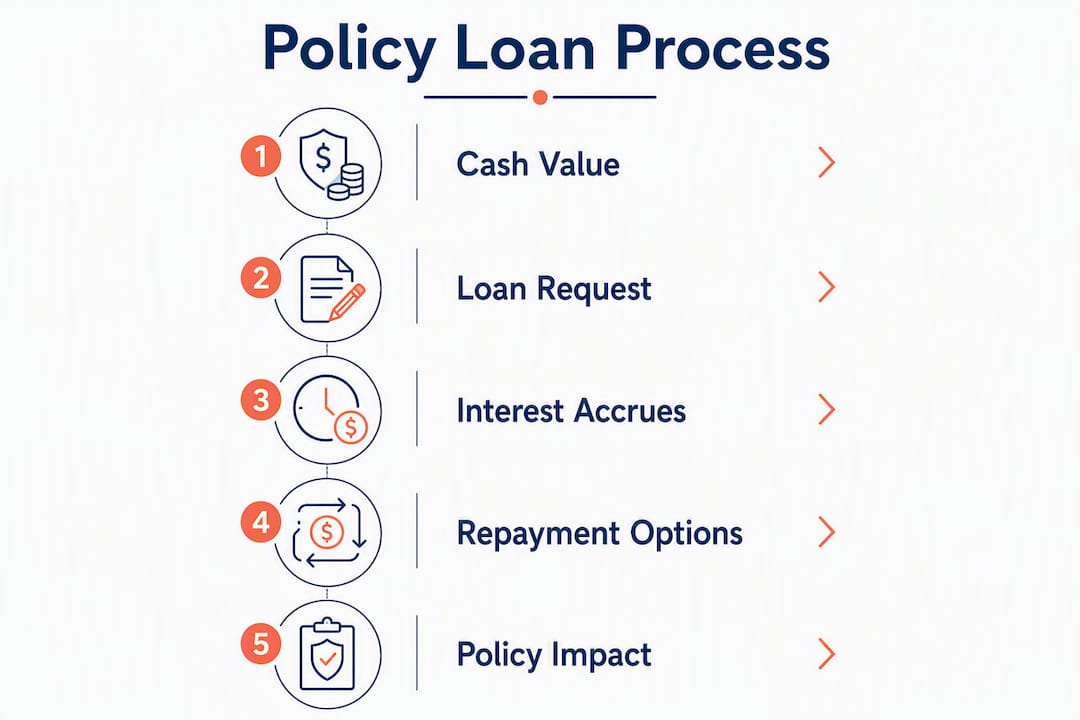
Policy types that allow loans
Only permanent life insurance policies with accumulated cash value are eligible for a life insurance policy loan. Term life insurance builds no cash value and is excluded entirely.
Qualifying policy types include:
- Whole life insurance — the most common source of policy loans; cash value grows on a guaranteed schedule and may earn dividends.
- Universal life insurance — flexible premiums and an adjustable death benefit; cash value grows based on a credited interest rate.
- Indexed universal life (IUL) — cash value growth is tied to a market index (such as the S&P 500), subject to caps and floors.
- Variable universal life (VUL) — cash value is invested in sub-accounts; growth and loan availability depend on market performance.
Waiting periods and loan caps
Cash value must accumulate before a loan is available. Depending on your premium schedule and policy design, that typically takes anywhere from two to ten years. Policies with higher early premiums build cash value faster; minimum-premium policies may take longer.
Insurers commonly cap policy loans at a percentage of available cash value. Common limits run up to most of the available cash value, depending on the carrier and product.
Most insurers cap policy loans at between 75% and 90% of your available cash value, with the remaining percentage serving as a safety buffer to absorb accruing interest and prevent immediate policy lapse. This buffer is designed so that even if you borrow at the maximum allowed percentage and skip interest payments, there is a margin to help avoid an unintended lapse. Some participating whole life carriers offer a loan structure where the policy continues to earn dividends on the full cash value even while a loan is outstanding. That product-level nuance changes the true cost of borrowing materially — and it is worth asking about specifically before you choose a carrier.
What does a loan from life insurance policy actually cost you?
Fixed vs. variable interest rates
Policy loan interest rates fall into two categories. Fixed rates are set at policy issue and do not change. Variable rates are tied to an index (often Moody’s Corporate Bond Yield Average or a similar benchmark), and can move up or down annually.
Typical policy loan rates run in the 5%–8% range, though the exact figure depends on your insurer, product, and whether the rate is fixed or variable. That range generally sits below credit card APRs (often 20%+) but may be comparable to or slightly above personal loan rates for borrowers with strong credit.
| Borrowing Option | Typical Rate Range (per online sources) | Credit Check | Collateral Required |
|---|---|---|---|
| Life insurance policy loan | 5%–8% | No | Cash value (internal lien) |
| Personal loan (good credit) | 5%–8% (varies by credit) | Yes | None (unsecured) |
| Credit card | 20%+ | Yes | None |
| HELOC | 5%–8% (varies by credit) | Yes | Home equity |
How unpaid interest compounds
Take a $30,000 loan at 6%. If you make no payments:
- Year 1: Balance grows to $31,800
- Year 2: Balance grows to $33,708
- Year 3: Balance grows to $35,730
- Year 5: Balance exceeds $40,100
Each year’s interest is calculated on the prior year’s total balance, not the original $30,000. After five years without payments, you owe more than one-third above what you originally borrowed. Administrative or processing fees for setting up a policy loan are not universal, but some carriers charge a small servicing fee. Ask your insurer directly.
What happens if you don’t repay — and when does a lapse become a tax problem?
Repayment options
Most insurers do not impose a mandatory repayment schedule on policy loans. That flexibility is genuinely useful in a short-term cash crunch, but it requires self-discipline. Your practical repayment options are:
- Interest-only payments — keeps the principal stable and prevents compounding; the minimum recommended approach.
- Periodic principal-plus-interest payments — reduces the balance over time and restores cash value.
- Dividend offset — on participating whole life policies, dividends can be directed to service loan interest, reducing out-of-pocket cost.
- No payments — interest capitalizes and compounds; the highest-risk approach.
Effect on your death benefit
If you die with an outstanding loan balance, the insurer subtracts that balance (plus any accrued interest) from the death benefit paid to your beneficiaries. Example: a $500,000 death benefit with a $40,000 outstanding loan and $3,000 in accrued interest pays out $457,000. Your family receives less than they expected, and they may not know why unless you have told them.
Loan drift is one of the most under-appreciated risks in permanent life insurance. Because no payment is required, many policyholders simply forget the balance is growing. Years later, the loan has quietly consumed most of the remaining cash value — and the next missed premium triggers a lapse.
The lapse and tax scenario
When a policy lapses with an outstanding loan, the IRS treats the loan balance as a distribution. If that amount exceeds your cost basis in the policy (the total premiums you paid in), the excess is taxable as ordinary income. A $50,000 loan balance with a $30,000 cost basis means $20,000 in taxable income — potentially in the same year you lost your coverage.
Modified Endowment Contracts (MECs): If your policy was funded too quickly and classified as a MEC by the IRS, different rules apply. Loans from a MEC are treated as taxable distributions first, and a 10% penalty may apply if you are under age 59½. Confirm your policy’s MEC status with your insurer before borrowing.
Monitoring steps to avoid a lapse:
- Review your loan balance statement at least annually.
- Keep your premium payments current — a lapse can occur even if you are paying premiums if the loan balance grows faster than the cash value.
- Set a personal repayment target and calendar reminders.

How to borrow from your policy — step by step
Before you call: eligibility checklist
- Confirm your policy is a permanent type (whole life, universal life, IUL, or VUL).
- Pull your most recent statement and note your current cash value.
- Check for any riders (e.g., accelerated death benefit, waiver of premium) that may restrict or interact with a loan.
- Identify your policy’s loan cap (75% or 90% of cash value is typical).
The process, step by step
- Contact your insurer or agent. Call the policyholder services number on your statement or reach out to your agent directly. Identify yourself as a policyholder requesting a loan illustration.
- Request a written loan illustration. Ask for projections showing your loan balance and death benefit under interest-only, no-payment, and full-repayment scenarios.
- Review and confirm loan terms. Verify the interest rate (fixed or variable), capitalization rules, and any fees in writing before proceeding.
- Complete the loan request form. Most insurers provide a one-to-two-page form. You will need your policy number, a government-issued ID, and your bank routing and account numbers for direct deposit.
- Choose your disbursement method. Direct deposit is fastest; a mailed check adds several business days.
- Set your repayment approach. Decide before funds arrive whether you will pay interest-only, make scheduled payments, or use dividends to offset interest.
Timeline to expect
Funds can arrive in as little as one business day or take up to a few weeks, depending on the insurer’s internal processing, whether the policy has an assignment or trustee requirement, and your chosen disbursement method. Policies held in trust or assigned to a lender typically require additional authorization steps that extend the timeline.
Documentation commonly required:
- Policy number
- Government-issued photo ID
- Bank account and routing numbers
- Signed loan request form
- Trustee or assignment authorization (if applicable)
Pros and cons — when does a policy loan actually make sense?
Advantages
- No credit check or underwriting. Your credit score is irrelevant; the cash value secures the loan.
- Tax-free proceeds while the policy stays in force.
- Flexible repayment. No mandatory schedule at most insurers.
- Speed. Faster than most bank loans, often within days.
- Lower rate than high-cost alternatives. At 5%–8%, a policy loan typically beats credit card rates significantly.
Disadvantages
- Interest compounds if unpaid, reducing both cash value and the death benefit over time.
- Lapse risk if the loan balance grows beyond remaining cash value.
- Taxable event on lapse — potentially a large, unexpected income tax bill.
- Reduced death benefit for your beneficiaries while any balance is outstanding.
- Possible effect on dividends in participating whole life policies, depending on carrier rules.
When it makes sense — and when it doesn’t
Good use cases:
- Short-term emergency cash when you have no other low-cost option.
- Bridging a gap until other financing closes (e.g., a home sale or business deal).
- Paying a premium to prevent a lapse when cash is temporarily tight.
Poor use cases:
- Funding ongoing or recurring expenses with no clear repayment plan.
- Long-term borrowing where the compounding interest will erode coverage you genuinely need.
- Situations where a lapse would leave dependents uninsured.
What are your alternatives to a policy loan?
Each alternative carries its own trade-offs on cost, tax treatment, and impact on your financial position.
- Policy withdrawal: You take money directly from the cash value. No repayment required, but the withdrawal permanently reduces the death benefit and may be partially taxable if it exceeds your cost basis. Unlike a loan, you cannot “repay” a withdrawal to restore coverage.
- Full policy surrender: You cancel the policy and receive the net cash surrender value. Coverage ends immediately. Any gain above your cost basis is taxable as ordinary income. This is a last resort, not a liquidity strategy.
- Personal loan: Requires a credit check and approval, but leaves your policy intact. Rates for borrowers with strong credit may be comparable to policy loan rates. Useful when you want to preserve full death benefit without any lien on the policy.
- Home equity loan or HELOC: Typically lower rates than personal loans, but your home is the collateral. Approval takes longer and closing costs apply.
- 401(k) loan: No credit check, and you repay yourself with interest. The risk: if you leave your employer or miss payments, the outstanding balance becomes a taxable distribution — similar to the policy lapse scenario.
| Situation | Better Option |
|---|---|
| Short-term emergency, no credit | Policy loan |
| Long-term debt consolidation | Personal loan or HELOC |
| Major purchase with home equity | HELOC |
| Ongoing monthly expenses | Neither loan type — address the budget |
| Preserving full death benefit | Personal loan |
Alternatives like withdrawals and surrenders terminate or permanently reduce coverage, making them fundamentally different from a loan in terms of long-term impact.
What should you ask your agent before borrowing?
Hettler Insurance Agency was founded by Ron Hettler, a Certified Insurance Counselor (CIC) with over 40 years of industry experience, and the agency has served Texas policyholders since 1992. Ron’s daughter Meghan, also CIC credentialed, leads the team today. The agency is recognized by both Three Best Rated® and Expertise.com as a leading insurance agency in Lubbock, holds an A+ BBB rating, and represents over 30 top-rated carriers — which means the team can compare loan terms across multiple insurers, not just one.
Before you initiate a loan, bring these specific questions to your agent:
- What is my current cash value, and what is the maximum loan amount available?
- Is the loan interest rate fixed or variable, and what index does it follow if variable?
- How is interest capitalized — annually, monthly, or continuously?
- Will an outstanding loan reduce or eliminate my policy dividends?
- Does my policy have any riders (accelerated death benefit, waiver of premium) that interact with a loan balance?
- What is the processing time, and are there any administrative fees?
- Can you run a loan illustration showing my projected balance and death benefit under three repayment scenarios?
Pro Tip: An independent agent who represents multiple carriers can pull loan illustrations from several insurers side by side. That comparison often reveals meaningful differences in interest calculation methods and caps — differences that a single-carrier agent cannot show you.
Because Hettler Insurance works with multiple carriers, the team can identify which policies in your situation offer the most favorable loan terms and walk you through a side-by-side illustration before you commit to anything.
This article provides general information about life insurance policy loans and is not a substitute for personalized financial or tax advice. Confirm current rules and your specific policy terms with your insurer and a qualified professional.
A word from the agency
At Hettler Insurance Agency, we talk with policyholders about policy loans more often than most people expect. The question usually comes up during a cash crunch — a medical bill, a business gap, an unexpected repair — and the policyholder did not realize their permanent life policy could be a resource. That is exactly the kind of conversation we are here for.
What we consistently tell clients: the loan itself is rarely the problem. The problem is borrowing without a repayment plan and then watching the balance grow silently for years. We walk every client through a loan illustration before they sign anything, so the numbers are visible and the decision is informed. If you are unsure whether your policy qualifies, what your current cash value is, or how a loan would affect your coverage long-term, call us. That conversation costs you nothing.
“The best independent insurance agents don’t just find you a policy. They find you the right insurance policy and then make sure it stays right as your life changes.” — Ron Hettler, CIC (certified insurance counselor), Hettler Insurance Agency
Hettler Insurance Agency can help you borrow smarter from your policy
Knowing your policy has cash value is one thing. Understanding exactly how much you can borrow, what it will cost, and how to protect your coverage while doing it is another. That is where Hettler Insurance’s independent perspective pays off directly.

The team at Hettler Insurance reviews your existing life policy, runs loan illustrations across multiple repayment scenarios, and compares loan terms across the carriers they represent. You get a clear picture of your options — not a sales pitch for one product. Whether you need a quick loan illustration, want to understand how a loan affects your beneficiaries, or are weighing a policy loan against a personal loan or HELOC, the agency’s CIC-credentialed advisors can walk you through it at no extra fee.
Texas policyholders can review their life insurance options with Hettler Insurance and schedule a consultation to request a loan illustration tailored to their specific policy and situation. Call the Lubbock office or reach out online to get started.
About the Author
Ronald J. Hettler, CIC is a Certified Insurance Counselor (CIC) [the gold-standard credential in the independent insurance industry]. Ron has over 46 years of real-world experience in the insurance industry. He is the owner/president of Hettler Insurance Agency in Lubbock, Texas and is licensed by the Texas Department of Insurance (License #666862). (Why Trust Hettler Insurance Agency? It’s a Local independent insurance agency representing multiple carriers. Hettler Insurance Agency has established business roots going back to it’s predecessor in the late 1800’s. Local expertise in Lubbock Texas and West Texas risks. Focused on clarity before a claim occurs.) Ron and his daughter Meghan, also a CIC, lead a team that represents 30+ carriers and serves clients across Texas.
Ron specializes in helping individuals, families, and small business owners understand complex insurance concepts in clear, practical terms so they can make informed decisions about their coverage. He specializes in helping individuals and families understand coverage gaps, deductible structures, and real-world claim outcomes before a loss occurs. Ron helps you to understand how insurance policies respond in real-world claim situations.
License verification available through the Texas Department of Insurance.
Frequently Asked Questions ?
Q1 ?: Which life insurance policies allow you to take a loan?
Q2 ?: How much can you borrow from a life insurance policy?
Q3 ?: What happens if you don’t repay a life insurance policy loan?
Q4 ?: When does a life insurance policy loan become taxable?
Q5 ?: How can you protect your policy when taking a loan?
— Life Insurance Instant Quote and Apply Tool @ GetLifePolicy.com > * Quick self-service term life insurance quote. With or without medical exam.
— Call us about Auto, Home, Business, Life, or Health insurance. * Click to Call (806) 798-7800, Mon-Fri 8:30am-5pm (lunch closed Noon-1pm)
— Come see us @ our new address 4720 S Loop 289 Lubbock, TX 79414 (maps link), or get your online quote started at https://GetHettler.com