
TL;DR summary:
- The best practices for insurance shopping come down to one repeatable workflow: start with your current declarations page, request written quotes from several carriers using the exact same limits, deductibles, and endorsements, compare total cost (fees and lost discounts included), and vet each insurer’s license, complaint record, and financial strength before you buy. Keep your current policy active until the new one is confirmed, and let an independent agent do the side-by-side work across multiple carriers for you.
Follow a repeatable workflow and you will get genuinely comparable quotes, avoid coverage gaps, and pick a policy that protects you without overpaying. Consumer guidance from the National Association of Insurance Commissioners (NAIC) and the Texas Department of Insurance (TDI) points in the same direction: know your current coverage, shop more than one company on the same coverages, and check the insurer before you buy. These best practices for insurance shopping give you a short checklist you can act on right now:
- Pull your current declarations page and note every limit, deductible, and endorsement.
- Request at least three quotes using those exact same inputs.
- Ask for written or emailed confirmation of every quote’s assumptions.
- Match coverage types, limits, and deductibles before comparing premiums.
- Verify each insurer’s license with the Texas Department of Insurance.
- Check complaint records and J.D. Power satisfaction scores.
- Ask about all available discounts and confirm which ones are ongoing.
- Confirm the new policy’s effective date before canceling your current one.
Table of Contents
- Key Takeaways
- 1. Start with your declarations page — it’s your comparison baseline
- 2. How to get truly comparable quotes — the apples-to-apples method
- 3. Where should you shop for quotes?
- 4. What actually drives your premium
- 5. Discounts and payment options that actually reduce your cost
- 6. How to verify an insurer before you buy
- 7. Questions to ask when getting a quote
- 8. When and how to switch insurers safely
- 9. How an independent agent compares quotes — a reproducible checklist
- The case for shopping every 12 to 24 months
- What Hettler Insurance Agency does with your declarations page
- Sources
- Frequently Asked Questions
Key Takeaways
Following a structured, repeatable shopping process, including reviewing your declarations page, collecting at least three written quotes on identical coverages, and vetting insurer quality, produces better coverage decisions than comparing premiums alone.
| Point | Details |
|---|---|
| Use your declarations page | Copy every limit, deductible, and endorsement before requesting any new quote. |
| Get at least three written quotes | The NAIC encourages getting quotes from more than one company on the same coverages; three written quotes give you a reliable comparison. |
| Vet insurer quality | Check licensing, complaint records, J.D. Power scores, and financial strength before binding. |
| Calculate total cost | Factor in installment fees, lost bundling discounts, and payment-method charges alongside the quoted premium. |
| Hettler Insurance Agency shops for you | Hettler Insurance Agency compares 30-plus carriers and returns written, comparable quotes at no extra fee to you. |
1. Start with your declarations page — it’s your comparison baseline
Your declarations page (often called the “dec page”) is the summary your insurer sends at the start of each policy term. It lists your named insureds, covered vehicles and VINs, policy effective and expiration dates, every coverage type, each coverage limit, and each deductible. Think of it as the specification sheet for your current protection.
Before you request a single new quote, pull that declarations page and copy down these specific fields:
- Bodily injury liability limits (for example, 100/300)
- Property damage liability limit
- Uninsured/underinsured motorist (UM/UIM) limits
- Comprehensive and collision deductibles
- Rental reimbursement coverage (daily limit and maximum)
- Any endorsements (gap coverage, roadside assistance, new-car replacement)
- Named drivers and their dates of birth
- Vehicle year, make, model, and VIN
The NAIC advises understanding your current coverages before you start comparing, because policies are bundles of individual coverages, not a single “full coverage” product. If you don’t know what you currently carry, you can’t tell whether a cheaper quote is actually cheaper or just thinner.
Life changes also trigger a coverage review before shopping. Marriage, a teenage driver joining the household, a new commute, or a vehicle purchase can all shift your rating profile and your coverage needs. Update your inputs before you shop, not after.
Pro Tip: Photograph or export your declarations page as a PDF and attach it to every quote-request email. It removes ambiguity and gives each agent or carrier the exact same starting point.
2. How to get truly comparable quotes — the apples-to-apples method
The best practices for insurance shopping collapse quickly if your three quotes aren’t quoting the same thing. A low premium looks great until you realize it carries a higher collision deductible than your current policy, or it drops UM/UIM coverage entirely.

The NAIC’s auto-shopping tool encourages contacting more than one agent or company and gathering quotes on the same or similar coverage, so you have enough price information to spot an outlier and see where one carrier is genuinely more competitive.
Use this numbered checklist for every quote request:
- Provide the same vehicle VIN, annual mileage, and garaging ZIP code to every source.
- Specify the exact liability limits from your declarations page.
- Request the same UM/UIM limits.
- Name the same collision and comprehensive deductibles.
- List every driver by name and date of birth.
- Ask for the same endorsements (rental, roadside, gap).
- Request the quote in writing or by email before you agree to anything.
When an online form generates a quote and a representative calls to confirm details, ask them to email the quote assumptions before you proceed. Online convenience can hide mismatched defaults, and a follow-up call is often when those defaults change.
What to compare on every quote:
| Line Item | What to Check | Why It Matters |
|---|---|---|
| Liability limits | Bodily injury and property damage match your dec page | Lower limits make a quote look cheaper while shifting lawsuit risk to you |
| UM/UIM | Included, at the same limits | Protects you when an at-fault driver has little or no insurance |
| Deductibles | Same comprehensive and collision deductibles on every quote | A higher deductible lowers premium but raises your cost at claim time |
| Endorsements | Rental, roadside, gap, and new-car replacement listed | Missing endorsements are the most common hidden difference |
| Drivers and vehicles | Every driver, VIN, usage, and annual mileage is correct | Wrong inputs can change the premium at binding or create claim problems later |
| Discounts | Which discounts are applied, and whether each is ongoing or temporary | New-customer and conditional discounts can disappear at renewal |
| Fees and payment terms | Installment fees, card surcharges, and paid-in-full options | Fees change the true annual cost of a quote |
| Total cost | Full-term premium plus fees, minus any discounts you would lose on other policies | The bottom line is the number to compare, not the monthly payment |
| Carrier quality | License, complaint record, J.D. Power score, and A.M. Best rating | A low premium means little if the carrier struggles to pay claims |
Treat quotes as comparable only after every line item matches. For a Texas-specific walkthrough, see How to Compare Insurance Quotes in Texas.
Pro Tip: Record your quoting inputs in a single document — VIN, mileage, named drivers, usage type — and attach it to every quote request. When premiums differ unexpectedly, you can check inputs first rather than assuming one carrier is simply cheaper.
3. Where should you shop for quotes?
Four main channels exist for getting auto insurance quotes, and each has a distinct trade-off between carrier access, personalization, and speed.
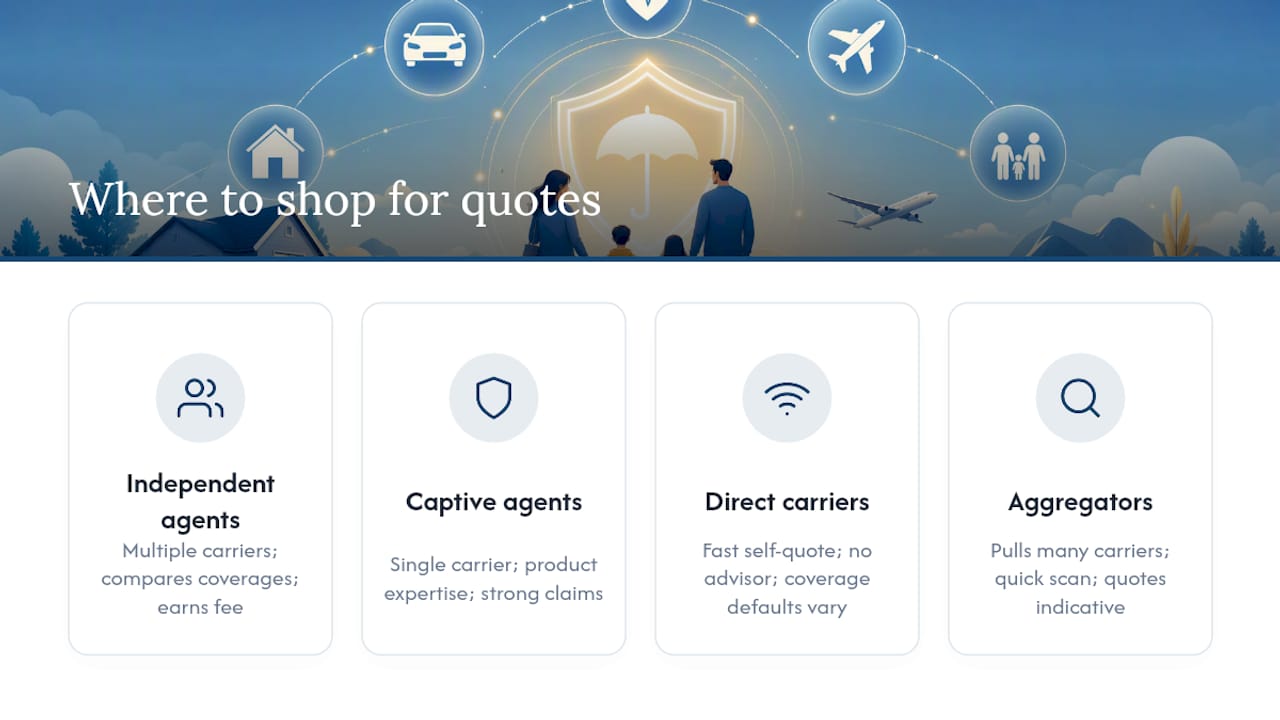
Independent agents represent multiple carriers, sometimes dozens. They can run your information through several companies in one conversation, normalize the coverages, and explain differences in plain language. They are paid by the carriers they place business with, so it is fair to ask which carriers they represent and why they recommend one over another.
Captive agents (those who represent a single company) offer deep product knowledge for that one carrier. What they cannot do is quote you a competitor, even if that competitor would be a better fit for your household.
Direct online carriers let you quote without speaking to anyone, which is fast. The risk is that default coverage selections may not match your current policy, and there is no one to flag a gap before you bind.
Online comparison websites pull estimates from multiple carriers at once. They can be useful for a quick look at the market, but the figures are often estimates rather than final quotes, and coverage defaults vary by carrier.
For most households, the strongest approach is to work with an independent agent who can quote multiple carriers on identical coverage and explain the trade-offs. If you have also gathered a direct or online estimate, share it with your agent so they can check it against the same coverage inputs. Learn more about why to use an independent insurance agent.
4. What actually drives your premium
Knowing which factors move your rate helps you understand why two quotes on identical coverages can still differ. Insurers use actuarial models, and the inputs below carry the most weight for personal auto.
- Driving record: At-fault accidents and moving violations raise rates significantly, often for three to five years.
- Location and ZIP code: Areas with higher theft, accident frequency, or severe-weather exposure, including West Texas hail, cost more to insure.
- Vehicle type: Repair cost, safety ratings, theft rates, and horsepower all factor in.
- Credit-based insurance score: Most states, including Texas, allow insurers to use a credit-based insurance score (distinct from your credit score) as a rating factor. A few states restrict or prohibit it.
- Annual mileage and usage: Higher mileage means more exposure. Commute use typically rates higher than pleasure use.
- Age and driving experience: Young and inexperienced drivers carry higher statistical risk.
- Coverage selections: Higher limits cost more; higher deductibles cost less upfront but shift risk to you at claim time.
On the deductible question specifically, choosing the right deductible is a balance between premium savings and what you can realistically pay out of pocket after a loss. On an older, lower-value vehicle, a high deductible can leave you paying for most of a repair yourself.
Watch for installment fees and credit card surcharges. CNBC Select notes that paying in full can reduce or eliminate installment fees and may qualify you for a paid-in-full discount. Calculate the full-year cost under each payment option before deciding which is cheaper.
Kiplinger’s guidance makes the same point from the other direction: don’t shop only on price. A lower premium that comes with a higher deductible, lower limits, or a carrier with poor claims handling is not a better deal.
5. Discounts and payment options that actually reduce your cost
Discounts are real, but they are not all equal. Some are permanent features of your rating profile; others are temporary, conditional, or lost the moment you change carriers. Ask about each one explicitly.
Common discounts to request:
- Multi-policy (bundling): Combining auto and home with the same carrier often produces one of the largest discounts. Bundling home and auto can reduce total premium meaningfully, but verify the net savings against each policy’s standalone rate.
- Safe driver / accident-free: Usually applied after three to five clean years.
- Paid-in-full: A discount for paying the full term upfront.
- Automatic payment (EFT): A small but reliable reduction for authorizing bank drafts.
- Good student: Available for full-time students with a qualifying GPA, typically under age 25.
- Low mileage: Some carriers offer a discount below a set annual mileage threshold.
- Telematics / usage-based programs: Many major insurers offer app-based or plug-in programs that monitor driving behavior and can produce meaningful discounts for safe drivers.
- Vehicle safety features: Anti-lock brakes, airbags, anti-theft devices, and newer safety tech often qualify.
Temporary discounts deserve special scrutiny. A new-customer discount may expire at renewal. A paid-in-full discount applies only when you pay that way. If you switch carriers and lose a bundling discount on your home policy, the net savings on auto may be smaller than the quoted difference suggests. See more real examples of insurance discounts you can claim now.
Pro Tip: Before switching, calculate your total insurance spend across all policies — auto, home, renters, umbrella — under both the current carrier and the new one. A small auto savings that costs you a larger home discount is a net loss.
6. How to verify an insurer before you buy
A low premium from an insurer you can’t trust is not a deal. Build this vetting workflow into every shopping cycle.
- Verify the license. Confirm the company and agent are both licensed to sell in your state. Texas residents can check with the Texas Department of Insurance (TDI).
- Check complaint records. TDI publishes complaint data resources for companies doing business in Texas, and the NAIC complaint index compares a company’s complaints to its market share. On the NAIC index, a ratio above 1.0 means more complaints than average for a company that size. Look at the complaint type, not just the number: repeated claim-denial complaints are a different signal than billing disputes.
- Review J.D. Power satisfaction scores. J.D. Power publishes annual auto insurance customer satisfaction and claims satisfaction studies. A carrier that scores well on claims handling is telling you something meaningful about what happens when you actually need the policy.
- Check Consumer Reports ratings. Consumer Reports surveys its members on claims experiences and publishes satisfaction data that complements J.D. Power’s studies.
- Confirm financial strength. A.M. Best and Standard & Poor’s rate insurer financial stability. To protect our clients, Hettler Insurance Agency tends not to work with carriers rated below A- by A.M. Best, and generally does not work with carriers whose financial-strength rating falls below B+.
- Request sample policy language. Ask for a sample declarations page or the policy form before binding. The claims section and exclusions section tell you exactly what the carrier will and won’t pay.
Red flags that justify more questions or walking away: unresolved licensing issues, a complaint ratio well above 1.0 with repeated claim-handling complaints, or a weak financial-strength rating.
7. Questions to ask when getting a quote
Most shoppers accept the quote as presented. The ones who get better coverage ask these questions before they sign anything.
- “What coverages are included in this quote, and what is explicitly excluded?”
- “What liability limits and deductibles are you quoting?”
- “Which discounts are applied, and are they permanent or conditional?”
- “How does your claims process work, and what is the typical timeline for a property damage claim?”
- “Are there any endorsements I should consider for my situation?”
- “Will this premium be guaranteed until the policy binds, or can it change?”
- “What is the cancellation policy, and how is any refund calculated?”
- “Can you email me the full quote with all assumptions listed before I make a decision?”
That last question is the most important. An emailed quote with every assumption listed keeps your comparison reproducible and gives you a record if the premium changes at binding.
Pro Tip: After the conversation, send a brief reply email summarizing what you discussed: the coverages quoted, the premium, the effective date, and any discounts applied. This creates a paper trail and often prompts the agent to correct any errors before you commit.
8. When and how to switch insurers safely
Switching carriers at the wrong moment can cost you more than you save. The mechanics matter.
- Get the new policy in writing and confirm the effective date before you cancel or let the old policy lapse.
- Align effective dates. The new policy should start no later than the day the old one ends, so there is no gap.
- Cancel in writing. Send a written cancellation request to your current carrier specifying the exact cancellation date. Keep a copy.
- Ask how your refund is calculated. Some policies return the full unused (pro-rata) premium; others may apply a short-rate calculation or fee if you cancel mid-term. Ask your carrier before you cancel.
- Check multi-policy impacts. If your auto and home are bundled, removing auto may trigger a rate increase on your home policy. Calculate the net change across both policies before deciding.
- Keep proof of insurance in your vehicle from the moment the new policy binds.
- Get cancellation confirmation in writing from the old carrier, including any refund amount and timeline.
AARP recommends comparing quotes regularly because market and pricing conditions shift over time, so the carrier that was most competitive two years ago may not be today. Shopping at renewal, rather than mid-term, usually gives you the cleanest transition.
9. How an independent agent compares quotes — a reproducible checklist
This is the kind of workflow an independent agent follows when a client sends in a declarations page. You can replicate it with any agent or when shopping on your own.
Step 1: Gather inputs. Collect the declarations page, vehicle VINs, annual mileage, named drivers with dates of birth, and the client’s preferred deductibles.

Step 2: Standardize the quote request. Every carrier receives the same liability limits, UM/UIM limits, deductibles, and endorsement list. No defaults are accepted without verification.
Step 3: Request written quotes from three or more carriers. Verbal quotes are not comparable. Written quotes with a quote number and expiration date are.
Step 4: Normalize the outputs. When carriers return quotes with different defaults (a carrier that auto-includes roadside assistance, for example), adjust for the cost of adding or removing that coverage to make premiums truly comparable.
Step 5: Run vetting checks. Confirm each carrier’s license, review complaint records, check financial-strength ratings, and note J.D. Power scores for claims satisfaction.
Step 6: Document the recommendation. The best-fit option is selected based on coverage match, premium, and insurer quality, and the reasoning is documented so the client understands the trade-offs.
| Step | Action | Output |
|---|---|---|
| 1. Gather inputs | Declarations page, VINs, drivers, mileage | Standardized quote request document |
| 2. Standardize | Same limits, deductibles, endorsements for all carriers | Apples-to-apples quote request |
| 3. Collect quotes | Written quotes from 3+ carriers | Comparable premium figures |
| 4. Normalize | Adjust for coverage differences | True cost comparison |
| 5. Vet insurers | License, complaint records, financial strength, J.D. Power | Quality-adjusted shortlist |
| 6. Document | Recommend best fit with written rationale | Decision record for client |
At Hettler Insurance Agency, Ron Hettler, CIC (Certified Insurance Counselor), agency founder and president with 45+ years of insurance industry experience, and Meghan Harris, CIC, who co-leads the agency with Ron, apply this same discipline to every comparison. The workflow is not proprietary. Any shopper who follows these six steps will make a better decision than one who compares only the bottom-line premium.
The case for shopping every 12 to 24 months
Many people shop for insurance once and then forget about it until something goes wrong. That habit can cost money and, more importantly, leave coverage gaps unaddressed as life changes.
A good cadence is every 12 to 24 months, or immediately after a major life event: a new vehicle, a marriage, a teenager getting a license, a home purchase, or a significant change in your driving record. Pricing and market conditions shift in ways that can make last year’s best deal less competitive this year. A carrier that was uncompetitive for your profile a few years ago may now be a strong option.
The most common mistakes our agents see: comparing quotes that don’t match on limits or deductibles, choosing a carrier based on price alone while ignoring claims service quality, and losing multi-policy discounts without accounting for the net cost. The third one is particularly painful because it’s invisible until renewal arrives and the home policy jumps.
Credentials matter in this process. The Certified Insurance Counselor (CIC) designation is a nationally recognized and highly respected credential. Earning it requires passing five 16-hour CIC courses, each followed by a two-hour, proctored, essay-style exam, and keeping it requires 16 hours of approved update education every year. Over a career, that adds up to hundreds of hours of advanced coursework in coverage analysis and risk management, and that depth shows up in the details of a quote comparison, not just the bottom-line number.
What Hettler Insurance Agency does with your declarations page
Shopping across 30-plus carriers takes time you probably don’t have. Hettler Insurance Agency does it for you, at no extra cost to you as the shopper.

Send your current declarations page, a list of your vehicles and drivers, your approximate annual mileage, and your preferred deductibles. The team will run those inputs through its carrier network, review each option’s complaint history and financial strength, and return written, comparable quotes with a clear explanation of the trade-offs. Your information stays confidential, and using an independent agent does not add a fee to your premium. Carriers pay the agency’s commission directly.
Hettler Insurance Agency serves Texans from Lubbock to Dallas to Midland-Odessa and all of Texas, covering auto, home, renters, commercial, life, and specialty lines. Hettler Insurance Agency is one of the few family-owned agencies in Texas where both principals carry the high level certification of CIC (Certified Insurance Counselor). Fewer than 2% of licensed insurance professionals in the U.S. have earned the CIC designation.
Ready to see what 30-plus carriers can offer your household? Contact Hettler Insurance Agency or call (806) 798-7800 to get started.
Sources
These public resources are worth bookmarking before you start shopping.
- A Shopping Tool for Auto Insurance — NAIC
- Auto Insurance Guide — Texas Department of Insurance
- Complaint Data Resources — Texas Department of Insurance
- How to Shop for Insurance — CNBC Select
- To Be a Smart Insurance Shopper, Don’t Shop Just for Price — Kiplinger
- Great Ways to Save on Insurance — AARP
- CIC | Certified Insurance Counselor — Risk & Insurance Education Alliance
Save or screenshot every written quote you receive, along with the date and the agent’s or carrier’s contact information. If a premium changes between quote and binding, you have a record to reference.
This article provides general information and is not a substitute for advice from a licensed insurance professional. Coverage, discounts, and eligibility vary by carrier and policy.
Frequently Asked Questions ?
Q1 ?: What are the best practices for insurance shopping?
Q2 ?: Why should I use my declarations page when shopping for insurance?
Q3 ?: How do I check whether an insurance company is trustworthy?
Q4 ?: How often should I shop for insurance?
Q5 ?: How do I switch insurers without a coverage gap?
Recommended
About the Author
Ronald J. Hettler, CIC is a Certified Insurance Counselor (CIC) [a gold-standard credential in the independent insurance industry that less than 2% earn]. Ron has over 46 years of real-world experience in the insurance industry. He is the owner/president of Hettler Insurance Agency in Lubbock, Texas and is licensed by the Texas Department of Insurance (License #666862). (Why Trust Hettler Insurance Agency? It’s a Local independent insurance agency representing multiple carriers. Hettler Insurance Agency has established business roots 100+ years going back to it’s predecessor in the late 1800’s. Local expertise in Lubbock Texas and West Texas risks. Focused on clarity before a claim occurs.) Ron and his daughter Meghan, also a CIC, lead a team that represents 30+ carriers and serves clients across Texas.
Ron specializes in helping individuals, families, and small business owners understand complex insurance concepts in clear, practical terms so they can make informed decisions about their coverage. He specializes in helping individuals and families understand coverage gaps, deductible structures, and real-world claim outcomes before a loss occurs. Ron helps you to understand how insurance policies respond in real-world claim situations.
License verification available through the Texas Department of Insurance.
— Life Insurance Instant Quote and Apply Tool @ GetLifePolicy.com > * Quick self-service term life insurance quote. With or without medical exam.
— Call us about Auto, Home, Business, Life, or Health insurance. * Click to Call (806) 798-7800, Mon-Fri 8:30am-5pm (lunch closed Noon-1pm)
— Come see us @ our new address 4720 S Loop 289 Lubbock, TX 79414 (maps link), or get your online quote started at https://GetHettler.com