
TL;DR summary:
- Insurable interest is the legal financial or relational stake needed to make an insurance policy valid. Without it, policies can be voided, and claims denied, especially in property and life insurance. It must exist at policy inception and, for property, also at the time of loss to ensure enforceability.
Insurable interest is defined as the legally recognized financial or relational stake you must have in a person or property before you can take out an insurance policy on it. Without this stake, insurance contracts become wagers and courts treat them as unenforceable. This requirement exists in every major line of coverage, from homeowners and auto policies to life and business insurance. Understanding the definition of insurable interest protects you from buying a policy that could be voided at the worst possible moment.
Table of Contents
- Key Takeaways
- What is insurable interest and why does it matter legally?
- How does insurable interest work in property and casualty insurance?
- What constitutes insurable interest in life insurance policies?
- Why is insurable interest important for policyholders and insurers?
- Insurable interest examples in everyday insurance scenarios
- Why I think most people misunderstand insurable interest until it’s too late
- Hettler Insurance Agency can help you get coverage right from the start
- Frequently Asked Questions
Key Takeaways
Insurable interest is the legally required financial or relational stake that makes an insurance policy valid and enforceable, and without it, both property and life insurance contracts can be denied or voided entirely.
| Point | Details |
|---|---|
| Core definition | Insurable interest is a legally recognized financial or relational stake required for a valid policy. |
| Timing differences | Property insurance requires interest at inception and at loss; life insurance requires it only at inception. |
| Multiple interests, one property | Owners, lenders, and tenants can each hold separate valid interests in the same property. |
| Life insurance limits | Coverage must reflect actual economic loss; over-insuring beyond the financial stake is not permitted. |
| Additional insured is not enough | Being named an additional insured does not create or substitute for a valid insurable interest. |
.
What is insurable interest and why does it matter legally?

Insurable interest is the legal boundary between risk management and gambling in insurance underwriting. Courts require it to confirm that you stand to suffer a real financial loss if the insured person dies or the insured property is damaged. If that financial stake does not exist, the policy has no legal foundation.
The concept traces back to English common law, and American courts have applied it consistently ever since. The factual expectancy test is the foundational legal standard. It asks a simple question: do you expect to benefit from the continued existence of this person or property? If the answer is yes and that benefit is measurable, insurable interest exists.
Regulators and insurers use this standard to prevent two specific harms. First, it stops people from profiting off losses they did not actually suffer. Second, it removes the financial incentive to cause harm to the insured. Both protections make the entire insurance system more trustworthy and stable.
Pro Tip: Check your insurance glossary before signing any policy. Knowing terms like “insurable interest,” “mortgagee clause,” and “additional insured” prevents surprises at claim time.
How does insurable interest work in property and casualty insurance?
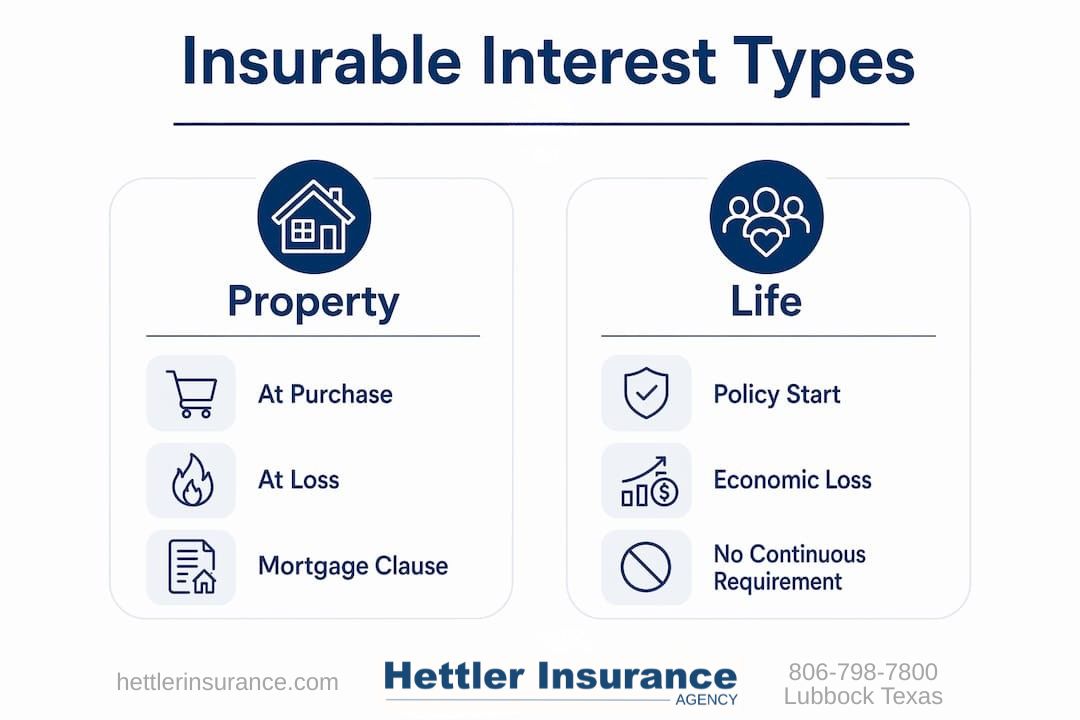
Property insurance requires insurable interest at two points: at the time you buy the policy and at the time of the loss. Property owners must maintain interest until the loss occurs. If you sell your home and then it burns down the next week, you cannot collect on the old policy because your financial stake ended at the sale.
Who can hold insurable interest in the same property?
Multiple parties can hold separate insurable interests in one property at the same time. Here are the most common examples:
- Owners: A homeowner has direct insurable interest up to the full market value of the property.
- Mortgage lenders: Mortgage lenders hold interest up to the outstanding loan balance. They appear on the policy as the mortgagee, and claim payments go to them first.
- Tenants: A renter has insurable interest in their personal belongings and any improvements they paid for, but not in the building itself.
- Landlords: A landlord’s insurable interest covers the building structure and lost rental income, not the tenant’s possessions.
- Bailees: Dry cleaners, warehouse operators, and repair shops hold insurable interest in property they are legally responsible for, even without ownership.
The mortgagee clause is the practical tool that handles multiple interests on one policy. It directs the insurer to pay the lender’s share directly to the lender, regardless of what happens between the borrower and the insurer. This protects the lender’s financial stake independently.
| Party | Basis for insurable interest | Timing requirement |
|---|---|---|
| Property owner | Ownership and equity | At inception and at loss |
| Mortgage lender | Outstanding loan balance | At inception and at loss |
| Tenant | Personal property and improvements | At inception and at loss |
| Landlord | Building structure and rental income | At inception and at loss |
| Bailee | Contractual responsibility for goods | At inception and at loss |
.
Pro Tip: If you are a house flipper or real estate investor, your insurable interest changes as your ownership stake changes. Review your policy at every transaction. Hettlerinsurance covers house flippers in Texas with policies designed for exactly this situation.
What constitutes insurable interest in life insurance policies?
Life insurance follows a different rule. Insurable interest is only required at policy inception, not continuously throughout the policy’s life. Once the policy is validly issued, it remains in force even if the relationship changes.
This timing difference has real consequences. A spouse who takes out a life insurance policy on their partner retains that coverage after a divorce. The insurable interest existed when the policy was written, so the contract stays valid. Courts have confirmed this standard repeatedly.
The recognized bases for insurable interest in life insurance are:
- Close family relationships: Spouses, parents, and children are presumed to have insurable interest in each other. The financial and emotional dependency is obvious and legally accepted without further proof.
- Financial dependency: Anyone who depends on another person’s income for their livelihood can establish insurable interest. This includes domestic partners and individuals supporting aging parents.
- Business relationships: A company has insurable interest in a key employee whose death would cause measurable economic loss. This is the legal foundation for key person insurance.
- Creditor relationships: A lender has insurable interest in a borrower, but only up to the outstanding debt amount. Coverage beyond that amount would cross into wagering territory.
- Business partnerships: Partners have insurable interest in each other because the death of one partner creates direct financial loss for the business.
Life insurance coverage limits must reflect actual economic loss. Over-insuring is not allowed. A company cannot take out a $10 million policy on a $200,000-per-year employee and expect it to hold up. The coverage amount must be tied to a quantifiable financial exposure.
Pro Tip: Key person insurance is one of the most overlooked business protections. If your business depends on one or two people to generate revenue, ask Hettler Insurance about structuring a policy with proper insurable interest documentation.
Why is insurable interest important for policyholders and insurers?
Insurable interest protects both sides of the insurance contract. For policyholders, it confirms that the policy is legally valid and that a claim will be paid. For insurers, it confirms that the policyholder has a real reason to prevent loss rather than cause it.
“Insurable interest is not just an administrative checkbox. Without valid interest, claims can be denied, leaving policyholders completely unprotected at the moment they need coverage most. The rule exists to protect you, not to create obstacles.”
The concept of moral hazard explains why this protection matters. Moral hazard is the risk that a person behaves differently because they are insured. If you could profit from a loss you did not suffer, the incentive to prevent that loss disappears. Insurable interest eliminates that problem by tying the payout to your actual financial stake.
Coverage is void without insurable interest. Insurers can deny claims and courts can refuse to enforce the contract. The practical risks for policyholders include:
- Paying premiums for years on a policy that will never pay out.
- Losing the ability to recover after a genuine loss because the policy was structured incorrectly.
- Facing legal scrutiny if the insurer suspects the policy was written without a valid stake.
Being named an additional insured does not automatically create insurable interest. Additional insured status provides coverage under someone else’s policy, but it does not give you ownership rights or a substitute financial stake if a claim dispute arises. These are two separate legal concepts, and confusing them is a common and costly mistake.
Insurable interest examples in everyday insurance scenarios
Real-world examples make the definition of insurable interest concrete and easier to apply to your own situation.
Property and home insurance examples
A homeowner buying a Texas homeowners policy has clear insurable interest: they own the property and would suffer a direct financial loss if it were damaged. A bank holding a mortgage on that same home also has insurable interest up to the loan balance. Both interests are valid and both are covered under the same policy through the mortgagee clause.
A renter has insurable interest in their furniture, electronics, and clothing, but not in the apartment walls. The landlord holds insurable interest in the building structure and the rental income stream. This is why renters insurance and landlord insurance are separate products covering separate financial stakes.
Business and creditor interest examples
A business partner has insurable interest in the other partner’s life because the death of one partner directly reduces the business’s revenue and creates buyout obligations. A bank lending $500,000 to a small business owner has insurable interest in that owner’s life up to $500,000. Coverage above that amount would not be supported by a valid financial stake.
Common misconceptions to avoid
| Scenario | Valid insurable interest? | Reason |
|---|---|---|
| Spouse insuring spouse | Yes | Close family relationship and financial dependency |
| Business insuring key employee | Yes | Measurable economic loss from death |
| Stranger insuring a neighbor | No | No financial or relational stake |
| Lender insuring borrower beyond loan amount | No | Coverage exceeds actual financial exposure |
| Divorced spouse on existing life policy | Yes | Interest existed at inception; policy remains valid |
.
Pro Tip: If you are unsure whether your business has valid insurable interest in an employee or partner, call Hettler Insurance Agency before the policy is written. Correcting the structure after a claim is filed is far more difficult and expensive.
Why I think most people misunderstand insurable interest until it’s too late
After years of working with insurance policyholders across Texas, I have seen the same pattern repeat. People buy insurance, pay premiums faithfully, and then discover at claim time that the policy was structured without a valid insurable interest. The insurer denies the claim. The policyholder is left with nothing.
The part that surprises most people is how technical the timing rules are. Property insurance requires your financial stake to exist at both the start of the policy and the moment of loss. Life insurance only requires it at the start. These are not minor details. They are the difference between a paid claim and a denied one.
Business owners are especially vulnerable. Key person insurance and buy-sell agreements are powerful tools, but only when the insurable interest is documented correctly at the time the policy is written. I have seen partnerships where the coverage amount far exceeded any quantifiable financial loss. Those policies would not survive a serious legal challenge.
My advice is direct: verify your insurable interest before you sign. Ask your agent to explain the basis for your coverage and confirm that the coverage amount matches your actual financial exposure. If your agent cannot answer that question clearly, find one who can. Hettler Insurance Agency has been answering these questions for Texas policyholders since 1992, and the answer is always worth getting right.
— “The best independent agents do not just find you a policy. They find you the right policy and then make sure it stays right as your life changes.” — Ron Hettler, CIC (certified insurance counselor), Hettler Insurance Agency
Hettler Insurance Agency can help you get coverage right from the start
Getting insurable interest right is not optional. It is the foundation of every valid insurance policy you own.

Hettler Insurance works with over 30 top-rated carriers to structure coverage that matches your actual financial stake, whether you are protecting a home, a business, or a key employee. Ron Hettler and Meghan Hettler are both Certified Insurance Counselors, which means they understand the legal requirements behind every policy they write. If you are a business owner, the minimum insurance for entrepreneurs page is a practical starting point for understanding what coverage you actually need. Call Hettler Insurance Agency before you sign. A policy written without valid insurable interest is not protection. It is a premium payment with no guarantee.
Recommended
About the Author
Ronald J. Hettler, CIC is a Certified Insurance Counselor (CIC) [the gold-standard credential in the independent insurance industry]. Ron has over 46 years of real-world experience in the insurance industry. He is the owner/president of Hettler Insurance Agency in Lubbock, Texas and is licensed by the Texas Department of Insurance (License #666862). (Why Trust Hettler Insurance Agency? It’s a Local independent insurance agency representing multiple carriers. Hettler Insurance Agency has established business roots going back to it’s predecessor in the late 1800’s. Local expertise in Lubbock Texas and West Texas risks. Focused on clarity before a claim occurs.) Ron and his daughter Meghan, also a CIC, lead a team that represents 30+ carriers and serves clients across Texas.
Ron specializes in helping individuals, families, and small business owners understand complex insurance concepts in clear, practical terms so they can make informed decisions about their coverage. He specializes in helping individuals and families understand coverage gaps, deductible structures, and real-world claim outcomes before a loss occurs. Ron helps you to understand how insurance policies respond in real-world claim situations.
License verification available through the Texas Department of Insurance.
Frequently Asked Questions ?
Q1 ?: What is the simplest definition of insurable interest?
Q2 ?: Does insurable interest need to exist at the time of a claim?
Q3 ?: Can two people have insurable interest in the same property?
Q4 ?: What happens if insurable interest is missing?
Q5 ?: Does being an additional insured create insurable interest?
— Life Insurance Instant Quote and Apply Tool @ GetLifePolicy.com > * Quick self-service term life insurance quote. With or without medical exam.
— Call us about Auto, Home, Business, Life, or Health insurance. * Click to Call (806) 798-7800, Mon-Fri 8:30am-5pm (lunch closed Noon-1pm)
— Come see us @ our new address 4720 S Loop 289 Lubbock, TX 79414 (maps link), or get your online quote started at https://GetHettler.com