

TL;DR summary:
- Moving to a new state requires timely changes to auto and property insurance to prevent coverage gaps and comply with regulations. Policy updates must often be coordinated with registration and licensing deadlines, and moving can impact your premiums based on location-specific risks. Consulting an independent agent helps ensure you meet all requirements and get the best coverage for your new residence.
Notify your insurer before moving day, not after. That single action prevents coverage gaps, keeps you legally compliant, and gives your agent time to confirm whether your current carrier is licensed in your new state. For an out-of-state move, expect to obtain a rewritten or replacement auto policy and a new homeowners or renters policy — a simple online address change will not satisfy state insurance regulations. Out-of-state moves commonly require a new policy to be written, and failing to coordinate the handoff creates a coverage gap that insurers treat as a risk signal, which can raise your future premiums.
Here is what to do right now:
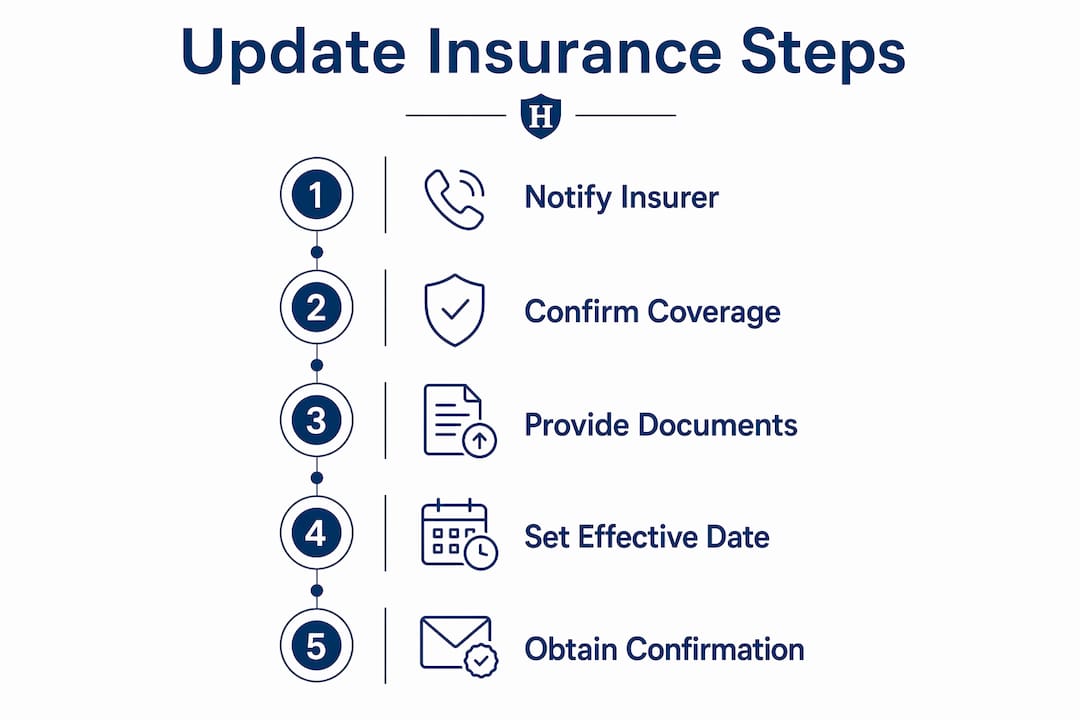
- Call your insurer or independent agent and give them your new address and move-in date.
- Confirm your carrier is licensed in the destination state (critical for out-of-state moves).
- Gather your documents: current declarations pages, vehicle VIN, driver’s license, new lease or deed, and move-in date.
- Set the new policy effective date to match or slightly overlap moving day — never leave a gap between the old policy end and the new policy start.
- Check your new state’s DMV and Department of Insurance for registration and license deadlines; most states give new residents 10–90 days to complete these updates before fines or registration suspension apply.
- For health coverage through the federal Marketplace, an out-of-state move requires starting a new state application to avoid a gap in coverage.
If you are moving within Texas or relocating to a new state, Hettlerinsurance can compare carriers, arrange binders for vehicle registration, and confirm your coverage is compliant from day one.
Table of Contents
- How does moving change your insurance premiums and coverage?
- How do you update your auto insurance after moving?
- How do you update homeowners, renters, or condo insurance when you move?
- Are your belongings covered while they’re in transit?
- How long do you have to update insurance, register your vehicle, and change your license?
- How do you handle temporary moves, seasonal homes, and two addresses?
- What mistakes do people make when updating insurance after a move?
- What documents do you need ready before calling your agent?
- What does a Certified Insurance Counselor recommend when you move?
- Key Takeaways
- Why getting this right matters more than most people realize
- Hettler Insurance helps movers get covered from day one
- Useful sources to verify deadlines and state rules
Key Takeaways
Updating your insurance after a move requires coordinating policy effective dates, confirming carrier licensing, and meeting state DMV deadlines before or on move-in day to avoid coverage gaps and legal penalties.
| Point | Details |
|---|---|
| Notify your insurer first | Call your agent before moving day with your new address and move-in date to start the update process. |
| Out-of-state moves require a new policy | A simple address change is not enough; most states require a rewritten or replacement auto and home policy. |
| Set overlapping effective dates | Start the new policy one day before the old one ends to eliminate any gap in coverage history. |
| State deadlines are 10–90 days | Most states require insurance, vehicle registration, and license updates within a broad window of time after moving; check your new state’s DMV for details. |
| Hettlerinsurance compares 30+ carriers | As an independent agency, Hettlerinsurance shops multiple carriers to find compliant, competitively priced coverage for your new address. |
How does moving change your insurance premiums and coverage?
A move is an underwriting event, not just an administrative change. Insurers recalculate your risk profile based on your new address, and the result can go either direction on price.
The main rating factors that shift with a new address include:
- ZIP code claims and crime history: A neighborhood with higher accident frequency or theft rates raises auto premiums; a lower-risk ZIP can reduce them.
- Commute length and annual mileage: Longer commutes increase exposure and push rates up. Shorter commutes or remote work arrangements can lower them.
- Garaging location: A vehicle parked in a private garage is rated differently than one left on a street or in an open lot.
- Local weather and disaster risk: Flood zones, wildfire corridors, hurricane-prone coastlines, and hail-heavy regions all affect homeowners premiums. Insurers recalculate homeowners premiums based on the new location’s flood, earthquake, and severe weather exposure, plus property age and construction type.
- Replacement cost and building codes: An older home in a market with high labor costs may require higher dwelling limits than your previous property.
A move across town might shift your auto premium by only a few dollars per month. A move from a rural ZIP to a dense urban area — or from the Texas Panhandle to a Gulf Coast flood zone — can require entirely different coverage types and meaningfully higher limits. Understanding why home insurance rates rise in your new region helps you set realistic expectations before you get quotes.
Pro Tip: Before assuming your premium will drop after a move, ask your agent to run the new address through their rating system. Bundling discounts, loyalty credits, and carrier-specific programs can change too — and not always in your favor.

How do you update your auto insurance after moving?
Follow these steps in order, starting before moving day. The goal is zero gap between your old coverage and your new state-compliant policy.
In-state move checklist
- Notify your insurer of your new address and move-in date as soon as you have them. Update your garaging address and estimated annual mileage immediately — both affect your rating basis even within the same state.
- Update garaging address, commute distance, and annual mileage on your policy.
- Request updated ID cards and a revised declarations page reflecting the new address.
- Confirm your lender or lienholder has the updated address on file if you carry a financed vehicle.
Out-of-state move checklist
- Notify your current insurer of the destination state and move-in date.
- Confirm your carrier is licensed in the new state. Many carriers operate nationally, but not all. If yours does not, you need a new carrier.
- Request a rewritten policy or a new quote that meets the destination state’s minimum liability, personal injury protection (PIP), and uninsured motorist requirements.
- Set the new policy effective date to match or slightly overlap your move-in date. Overlapping by one day costs almost nothing and eliminates gap risk.
- Obtain a binder (a temporary proof-of-insurance document) before you register the vehicle in the new state — most DMV offices require proof of state-compliant insurance at registration.
- Register your vehicle and update your driver’s license within the state’s required window (typically 10–90 days).
- Request written confirmation of cancellation of your old policy and confirm any prorated refund.
Questions to ask your agent before you finalize
- Is our current carrier licensed and writing new policies in my destination state?
- What are the new state’s minimum liability limits, and do I need PIP or uninsured motorist coverage?
- Will you rewrite my existing policy or do I need a new application?
- Can you issue a binder today so I can register the vehicle on move-in day?
- Is there an SR-22 requirement in the new state I should know about?
| Factor | In-state move | Out-of-state move |
|---|---|---|
| Policy action required | Address update on existing policy | Policy rewrite or new policy required |
| Carrier change likely? | Rarely | Possibly — depends on carrier licensing |
| State minimums change? | No | Yes — verify new state’s requirements |
| New ID cards needed? | Yes | Yes, plus new declarations page |
| DMV registration update | Update address | Re-register vehicle in new state |
| Timeline pressure | Lower | High — complete before or on move-in day |
.
Pro Tip: Set your new policy to start one day before the old one ends. Then request written cancellation confirmation and ask specifically about prorated refunds. Carriers sometimes continue billing if cancellation is not confirmed in writing.
How do you update homeowners, renters, or condo insurance when you move?
A homeowners or renters policy insures a specific address. A policy written for one property does not automatically cover a different address — you need a new policy or a formal endorsement for the new location.
Step-by-step checklist
- Notify your insurer of the new address, move-in date, and whether you are buying or renting.
- Provide details about the new dwelling: year built, construction type (frame, masonry, mixed), roof age and material, square footage, and security features (deadbolts, alarm system, sprinklers).
- Request updated declarations showing the new address, dwelling limit, and personal property limit.
- Confirm mortgage/lender information. Your lender must be listed as an additional insured on the new policy. Lenders typically require proof of coverage before or at closing.
- Review location-specific perils and add endorsements or separate policies as needed.
Coverage checklist for the new location
| Coverage | When to add it |
|---|---|
| Flood insurance | Any FEMA flood zone designation, coastal areas, or low-lying properties |
| Earthquake coverage | Pacific Coast, New Madrid Seismic Zone, or carrier-required areas |
| Wind/hurricane endorsement | Gulf Coast, Atlantic Coast, or high-wind corridors |
| Ordinance & law coverage | Older homes where rebuilding must meet current codes |
| Increased dwelling limits | Higher construction costs or larger square footage than the previous home |
| Additional living expenses | Any move where temporary housing costs would be significant |
.
Home inventory: what to document
Before the move, photograph every room and create a record with these fields: item name, serial number, purchase date, purchase price, current estimated value, and a photo timestamp or receipt link. This record protects you if items are damaged in transit or lost in a claim at the new address. Many landlords require renters insurance in leases, so having an accurate personal property value ready speeds up the application. College students moving into apartments should also review renters insurance considerations before signing a lease.

Pro Tip: Document safety features — monitored alarm, deadbolts, fire suppression — and have receipts or appraisals for high-value items ready before you call for quotes. Carriers apply discounts for security features, and accurate values prevent under-insurance at claim time.
Are your belongings covered while they’re in transit?
Not fully, and the gaps matter. Standard homeowners and renters policies typically extend limited coverage to personal property in transit, but exclusions are common and high-value items often require separate riders or declared value coverage during a move.
Key points to understand before moving day:
- Transit coverage under homeowners/renters: Most policies cover personal property away from the home, but at a percentage of your total personal property limit and subject to your deductible. Theft from a moving truck or storage unit may be covered; mechanical damage during loading often is not.
- Mover liability is not the same as insurance. Federal law requires interstate movers to offer two valuation options: released value (minimal, based on weight) and full value protection (the mover repairs, replaces, or pays current market value). Released value is essentially no coverage for most items.
- High-value items need special attention. Jewelry, art, collectibles, and electronics that exceed your policy’s sublimits require a scheduled personal property endorsement or a separate floater. Confirm these limits before the truck is loaded.
- Theft in transit is a common claim scenario. Document every item going onto the truck with photos and serial numbers before the movers arrive.
- Damage during loading and unloading is frequently excluded from both homeowners policies and mover liability unless you purchase full value protection from the mover.
Pro Tip: If you are moving cross-country or using a van line, get written confirmation of the mover’s liability level and valuation options before signing the contract. For high-value loads, ask your agent about short-term transit insurance — it is often available as a policy endorsement and costs far less than a denied claim.
How long do you have to update insurance, register your vehicle, and change your license?
State deadlines vary, and the consequences for missing them range from fines to registration suspension. The practical rule: secure new state-compliant coverage before or on the day you register the vehicle. Registration without compliant insurance is not possible at most DMV offices, so the insurance update must come first.
Action deadlines by move type
- In-state move (same city or county): Notify your insurer within a few days of move-in. Update your garaging address and mailing address immediately. No registration change is typically required, but your policy must reflect the correct address.
- In-state move (different city or county): Notify insurer within 30 days. Update your vehicle registration address with the state DMV. Driver’s license update requirements vary by state.
- Out-of-state move: Most states require new residents to obtain state-compliant insurance, register their vehicle, and update their driver’s license within a window that commonly falls between 10 and 90 days of establishing residency.
Common deadline ranges
| Action | Typical deadline range | Notes |
|---|---|---|
| Notify insurer of new address | Immediately to 30 days | Sooner is always better; some policies require prompt notice. |
| Obtain state-compliant auto insurance | Before vehicle registration | Required before the DMV will process vehicle registration. |
| Register vehicle in new state | 10–90 days (varies by state) | Check your new state’s DMV for the exact registration window. |
| Update driver’s license | 10–90 days (varies by state) | Often subject to the same or a similar deadline as vehicle registration. |
| Update homeowners/renters policy | At or before move-in | Mortgage lenders generally require proof of homeowners coverage at closing. |
States with unique requirements worth checking: some require personal injury protection (PIP) as mandatory coverage; others require uninsured motorist coverage at specific limits; a handful have SR-22 filing requirements for certain driver histories. Check your new state’s DMV and Department of Insurance pages directly — state rules change, and a carrier or agent in the new state will know the current requirements. If you are moving to Tennessee, a resource on switching insurance companies in that state covers the state-specific process in detail.
How do you handle temporary moves, seasonal homes, and two addresses?
Splitting time between two residences creates real coverage complexity. The wrong policy structure can leave one location uninsured or trigger a material misrepresentation issue.
Your main options:
- Update your primary garaging address to wherever the vehicle spends the majority of its nights. This is the address that drives your auto rating.
- Add a temporary location endorsement to your homeowners or renters policy to cover a second address for a defined period.
- Purchase short-term renters coverage for a temporary rental while your primary home is being sold, renovated, or occupied by others.
- Maintain separate policies for each residence when both are occupied regularly and carry meaningful property values.
Common scenarios and how to handle them:
- Seasonal relocation for work: Update your primary garaging address to the location where the vehicle is kept most of the year. Discuss the split with your agent and document expected days at each address.
- Second home or vacation property: A standard homeowners policy does not automatically extend to a second property. A separate dwelling policy or seasonal home policy is typically required.
- Students away at college: A student living in a dorm or apartment may be covered under a parent’s homeowners policy for personal property, but coverage limits are often low. A separate renters policy provides better protection.
- Deployed military: Active-duty servicemembers have specific protections under the Servicemembers Civil Relief Act (SCRA) and should discuss storage and deployment scenarios with their agent before deploying.
Do not list an inaccurate primary garaging address on your auto policy. Providing an inaccurate address is a material misrepresentation that can give your insurer grounds to deny a claim or void the policy entirely. If you are unsure which address qualifies as primary, ask your agent — the answer depends on where the vehicle is garaged most nights, not where you receive mail.
What mistakes do people make when updating insurance after a move?
Most coverage gaps and claim denials after a move trace back to a short list of avoidable errors.
- Updating only the mailing address. Your mailing address and your garaging or insured property address are separate fields. Updating one does not update the other. Confirm both with your agent in writing.
- Failing to change the garaging address. An inaccurate address is a material fact that can void a claim. If your vehicle is now garaged at a new location, that address must be on the policy.
- Canceling the old policy before the new one is active. Even a one-day gap can trigger a lapse on your insurance history, which carriers use to rate future policies. Set the new policy start date first, then cancel.
- Assuming your carrier is licensed in the new state. Not every carrier writes policies in every state. Confirm licensing before your move date, not after you arrive.
- Forgetting to update high-value item riders. Scheduled personal property endorsements are tied to a specific policy. When you rewrite or replace a policy, those endorsements do not automatically transfer.
- Not requesting written cancellation confirmation. Verbal cancellations are not reliable. Get written confirmation and ask specifically about prorated refunds to avoid being billed for coverage you no longer need.
For homeowners, common insurance mistakes at the time of a property change often involve under-insuring the new dwelling or failing to update limits after a move to a higher-cost market.
What documents do you need ready before calling your agent?
Having these items ready before you call cuts the update process from multiple calls to one.
Auto insurance update:
- Current auto declarations page
- Vehicle VIN and current registration
- Driver’s license (yours and any listed drivers)
- New address (lease agreement or deed)
- Move-in date
- Estimated annual mileage at the new address
- Whether the vehicle will be garaged or street-parked
Homeowners or renters insurance update:
- Current homeowners or renters declarations page
- New property address and move-in date
- Year built, construction type, roof age and material
- Square footage and number of stories
- Security features (alarm type, deadbolt, sprinkler)
- Mortgage lender name and loan number (homeowners)
- Photos, receipts, or appraisals for high-value items
Home inventory fields to record for each item:
Item name | Serial number | Purchase date | Purchase price | Current estimated value | Photo link or receipt scan
This format works in a spreadsheet, a notes app, or a printed form. The goal is a record you can hand to your agent or adjuster without reconstructing from memory. For a deeper look at auto insurance policy structure before you update, that resource covers coverage types and limits in plain language.
Pro Tip: Before you call, confirm the new address, move-in date, and whether the vehicle will be garaged or street-parked. Those three details drive the first questions every agent asks, and having them ready prevents a callback.
What does a Certified Insurance Counselor recommend when you move?
Ron Hettler and Meghan Harris, both Certified Insurance Counselors (CIC) at Hettler Insurance Agency, work through policy changes with clients relocating across Texas and surrounding states. The CIC credential represents the gold-standard professional standard in insurance counseling, and the perspective it brings to a move is different from a standard customer service call. “The best independent insurance agents don’t just find you a policy. They find you the right insurance policy and then make sure it stays right as your life changes.” — Ron Hettler, CIC (certified insurance counselor), Hettler Insurance Agency
When an agent evaluates a policy change after a move, they are looking at several factors simultaneously: the new garaging address and its loss history, the commute change and its effect on annual mileage, the local peril exposure at the new property, and whether the current carrier can even write the policy in the new jurisdiction. These are underwriting decisions, not just data entry.
Questions to ask your agent during the update call:
- Is our current carrier licensed and actively writing new policies in the destination state?
- What are the new state’s minimum liability limits, and do I need PIP or uninsured motorist coverage at specific levels?
- Will the carrier rewrite my existing policy or require a new application?
- Can a binder be issued immediately so I can register the vehicle on move-in day?
- Are there any SR-22 or state-specific filing requirements I need to know about?
- How will my premium change, and what discounts apply at the new address?
When to stay with your current carrier vs. shop multiple carriers: If your carrier is licensed in the new state, has competitive rates for the new ZIP code, and can rewrite the policy without a lapse, staying is often the simpler path. But a move is one of the best natural moments to compare options. An independent agent with access to multiple carriers can run that comparison without you making a dozen calls. Regular policy reviews after major life events like a move consistently surface better coverage structures and pricing that a single-carrier agent cannot offer.
Why getting this right matters more than most people realize
Most people treat an insurance update after a move as a five-minute task. It rarely is, and the consequences of getting it wrong are not minor. A coverage gap of even a few days can show up on your insurance history and raise your rates for years. An inaccurate garaging address can void a claim entirely. A carrier that is not licensed in your new state cannot legally pay a claim there.
What gets overlooked most often is the underwriting dimension. Your new ZIP code does not just change your mailing address. It changes your risk tier, your available discounts, your eligibility for certain carrier programs, and sometimes the type of coverage you are legally required to carry. A move from one Texas city to another can shift a homeowners premium significantly if the new location carries a different hail or wind exposure profile.
The practical answer is to treat the insurance update as part of the move itself, not an afterthought. Call your agent before the moving truck is booked. Confirm carrier licensing before you sign a lease or close on a home. Set effective dates with the same care you give to utility transfers. The paperwork takes an hour. The protection lasts as long as you live there.
Hettler Insurance Agency helps movers get covered from day one
Moving is one of the few moments when reviewing your entire insurance portfolio actually makes sense. Hettler Insurance gives you something a single-carrier agent cannot: the ability to compare over 30 top-rated carriers to find the right fit for your new address, whether you are moving across Lubbock or relocating out of state.
The agency handles the details that trip people up during a move: confirming carrier licensing in the destination state, arranging binders for vehicle registration, updating homeowners and renters policies to reflect the new address and its specific perils, and adding endorsements for high-value items. Ron Hettler and Meghan Harris, both CIC-credentialed, bring decades of combined experience to every policy review. There are no extra fees for shopping multiple carriers. You get real options, not a single take-it-or-leave-it quote.
If you are relocating and want a policy review before moving day, contact Hettler Insurance Agency to compare carriers, confirm your coverage is compliant, and get a binder ready for registration.
Useful sources to verify deadlines and state rules
These authoritative resources help you confirm state-specific requirements for insurance updates, vehicle registration, and driver’s license changes after a move.
- HealthCare.gov — Reporting a Move to the Marketplace: Official guidance on reporting an out-of-state move for federal Marketplace health coverage and starting a new state application to avoid a gap.
- Your new state’s Department of Motor Vehicles (DMV): Search “[new state] DMV new resident” to find the exact deadline for vehicle registration and driver’s license updates. Deadlines vary from 10 to 90 days depending on the state.
- Your new state’s Department of Insurance: Search “[new state] Department of Insurance” to verify minimum auto liability limits, PIP requirements, and any state-specific filing requirements like SR-22. This is the primary source for insurance compliance rules.
- Your current insurer or independent agent: Before any other step, your agent can confirm carrier licensing in the destination state, initiate a policy rewrite, and issue a binder for registration. An independent agent with access to multiple carriers can also compare options if your current carrier does not operate in the new state.
- Federal Motor Carrier Safety Administration (FMCSA) — Moving Company Licensing: If you are using a professional mover for an interstate move, verify the mover’s FMCSA license and insurance at protectyourmove.gov before signing a contract.
Always verify state deadlines directly on official state pages. Rules change, and the 10–90 day window is a general range, not a universal standard.
This article provides general information about insurance update processes and is not a substitute for professional insurance advice. Confirm current requirements with your state’s DMV, Department of Insurance, or a licensed insurance professional for your specific situation.
Recommended
About the Author
Ronald J. Hettler, CIC is a Certified Insurance Counselor (CIC) [the gold-standard credential in the independent insurance industry]. Ron has over 46 years of real-world experience in the insurance industry. He is the owner/president of Hettler Insurance Agency in Lubbock, Texas and is licensed by the Texas Department of Insurance (License #666862). (Why Trust Hettler Insurance Agency? It’s a Local independent insurance agency representing multiple carriers. Hettler Insurance Agency has established business roots going back to it’s predecessor in the late 1800’s. Local expertise in Lubbock Texas and West Texas risks. Focused on clarity before a claim occurs.) Ron and his daughter Meghan, also a CIC, lead a team that represents 30+ carriers and serves clients across Texas.
Ron specializes in helping individuals, families, and small business owners understand complex insurance concepts in clear, practical terms so they can make informed decisions about their coverage. He specializes in helping individuals and families understand coverage gaps, deductible structures, and real-world claim outcomes before a loss occurs. Ron helps you to understand how insurance policies respond in real-world claim situations.
License verification available through the Texas Department of Insurance.
Frequently Asked Questions ?
Q1 ?: When should I notify my insurer that I am moving?
Q2 ?: Is a simple address change enough for an out-of-state move?
Q3 ?: How long do I have to register my vehicle and update my license after moving to a new state?
Q4 ?: Are my belongings covered while they are in transit during a move?
Q5 ?: What are the most common mistakes people make when updating insurance after a move?
— Life Insurance Instant Quote and Apply Tool @ GetLifePolicy.com > * Quick self-service term life insurance quote. With or without medical exam.
— Call us about Auto, Home, Business, Life, or Health insurance. * Click to Call (806) 798-7800, Mon-Fri 8:30am-5pm (lunch closed Noon-1pm)
— Come see us @ our new address 4720 S Loop 289 Lubbock, TX 79414 (maps link), or get your online quote started at https://GetHettler.com