
TL;DR summary:
- Medical payments coverage, or MedPay, is a low-cost, no-fault insurance add-on that pays accident-related medical bills immediately for auto and homeowners policies. It covers ambulance rides, ER visits, surgeries, and other injuries regardless of fault, filling a crucial gap before health insurance processes claims. For Texas families, opting for MedPay alongside or instead of PIP offers quick, affordable protection against guest injuries, vehicle accidents, and medical expenses that might otherwise cause financial strain.
Medical payments coverage, known in the industry as MedPay, is a no-fault insurance add-on that pays your accident-related medical bills immediately, regardless of who caused the accident. It applies to both auto and homeowners insurance policies, covering costs like ambulance rides, emergency room visits, and follow-up care. For Texas families, MedPay fills a critical gap: it pays first, before your health insurance processes a single claim. Understanding how it works, what it excludes, and how it compares to Personal Injury Protection (PIP) helps you make a smarter decision about your coverage portfolio.
Table of Contents
- Key takeaways
- What is medical payments coverage and how does it work in Texas auto insurance?
- Medical payments coverage in homeowners insurance: what it covers and why it matters
- Comparing medical payments coverage with PIP, liability, and health insurance
- Is medical payments coverage worth it for Texas homeowners and families?
- What I have learned advising Texas families on MedPay
- How Hettler Insurance Agency helps Texas families choose the right coverage
- Frequently Asked Questions
Key takeaways
MedPay is the most affordable way for Texas families to secure immediate, no-fault medical bill coverage for both auto accidents and home injuries.
| Point | Details |
|---|---|
| MedPay pays first | It covers medical bills before health insurance or liability claims are processed. |
| Auto and home policies both include it | MedPay applies to car accidents and guest injuries on your property under separate policy sections. |
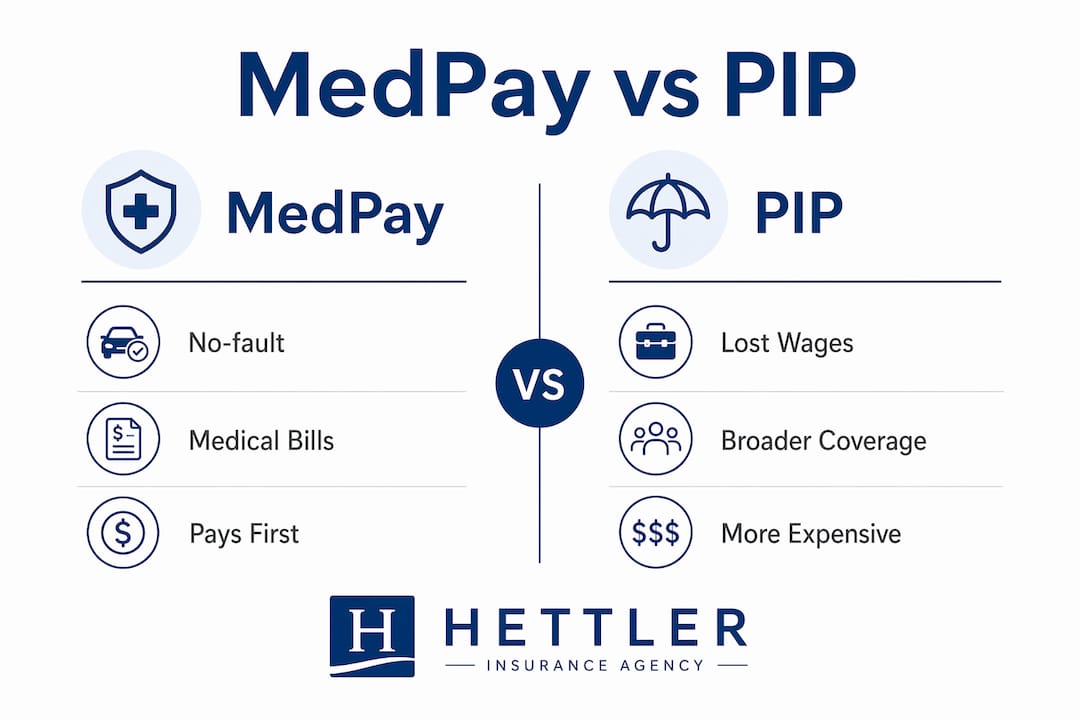
| It differs from PIP | MedPay covers medical bills only; PIP also covers lost wages and household services in Texas. |
| Cost is low | Adding $5,000 in MedPay coverage typically costs $5 to $10 per month on an auto policy. |
| Verify your declarations page | Many Texas drivers assume they have MedPay or PIP without confirming which coverage is actually active. |
What is medical payments coverage and how does it work in Texas auto insurance?
MedPay is defined as a first-dollar medical expense coverage that activates immediately after a car accident, with no fault determination required. According to MoneyGeek, MedPay covers all vehicle occupants and even pedestrians or cyclists struck by your vehicle. That scope is broader than most Texas drivers realize.
Here is what MedPay typically pays for after an accident:
- Ambulance and emergency medical transport
- Emergency room treatment and hospital stays
- Surgery and anesthesia costs
- X-rays, MRIs, and diagnostic imaging
- Follow-up doctor visits and physical therapy
- Dental treatment caused by the accident
- Funeral expenses in fatal accidents
MedPay pays medical bills before your health insurance processes claims, which means it can cover your deductible and copays on the spot. For a family with a $3,000 health insurance deductible, that timing matters enormously. You are not waiting weeks for a liability determination or a health insurance reimbursement while medical bills stack up.
Coverage limits typically range from $1,000 to $10,000, and adding $5,000 in MedPay may cost as little as $5 to $10 extra per month. That is a low premium for meaningful immediate protection.

Texas is not a no-fault state, so MedPay fills a role that PIP fills in states like Florida or Michigan. In Texas, insurers must offer PIP with a minimum of $2,500 per person, but MedPay is optional and narrower, focused solely on medical expenses. You can reject PIP in writing and carry MedPay instead, or carry both. Check your auto policy declarations page to confirm exactly what you have.
Pro Tip: If your health insurance carries a high deductible, adding $5,000 in MedPay coverage for roughly $5 to $10 per month is one of the most cost-effective ways to reduce your out-of-pocket exposure after an accident.
Medical payments coverage in homeowners insurance: what it covers and why it matters
MedPay in a homeowners policy, formally called Coverage F, operates on the same no-fault principle as auto MedPay. Homeowners MedPay reimburses medical expenses for guests injured on your property, regardless of whether you were legally at fault. This is a detail that catches many Texas homeowners off guard.
Consider these common scenarios where homeowners MedPay pays:
- A neighbor slips on your wet porch steps and needs stitches.
- A child attending a birthday party at your home breaks a wrist on a trampoline.
- A delivery driver trips on an uneven walkway and requires an ER visit.
- A guest burns a hand on your outdoor grill during a cookout.
- A contractor cuts a hand while doing minor work on your property.
In each case, MedPay steps in to pay the injured person’s medical bills directly, without requiring them to file a lawsuit or prove negligence. This is the key distinction from liability coverage. Liability coverage under a homeowners policy pays when you are found legally responsible for someone’s injury. MedPay pays regardless of fault, which means it handles smaller claims quickly and quietly, often preventing them from escalating into liability disputes.
Homeowners MedPay limits are typically lower than auto MedPay, often ranging from $1,000 to $5,000. That is not enough to cover a major injury, but it handles the minor incidents that happen most often. The real value is in preventing a neighbor’s $800 ER bill from becoming a $50,000 lawsuit because no one addressed it promptly.
Comparing medical payments coverage with PIP, liability, and health insurance
Understanding MedPay requires placing it alongside the other coverages it interacts with. The differences are specific and consequential for Texas families.
| Coverage Type | Who It Covers | What It Pays | Fault Required? | Lost Wages? |
|---|---|---|---|---|
| MedPay (auto) | You, passengers, pedestrians | Medical bills only | No | No |
| PIP (Texas) | You and passengers | Medical bills + lost wages + household services | No | Yes |
| Bodily injury liability | Other parties you injure | Their medical bills and damages | Yes (you at fault) | Yes (theirs) |
| Health insurance | You and covered dependents | Medical bills after deductible/copay | No | No |
.
MedPay does not cover lost wages or rehabilitation costs, which fall under PIP in Texas. PIP is broader but also more expensive. MedPay is the leaner option for families who have solid health insurance and primarily want immediate bill coverage after an accident.
Bodily injury liability is a separate category entirely. It protects you from claims made by people you injure. It does not pay your bills or your passengers’ bills. MedPay does. That distinction is why carrying MedPay alongside liability coverage makes sense even when you have strong liability limits.
When MedPay and health insurance overlap, MedPay typically pays first. MedPay coordinates with PIP in some policies to avoid double payment, so if you carry both, your insurer will apply them in a specific order. Ask your agent to clarify that sequence before an accident happens, not after.
Pro Tip: If you rejected PIP when you purchased your Texas auto policy, confirm whether MedPay was added in its place. Many Texas drivers confuse MedPay with PIP and assume they have broader coverage than they actually do. Pull your declarations page and read both sections.
Is medical payments coverage worth it for Texas homeowners and families?
MedPay is a valuable and affordable supplement for families with higher health insurance deductibles or anyone who wants immediate medical bill coverage without waiting for fault determinations. The cost-to-benefit ratio is strong for most Texas households.
Who benefits most from carrying MedPay:
- Families with children who are frequently in vehicles or hosting other kids at home
- Drivers with high-deductible health plans who face significant out-of-pocket costs before insurance kicks in
- Homeowners who entertain frequently and want to handle guest injuries without liability disputes
- Households without PIP who need some form of no-fault medical coverage on their auto policy
- Seniors or individuals with chronic conditions who want faster access to medical bill payment after accidents
MedPay does have real limitations. It does not pay for lost income if an accident keeps you out of work. It does not cover household services like childcare or cleaning if you are incapacitated. Coverage caps mean a serious accident will exhaust MedPay quickly, leaving health insurance to handle the remainder. For families with very low health insurance deductibles and strong PIP coverage, MedPay may add less value.
A common misconception is that MedPay is redundant if you have health insurance. It is not. Health insurance does not pay ambulance bills instantly. It does not cover your passengers. It does not apply to guests injured in your home. MedPay fills those specific gaps at a low monthly cost. Review your Texas auto insurance checklist to see how MedPay fits into your full coverage picture.
What I have learned advising Texas families on MedPay
After years of reviewing insurance policies with Texas homeowners and families, the pattern I see most often is this: people assume they are covered until they are not. A client will come in after an accident, certain they had PIP, only to discover they signed a rejection form years ago and never replaced it with MedPay. That gap costs real money.
The Texas-specific insurance rules around PIP and MedPay create genuine confusion. Insurers are required to offer PIP, but you can reject it in writing. Many people do, often to save a few dollars on their premium, without understanding what they are giving up. MedPay is the logical replacement if you reject PIP, but it is not automatic. You have to ask for it.
My advice is direct: pull your declarations page today. Look for MedPay or Coverage F on your homeowners policy and MedPay or PIP on your auto policy. If neither appears, you have a gap worth closing. For most Texas families, adding $5,000 in MedPay to both policies costs less than a dinner out each month. The protection it provides in the first hours after an accident, when bills are arriving and fault has not been determined, is worth far more than that.
Do not wait until after an accident to understand your coverage. Call your agent, ask the specific question, and get a straight answer in writing.
— Ron Hettler
How Hettler Insurance Agency helps Texas families choose the right coverage

Hettler Insurance Agency has served Texas homeowners and families since 1992, and MedPay questions are among the most common we field. As an independent agency representing over 30 top-rated carriers, we compare policies across providers to find coverage that fits your actual situation, not a generic package. Whether you need MedPay added to an existing auto policy, want to review your homeowners Coverage F limits, or are starting from scratch, our team walks you through every option without pressure. Ron and Meghan Hettler are both Certified Insurance Counselors, and that credential means you get expert guidance, not a sales pitch. Review your coverage options with Hettler and make sure your family is protected before the next accident happens.
About the Author
Ronald J. Hettler, CIC is a Certified Insurance Counselor (CIC) [the gold-standard credential in the independent insurance industry]. Ron has over 46 years of real-world experience in the insurance industry. He is the owner/president of Hettler Insurance Agency in Lubbock, Texas and is licensed by the Texas Department of Insurance (License #666862). (Why Trust Hettler Insurance Agency? It’s a Local independent insurance agency representing multiple carriers. Hettler Insurance Agency has established business roots going back to it’s predecessor in the late 1800’s. Local expertise in Lubbock Texas and West Texas risks. Focused on clarity before a claim occurs.) Ron and his daughter Meghan, also a CIC, lead a team that represents 30+ carriers and serves clients across Texas.
Ron specializes in helping individuals, families, and small business owners understand complex insurance concepts in clear, practical terms so they can make informed decisions about their coverage. He specializes in helping individuals and families understand coverage gaps, deductible structures, and real-world claim outcomes before a loss occurs. Ron helps you to understand how insurance policies respond in real-world claim situations.
License verification available through the Texas Department of Insurance.
Frequently Asked Questions ?
Q1 ?: What does medical payments coverage pay for?
Q2 ?: Does my Texas auto policy include medical payments coverage?
Q3 ?: How is MedPay different from PIP in Texas?
Q4 ?: Does homeowners insurance include medical payments coverage?
Q5 ?: Can I have both MedPay and health insurance?
— Life Insurance Instant Quote and Apply Tool @ GetLifePolicy.com > * Quick self-service term life insurance quote. With or without medical exam.
— Call us about Auto, Home, Business, Life, or Health insurance. * Click to Call (806) 798-7800, Mon-Fri 8:30am-5pm (lunch closed Noon-1pm)
— Come see us @ our new address 4720 S Loop 289 Lubbock, TX 79414 (maps link), or get your online quote started at https://GetHettler.com