
TL;DR summary:
- Texas has a high uninsured rate due to limited Medicaid expansion and complex coverage options.
- Health plans in Texas vary widely, with subsidies making coverage affordable for many but not all.
- Insurance covers medical treatment after disasters, but property damage requires separate flood insurance.
Texas leads the nation with a 16.7% uninsured rate, meaning millions of Texans are one accident or illness away from financial disaster. For first-time buyers, the confusion runs deep. What does health insurance actually cover? What happens after a hurricane floods your neighborhood? How do you know if you’re overpaying? These are real questions we hear from Texans every day. This guide walks you through how health insurance works in Texas, what it costs, how to pick the right plan, and exactly what it covers and doesn’t cover when disaster strikes.
Table of Contents
- How health insurance works in Texas
- Understanding premiums, subsidies, and costs
- Key plan types, enrollment rules, and edge cases
- What health insurance covers (and doesn’t) in Texas
- A fresh perspective: The real hurdles for Texans seeking health insurance
- Get expert help choosing health insurance in Texas
- Frequently asked questions
Key Takeaways
| Point | Details |
|---|---|
| ACA coverage is key | Most Texans get health insurance through the ACA Marketplace, employer plans, or direct policies. |
| Subsidies make plans affordable | Over 83% of Texans enrolling use premium subsidies to reduce monthly costs. |
| Disaster risks need extra protection | Health insurance covers medical treatment after floods or hurricanes, but you need separate flood insurance for property losses. |
| Plan choice and timing matter | Enrollment windows and plan types affect access, costs, and network coverage for Texans. |
| Understand your plan limits | Out-of-pocket maximums, referrals, and network restrictions are often overlooked but drive costs and access. |
How health insurance works in Texas
Texas has a unique insurance landscape. Unlike many states, Texas does not run its own health insurance marketplace and has not expanded Medicaid under the Affordable Care Act (ACA). That means coverage options and eligibility rules here are different from what you might read in a national guide.
Here are the main ways Texans get health insurance:
- Federal Marketplace (Healthcare.gov): Open to individuals and families who don’t have employer coverage. Subsidies are available based on income.
- Employer group plans: The most common source of coverage for working-age Texans. Employers typically pay a portion of the premium.
- Direct individual policies: Purchased directly from an insurer, outside the Marketplace. These don’t qualify for subsidies.
- Medicaid and CHIP: Available for low-income children, pregnant women, and some disabled adults. Texas has not expanded Medicaid to cover low-income adults broadly.
- Short-term and catastrophic plans: Limited coverage options for specific situations, such as young adults or those between jobs.
Because Texas did not expand Medicaid, a significant coverage gap exists. Adults earning too much for Medicaid but too little to qualify for ACA subsidies can fall through the cracks. This is one reason Texas consistently ranks last in coverage rates. Nearly 4 million Texans enrolled in ACA Marketplace plans in 2025, a record high, but millions more remain uninsured.
| Plan type | Who it’s for | Subsidies available | Network flexibility |
|---|---|---|---|
| ACA Marketplace | Individuals/families | Yes | Varies by plan |
| Employer group plan | Employees | Employer contributes | Usually broad |
| Direct individual | Anyone | No | Varies |
| Short-term plan | Gaps in coverage | No | Limited |
| Catastrophic plan | Under 30 or hardship | No | Limited |
Choosing the right carrier matters just as much as choosing the right plan type. When comparing Texas insurance carriers, look at network size, financial strength ratings, and customer service records before committing.
Understanding premiums, subsidies, and costs
Once you know your options, it’s critical to understand what you’ll pay and how to maximize value. Health insurance costs in Texas are driven by several factors, and knowing them helps you budget accurately.
What drives your premium:
- Age: Older applicants pay more. A 60-year-old can pay up to three times what a 21-year-old pays for the same plan.
- Location: Premiums vary by county. Urban areas like Dallas may have more competition and lower rates than rural West Texas.
- Tobacco use: Insurers can charge tobacco users up to 50% more.
- Family size: Adding dependents increases your total premium, though subsidies scale with family size too.
Premiums depend on age, location, and tobacco use, and 83% of ACA enrollees in Texas use subsidies to lower their costs. The average Silver HMO plan in Texas runs about $610 per month before subsidies. With subsidies, many Texans pay far less, and some pay $0.

Subsidies are available for incomes between 100% and 400% of the federal poverty level (FPL). For 2026, that’s roughly $15,000 to $60,000 for a single adult. Enhanced tax credits introduced in recent years have made coverage more affordable, but those credits are subject to federal policy changes. If they expire, some Texans could see premium increases of up to 114%.
| Annual income (single adult) | Estimated monthly premium (Silver plan) | Estimated subsidy |
|---|---|---|
| $20,000 | $610 | ~$500 |
| $35,000 | $610 | ~$300 |
| $50,000 | $610 | ~$150 |
| $65,000 | $610 | $0 |
Statistic to know: 83% of Texas ACA enrollees receive subsidies, and many qualify for plans under $50/month.
Understanding open enrollment importance is essential. Missing the enrollment window means waiting until the next cycle unless you qualify for a special enrollment period. The historical context of Texas coverage shows how much the landscape has shifted, and staying current matters.
Pro Tip: Use the Healthcare.gov subsidy estimator before you shop. If your estimated subsidy brings your premium to $0, you still need to formally enroll to activate coverage.
Key plan types, enrollment rules, and edge cases
With pricing understood, it’s important to know how to pick a plan and when you can enroll. Not all health plans work the same way, and the differences can cost you significantly if you choose the wrong type.
The four main plan types:
- HMO (Health Maintenance Organization): Requires you to choose a primary care physician (PCP) and get referrals for specialists. Only covers in-network care except in emergencies. Generally lower premiums.
- PPO (Preferred Provider Organization): More flexibility. You can see specialists without referrals and use out-of-network providers, though at a higher cost. Higher premiums.
- EPO (Exclusive Provider Organization): Similar to an HMO but without the referral requirement. No out-of-network coverage except emergencies.
- Catastrophic plan: Very high deductibles with low premiums. Available to adults under 30 or those with a hardship exemption. Not eligible for subsidies.
Key cost terms you need to know:
- Deductible: What you pay out of pocket before insurance kicks in.
- Copay: A fixed fee for a specific service, like $30 for a doctor visit.
- Coinsurance: Your share of costs after meeting your deductible, usually 20-30%.
- Out-of-pocket maximum: The most you’ll pay in a year. After this, insurance covers 100%.
All ACA plans cover preventive care at no cost, including annual checkups, screenings, and vaccines. Insurers cannot deny coverage for pre-existing conditions under ACA Marketplace plans. That’s a protection worth understanding before you buy.
Enrollment windows:
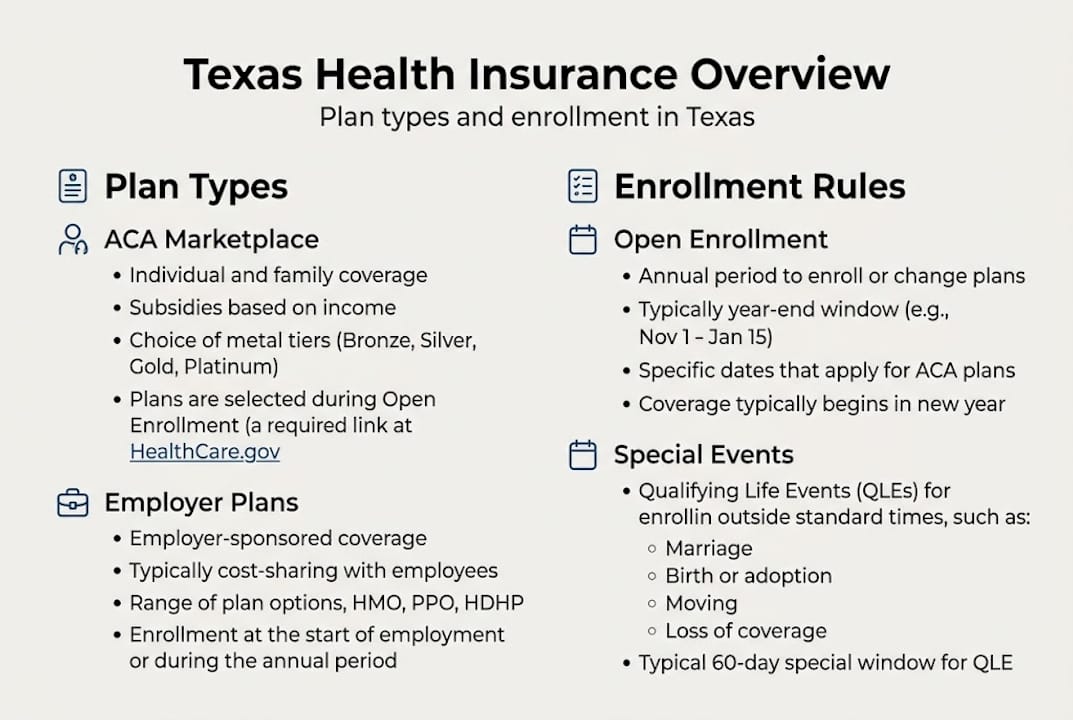
Open enrollment typically runs November through January. Outside of that, you can only enroll if you have a qualifying life event. Job loss, marriage, divorce, and having a baby all trigger a 31-day special enrollment window. If you’re under 26, staying on a parent’s plan is often the most affordable option.
“The ACA has expanded access for millions of Texans, but the lack of Medicaid expansion continues to leave low-income adults without affordable options.”
Understanding open enrollment impact before a life event happens saves you from scrambling. Also review minimum insurance requirements if you’re self-employed or running a small business.
Pro Tip: Short-term plans are cheap but dangerous. They can deny claims for pre-existing conditions and don’t meet ACA standards. Use them only as a true bridge, not a long-term solution.
What health insurance covers (and doesn’t) in Texas
Finally, let’s dispel confusion about what health insurance really covers during Texas disasters and what additional protection is needed. This is where many Texans make costly assumptions.
Health insurance covers:
- Emergency room visits and hospitalization after a disaster
- Treatment for injuries sustained during a hurricane, flood, or tornado
- Infections, respiratory illness, or mold-related health conditions after flooding
- Mental health treatment, including disaster-related trauma and PTSD
- Follow-up care and prescription medications
Health insurance does NOT cover:
- Damage to your home or personal property from a flood or hurricane
- Temporary housing or relocation costs
- Replacement of lost belongings
- Structural repairs to your home
Health insurance does not cover weather-related property losses. Standard homeowners policies also exclude flood damage. You need a separate flood insurance policy, typically through the National Flood Insurance Program (NFIP), to protect your property.
This distinction matters more in Texas than almost anywhere else. Hurricane season floods occur even in areas considered low-risk, and many Texans discover too late that their homeowners policy doesn’t cover the water damage. Your health plan will pay your medical bills after the storm. It won’t rebuild your house.
Post-disaster health risks are real and often underestimated. Mold exposure after flooding can cause serious respiratory problems. Standing water breeds bacteria and disease. Injuries during cleanup are extremely common. Your health insurance is your financial protection for all of those medical costs, but only if you’re enrolled before the disaster happens.
Learn more about how climate change and insurance intersect in Texas, and consider reviewing your homeowners policy coverage alongside your health plan. If you’re unsure whether your property sits in a flood zone, check out our floodplain insurance guide for Lubbock homeowners and business owners.
A fresh perspective: The real hurdles for Texans seeking health insurance
Most guides stop at the facts. Here’s what they miss.
Texas health insurance is genuinely harder to navigate than in most states. The absence of Medicaid expansion creates a gap that leaves roughly 800,000 low-income adults without any realistic coverage option. That’s not a technicality. That’s people skipping care because they can’t afford it.
The ACA expanded access significantly, but subsidy expiration threatens to reverse those gains. Many buyers don’t realize their current premium is artificially low because of enhanced credits. When those credits change, the sticker shock is real.
The most common mistakes we see buyers make:
- Choosing a plan based only on the monthly premium, ignoring the out-of-pocket maximum
- Assuming a short-term plan provides the same protection as an ACA plan
- Not checking whether their preferred doctors are in-network before enrolling
- Misunderstanding disaster exclusions and assuming health insurance covers everything
Working with an independent agent who can compare Texas providers across multiple carriers gives you a real advantage. You get honest comparisons, not a pitch for one company’s product.
Pro Tip: Always ask about the out-of-pocket maximum, not just the premium. A $200/month plan with a $9,000 out-of-pocket maximum can cost you far more than a $350/month plan with a $3,000 cap if you actually use your coverage.
Get expert help choosing health insurance in Texas
Navigating Texas health insurance on your own is possible, but it’s easy to make an expensive mistake. The wrong plan type, a missed enrollment window, or a misunderstood exclusion can cost you thousands.

At Hettler Insurance Agency, we’ve been helping Texans find the right coverage since 1992. As an independent agency, we compare plans across more than 30 carriers to find the right fit at the right price. Whether you’re buying health insurance for the first time, reviewing your current plan, or trying to understand minimum insurance essentials for your small business, we’re here to help. Visit Hettler Insurance to request a consultation or get a personalized plan comparison. No pressure. No jargon. Just honest guidance from a family-owned agency that puts your coverage first.
Frequently asked questions
How do I know if I qualify for subsidies in Texas?
Texans qualify for ACA subsidies if their income falls between 100% and 400% of the federal poverty level, roughly $15,000 to $60,000 annually for a single adult. 83% of Texas ACA enrollees currently use these subsidies to reduce their premiums.
Does Texas health insurance cover hurricane or flood damage?
No. Health insurance covers medical treatment after a disaster, such as injuries, infections, and trauma care, but it does not cover property loss. Flood damage requires a separate flood insurance policy, typically through the NFIP.
Can I get coverage if I have pre-existing conditions?
Yes. ACA Marketplace plans cannot deny coverage or charge higher premiums based on pre-existing conditions. This protection applies to all plans sold through Healthcare.gov in Texas.
What’s the difference between HMO, PPO, and EPO plans?
HMOs require referrals and limit you to in-network care, PPOs allow you to see any provider with broader out-of-network access, and EPOs skip the referral requirement but still restrict you to in-network providers only.
How can I keep my premiums low in Texas?
Compare plans every year during open enrollment, confirm your subsidy eligibility, and consider a high-deductible plan if you’re generally healthy and expect low medical costs. Premiums vary widely by county, so shopping across options is essential.
About the Author
Ronald J. Hettler, CIC is a Certified Insurance Counselor (CIC) [the gold-standard credential in the independent insurance industry]. Ron has over 46 years of real-world experience in the insurance industry. He is the owner/president of Hettler Insurance Agency in Lubbock, Texas and is licensed by the Texas Department of Insurance (License #666862). (Why Trust Hettler Insurance Agency? It’s a Local independent insurance agency representing multiple carriers. Hettler Insurance Agency has established business roots going back to it’s predecessor in the late 1800’s. Local expertise in Lubbock Texas and West Texas risks. Focused on clarity before a claim occurs.) Ron and his daughter Meghan, also a CIC, lead a team that represents 30+ carriers and serves clients across Texas.
Ron specializes in helping individuals, families, and small business owners understand complex insurance concepts in clear, practical terms so they can make informed decisions about their coverage. He specializes in helping individuals and families understand coverage gaps, deductible structures, and real-world claim outcomes before a loss occurs. Ron helps you to understand how insurance policies respond in real-world claim situations.
License verification available through the Texas Department of Insurance.
Frequently Asked Questions (expanded) ?
Q1 ?: How do I know if I qualify for ACA subsidies in Texas?
Q2 ?: Does Texas health insurance cover hurricane or flood damage?
Q3 ?: Can I be denied coverage for pre-existing conditions in Texas?
Q4 ?: What’s the difference between HMO, PPO, and EPO plans?
Q5 ?: How can I keep my health insurance premiums low in Texas?
— Life Insurance Instant Quote and Apply Tool @ GetLifePolicy.com > * Quick self-service term life insurance quote. With or without medical exam.
— Call us about Auto, Home, Business, Life, or Health insurance. * Click to Call (806) 798-7800, Mon-Fri 8:30am-5pm (lunch closed Noon-1pm)
— Come see us @ our new address 4720 S Loop 289 Lubbock, TX 79414 (maps link), or get your online quote started at https://GetHettler.com