

TL;DR summary:
- Missing the right insurance or bonds can lead to lost bids, delayed payments, or personal asset exposure for Texas contractors. Understanding core policies like commercial general liability, workers’ compensation, and bonding requirements is crucial for legal compliance and business protection. Proactive management, including verifying endorsements and maintaining active coverage, is essential for sustained success and avoiding costly claims.
If you are a contractor in Texas, missing the right insurance or bond can cost you a bid, delay payment, or expose your personal assets to a lawsuit. Texas has its own set of rules governing contractor insurance and bonding requirements, and those rules change depending on whether your project is public or private, how large the contract is, and what your trade involves. This guide breaks down exactly what you need, when you need it, and how to stay compliant so you can focus on the work instead of the paperwork.
Table of Contents
- Core insurance policies every Texas contractor must know
- Bonding requirements: Performance, payment, and mechanics’ lien bonds
- Side-by-side: Insurance versus bonds for Texas contractors
- Expert recommendations: Navigating state rules and contracts
- The real decision: Compliance isn’t just paperwork—it’s business survival
- Get expert support for your Texas contractor insurance needs
- Frequently asked questions
Key Takeaways
| Point | Details |
|---|---|
| Coverage is project-specific | Texas contractor insurance and bonding needs vary by project type, value, and owner demands. |
| Bonds protect clients, insurance protects you | Bonds guarantee obligations to owners and suppliers; insurance covers your business from loss or liability. |
| State law defines minimums | The Texas Insurance Code and Property Code specify key requirements for valid policies and bonds. |
| Missing compliance can cost you | Failing to meet insurance or bond rules leads to contract loss, legal action, or payment delays. |
| Agent support is key | Working with an experienced agent ensures your policies and endorsements match contract requirements. |
Core insurance policies every Texas contractor must know
With so much riding on every contract, understanding each core insurance type is step one toward protecting your business and staying eligible for work across Texas.
Commercial general liability
Commercial General Liability (CGL) insurance is the foundation of contractor coverage. It protects you if a third party, meaning a client, visitor, or property owner, suffers bodily injury or property damage because of your operations. Most project owners, general contractors, and government agencies will not even let you on the job site without proof of CGL coverage.
Here is what CGL typically covers for Texas contractors:
- Bodily injury: A subcontractor’s injury attributed to your work area, or a homeowner tripping over your equipment
- Property damage: Accidentally breaking a water line or damaging a neighboring structure during your work
- Personal and advertising injury: Defamation claims or copyright issues arising from business operations
- Legal defense costs: Attorney fees and court costs, even if you are found not at fault
One area that trips up many contractors is the concept of endorsements and additional insured status. An endorsement is a written modification to your base policy that adds, removes, or changes coverage. An “additional insured” is a person or entity, usually a property owner or general contractor, added to your policy so they share protection under it. Most commercial contracts will require you to add the project owner as an additional insured before work begins.
Texas uses the Insurance Code and Texas Department of Insurance (TDI) framework to govern approved policy forms and endorsements, including how additional insured provisions interact with construction contract practices. This matters because not every endorsement wording satisfies every contract. Some contracts specify ISO (Insurance Services Office) form language. Others require broader additional insured coverage that extends to completed operations. If your endorsement does not match what the contract demands, you may be in default before a single nail is driven.
Pro Tip: Before you sign any contract, have your agent pull the actual policy endorsement language and compare it to the contract’s insurance exhibit. A mismatch in wording can void your additional insured status entirely. Read more on insurance needs before signing contracts before your next bid.
Workers’ compensation
Texas is the only state that does not legally require most private employers to carry workers’ compensation insurance. However, “optional” does not mean “risk-free.” If you opt out and one of your employees is injured on the job, you lose statutory protections and can be sued directly. Many public sector projects and large general contractors require workers’ comp as a condition of working on their sites.
Review insurance compliance for Texas contractors for a full breakdown of how workers’ comp decisions affect your bid eligibility and legal exposure.
For specialty trades like roofing, the stakes are especially high given the physical risks involved. Check the specific insurance for roofing contractors to understand what coverage roofing firms typically carry and what clients expect.
Bonding requirements: Performance, payment, and mechanics’ lien bonds
Once you know which basic policies you need, your next hurdle is meeting various bonding standards that apply to Texas construction work.
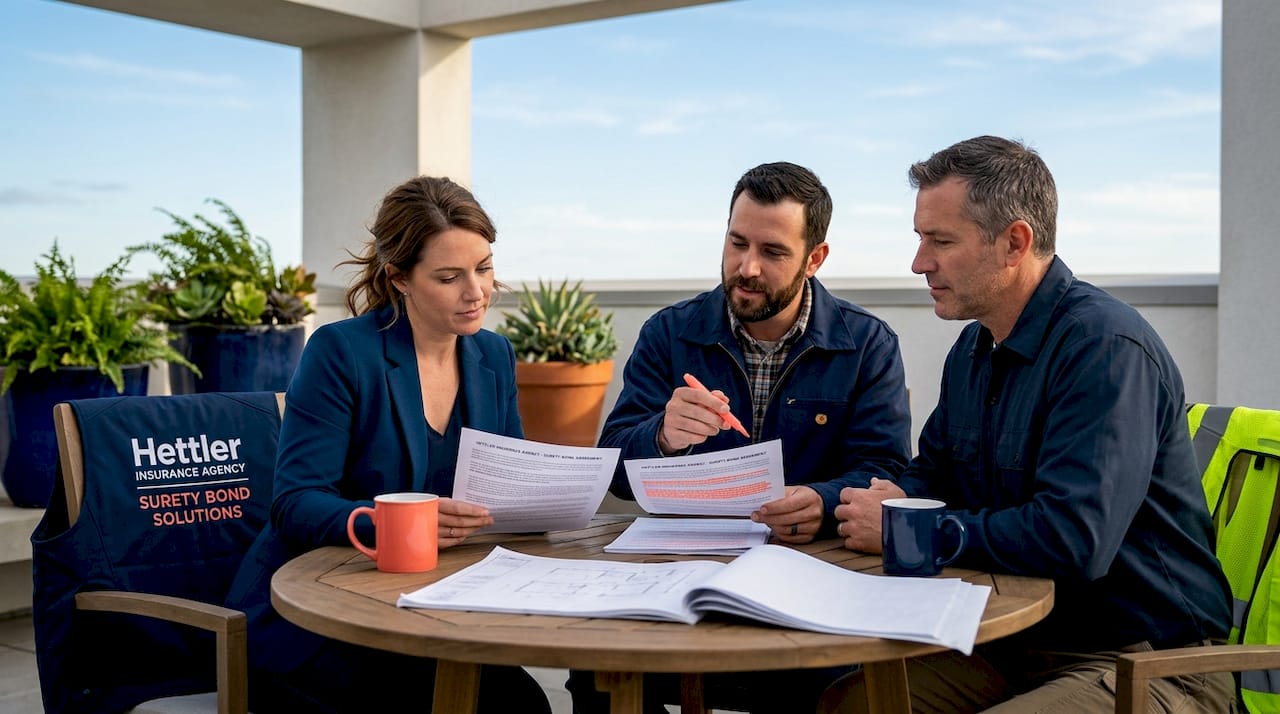
Bonds are not insurance. They are financial guarantee instruments issued by a surety company (the bond provider) on your behalf. If you fail to perform, the surety pays the claim and then seeks reimbursement from you. That is a critical distinction.
Texas construction bonding requirements vary significantly by project type and contract value. Here is a quick overview of the three most common bond types you will encounter:
The three main bond types explained
- Performance bond: Guarantees you will complete the project according to contract terms. Required for most Texas public works contracts and triggered by specific contract dollar thresholds under the Texas Government Code. If you abandon the job or fail to perform, the project owner can call the bond and the surety steps in to complete or compensate.
- Payment bond: Guarantees that subcontractors, suppliers, and workers get paid. On government contracts, this bond protects parties who cannot file a mechanics’ lien against public property. The Texas Government Code sets the thresholds at which payment bonds become mandatory on public works.
- Mechanics’ lien release bond: Used on private projects when a lien has already been filed against a property. The contractor or property owner “bonds around” the lien, meaning they substitute the bond for the lien so the property can be sold or refinanced while the dispute is resolved. Under the Texas Property Code, the bond amount rules require the bond to equal double the lien amount. If liens exceed $40,000, an alternative formula applies, and the bond must be conditioned payable to the lien claimants.
| Bond type | When required | Who is protected | Amount formula |
|---|---|---|---|
| Performance bond | Public works above threshold | Project owner / agency | Typically 100% of contract value |
| Payment bond | Public works above threshold | Subs, suppliers, workers | Typically 100% of contract value |
| Mechanics’ lien release | After lien filed on private job | Lien claimants | Double lien amount (or formula for amounts over $40,000) |
.
Pro Tip: Get bonding capacity established with your surety provider before you need it. Waiting until a bid is due to request a bond can delay your submission or result in unfavorable pricing. Visit our Texas surety bonds overview to understand the bonding process from start to finish.
For trade-specific bonding details, including what plumbing contractors are typically required to carry, see the bond requirements for plumbing contractors resource.
Side-by-side: Insurance versus bonds for Texas contractors
With the basics down, let us clear up the confusion between insurance and bonds by comparing their protections and obligations directly.
This is one of the most misunderstood areas in contractor compliance. Many contractors assume that having insurance means they are also covered for bonding requirements. They are separate instruments with different purposes, different claim processes, and different legal consequences.
| Feature | Insurance | Surety bond |
|---|---|---|
| Who is primarily protected | Your business (and third parties) | Project owner, agency, or claimants |
| Who pays a claim | Insurance carrier (no repayment from you) | Surety pays first, then collects from you |
| Purpose | Cover losses from accidents or liability | Guarantee contract performance or payment |
| Underwriting based on | Business risk and loss history | Your financial strength and credit |
| Claim triggers | Accident, injury, property damage | Contract default, nonpayment, lien filing |
.
Here is a practical example. Suppose your crew accidentally damages a client’s building during an HVAC installation. Your CGL insurance responds by paying for the repair and legal defense. You do not owe the insurer back. Now suppose you take on a public school renovation and fail to pay your steel supplier. The payment bond responds, the surety pays the supplier, and then the surety comes after you for the full amount. Two very different outcomes.
Key point: Insurance absorbs losses. Bonds guarantee obligations. Both protect others, but only insurance actually shields your business from out-of-pocket costs after a claim.
On bonded public projects, a payment bond can substitute for property security from the standpoint of claimants. For lien-release bonding, the Texas Property Code sets specific math and conditioning requirements that must be followed precisely or the bond will not be effective. Landscaping contractors working on private residential properties should also understand mechanics’ lien protections for landscaping contractors and when bonding may apply.
Expert recommendations: Navigating state rules and contracts
Understanding the differences is key, but real-world compliance means smart, proactive policy and contract management every time you take on a job.
Here is a step-by-step process we recommend to every Texas contractor before signing any contract:
- Read the insurance exhibit carefully. Most commercial and public contracts include a dedicated section listing minimum liability limits, required endorsements, and acceptable policy forms. Do not assume your existing policy meets those requirements automatically.
- Identify all required endorsements. Common endorsements required by Texas contracts include additional insured (ongoing operations and completed operations), waiver of subrogation (which prevents your insurer from suing the project owner after paying your claim), and primary and noncontributory language (meaning your policy pays first, before the owner’s coverage kicks in).
- Request state-approved policy wording from your agent. The TDI framework for approved forms governs which endorsements are valid in Texas. Your agent should be able to pull the ISO form numbers or Texas-specific language required by the contract and confirm your policy matches.
- Verify your certificate of insurance (COI) accuracy. A COI is the document you hand to project owners as proof of coverage. But a COI does not guarantee the endorsements are actually attached to your policy. Always have your agent confirm the endorsements are live, not just listed on the certificate.
- Track renewal dates and notify clients proactively. If your policy lapses mid-project, you may be in breach of contract. Set calendar reminders 60 days before renewal and loop in your agent early to avoid gaps.
- Document everything in writing. Verbal confirmations from agents or project owners mean nothing in a dispute. Get endorsement confirmations, COI approvals, and bond approvals in writing.
Pro Tip: Ask your agent about additional insured provisions explained and how waiver of subrogation endorsements interact. Missing one of these can expose you to contract liability even when your policy is technically active.
The real decision: Compliance isn’t just paperwork—it’s business survival
Here is the uncomfortable truth that years of working with Texas contractors has made clear: most compliance failures are not caused by ignorance. They are caused by rushing.
Contractors bid jobs under pressure. Insurance decisions get made in minutes because the deadline is tomorrow. Then a project owner rejects the COI because the endorsement language is wrong. Or a mechanics’ lien gets filed because a subcontractor was not paid on time and there was no payment bond in place. These situations are almost always preventable.
Many small Texas businesses treat insurance as a box to check when they first get licensed and then forget about it. The policy sits in a drawer. Limits never get updated. Endorsements get added to one job’s COI but not actually attached to the policy. Then a real claim happens, and the contractor finds out the hard way that their coverage had a gap.
The contractors who consistently win bids, keep clients, and survive disputes are the ones who treat insurance and bonding as an active, ongoing part of their business operations. They call their agent before signing, not after. They review their coverage at every renewal cycle. They know their limits, their endorsements, and their bond capacity before a project owner ever asks.
There is also a financial reality that often gets overlooked. Bidding work without proper insurance can result not just in legal action but in being removed from approved vendor lists for major project owners. Once that happens, rebuilding your reputation takes years. The cost of getting the right coverage is almost always far less than the cost of a single compliance failure.
Get expert support for your Texas contractor insurance needs
You have done the reading. Now it is time to make sure your actual policies and bonds match what Texas law and your contracts require.

At Hettler Insurance Agency, we have been helping Texas contractors get the right coverage since 1992. Ron and Meghan Hettler are both Certified Insurance Counselors (CIC), and our team represents over 30 top-rated carriers so we can shop your coverage and find the right fit at the right price. Whether you need to understand Texas contractor insurance minimums or you are ready for a full policy and bond review before your next big bid, we are here to help. No pressure. No jargon. Just straight answers from people who know Texas construction. Contact Hettler Insurance Agency today to get started.
Frequently asked questions
Is general liability insurance required by law for all Texas contractors?
General liability is not legally mandated for all Texas contractors, but most project owners and public agencies require it as a condition of bidding or working on any commercial job. The TDI framework governs approved policy forms for CGL coverage in Texas.
What triggers the need for a performance or payment bond in Texas?
Performance and payment bonds are generally triggered when a public works contract exceeds dollar thresholds set by the Texas Government Code. Texas public works bonding requirements vary by project type, so check the threshold for your specific contract.
How is the amount for a Texas mechanics’ lien release bond calculated?
The Texas Property Code requires the bond to equal double the lien amount for smaller liens, and a separate formula applies when the total liens exceed $40,000. The bond must also be conditioned payable to the lien claimants.
Do I need both insurance and bonds for private residential jobs?
Insurance is almost always required for private residential work. Bonds are generally only needed if a mechanics’ lien is filed or the contract specifically requires bonding. Texas bonding rules for private jobs are distinct from public works requirements.
Who should be listed as an additional insured on my contractor policy?
Project owners and general contractors typically require additional insured status under your CGL policy to ensure protection during and after your work. The TDI-approved endorsement language governs how these provisions must be structured to be valid in Texas.
Recommended
About the Author
Ronald J. Hettler, CIC is a Certified Insurance Counselor (CIC) [the gold-standard credential in the independent insurance industry]. Ron has over 46 years of real-world experience in the insurance industry. He is the owner/president of Hettler Insurance Agency in Lubbock, Texas and is licensed by the Texas Department of Insurance (License #666862). (Why Trust Hettler Insurance Agency? It’s a Local independent insurance agency representing multiple carriers. Hettler Insurance Agency has established business roots going back to it’s predecessor in the late 1800’s. Local expertise in Lubbock Texas and West Texas risks. Focused on clarity before a claim occurs.) Ron and his daughter Meghan, also a CIC, lead a team that represents 30+ carriers and serves clients across Texas.
Ron specializes in helping individuals, families, and small business owners understand complex insurance concepts in clear, practical terms so they can make informed decisions about their coverage. He specializes in helping individuals and families understand coverage gaps, deductible structures, and real-world claim outcomes before a loss occurs. Ron helps you to understand how insurance policies respond in real-world claim situations.
License verification available through the Texas Department of Insurance.
Enhanced Frequently Asked Questions ?
Q1 ?: Is general liability insurance required by law for all Texas contractors?
Q2 ?: What triggers the need for a performance or payment bond in Texas?
Q3 ?: How is the amount for a Texas mechanics’ lien release bond calculated?
Q4 ?: Do I need both insurance and bonds for private residential jobs?
Q5 ?: Who should be listed as an additional insured on my contractor policy?
— Life Insurance Instant Quote and Apply Tool @ GetLifePolicy.com > * Quick self-service term life insurance quote. With or without medical exam.
— Call us about Auto, Home, Business, Life, or Health insurance. * Click to Call (806) 798-7800, Mon-Fri 8:30am-5pm (lunch closed Noon-1pm)
— Come see us @ our new address 4720 S Loop 289 Lubbock, TX 79414 (maps link), or get your online quote started at https://GetHettler.com