

TL;DR summary:
- Homeowners insurance in Texas covers your home, belongings, liability, and living expenses but excludes flood and earthquake damage. First-time buyers should base coverage on replacement costs and start shopping two to four weeks before closing to prevent delays. Choosing an independent agent helps you find tailored, comprehensive coverage suited for Texas weather risks.
Homeowners insurance is defined as a policy that protects your home’s structure, personal belongings, personal liability, and living expenses when a covered loss forces you out of your home. For first-time buyers in Texas, this coverage is not optional. Texas lenders require proof of homeowners insurance before your mortgage closes, covering dwelling, personal property, liability, and loss of use. The standard industry term for the most common policy type is the HO-3 policy, and understanding what it covers and what it excludes is the foundation of every smart first time homeowners insurance guide. Texas homes face hail, windstorms, and flooding at rates that make coverage decisions more consequential here than in most other states.
Table of Contents
- Key Takeaways
- What does homeowners insurance cover for new Texas homeowners?
- How do you choose the right coverage amounts and deductibles?
- How do you compare homeowners insurance premiums in Texas?
- What steps do first-time buyers need to take before closing?
- Why lender requirements are the floor, not the ceiling
- How Hettler Insurance Agency helps first-time Texas buyers get it right
- Frequently Asked Questions
Key Takeaways
First-time Texas homebuyers must base dwelling coverage on replacement cost, not purchase price, and secure their policy at least two to four weeks before closing to protect both their home and their mortgage approval.
| Point | Details |
|---|---|
| Base coverage on replacement cost | Insure what it costs to rebuild, not what you paid for the home. |
| Flood and wind need separate policies | Standard HO-3 policies exclude flood and windstorm damage in Texas. |
| Start shopping 2–4 weeks early | Late policy procurement can delay or cancel your mortgage closing. |
| Compare coverage details, not just price | Deductible structure and exclusions matter more than the annual premium alone. |
| Review your policy every year | Renovations and rising construction costs can leave you underinsured fast. |
.
What does homeowners insurance cover for new Texas homeowners?
A standard HO-3 policy covers four core areas. Each one protects a different part of your financial life as a homeowner.
- Dwelling coverage pays to repair or rebuild your home’s structure after a covered event like fire, hail, or wind damage. This is the coverage your lender cares about most.
- Personal property coverage protects your furniture, electronics, clothing, and other belongings. Standard limits apply, but you can add riders for high-value items like jewelry or musical instruments. Learn more about personal property protection and what it includes for Texas homeowners.
- Liability coverage pays legal costs and damages if someone is injured on your property or if you accidentally damage someone else’s property. A typical policy starts at $100,000 in liability limits, but many Texas homeowners carry $300,000 or more.
- Loss of use coverage (also called additional living expenses) pays for hotel stays, restaurant meals, and other costs if a covered loss makes your home temporarily uninhabitable.
Texas adds two critical exclusions that catch first-time buyers off guard. Standard HO-3 policies exclude flood and earthquake damage entirely. If your home sits in a flood zone, you need a separate policy through the National Flood Insurance Program (NFIP) or a private flood insurer. Coastal and Gulf-area homes may also require a separate windstorm policy through the Texas Windstorm Insurance Association (TWIA). These are not add-ons to your standard policy. They are entirely separate contracts with separate premiums and deductibles.
Pro Tip: Ask your agent specifically whether your address falls in a FEMA-designated flood zone before you close. Many West Texas buyers assume they are safe, but flash flooding affects areas far outside traditional flood plains.

How do you choose the right coverage amounts and deductibles?
Getting your coverage amounts right is the most consequential decision in this process. Most first-time buyers make the mistake of insuring their home for its purchase price or market value. That number is wrong for insurance purposes.
Replacement cost often exceeds market value because it reflects what it actually costs to rebuild your home today using current labor rates and materials. In Texas, construction costs have risen sharply in recent years. A home you bought for $280,000 might cost $380,000 or more to rebuild from the ground up. Basing your dwelling coverage on the purchase price leaves a six-figure gap that you would pay out of pocket.
Follow these steps to set coverage amounts correctly:
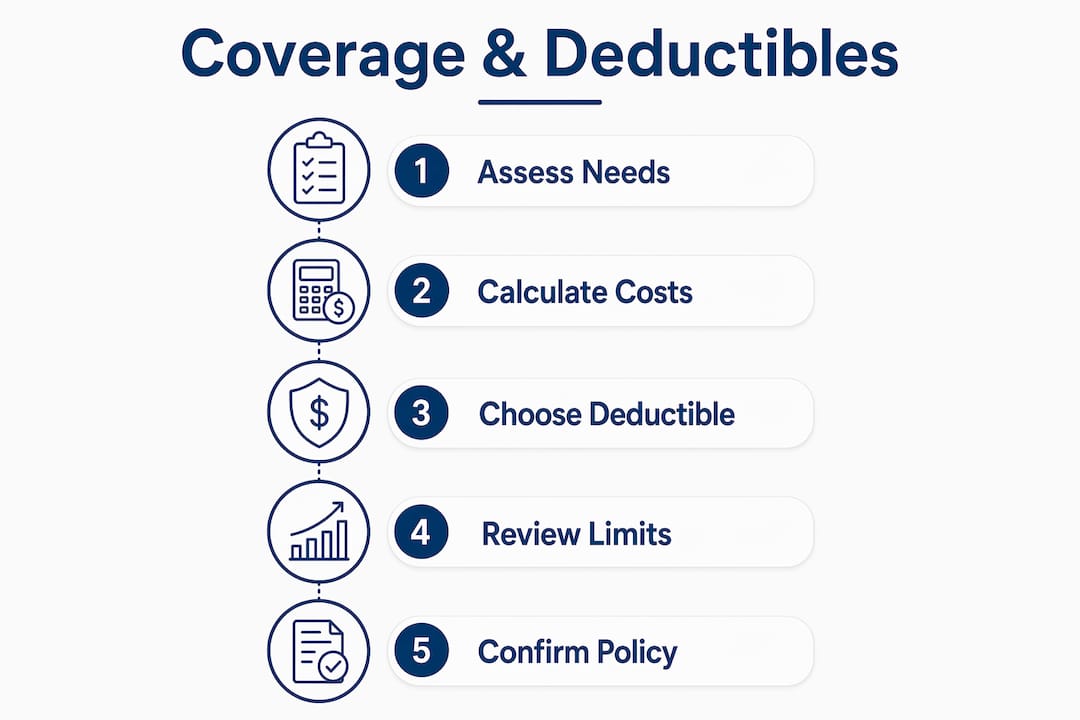
- Get a replacement cost estimate. Ask your agent to run a replacement cost estimator based on your home’s square footage, construction type, and local building costs. This number should drive your dwelling coverage limit.
- Inventory your personal property. Walk through every room and document your belongings. A home inventory helps you set an accurate personal property limit and speeds up any future claim.
- Choose your deductible deliberately. A higher deductible lowers your annual premium but raises your out-of-pocket cost when you file a claim. Comparing deductible amounts directly impacts both your premium and your financial exposure after a loss.
- Review your policy every year. Annual policy reviews catch underinsurance before it becomes a problem, especially after renovations, additions, or major purchases that increase your home’s rebuild cost.
- Check local building code requirements. Texas municipalities update building codes regularly. Your policy should include ordinance or law coverage so you are not paying out of pocket to bring a rebuilt home up to current code.
Pro Tip: Texas hail deductibles are often listed as a percentage of your dwelling coverage rather than a flat dollar amount. On a $300,000 policy, a 2% hail deductible means $6,000 out of pocket before your insurer pays anything. Read that line carefully.
How do you compare homeowners insurance premiums in Texas?
Premium comparison is where first-time buyers most often go wrong. The lowest premium is rarely the best policy.
Texas homeowners pay an average of $3,417 annually for $250,000 in dwelling coverage. That figure varies significantly based on your credit score, location, construction type, and the coverage choices you make. A policy priced $400 per year cheaper may carry a higher hail deductible, exclude certain water damage scenarios, or cap personal property at a lower limit.
When comparing policies, focus on these factors:
- Coverage limits: Are dwelling, personal property, and liability limits identical across the quotes you are comparing?
- Deductible structure: Does each policy use a flat deductible or a percentage-based deductible for wind and hail?
- Exclusions: What specific perils does each policy exclude? Water backup, mold, and foundation damage are common exclusions that vary by carrier.
- Replacement cost vs. actual cash value: Replacement cost pays to replace a damaged item at today’s price. Actual cash value deducts depreciation. Always choose replacement cost if you can.
The Texas Department of Insurance operates HelpInsure.com, a free tool that provides sample premium ranges for Texas homes by ZIP code. Use it as a baseline before you contact agents.
Independent agents shop multiple carriers simultaneously, which means you get a real comparison rather than a single company’s best offer. A captive agent represents one carrier. An independent agent represents dozens. That distinction matters when Texas weather risks make your home harder to place with standard carriers.
| Comparison factor | What to look for |
|---|---|
| Dwelling coverage limit | Must reflect replacement cost, not market value |
| Hail and wind deductible | Flat dollar vs. percentage of dwelling limit |
| Flood coverage | Separate NFIP or private policy required |
| Personal property basis | Replacement cost preferred over actual cash value |
| Liability limit | $300,000 minimum recommended for most Texas homes |
.
Working with an independent insurance agent gives you access to carriers that do not sell directly to consumers, along with professional risk assessment that automated quote tools cannot replicate.
What steps do first-time buyers need to take before closing?
Timing is everything. A late insurance policy can delay or derail your mortgage closing. Follow this sequence to avoid that outcome.
- Start shopping 2–4 weeks before your closing date. Securing insurance at least two to four weeks before closing prevents underwriting delays that can hold up your mortgage approval. Some carriers require inspections or additional documentation that takes time.
- Gather your home’s details. You will need the year built, square footage, roof age, construction type, and any recent upgrades. Your real estate agent or the seller’s disclosure can provide most of this.
- Contact an independent agent early. Give your agent time to shop multiple carriers and address any underwriting questions before your closing deadline. Waiting until the week of closing is a common mistake that creates unnecessary pressure.
- Confirm flood zone status. Check your property’s FEMA flood map designation. If you are in a high-risk zone, your lender will require a separate flood policy, and NFIP policies can take 30 days to take effect.
- Prepay your first-year premium at closing. Most lenders require you to prepay the first year of homeowners insurance as part of your closing costs. Budget for this in advance. It typically runs $2,000–$4,000 for Texas homes depending on coverage levels.
- Avoid coverage gaps. Your policy must be active on the day of closing. A gap between the policy start date and your closing date can trigger a lender hold. Confirm the exact effective date with your agent.
Pro Tip: If you are purchasing a home that has had prior claims, ask your agent to pull a CLUE report (Comprehensive Loss Underwriting Exchange). Prior claims on the property can affect your premium and even your ability to get coverage from certain carriers.
For a broader look at common insurance mistakes Texas buyers make, review Hettlerinsurance’s breakdown of the three most costly errors first-time homeowners commit.
Why lender requirements are the floor, not the ceiling
Here is something most first-time buyers do not realize until it is too late. Your lender’s insurance requirement is designed to protect the lender’s financial interest in your property. It is not designed to protect you.
Lender-required insurance may not cover full replacement cost. A lender typically requires coverage equal to the loan balance. If your loan is $220,000 but your home costs $350,000 to rebuild, you are carrying a $130,000 gap that comes entirely out of your pocket after a total loss. I have seen this scenario play out for homeowners who followed the lender’s minimum and assumed they were fully covered.
Texas compounds this problem. Hail damage, flash flooding, and windstorm events are not rare occurrences here. They are regular, predictable risks that require intentional coverage decisions. Choosing a policy based on the lowest premium that satisfies your lender is the financial equivalent of buying a smoke detector and skipping the batteries.
The buyers who come out ahead are the ones who treat insurance as a risk management decision, not a closing cost checkbox. That means working with an agent who understands Texas-specific coverage needs, reviewing your policy every year as your home’s value and your personal assets grow, and never assuming that what was adequate at closing is still adequate three years later.
— Ron Hettler, CIC (certified insurance counselor)
How Hettler Insurance Agency helps first-time Texas buyers get it right
Buying your first home in Texas is a significant financial commitment. Getting the insurance right from day one protects that investment for the long term.

Hettler Insurance has served Texas homeowners since 1992, representing over 30 top-rated carriers as an independent agency. That means the team shops the market on your behalf, compares coverage details across multiple policies, and flags Texas-specific risks like hail, windstorm, and flood that standard quote tools miss. Ron Hettler and Meghan Hettler are both Certified Insurance Counselors (CIC), the gold standard credential in the industry. Whether you are closing in Lubbock, Midland, or Dallas, Hettler Insurance delivers the kind of expert homeowners guidance that turns a confusing process into a confident decision. Contact Hettler Insurance Agency before your closing date and get the coverage your home actually needs.
Recommended
About the Author
Ronald J. Hettler, CIC is a Certified Insurance Counselor (CIC) [the gold-standard credential in the independent insurance industry]. Ron has over 46 years of real-world experience in the insurance industry. He is the owner/president of Hettler Insurance Agency in Lubbock, Texas and is licensed by the Texas Department of Insurance (License #666862). (Why Trust Hettler Insurance Agency? It’s a Local independent insurance agency representing multiple carriers. Hettler Insurance Agency has established business roots going back to it’s predecessor in the late 1800’s. Local expertise in Lubbock Texas and West Texas risks. Focused on clarity before a claim occurs.) Ron and his daughter Meghan, also a CIC, lead a team that represents 30+ carriers and serves clients across Texas.
Ron specializes in helping individuals, families, and small business owners understand complex insurance concepts in clear, practical terms so they can make informed decisions about their coverage. He specializes in helping individuals and families understand coverage gaps, deductible structures, and real-world claim outcomes before a loss occurs. Ron helps you to understand how insurance policies respond in real-world claim situations.
License verification available through the Texas Department of Insurance.
Frequently Asked Questions ?
Q1 ?: What does homeowners insurance cost in Texas?
Q2 ?: Does standard homeowners insurance cover flood damage in Texas?
Q3 ?: When should I buy homeowners insurance before closing?
Q4 ?: Should I insure my home for its purchase price or replacement cost?
Q5 ?: What is the benefit of using an independent insurance agent in Texas?
— Life Insurance Instant Quote and Apply Tool @ GetLifePolicy.com > * Quick self-service term life insurance quote. With or without medical exam.
— Call us about Auto, Home, Business, Life, or Health insurance. * Click to Call (806) 798-7800, Mon-Fri 8:30am-5pm (lunch closed Noon-1pm)
— Come see us @ our new address 4720 S Loop 289 Lubbock, TX 79414 (maps link), or get your online quote started at https://GetHettler.com