

TL;DR summary:
- Insurance rates fluctuate because insurers adjust premiums based on expected claims, costs, and regional risks. Texas experiences higher rate changes due to frequent weather-related claims and systemic factors like inflation and reinsurance costs. Managing exposure involves reviewing coverage, monitoring personal risk factors, and shopping multiple carriers proactively.
Insurance rates fluctuate when insurers recalculate the cost of covering risk across their entire policyholder pool. For Texas homeowners and families aged 28–42, that recalculation hits especially hard. Texas sits in the crosshairs of hail storms, hurricanes, and rapid construction cost inflation, all of which push premiums upward. Understanding why insurance rates fluctuate, and which factors you can actually control, is the first step toward protecting your household budget. This guide breaks down both the personal and systemic forces behind premium changes so you can plan with confidence.
Table of Contents
- Key Takeaways
- Why do insurance rates fluctuate for Texas homeowners?
- What personal factors cause insurance rates to change?
- How do broader market and regional factors drive insurance rate variability?
- Why do premiums increase even when you haven’t filed a claim?
- How can Texas homeowners manage fluctuating insurance costs?
- What I’ve learned after 45+ years of watching Texas rates move
- How Hettler Insurance Agency helps Texas families navigate rate changes
- Frequently Asked Questions
Key Takeaways
Insurance rates fluctuate because of both personal risk factors you control and systemic market forces you do not, and separating the two is the foundation of any sound insurance cost strategy.
| Point | Details |
|---|---|
| Personal factors drive individual rates | Driving record, claims history, and credit-based insurance scores directly affect your premium for 3–5 years. |
| Market forces affect all policyholders | Rising reinsurance costs and inflation push rates up for every policyholder, regardless of personal claims. |
| Texas weather amplifies rate pressure | Hail storms and hurricanes cause more frequent rate adjustments for Texas homeowners than the national average. |
| Dwelling coverage rises with inflation | Insurers recalculate replacement costs annually, increasing home premiums even without policy changes. |
| Shopping multiple carriers saves money | Independent agencies with access to 30-plus carriers generate competitive quotes that single-carrier agents cannot match. |
.
Why do insurance rates fluctuate for Texas homeowners?
Insurance rates fluctuate because insurers must price policies to cover expected future claims, operating costs, and regulatory requirements. When any of those inputs change, your premium changes too. The industry term for this process is “rate adequacy,” meaning the premium must be adequate to pay claims without the insurer going insolvent.
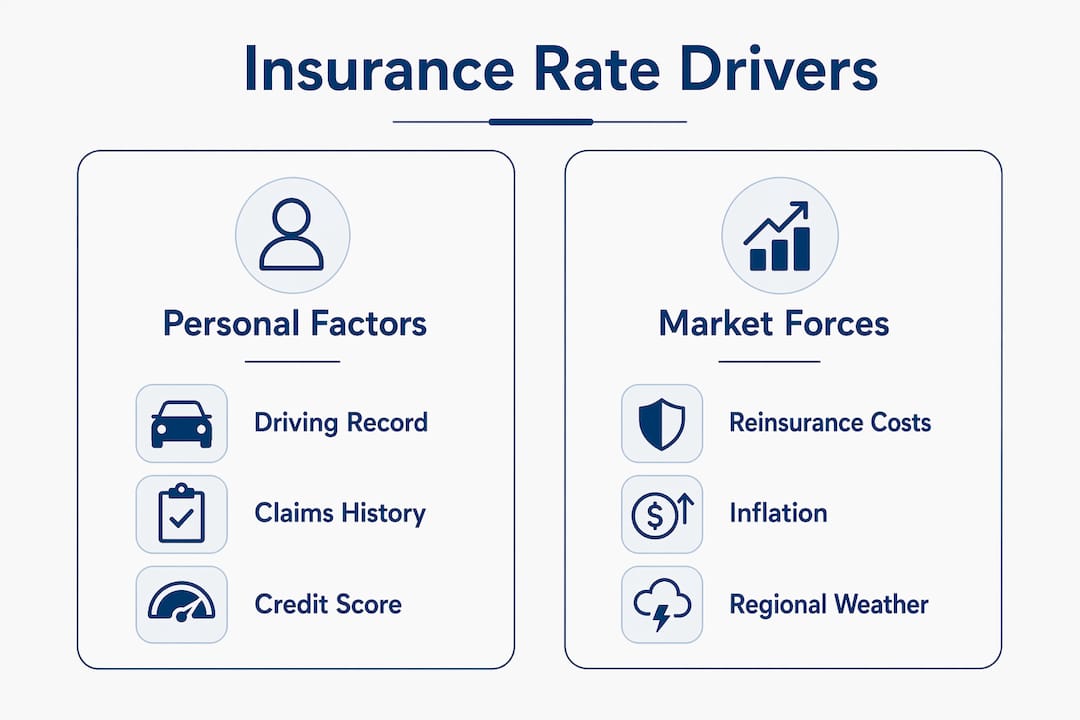
Two categories of factors drive rate changes. The first is personal: your driving record, claims history, credit-based insurance score, and coverage choices. The second is systemic: inflation, reinsurance costs, regional weather exposure, and state-approved rate filings. Both categories affect your renewal premium, often at the same time.
Texas compounds both categories. Regional weather exposure from hurricanes and hail storms causes insurers to adjust property and auto rates more frequently here than in most other states. That is not a coincidence. It is the direct result of actuarial data showing Texas generates more weather-related claims per policyholder than the national average.
What personal factors cause insurance rates to change?
Your individual risk profile is the most direct lever insurers pull when setting your premium. Here are the personal factors that carry the most weight:
- Driving record. At-fault accidents and traffic violations increase premiums for a minimum of 3 years. A DUI can extend that impact even longer. Texas drivers should check their Motor Vehicle Record annually to know exactly what insurers see.
- Claims history. Filing a claim signals higher future risk. Multiple claims within a short window can trigger a non-renewal notice, not just a rate increase.
- Credit-based insurance score. This score is not the same as your consumer credit score. Insurance scores predict claim likelihood using specialized weighting, meaning a strong FICO score does not guarantee the lowest insurance rate.
- Coverage limits and deductibles. Raising your deductible lowers your premium. Increasing your liability limits raises it. These are choices you control at every renewal.
- Policy changes mid-term. Adding a teenage driver, buying a new vehicle, or finishing a home addition all trigger mid-term recalculations.
Speeding tickets are a common blind spot for Texas drivers. Many families assume a single ticket fades quickly. Speeding violations in Texas can affect your auto premium for three years or more, depending on the severity and your insurer’s rating model.
Pro Tip: Review your driving record and claims history six months before your renewal date. That window gives you time to shop quotes before your insurer files the increase.
How do broader market and regional factors drive insurance rate variability?
Systemic forces drive premium changes that have nothing to do with your personal behavior. These are the factors that frustrate homeowners most, because you cannot control them directly.

Rising reinsurance costs sit at the top of the list. Reinsurance is the insurance that insurance companies buy to protect themselves from catastrophic losses. When reinsurance prices rise, those costs flow directly to policyholders. State regulators approve rate changes for entire books of business, meaning every policyholder in a given category absorbs the increase, regardless of individual claims history.
Inflation in construction, medical care, and vehicle repairs is the second major driver. Hospital prices have increased 250% since 2000, more than double general inflation. Vehicle repair costs have followed a similar trajectory due to supply chain disruptions and the complexity of modern electronics in cars. When the cost to settle a claim rises, the premium required to fund that settlement rises with it.
Regional weather risk is the factor most specific to Texas. The table below shows how different systemic factors translate into real premium pressure for Texas homeowners and families.
Auto insurance costs vary over 200% between states due to weather, crime, and local repair costs. Texas sits well above the national average on all three of those metrics.
Why do premiums increase even when you haven’t filed a claim?
| Factor | How it affects your premium | Texas example |
|---|---|---|
| Reinsurance cost increases | Passed to all policyholders via approved rate filings | Statewide home and auto rate increases in 2024 |
| Construction cost inflation | Raises dwelling replacement cost, triggering higher coverage limits | West Texas rebuild costs up sharply after hail events |
| Medical cost inflation | Increases liability and personal injury protection payouts | Higher auto liability premiums across Texas metro areas |
| Weather exposure | Drives frequency and severity of property claims | Hurricane and hail losses in Houston, Lubbock, and Midland |
| Crime rates | Increases auto theft and vandalism claims | Higher comprehensive premiums in high-theft zip codes |
.
This is the question Hettler Insurance Agency hears most often from Texas families at renewal time. The answer lies in how insurance pricing actually works.
Your premium is not calculated in isolation. It reflects the collective claims experience of every policyholder in your risk category. When your neighbors file more claims, your pool becomes more expensive to maintain, and your rate goes up even if you personally filed nothing. Premium increases often reflect changes in the overall risk pool to maintain insurer solvency, not a judgment on your individual behavior.
A second mechanism is expense loading. Expense loading includes underwriter administration costs, technology investments, and reinsurance expenses. These corporate-level costs are distributed evenly across all policyholders. When those costs rise, every policyholder absorbs a share.
For homeowners specifically, dwelling coverage limits rise annually to keep pace with inflation and replacement costs. Your insurer recalculates what it would cost to rebuild your home from scratch each year. If construction costs went up, your coverage limit goes up, and so does your premium, even if you made no changes to your policy.
Pro Tip: Ask your agent to separate your renewal increase into two line items: personal risk changes versus market-driven adjustments. That breakdown tells you exactly where to focus your attention.
The key distinction is this: controllable factors like deductibles and coverage levels differ from uncontrollable ones like weather and inflation. Knowing which category is driving your increase tells you whether shopping for a new rate or adjusting your coverage is the right move.
How can Texas homeowners manage fluctuating insurance costs?
You cannot eliminate rate variability, but you can manage your exposure to it. Here is a practical sequence for Texas homeowners and families.
-
- Review your coverage annually. Pull out your declarations page 60 days before renewal. Confirm your dwelling replacement cost reflects current construction prices, not what you paid for the home. Confirm your liability limits still match your net worth.
- Understand your local risk profile. West Texas homeowners face hail risk. Gulf Coast families face hurricane exposure. Knowing your specific regional risks helps you decide where to carry higher limits and where a higher deductible makes financial sense.
- Monitor your personal risk factors. Check your driving record, review any claims filed in the past three years, and pull your credit report. All three feed directly into your insurance pricing. Correcting errors on any of them can lower your rate.
- Shop multiple quotes before renewal. An independent agency like Hettlerinsurance represents over 30 top-rated carriers. That means one conversation generates real competitive quotes, not a single take-it-or-leave-it number. Texas home insurance rates vary significantly between carriers for identical coverage, so shopping is not optional if cost matters.
- Adjust deductibles strategically. Raising your wind and hail deductible from 1% to 2% of your dwelling value can produce meaningful premium savings in Texas. Calculate your out-of-pocket exposure first to confirm the tradeoff makes sense for your cash reserves.
- Consult a Certified Insurance Counselor. The CIC designation is the gold standard credential in the insurance industry. Ron Hettler and Meghan Hettler at Hettler Insurance Agency both hold CIC credentials, which means their advice reflects deep technical training, not just product familiarity.
What I’ve learned after 45+ years of watching Texas rates move
Rate increases feel personal. I understand that. You did everything right, filed no claims, paid on time, and still opened a renewal notice showing a 15% jump. That experience makes people angry, and the anger is understandable.
What I’ve seen over years of working with Texas homeowners is that the anger fades quickly once people understand the mechanics. The increase is almost never about you. It is about the hailstorm that hit three zip codes over, the reinsurance market tightening after a catastrophic hurricane season, or a state-approved rate filing that applies to every homeowner in your coverage category.
The families who manage this best are the ones who treat insurance like a financial instrument, not a bill. They review it annually. They ask specific questions about what drove the change. They shop when the market warrants it and stay put when their carrier is still competitive. They do not wait until a claim to find out their coverage was inadequate.
My honest advice: build a relationship with an independent agent who knows the Texas market and will call you before renewal, not after. That one habit saves more money over a decade than any single coverage tweak.
— Ron Hettler, CIC (certified insurance counselor)
How Hettler Insurance Agency helps Texas families navigate rate changes
Hettler Insurance has served Texas homeowners and families since 1992, and rate management is one of the most common conversations the team has at renewal time.

As an independent agency representing over 30 top-rated carriers, Hettler Insurance Agency shops the market on your behalf at no extra fee. Ron Hettler and Meghan Hettler, both Certified Insurance Counselors, review your coverage, identify where personal risk factors are driving costs, and find competitive alternatives when the market has shifted. Whether you are protecting a home in Lubbock, a vehicle in Midland, or a growing business across West Texas, the team builds a coverage plan that fits your actual risk profile. For families also managing business exposure, the minimum insurance for entrepreneurs resource is a practical starting point. Call Hettler Insurance before your next renewal.
Recommended
About the Author
Ronald J. Hettler, CIC is a Certified Insurance Counselor (CIC) [the gold-standard credential in the independent insurance industry]. Ron has over 46 years of real-world experience in the insurance industry. He is the owner/president of Hettler Insurance Agency in Lubbock, Texas and is licensed by the Texas Department of Insurance (License #666862). (Why Trust Hettler Insurance Agency? It’s a Local independent insurance agency representing multiple carriers. Hettler Insurance Agency has established business roots going back to it’s predecessor in the late 1800’s. Local expertise in Lubbock Texas and West Texas risks. Focused on clarity before a claim occurs.) Ron and his daughter Meghan, also a CIC, lead a team that represents 30+ carriers and serves clients across Texas.
Ron specializes in helping individuals, families, and small business owners understand complex insurance concepts in clear, practical terms so they can make informed decisions about their coverage. He specializes in helping individuals and families understand coverage gaps, deductible structures, and real-world claim outcomes before a loss occurs. Ron helps you to understand how insurance policies respond in real-world claim situations.
License verification available through the Texas Department of Insurance.
Frequently Asked Questions ?
Q1 ?: Why did my insurance go up if I never filed a claim?
Q2 ?: How long does a traffic violation affect my insurance rate?
Q3 ?: Does my credit score affect my insurance premium?
Q4 ?: Why does Texas have higher insurance rates than other states?
Q5 ?: What is the fastest way to lower my insurance costs in Texas?
— Life Insurance Instant Quote and Apply Tool @ GetLifePolicy.com > * Quick self-service term life insurance quote. With or without medical exam.
— Call us about Auto, Home, Business, Life, or Health insurance. * Click to Call (806) 798-7800, Mon-Fri 8:30am-5pm (lunch closed Noon-1pm)
— Come see us @ our new address 4720 S Loop 289 Lubbock, TX 79414 (maps link), or get your online quote started at https://GetHettler.com