
TL;DR summary:
- An additional insured is added to another’s liability policy by endorsement, gaining limited coverage for claims related to the insured’s acts. This status is vital for protecting contractors, tenants, or vendors but requires proper endorsement verification to be effective. Properly managing this coverage minimizes liability risks and prevents coverage gaps during legal claims. “The best independent insurance agents don’t just find you a policy. They find you the right insurance policy and then make sure it stays right as your life changes.” — Ron Hettler, CIC (certified insurance counselor), Hettler Insurance Agency
An additional insured is defined as a party added to another’s liability policy by endorsement, gaining coverage for claims related to the named insured’s acts but not owning the policy or paying premiums. This status protects you when a contractor, tenant, or vendor causes harm during work connected to your business. For Texas small business owners and individuals navigating contracts, understanding what is additional insured status means knowing exactly who is protected, under what conditions, and where the gaps are. Get this wrong, and you could face a lawsuit with no coverage to back you up.
Table of Contents
- Key Takeaways
- What is additional insured status and how does it work?
- What is the difference between additional insured, named insured, and certificate holder?
- What are the benefits and limitations of additional insured status?
- How do you add or confirm additional insured status?
- Why I take additional insured status seriously on every contract
- How Hettler Insurance Agency helps Texas businesses get coverage right
- Frequently Asked Questions
Key Takeaways
Additional insured status protects Texas business owners from liability tied to another party’s work, but only when the policy endorsement is properly executed, verified, and aligned with the contract’s scope.
| Point | Details |
|---|---|
| Endorsement is required | A certificate of insurance alone does not create additional insured status. |
| Coverage is limited in scope | Protection applies only to claims arising from the named insured’s specific operations. |
| Shared limits create risk | Multiple additional insureds on one policy can reduce available coverage per claim. |
| Verify before work begins | Request and review the actual endorsement, not just the certificate. |
| Cancellation notices rarely sent | Additional insureds must monitor policy status independently to avoid coverage gaps. |
.
What is additional insured status and how does it work?
An additional insured endorsement modifies an existing liability policy to extend coverage to a third party. That coverage applies only to claims arising from the named insured’s operations or acts, not from the additional insured’s own independent actions. A general contractor, for example, gets added to a subcontractor’s policy so that if the subcontractor’s work causes property damage, the general contractor has defense and indemnity coverage under that policy.

The endorsement is the legal mechanism that makes this work. Without it, the additional insured has no actual coverage rights, regardless of what a contract says. The contract creates the obligation to add someone; the endorsement delivers the protection.
Here is what the additional insured relationship typically involves:
- Coverage scope: Protection applies only to liability arising from the named insured’s specific work or operations, not unrelated claims.
- No premium obligation: The additional insured does not pay premiums and does not control the policy.
- Contractual trigger: The requirement to add an additional insured usually comes from a signed contract, such as a lease, subcontract, or vendor agreement.
- Defense access: The additional insured can access the named insured’s policy for legal defense and settlement costs tied to covered claims.
- Endorsement requirement: A certificate of insurance alone does not create additional insured status. The actual policy must be endorsed.
Failing to provide required additional insured status is a breach of contract that insurance typically does not cover. That means the breaching party faces personal liability exposure. Call your agent before you sign any contract that requires you to add someone as an additional insured.
What is the difference between additional insured, named insured, and certificate holder?
These three terms get confused constantly, and the confusion costs people real money. Each status carries different rights, and mixing them up leaves gaps in your protection.
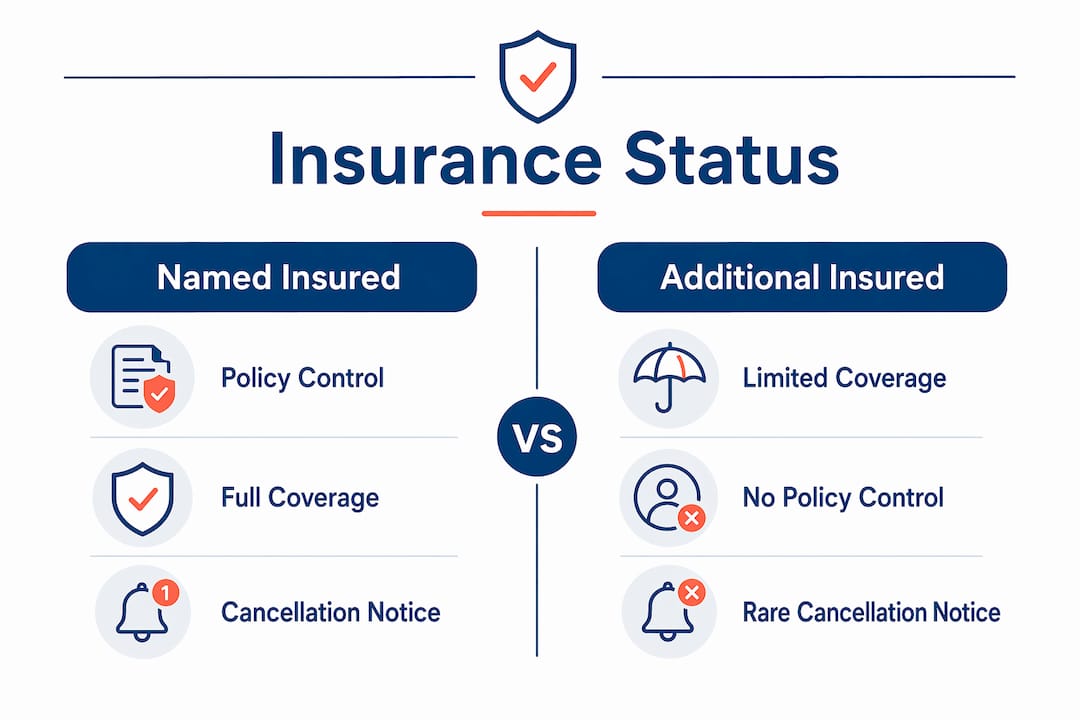
The named insured is the policyholder. This party holds full rights and obligations under the policy, including the right to make changes, receive cancellation notices, and file claims for any covered loss. The named insured pays the premium and controls the coverage.
The additional insured is added by endorsement with coverage limited to named insured activities. This party has no control over policy terms, cannot cancel or modify coverage, and typically does not receive cancellation notices. Coverage exists only for claims tied to the named insured’s work.
The certificate holder receives only proof that a policy exists at a point in time. A certificate of insurance is not a coverage document. Being listed on a certificate is not the same as being an additional insured. Certificate holders have no defense rights and no claim rights under the policy.
| Status | Policy control | Coverage rights | Receives cancellation notice |
|---|---|---|---|
| Named insured | Full | Broad, all covered losses | Yes |
| Additional insured | None | Limited to named insured’s acts | Rarely |
| Certificate holder | None | None | No |
.
Pro Tip: Always request a copy of the actual endorsement, not just the certificate of insurance. If the endorsement is not in writing and attached to the policy, your additional insured status may not hold up when a claim is filed.
What are the benefits and limitations of additional insured status?
Additional insured coverage provides real protection for Texas business owners, but it comes with boundaries you need to understand before relying on it.
Key benefits
- Clean loss history: Additional insured status keeps claims off your own policy when they arise from someone else’s work. Your premiums stay protected.
- Defense coverage: The named insured’s policy pays for your legal defense and any settlement for covered claims. You do not have to tap your own policy.
- Direct claim access: As an additional insured, you can submit claims directly to the insurer without going through the named insured first.
- Risk transfer: You shift liability exposure back to the party whose work created the risk, which is the correct alignment of responsibility.
Real limitations to watch
Coverage limits are shared between the named insured and all additional insureds on the policy. Excessive sharing of limits can reduce the amount available per claim, leaving you underprotected on a large loss. This is a serious risk on projects with multiple parties added to one policy.
Additional insureds also rarely receive cancellation notices. If the named insured’s policy lapses or gets canceled, you may not find out until a claim is filed. At that point, you have no coverage and no warning. Texas contractors and landlords face this scenario more often than they realize.
Coverage is also strictly tied to the scope of the named insured’s work. Additional insured coverage must be limited to the defined relationship to avoid unintended broadening. If a claim falls outside that scope, the policy will not respond. You need your own general liability coverage for everything else.
How do you add or confirm additional insured status?
Securing proper additional insured status requires more than a contract clause. Follow these steps to protect yourself.
- Include the requirement in the contract. State clearly that the other party must add you as an additional insured on their commercial general liability policy before work begins. Specify the endorsement form if possible.
- Request the endorsement in writing. Ask for a copy of the actual endorsement attached to the policy, not just a certificate of insurance. The endorsement is the document that creates your coverage rights.
- Verify the endorsement language. Review the endorsement to confirm it covers the correct scope of work, names you correctly, and reflects adequate liability coverage limits. Vague or overly narrow language creates gaps.
- Check the policy expiration date. Confirm the policy is active and will remain active through the duration of the project or contract. Set a calendar reminder to re-verify before renewal.
- Coordinate with your own agent. Share the endorsement with your insurance agent so they can confirm it aligns with your risk exposure. Your agent can spot gaps you might miss.
- Document everything. Keep copies of the contract, the certificate of insurance, and the endorsement in one file. If a claim arises, you will need all three documents.
Pro Tip: An additional insured endorsement should be verified beyond a certificate of insurance. Failure to verify can leave you unprotected despite what the contract says.
Why I take additional insured status seriously on every contract
Most business owners treat additional insured requests as routine paperwork. I have seen that attitude cause serious financial damage.
The problem is that requests for additional insured status are often handled without real understanding, leading to misapplications and coverage gaps. A contractor adds a client to their policy without reading the endorsement language. The endorsement is too narrow. A claim falls outside the defined scope. Nobody is covered. That scenario plays out regularly in Texas construction and real estate.
What I tell every client is this: additional insured status should only be provided when it genuinely aligns insurance responsibility with control and exposure. Giving it away routinely, or accepting it without verification, creates false confidence. The party whose work creates the risk should carry the coverage. The endorsement should reflect that relationship precisely.
Early communication between the named insured and the additional insured about defense and settlement rights prevents the biggest disputes. When a claim hits, you do not want to be figuring out who controls the defense for the first time. That conversation belongs at the contract stage, not in a courtroom.
— Ron Hettler, CIC (certified insurance counselor), Hettler Insurance Agency
How Hettler Insurance Agency helps Texas businesses get coverage right
Texas contracts move fast, and insurance requirements often get buried in the fine print. Hettler Insurance has helped business owners and individuals across Texas navigate additional insured endorsements, verify policy language, and close coverage gaps before they become claims.

As an independent agency representing over 30 top-rated carriers, Hettler Insurance shops your coverage across the market to find the right fit for your specific risk. Whether you need to add an additional insured to your existing policy or confirm that someone else’s endorsement actually protects you, the team reviews the details so nothing slips through. For Texas entrepreneurs and small business owners, understanding the minimum insurance you need is the first step. Hettler Insurance Agency makes that step straightforward. Call the Lubbock office or reach out online to get a policy review today.
Recommended
About the Author
Ronald J. Hettler, CIC is a Certified Insurance Counselor (CIC) [the gold-standard credential in the independent insurance industry]. Ron has over 46 years of real-world experience in the insurance industry. He is the owner/president of Hettler Insurance Agency in Lubbock, Texas and is licensed by the Texas Department of Insurance (License #666862). (Why Trust Hettler Insurance Agency? It’s a Local independent insurance agency representing multiple carriers. Hettler Insurance Agency has established business roots going back to it’s predecessor in the late 1800’s. Local expertise in Lubbock Texas and West Texas risks. Focused on clarity before a claim occurs.) Ron and his daughter Meghan, also a CIC, lead a team that represents 30+ carriers and serves clients across Texas.
Ron specializes in helping individuals, families, and small business owners understand complex insurance concepts in clear, practical terms so they can make informed decisions about their coverage. He specializes in helping individuals and families understand coverage gaps, deductible structures, and real-world claim outcomes before a loss occurs. Ron helps you to understand how insurance policies respond in real-world claim situations.
License verification available through the Texas Department of Insurance.
Frequently Asked Questions ?
Q1 ?: What is the additional insured definition in simple terms?
Q2 ?: Who is an additional insured in a typical Texas contract?
Q3 ?: Does being a certificate holder make you an additional insured?
Q4 ?: What are the main benefits of additional insured status?
Q5 ?: How do you add an additional insured to a policy?
— Life Insurance Instant Quote and Apply Tool @ GetLifePolicy.com > * Quick self-service term life insurance quote. With or without medical exam.
— Call us about Auto, Home, Business, Life, or Health insurance. * Click to Call (806) 798-7800, Mon-Fri 8:30am-5pm (lunch closed Noon-1pm)
— Come see us @ our new address 4720 S Loop 289 Lubbock, TX 79414 (maps link), or get your online quote started at https://GetHettler.com