

TL;DR Summary:
- Texas businesses face unique risks like hurricanes, hailstorms, and optional workers’ compensation.
- Customizing coverage, including bundling and increasing deductibles, can lead to significant savings.
- Regular policy reviews and working with knowledgeable agents optimize protection and cost-efficiency.
Running a business in Texas means facing risks that owners in other states simply don’t deal with in the same way. From West Texas hail storms and Gulf Coast hurricanes to a workers’ compensation system unlike any other in the country, the insurance landscape here is genuinely different. Generic, off-the-shelf policies often leave you either overexposed or overpaying. The good news is that customizing Texas business insurance is not only possible, it can lead to real savings and far better protection. This guide walks you through what to assess, what to adjust, and how to build a policy that actually fits your business.
Table of Contents
-
- Assessing your insurance needs and Texas-specific factors
- Customizing coverage types and limits
- Money-saving strategies: Bundling, payments, and programs
- Working with agents and avoiding common mistakes
- What most Texas business owners miss about customizing insurance
- Get expert help to optimize your Texas business insurance
- Frequently asked questions
Key Takeaways
| Point | Details |
|---|---|
| Tailor coverage to Texas risks | Texas businesses must account for local exclusions, weather risks, and regulatory differences to avoid hidden gaps. |
| Bundle and save | Bundling policies, adjusting deductibles, and paying annually can reduce business insurance premiums by up to 30 percent. |
| Independent agents add value | Working with Texas-focused independent agents helps access more options and avoid needless overlap or missed discounts. |
| Don’t set and forget | Annual policy reviews capture new savings and ensure coverage shifts with your changing business risks. |
Assessing your insurance needs and Texas-specific factors
Before you adjust a single coverage limit, you need a clear picture of what you’re actually protecting. Start by making a detailed inventory of your business assets, people, and exposures.
What to inventory:
- Physical property: equipment, inventory, vehicles, and real estate
- Number of employees and their job-related risks
- Industry-specific hazards (construction, food service, retail, professional services)
- Your business location and proximity to flood zones or coastal areas
- Any contracts or leases that require specific liability limits or endorsements
Texas has a regulatory environment worth understanding before you shop for coverage needs. One major example: workers’ comp is optional in Texas, making it the only state where private employers can legally opt out. That flexibility sounds appealing, but non-subscribers lose important legal protections and can be sued directly by injured employees without the typical defenses workers’ comp provides.
Here’s a quick look at how Texas-specific factors affect coverage decisions:
| Risk factor | Coverage consideration | Mandatory in Texas? |
|---|---|---|
| Employee injuries | Workers’ compensation | No (optional) |
| Property damage from wind/hail | Windstorm endorsement or separate policy | No (but often required by lenders) |
| General business liability | General liability insurance | No (but often required by contracts) |
| Coastal hurricane exposure | Texas Windstorm Insurance Association (TWIA) | No (but critical for coastal businesses) |
| Commercial vehicles | Commercial auto insurance | Yes, minimum liability required |
For businesses in coastal counties, standard property policies often exclude windstorm damage. You may need a separate windstorm policy through Texas commercial insurance guidance or the TWIA, the state’s insurer of last resort for wind and hail in designated coastal areas.
Pro Tip: Talk to an independent agent who knows your region before buying any policy. West Texas businesses face different risks than those on the Gulf Coast, and a locally experienced agent will catch coverage gaps a national call center rep might miss.
With your specific risks in mind, the next step is to see how you can customize a policy to match these needs.
Customizing coverage types and limits
Once you understand your exposures, you can build a policy structure that fits your actual business instead of a hypothetical one. Most Texas businesses need a core set of coverages, with optional add-ons based on their specific situation.
Core coverages to consider:
- General liability covers bodily injury and property damage claims from third parties. This is the baseline for almost every business.
- Commercial property protects your building, equipment, and inventory from fire, theft, vandalism, and covered weather events.
- Business interruption replaces lost income if a covered event forces you to temporarily close. Many business owners skip this one until they need it.
- Commercial auto covers vehicles used for business purposes. Personal auto policies typically exclude business use.
- Umbrella policy provides an extra layer of liability protection above your existing limits, often at a surprisingly low cost per dollar of additional coverage.
Beyond the core, depending on your industry you may want to add inland marine coverage for equipment transported off-site, or cyber liability insurance if you store customer data or process payments online.
Comparison: bare minimum vs. full-scope Business Owners Policy (BOP)
| Coverage element | Bare minimum setup | Full-scope BOP |
|---|---|---|
| General liability | $500,000 limit | $1,000,000+ limit |
| Property coverage | Actual cash value | Replacement cost value |
| Business interruption | Not included | Included |
| Cyber liability | Not included | Included |
| Umbrella | Not included | $1M–$5M umbrella |
| Annual premium estimate | Lower upfront cost | Higher upfront, lower risk |
Adjusting your deductible is one of the most effective levers you have. Raising deductibles from $250 to $1,000 can save 10 to 20% on your premium, and BOP bundling can yield 20 to 30% savings compared to buying each policy separately. Before adjusting deductibles, though, make sure your business has enough cash on hand to cover that amount in a real claim scenario. A $5,000 deductible saves money on paper but creates a cash flow problem if something goes wrong.

Pro Tip: Review your deductible strategies annually. As your cash reserves grow, you may be able to take on higher deductibles and pocket the savings.
Money-saving strategies: Bundling, payments, and programs
Optimizing cost and coverage is possible if you use smart strategies that go beyond just picking a policy. Here are the most effective ways Texas business owners reduce premiums without cutting critical protection.
Key discount strategies:
- Bundle into a BOP: Combining general liability and property insurance into a single Business Owners Policy typically saves 20 to 30% compared to buying each separately. Carriers reward simplicity.
- Pay annually: Switching from monthly to annual payments can reduce your total premium by 5 to 10%. Think of it like a small cash advance that pays you back immediately.
- Implement safety programs: Formal workplace safety programs, documented procedures, and loss prevention training can cut workers’ comp premiums by 5 to 15%. Some carriers require documentation, so keep records.
- Join industry associations: Many trade groups negotiate group rates with carriers. If you’re in construction, healthcare, or retail, check what your association offers before going it alone.
- Raise deductibles strategically: As mentioned, this is one of the fastest ways to reduce your premium. Just balance it against your actual cash reserves.
- Maintain a clean claims history: Carriers price premiums partly based on your loss history. Fewer claims over time means lower rates at renewal.
For annual and usage-based savings, some carriers now offer programs that track vehicle usage or safety metrics, rewarding low-risk behavior with lower commercial auto premiums.
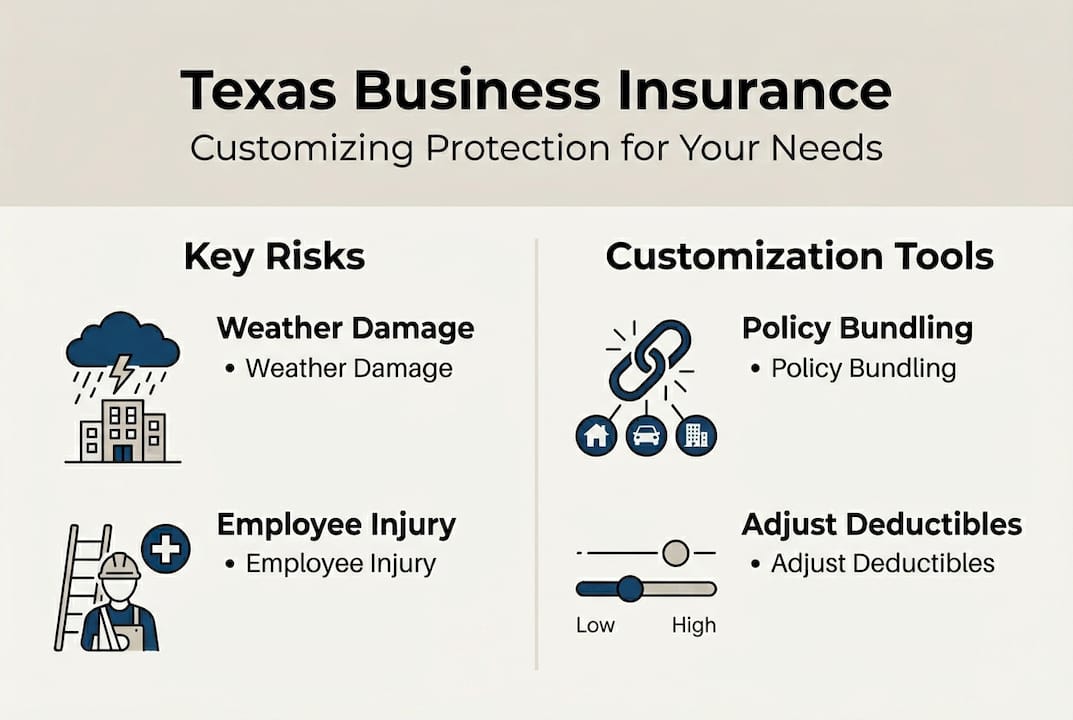
One thing worth saying plainly: don’t choose the cheapest coverage if it creates critical gaps. A policy that saves you $200 a month but excludes windstorm damage in Lubbock, or excludes your industry’s most common liability exposure, is not a deal. It’s a problem waiting to happen. Use bundling for discounts to lower costs, but always run every change past an agent who can flag what you’d be giving up.
Pro Tip: Don’t skip formal safety documentation. Even a basic written safety policy submitted to your carrier can qualify you for a discount. It takes one afternoon to write and could save you thousands annually.
Working with agents and avoiding common mistakes
Now that you know how to reduce costs, collaborate with an expert who understands the Texas market and make sure you don’t miss any details. Here’s a practical step-by-step approach.
- Gather your business information first. Before you contact any agent, have your revenue figures, employee count, asset values, and existing policies ready. The more accurate your data, the more accurate your quote.
- Request quotes from multiple carriers. Independent agents can access multiple carriers and spot duplicate or overlapping coverage that you might never notice on your own. A captive agent who works for one company cannot do this.
- Ask specifically about Texas exclusions. Windstorm, flood, and certain liability exclusions are common in Texas policies. Ask your agent to walk through every exclusion in plain language.
- Review for duplicate coverage. Overlapping policies are more common than you’d think. If you have a BOP and a separate property policy, you might be paying twice for the same protection.
- Check endorsements. An endorsement is a modification to your base policy that adds or removes coverage. Missing a required endorsement (like adding an additional insured for a client contract) can void a claim entirely. Review all exclusions carefully with your agent before signing.
- Set an annual review date. Your business changes. Your insurance should too. Revenue growth, new equipment, added employees, or a new contract can all change your coverage needs.
“Independent agents often find better rates and coverage by shopping multiple carriers, especially in Texas, where regional risk factors and carrier appetite vary widely by location and industry.”
Don’t assume the policy you bought two years ago still fits. Many business owners discover gaps only after a claim is denied. That’s too late.
What most Texas business owners miss about customizing insurance
Here’s the part most articles skip. Business owners tend to negotiate their insurance once, feel good about the rate, and then auto-renew for years. That’s a mistake, especially in Texas.
The Texas insurance market shifts based on storm seasons, carrier appetite, and regulatory changes. New endorsements become available. Carriers enter and exit specific markets. Workers’ comp rates fluctuate with industry loss data. If you’re not reviewing your coverage annually with the right agency, you’re leaving savings on the table and potentially carrying coverage that no longer matches your actual risk profile.
The businesses that get the best long-term value from their insurance are not the ones who found the cheapest policy once. They’re the ones who treat insurance as a living part of their risk management strategy. Review it. Update it. Ask questions every year. That discipline is where the real savings and the real protection come from.
Get expert help to optimize your Texas business insurance
Customizing your commercial insurance takes real knowledge of Texas regulations, carrier options, and your specific industry risks. It’s not something you should guess at or handle alone.
At Hettler Insurance Agency, we’ve been helping Texas business owners build smarter coverage since 1992. As an independent agency representing over 30 top-rated carriers, we shop the market so you get the best fit at the best price, with no extra fee. Whether you’re just starting out and need to understand minimum coverage for Texas entrepreneurs or you’re ready for a full policy review, our team is here to help. Contact us today and let’s build a coverage plan that actually protects what you’ve worked for.
Frequently asked questions
What are the main types of business insurance in Texas?
The main types are general liability, commercial property, commercial auto, business interruption, and optional coverages like workers’ comp, cyber liability, and inland marine. Texas workers’ comp is optional, which makes it different from nearly every other state.
Is workers’ compensation insurance required in Texas?
No. Texas does not require most private employers to carry workers’ comp, but opting out removes key legal protections and opens businesses to direct employee lawsuits.
How can I save money when customizing my business insurance?
The most effective methods include BOP bundling, higher deductibles, annual payments, and safety programs, all of which can meaningfully reduce your total premium without removing essential protection.
What unique risks do Texas businesses face?
Coastal businesses deal with hurricane and windstorm exposures often excluded from standard policies, while all Texas businesses face the unique liability risk that comes from opting out of workers’ comp coverage.
What does bundling insurance policies mean?
Bundling means combining multiple coverages, like general liability and property, into one package such as a BOP. This approach typically lowers total premiums by 20 to 30% compared to buying separate policies.
Recommended
About the Author
Ronald J. Hettler, CIC is a Certified Insurance Counselor (CIC) [the gold-standard credential in the independent insurance industry]. Ron has over 46 years of real-world experience in the insurance industry. He is the owner/president of Hettler Insurance Agency in Lubbock, Texas and is licensed by the Texas Department of Insurance (License #666862). (Why Trust Hettler Insurance Agency? It’s a Local independent insurance agency representing multiple carriers. Hettler Insurance Agency has established business roots going back to it’s predecessor in the late 1800’s. Local expertise in Lubbock Texas and West Texas risks. Focused on clarity before a claim occurs.) Ron and his daughter Meghan, also a CIC, lead a team that represents 30+ carriers and serves clients across Texas.
Ron specializes in helping individuals, families, and small business owners understand complex insurance concepts in clear, practical terms so they can make informed decisions about their coverage. He specializes in helping individuals and families understand coverage gaps, deductible structures, and real-world claim outcomes before a loss occurs. Ron helps you to understand how insurance policies respond in real-world claim situations.
License verification available through the Texas Department of Insurance.
Enhanced Frequently Asked Questions ?
Q1 ?: What are the main types of business insurance in Texas?
Q2 ?: Is workers’ compensation insurance required in Texas?
Q3 ?: How can I save money when customizing my business insurance?
Q4 ?: What unique risks do Texas businesses face?
Q5 ?: What does bundling insurance policies mean?
— Life Insurance Instant Quote and Apply Tool @ GetLifePolicy.com > * Quick self-service term life insurance quote. With or without medical exam.
— Call us about Auto, Home, Business, Life, or Health insurance. * Click to Call (806) 798-7800, Mon-Fri 8:30am-5pm (lunch closed Noon-1pm)
— Come see us @ our new address 4720 S Loop 289 Lubbock, TX 79414 (maps link), or get your online quote started at https://GetHettler.com