
TL;DR summary:
- The declaration page summarizes your insurance coverage limits, deductibles, and key policy details.
- Reviewing the dec page annually ensures you understand changes that could affect claim payouts and costs.
An insurance declaration page is a concise, 1–2 page official summary of your insurance contract that lists your coverage limits, deductibles, named insureds, policy period, and premium. Known in the industry as the “dec page,” this document is the fastest way to verify what your policy actually covers. The Texas Department of Insurance recognizes the dec page as the official summary required to verify coverage with mortgage lenders and other parties. For Texas homeowners and renters facing hail storms, high winds, and flood risk, understanding this document is not optional. It is the financial blueprint of your protection.
Table of Contents
- Key Takeaways
- What information is on an insurance declaration page?
- Why is the declarations page the most critical document in your policy?
- What are the five key numbers on a Texas homeowners declaration page?
- How should Texas homeowners and renters use the declarations page effectively?
- The dec page is not paperwork. It is your financial protection blueprint.
- Hettler Insurance Agency helps Texas homeowners read and manage their dec pages
- Frequently Asked Questions
Key Takeaways
The insurance declaration page is the single most important document in your policy because it sets the financial terms that determine every claim outcome.
| Point | Details |
|---|---|
| Dec page is the binding summary | It sets coverage limits and deductibles that directly control what you receive in a claim. |
| Five numbers drive most outcomes | Coverage A, wind/hail deductible, roof basis, personal property basis, and liability limit matter most for Texas homeowners. |
| Carriers adjust terms at renewal | Compare each new dec page to the prior year’s version to catch quiet changes in limits or deductibles. |
| Keep copies for 3–5 years | Past dec pages verify coverage for claims tied to prior policy periods. |
| Endorsements require follow-up | Dec pages list endorsements by form number only; consult your agent for the full details of each one. |
.
What information is on an insurance declaration page?
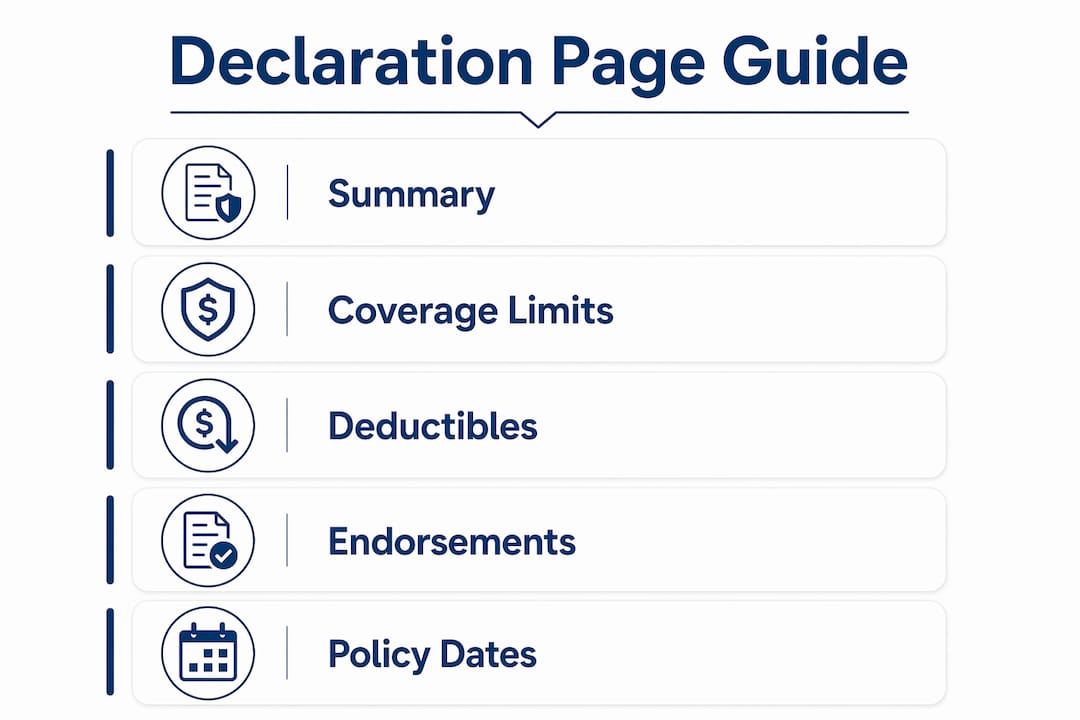
The declaration page (i.e.: dec page) packs a significant amount of critical data into a short document. Insurance carriers typically issue a 1–2 page declaration at every policy inception and renewal, usually 14–45 days before the policy anniversary. That timing matters because you need enough time to review changes and request corrections before the new term begins.
Every dec page for a Texas homeowners or renters policy includes these core elements:
- Policy number and effective dates: The exact start and end dates of your coverage period, plus the unique identifier for your policy.
- Named insureds: The people legally covered under the policy. If your spouse or co-owner is not listed, they may face complications during a claim.
- Covered property details: The address of the insured home or rental unit, and any attached structures included in coverage.
- Coverage limits: Dollar amounts for dwelling (Coverage A), other structures (Coverage B), personal property (Coverage C), loss of use (Coverage D), and liability (Coverage E).
- Deductible amounts: Your standard all-perils deductible and any separate deductibles for wind, hail, or other specific events.
- Premium breakdown: The total annual or monthly cost, sometimes split by coverage type.
- Endorsements by form number: Added or modified coverages listed by their official form numbers.
That last point deserves attention. Dec pages list endorsements by form number only, which means you need to consult the full policy or your agent to understand exactly what each endorsement adds or removes. The dec page tells you an endorsement exists. The full policy tells you what it does. Both documents work together, but they serve different purposes. You can review common insurance terms in the Hettler Insurance glossary to decode form numbers and policy language faster.
Why is the declarations page the most critical document in your policy?
The dec page controls claim outcomes because it contains the actual numbers carriers use to calculate payouts. The full policy sets the rules for how claims are handled. The dec page sets the financial terms that determine how much you receive. That distinction is not subtle. It is the difference between knowing you have coverage and knowing how much that coverage is worth.
“The dec page is the binding summary that controls claim outcomes. The full policy sets the rules, but the dec page sets the numbers. Review every renewal dec page carefully, because carriers may adjust terms without explicit notification.”
Carriers can and do make quiet adjustments at renewal. Your Coverage A limit might increase due to an inflation guard endorsement. Your wind/hail deductible might shift from a flat dollar amount to a percentage of your dwelling value. Reviewing each renewal dec page against your prior year’s document is the only reliable way to catch these changes before a claim forces you to discover them.
Pro Tip: Save your dec page from each policy year. Comparing last year’s document to this year’s takes less than five minutes and can reveal coverage reductions or deductible increases that would otherwise go unnoticed until a claim.

The dec page serves as the binding summary that controls claim outcomes, while the full policy contract defines the rules governing those outcomes. Policyholders who treat the dec page as routine mail miss the most important financial document they receive each year.
What are the five key numbers on a Texas homeowners declaration page?
Texas homeowners face weather risks that make five specific numbers on the dec page more consequential than anywhere else in the country. These five metrics dictate most claim outcomes for homeowners: Coverage A, wind/hail deductible, roof settlement basis, personal property coverage basis, and liability limit.
- Coverage A (Dwelling coverage limit): This is the maximum your carrier pays to rebuild your home after a total loss. It should reflect current construction costs, not your purchase price or market value. West Texas construction costs have risen sharply, so a limit set three years ago may already be inadequate. Learn more about how much home coverage you actually need.
- Wind/hail deductible: Many Texas homeowners carry separate deductibles for wind and hail events, and some policies include earthquake deductibles as well. Overlooking these can create serious financial shock during claims. A 2% wind/hail deductible on a $300,000 home means you pay $6,000 out of pocket before your carrier contributes a dollar. Read the Texas insurance deductible guide to understand how these structures work in practice.
- Roof settlement basis: Your dec page will indicate whether your roof is covered on a Replacement Cost Value (RCV) or Actual Cash Value (ACV) basis. RCV pays to replace your roof at today’s prices. ACV deducts depreciation, which can reduce a $15,000 roof claim to $6,000 or less depending on the roof’s age. This single line item has a larger impact on hail claims than almost any other factor.
- Personal property coverage basis: Like roof coverage, personal property can be settled on RCV or ACV. ACV settlement on personal property means your five-year-old laptop gets paid out at its current market value, not what it costs to replace it today.
- Liability limit: This number protects your personal assets if someone is injured on your property and sues you. Standard policies often carry $100,000 in liability coverage. That amount is frequently insufficient given today’s medical and legal costs. Understanding why higher liability limits matter applies equally to homeowners policies.
Pro Tip: If your dec page shows ACV for roof settlement, ask your agent about an endorsement to upgrade to RCV. In Texas hail country, that upgrade often costs less than $100 per year and can save you thousands after a storm.
How should Texas homeowners and renters use the declarations page effectively?
Knowing what the dec page contains is only useful if you act on that knowledge. Here is a practical process for managing your dec page year over year.
- Review at inception. When you first receive a new policy, read the dec page the same day. Confirm your name is spelled correctly, the property address is accurate, and the coverage limits match what you discussed with your agent. Errors at inception are easy to fix. Errors discovered during a claim are not.
- Compare at every renewal. Place your new dec page next to last year’s version. Look for changes in Coverage A limits, deductible amounts, and listed endorsements. Carriers may add or remove endorsements at renewal without a separate notice.
- Identify all deductibles. Texas policies frequently carry more than one deductible. Locate every deductible listed on your dec page, including the standard all-perils deductible and any separate wind/hail deductible. Know the dollar amount or percentage for each before storm season arrives.
- Store copies for 3–5 years. Policyholders should maintain dec pages from prior policy periods for 3–5 years to verify coverage for claims on past losses. A water damage claim discovered months after the event may require proof of what your policy covered at the time of loss. Keep both digital and physical copies.
- Contact your agent with questions. If any number on your dec page does not match your expectations, call your agent before the policy term begins. Corrections made mid-term are possible but more complicated. The Hettlerinsurance team answers these questions regularly and can walk you through every line item.
- Use the dec page for lender and landlord verification. Mortgage lenders require proof of insurance at closing and at renewal. Your dec page is the document they need. Renters may also need to provide a dec page to landlords who require proof of renters insurance.
Pro Tip: Photograph your dec page and store it in a cloud folder alongside photos of your home’s contents. If a disaster destroys your paper files, you will still have the coverage details and the documentation needed to support your claim.
The dec page also plays a direct role in how quickly claims move forward. Adjusters reference it immediately to confirm coverage limits and applicable deductibles. Knowing those numbers yourself puts you in a stronger position during any claim conversation. The insurance questions answered resource from Hettler Insurance Agency covers many of the practical scenarios policyholders face at claim time.
The dec page is not paperwork. It is your financial protection blueprint.
I have seen claim disputes that should never have happened. A homeowner files a hail claim, expects a full roof replacement, and then learns their policy settled roofs on ACV. The dec page showed that clearly. They just never read it.
The dec page functions as the “nutrition label” of your insurance policy. It gives you the critical overview without requiring you to read 40 pages of policy language. Most people ignore it. That is a costly habit in a state where hail, wind, and severe weather are annual events, not rare occurrences.
My honest advice: treat your dec page like a contract, because it is one. Read it when it arrives. Compare it to last year’s. Ask questions about anything that changed. The coverage you think you have and the coverage you actually have should be the same thing. The dec page tells you which one is true. If you need guidance on sufficient coverage levels, the principles apply across policy types. Do not wait for a claim to find out your limits were wrong.
— Ron Hettler, CIC (certified insurance counselor)
Hettler Insurance Agency helps Texas homeowners read and manage their dec pages
Texas homeowners and renters deserve to know exactly what their policy covers before a storm hits, not after.

Hettler Insurance has served Texas policyholders since 1992, and reading declaration pages is something the team does every day. As an independent agency representing over 30 top-rated carriers, Hettler Insurance compares coverage options across the market to find the right fit for your home, your risk profile, and your budget. Ron Hettler and Meghan Hettler are both Certified Insurance Counselors (CIC), the gold standard credential in the industry, and they bring that expertise to every policy review. Whether you need a coverage review for your home or want to understand what your current dec page actually means, Hettler Insurance Agency is ready to help. Call the Lubbock, Texas office or request a consultation online today.
Recommended
About the Author
Ronald J. Hettler, CIC is a Certified Insurance Counselor (CIC) [the gold-standard credential in the independent insurance industry]. Ron has over 46 years of real-world experience in the insurance industry. He is the owner/president of Hettler Insurance Agency in Lubbock, Texas and is licensed by the Texas Department of Insurance (License #666862). (Why Trust Hettler Insurance Agency? It’s a Local independent insurance agency representing multiple carriers. Hettler Insurance Agency has established business roots going back to it’s predecessor in the late 1800’s. Local expertise in Lubbock Texas and West Texas risks. Focused on clarity before a claim occurs.) Ron and his daughter Meghan, also a CIC, lead a team that represents 30+ carriers and serves clients across Texas.
Ron specializes in helping individuals, families, and small business owners understand complex insurance concepts in clear, practical terms so they can make informed decisions about their coverage. He specializes in helping individuals and families understand coverage gaps, deductible structures, and real-world claim outcomes before a loss occurs. Ron helps you to understand how insurance policies respond in real-world claim situations.
License verification available through the Texas Department of Insurance.
Frequently Asked Questions ?
Q1 ?: What is an insurance declaration page?
Q2 ?: How is the dec page different from the full policy?
Q3 ?: Why do Texas homeowners have more than one deductible?
Q4 ?: What does roof settlement basis mean on a dec page?
Q5 ?: How long should I keep old declaration pages?
— Life Insurance Instant Quote and Apply Tool @ GetLifePolicy.com > * Quick self-service term life insurance quote. With or without medical exam.
— Call us about Auto, Home, Business, Life, or Health insurance. * Click to Call (806) 798-7800, Mon-Fri 8:30am-5pm (lunch closed Noon-1pm)
— Come see us @ our new address 4720 S Loop 289 Lubbock, TX 79414 (maps link), or get your online quote started at https://GetHettler.com