
TL;DR summary:
- Texas contractors need tailored insurance matching project and legal requirements.
- Proper documentation, endorsements, and pre-contract reviews prevent costly coverage gaps.
- Special rules apply for public projects, roofing, and non-subscribers, requiring careful compliance.
You bid on a solid commercial job, submitted everything on time, and then lost the contract because your certificate of insurance listed the wrong liability limits. No legal violation. No lapse in coverage. Just a mismatch between your policy and what the client required. That scenario plays out for Texas contractors every week, and it costs real money. Getting your insurance right isn’t just about staying legal. It’s about staying competitive, avoiding denied claims, and protecting the business you’ve built. This guide walks you through exactly what you need, how to match your coverage to contract demands, and how to verify everything before you sign.
Table of Contents
- Understanding Texas contractor insurance essentials
- Step 1: Assess your insurance needs by trade and project
- Step 2: Secure the right coverage and match endorsements
- Step 3: Address specialty, public works, and edge-case insurance rules
- What most Texas contractors miss about insurance compliance
- Protect your Texas contracting business with tailored insurance
- Frequently asked questions
Key Takeaways
| Point | Details |
|---|---|
| Review contract insurance terms | Contract requirements usually exceed Texas minimums and must be checked before each project. |
| Match policies to your trade | Specialty contractors and public works require specific coverage, limits, and possibly surety bonds. |
| Get and update proper endorsements | Additional insured, waiver of subrogation, and similar forms are often contract requirements. |
| File workers’ comp notice if non-subscribed | Non-subscribing employers must file with the state and face higher liability for employee injuries. |
Understanding Texas contractor insurance essentials
Texas contractor insurance isn’t one-size-fits-all. The coverage you need depends on your trade, the type of project, and who’s hiring you. Requirements come from four different places: state law, licensing boards, private contracts, and public agencies. Each layer can add requirements on top of the last.
General contractors in Texas do not need a state license, but specialty trades are licensed and require minimum liability insurance. Plumbers, electricians, HVAC technicians, and other licensed trades must carry specific minimums just to operate legally. But here’s the part many contractors miss: those legal minimums are almost never enough for real-world contracts.
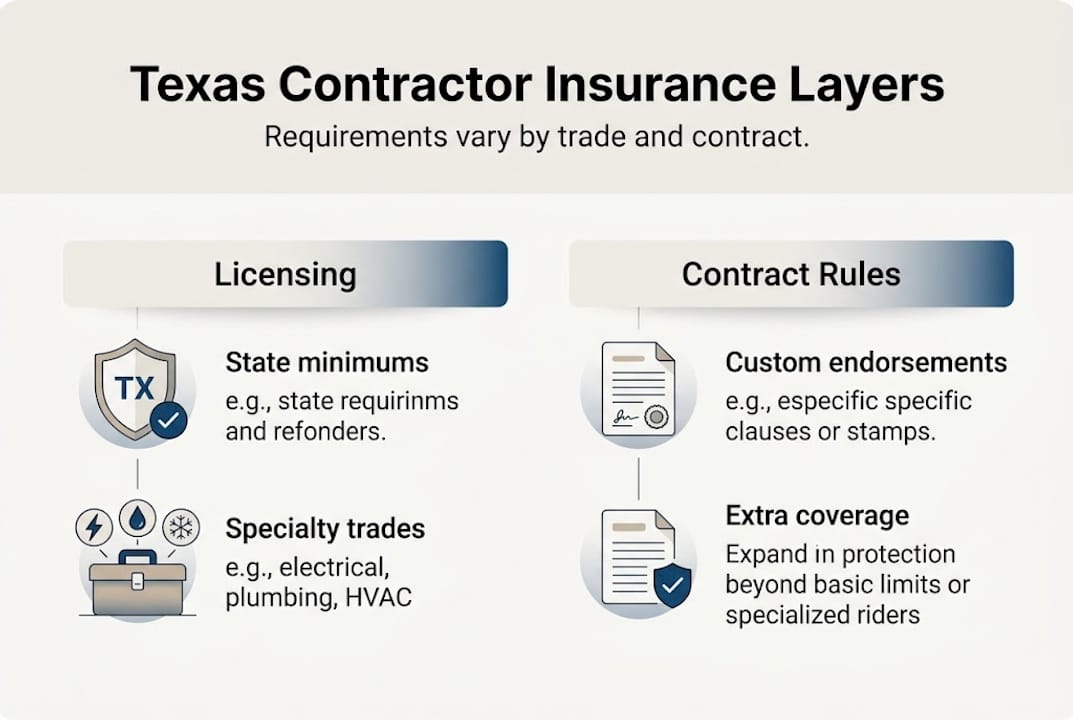
Insurance requirements are layered: statutory, licensing, contract, and public agency. Each layer can raise the bar. A private commercial client may require $2 million aggregate general liability. A city or county project may add workers’ compensation, surety bonds, and auto coverage on top of that. You need to understand all four layers before you price a job.
Here’s a quick overview of the most common coverage types for Texas contractors:
| Coverage type | What it covers | Who typically requires it |
|---|---|---|
| Commercial General Liability (CGL) | Third-party bodily injury and property damage | Nearly all contracts |
| Workers’ compensation | Employee injury and lost wages | Public projects, many private clients |
| Commercial auto | Vehicles used for business | Most contracts with site travel |
| Builder’s risk | Property under construction | Project owners, lenders |
| Professional/E&O | Design or advice errors | Design-build, consulting roles |
| Umbrella/excess liability | Extra limits above primary policies | Large commercial projects |
| Inland marine | Tools and equipment in transit | Equipment-heavy trades |
Key coverages to understand:
- CGL (Commercial General Liability): Covers third-party claims for bodily injury or property damage caused by your work or your crew. Standard limits in Texas contracts are $1 million per occurrence and $2 million aggregate.
- Workers’ compensation: Texas is the only state that doesn’t mandate this for private employers, but skipping it carries serious financial risk.
- Commercial auto: Required any time your vehicles are used for business purposes, including hauling materials or driving to job sites.
- Surety bonds: Performance and payment bonds guarantee you’ll complete the work and pay subcontractors. Required on most public projects.
When choosing a Texas carrier, make sure they’re familiar with contractor-specific endorsements and can issue certificates quickly. Speed matters when a job is on the line.
Step 1: Assess your insurance needs by trade and project
With the basics in mind, it’s time to tailor your coverage to your specific trade and the jobs you pursue. Not every contractor faces the same risks, and your insurance program should reflect that.
Here’s a comparison of typical minimum coverage requirements by trade and project type:
| Trade/project type | CGL minimum | Auto liability | Workers’ comp | Bonds required |
|---|---|---|---|---|
| General contractor (private) | $1M/$2M | $1M | Recommended | Sometimes |
| Plumbing (licensed) | $300K min (state) | $1M (contracts) | Recommended | Rarely |
| HVAC (licensed) | $300K min (state) | $1M (contracts) | Recommended | Rarely |
| Roofing contractor | $1M/$2M | $1M | Strongly advised | Rarely |
| Public works/TxDOT | $1M/$2M | $1M | Required | Required |
Typical commercial contracts require $1 million per occurrence and $2 million aggregate CGL, $1 million auto liability, and often workers’ compensation. Public works contracts add performance and payment bonds on top of all that.
Here’s how to assess your needs step by step:
- Identify your trade license requirements. Check with your licensing board for the minimum liability insurance required to hold your license. For licensed plumbing insurance or HVAC contractor requirements, those minimums are set at the state level.
- Review your typical contracts. Pull the insurance section from your last three contracts. Note the required limits, endorsements, and any bond requirements.
- Separate public from private work. Public projects almost always require more. If you bid TxDOT or municipal jobs, plan for higher limits and surety bonds.
- Account for subcontractors. If you hire subs, you may be required to verify their insurance or extend your coverage to their work.
- Check for project-specific requirements. Some owners or lenders require builder’s risk or professional liability even for straightforward construction work.
For roofing contractor insurance, requirements can be especially strict given the high-risk nature of the work. Many clients require higher limits and specific endorsements before a roofer sets foot on a property.
Pro Tip: Always review the “Insurance” section of your contract before you price the job. Contract requirements almost always exceed state minimums, and failing to carry the right limits can void your coverage for that project entirely.
Step 2: Secure the right coverage and match endorsements
Once you know what’s necessary, you’ll need to secure policies and endorsements that pass client review. Having a policy is only part of the job. The policy has to be structured correctly.

Contractor reviewing business insurance in Lubbock Texas office
Certificates of Insurance (COI), specifically the ACORD 25 form, are the standard way to prove coverage in Texas. Every client, general contractor, or public agency will ask for one. The COI must list the correct limits, the correct named insured, and often the client or project owner as an additional insured.
Here’s what you’ll typically need to provide:
- ACORD 25 Certificate of Insurance: Lists your policy types, limits, effective dates, and the certificate holder.
- Additional insured endorsement: Adds the client or GC to your policy so they’re covered for claims arising from your work. This is one of the most commonly required and most commonly missed items.
- Waiver of subrogation endorsement: Prevents your insurer from pursuing the client for reimbursement after paying a claim on your behalf.
- Primary and non-contributory wording: Specifies that your policy pays first, before any coverage the client carries. Many contracts require this exact language.
- Performance and payment bonds: Required on public projects. These are separate from insurance but often coordinated through your insurance agent.
“COI limits and terms must scale with project size. Double-check requirements for every job, not just once a year at renewal.”
When choosing an insurance carrier, ask specifically whether they can issue endorsements quickly and whether their certificates can be customized per project. Some carriers take days to process endorsement requests. That delay can cost you a contract.
Pro Tip: Ask your agent to issue certificates directly to each client or project owner rather than routing them through you. This speeds up the process and reduces the chance of errors.
Step 3: Address specialty, public works, and edge-case insurance rules
Beyond basic insurance, specialty trades and larger projects have additional, sometimes confusing, requirements. These edge cases trip up even experienced contractors.
Here are the key rules and risks to know:
Roofing contractors:
- Roofing contractors cannot act as public adjusters or legally waive insurance deductibles for clients. Violating this law can result in criminal charges and loss of licensure.
- Public roofing projects require surety bonds for public works, including both performance and payment bonds.
- High-wind and hail exposure in West Texas means many carriers restrict or exclude roofing coverage. Work with an independent agent who can find carriers that will actually cover your trade.
Public works and TxDOT projects:
- Performance and payment bonds are mandatory. These bonds guarantee project completion and payment to subcontractors and suppliers.
- Workers’ compensation is required on most public contracts, even though Texas law doesn’t mandate it for private employers.
- Some public agencies require additional endorsements like completed operations coverage for a set period after the project closes.
Workers’ compensation non-subscription:
- Failure to carry workers’ comp puts non-subscribing employers at unlimited liability if a worker is injured. You also lose common-law defenses, meaning you can’t argue the employee assumed the risk or contributed to the accident.
- Non-subscribers must file a written notice with the Texas Department of Insurance and post notice at the job site. Skipping this step adds penalties on top of the existing liability exposure.
Coastal and storm-related coverage:
- Contractors working near the Texas coast may need coverage through the Texas Windstorm Insurance Association (TWIA) for wind and hail exposure that standard carriers exclude.
- The Texas anti-indemnity law limits how much risk you can contractually transfer to a subcontractor. Review indemnity clauses carefully before signing.
Avoid these edge cases by reviewing every contract with your agent before you sign. One overlooked clause can create a gap that leaves you personally liable.
What most Texas contractors miss about insurance compliance
After working with contractors across West Texas for decades, we’ve seen the same pattern repeat: a contractor carries solid insurance, pays premiums on time, and still loses a claim or a bid because of a detail buried in the contract.
State law sets the floor. Contracts set the ceiling. Most contractors focus on meeting legal minimums and assume they’re covered. They’re not. The real risk lives in the gap between what your policy says and what your contract requires.
Certificates get issued with wrong limits. Endorsements get forgotten. Additional insured language doesn’t match what the client specified. These aren’t coverage failures. They’re documentation failures, and they’re just as costly.
The best practice we recommend is simple: build a contract checklist for every project. Before you sign anything, run the insurance section by your agent and confirm that your current policies, limits, and endorsements match exactly. A pre-contract insurance review takes 20 minutes and can save you from a denied claim or a lost contract. Make it standard practice, not an afterthought.
Protect your Texas contracting business with tailored insurance
Ready to simplify insurance and win more contracts? Here’s how to take the next step.
At Hettler Insurance Agency, we work with Texas contractors every day to match coverage to contract requirements, secure the right endorsements, and issue certificates that hold up to client scrutiny. We represent over 30 top-rated carriers, so we shop the market to find the right fit at the right price.

Whether you’re a plumber, roofer, HVAC tech, or general contractor, we’ll help you understand your minimum insurance requirements and build a program that protects your business on every job. Visit Hettler Insurance to request a quote or schedule a compliance review with our team today. Call before you sign your next contract.
Frequently asked questions
Is workers’ compensation required for Texas contractors?
Texas does not require private employers to carry workers’ compensation, but contractors who don’t carry it face unlimited liability and lose common-law defenses if a worker is injured on the job.
What insurance is most often required for contractor bids in Texas?
Most bids require at least $1 million CGL, $1 million auto liability, and for public works, workers’ compensation and surety bonds.
How do I prove my insurance coverage to a client or general contractor?
Use a Certificate of Insurance (ACORD 25 form), listing the client or general contractor as additional insured when the contract requires it.
Are there special insurance rules for Texas roofing contractors?
Yes. Texas law prohibits roofing contractors from acting as public adjusters or waiving deductibles for clients, and public roofing projects require performance and payment bonds.
———————
About the Author
Ronald J. Hettler, CIC is a Certified Insurance Counselor (CIC) with over 46 years of real-world experience in the insurance industry. He is the owner/president of Hettler Insurance Agency in Lubbock, Texas and is licensed by the Texas Department of Insurance (License #666862). (Why Trust Hettler Insurance Agency? It’s a Local Independent insurance agency representing multiple carriers. Local expertise in Lubbock Texas and West Texas risks. Focused on clarity before a claim occurs.)
Ron specializes in helping individuals, families, and small business owners understand complex insurance concepts in clear, practical terms so they can make informed decisions about their coverage. He specializes in helping individuals and families understand coverage gaps, deductible structures, and real-world claim outcomes before a loss occurs. Ron helps you to understand how insurance policies respond in real-world claim situations.
License verification available through the Texas Department of Insurance.
Enhanced Frequently Asked Questions ?
Q1 ?: Is workers’ compensation required for Texas contractors?
Q2 ?: What insurance is most often required for contractor bids in Texas?
Q3 ?: How do I prove my insurance coverage to a client or general contractor?
Q4 ?: Are there special insurance rules for Texas roofing contractors?
Q5 ?: Why do contract insurance requirements usually exceed Texas state minimums?
— Life Insurance Instant Quote and Apply Tool @ GetLifePolicy.com > * Quick self-service term life insurance quote. With or without medical exam.
— Call us about Auto, Home, Business, Life, or Health insurance. * Click to Call (806) 798-7800, Mon-Fri 8:30am-5pm (lunch closed Noon-1pm)
— Come see us @ our new address 4720 S Loop 289 Lubbock, TX 79414 (maps link), or get your online quote started at https://GetHettler.com